Home Blog Page 87

Isolated Footing: A Comprehensive Guide to Foundation Support for Buildings

0
Isolated-Footing

A foundation is like the base of a house, supporting it and spreading its weight to the ground. Foundations are classified as shallow and deep foundations. Shallow foundations, also called spread footings, are made for buildings with the strong ground near the surface.

There are different types of shallow foundations, including isolated footings that support one column, combined footings that help with more than one column, and mat foundations that cover the whole building area. The weight of the building, the state of the ground, and the construction specifications all affect the kind of foundation that is chosen. The right foundation is important for ensuring a building lasts a long time.

Among all the types of shallow foundations, Isolated pad footing is the most commonly used foundation in India.

This blog will explore detailed information about isolated footing, its types, suitability, and advantages and disadvantages of isolated footing.

What is Isolated Footing?

Isolated footing is the most commonly used foundation in building construction. This type of foundation is specifically constructed for a single column. The shape of the isolated footing is either square or rectangular, depending on the structure’s column load requirements.

The size of the footing is determined by considering both the load on the column and the safe bearing capacity of the soil. A rectangular isolated footing is chosen for enhanced stability when moments are caused by load eccentricity or horizontal forces.

For example, imagine a column carrying a vertical load of 200 kN, and the ground can safely bear 100 kN per square meter. In this case, the required area for the footing would be 200/100 = 2 square meters. The measurements of a square footing would be 1.414 meters long by 1.414 meters wide.

How Isolated Footings Take Shape

Isolated Footings take shape in two ways, and they include

  • Excavation and Preparation
  • Reinforcement and Concrete Placement

Excavation and Preparation

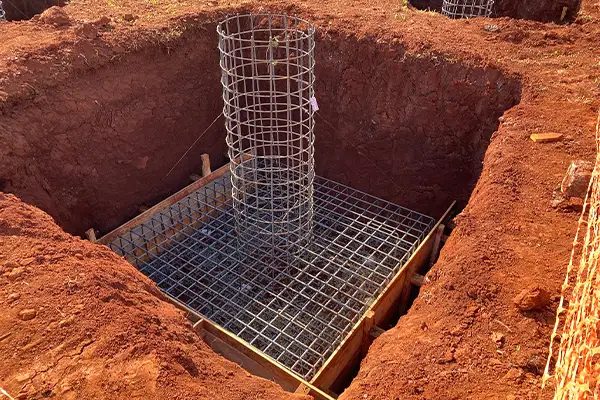
The construction begins with excavating the soil to a specific depth, creating a pit for the footing. The size and depth of the excavation depend on the load-bearing requirements and soil conditions.

Reinforcement and Concrete Placement

Reinforcement bars, or rebar, are strategically placed within the excavated area to enhance the strength of the footing. Concrete is then poured into the form, creating a solid base.

Types of Designed Isolated Spread Footing

There are two types of designed Isolated footings, each tailored to specific construction needs. 

The two primary types are:

  • Square Isolated Footing
  • Rectangular Isolated Footing

Square Isolated Footing
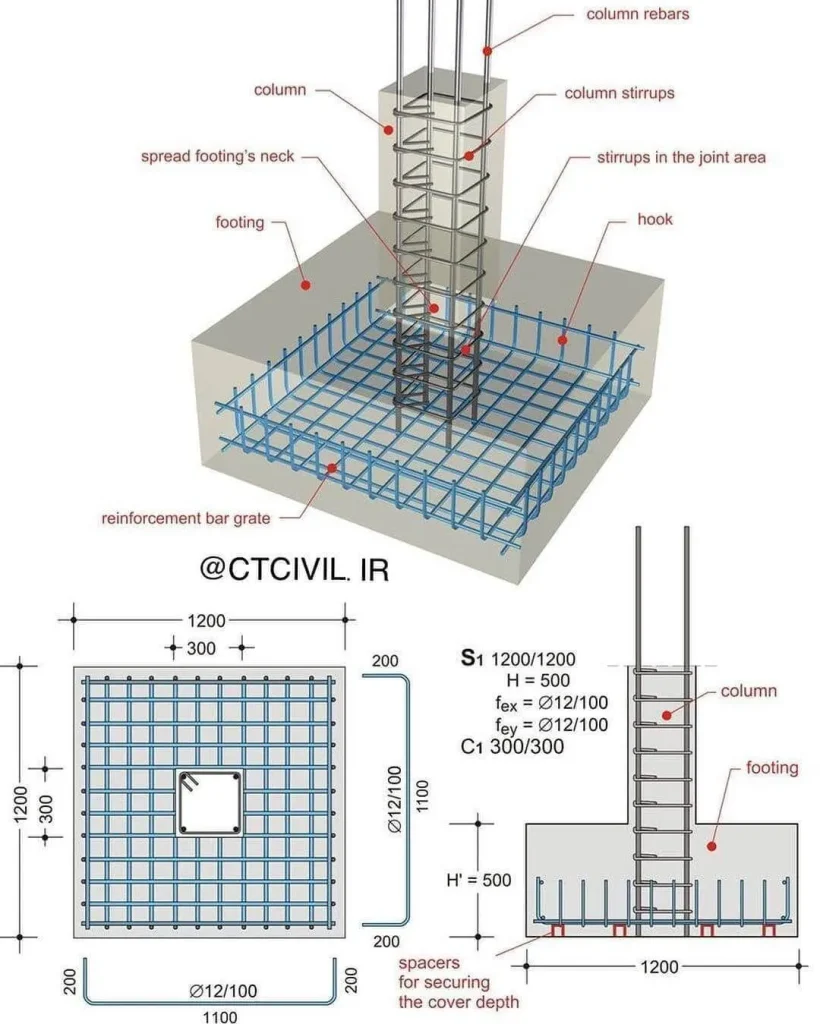
Square Isolated Footing

Square isolated footings are a common and practical foundation isolated footing designed to support a single column, known as a pad foundation, and characterized by equal lengths and widths. Square isolated footings create a symmetrical, square-shaped base. This type of footing is particularly well-suited for situations where the load from the column is evenly distributed.

Rectangular Isolated Footing
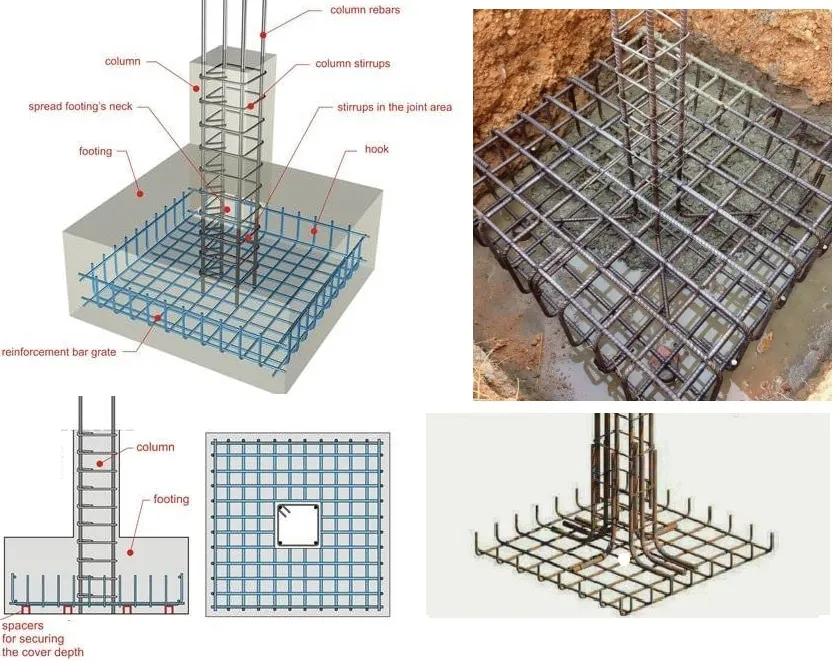
Rectangular Isolated Footing

Rectangular isolated footing is a foundation that supports a structure’s single column or load-bearing element. Unlike square isolated footings, rectangular footings have varying lengths and widths, forming a rectangular shape. This design is specifically chosen when the load on the column creates moments due to eccentricity or horizontal forces, requiring a more stable and adaptable foundation.

Suitability of Isolated Footing

The suitability of isolated footing is determined by various factors influencing its design and application in construction projects. 

Here are key considerations that determine the suitability of isolated footings:

Load Distribution:

Isolated footings are a good fit for cases where the weight from a single column is moderate and can be effectively spread across the foundation region. They are frequently employed in the construction of houses and smaller commercial buildings.

Soil Bearing Capacity:

The strength of the soil under the footing is essential in deciding its appropriateness. Isolated footings work well where the soil has enough strength to bear the applied loads.

Isolated Column Footing Spacing:

Isolated footings are effective when columns are placed at intervals, permitting individual support. The design of the foundation considers how columns are spaced and arranged.

Structural Stability:

The structure of isolated footings is designed to guarantee stability, preventing excessive settling and tilting. It’s crucial to consider aspects like the structure type, load magnitude, and potential variations in load distribution.

Uniformity of Loads:

Isolated footings work well when the column loads are fairly consistent, avoiding significant irregularities. Alternative footing types might be more appropriate in situations with substantial load variations.

Construction Simplicity:

Known for their straightforward design and construction, isolated footings are well-suited for projects where a simple and cost-effective foundation solution is preferred.

Site-Specific Conditions:

To ensure the prolonged effectiveness of isolated footings, considerations of site-specific conditions, including environmental elements and potential alterations in soil properties, are imperative.

Advantages of Isolated Footing

Isolated footings offer several advantages in construction, making them a preferred choice for supporting individual columns in diverse structures. 

The following are key benefits of isolated footings:

Focused Load Distribution:

Tailored for supporting individual columns, isolated footings efficiently distribute loads locally, preventing excessive weight transfer to neighbouring columns or areas.

Versatility Across Construction Projects:

These footings exhibit versatility, applying in a broad spectrum of structures, from residential buildings to smaller commercial projects. Their adaptability suits various architectural designs.

Simplicity in Design and Construction:

Isolated footings are recognised for their simple design and construction procedures. This simplicity not only enhances cost-effectiveness but also streamlines implementation on construction sites.

Reduced Risk of Differential Settlement:

By offering individualised support to columns, isolated footings mitigate the risk of differential settlement. This ensures uniform settling of the structure, minimising the chances of uneven or tilted foundations.

Convenient Inspection and Maintenance:

The isolated nature of these footings simplifies inspection and maintenance. Issues with a specific column isolated footing can be addressed without impacting the entire foundation, streamlining repair and maintenance tasks.

Cost-Effectiveness:

Isolated footings often prove more cost-effective, particularly in relatively light-load scenarios. Their straightforward design and construction contribute to overall project cost savings.

Adaptability to Varied Soil Conditions:

Engineers can tailor these footings to suit different soil conditions. Customisation of size and depth based on the bearing capacity and characteristics of the underlying soil enhances adaptability.

Effective Management of Eccentric Loads:

The design of isolated footings facilitates the efficient handling of eccentric loads. This is particularly valuable in situations where applied loads create moments due to horizontal forces or irregularities in load distribution.

Disadvantages of Isolated Footing

Even though isolated footings have several benefits, it’s important to consider any potential drawbacks before using them in construction projects. 

Here are some drawbacks of isolated footings:

Load-Bearing Constraints:

Isolated footings may have limitations in supporting maximum loads. Alternative foundation types may prove more appropriate in situations involving heavy loads or larger structures.

Inadequate for Tall Structures:

In the context of tall or high-rise structures, the relatively small size of isolated footings may not offer sufficient support against potential settlement or tilting. This limitation makes them less suitable for such projects.

Extended Construction Time for Multiple Footings:

In projects requiring numerous columns with individual footings, the construction time and effort for installing multiple isolated footings may be higher than using a combined footing or other foundation types.

Design Complexity for Eccentric Loads:

When dealing with eccentric loads or horizontal forces, the design of isolated footings becomes more intricate. In such circumstances, the foundation’s stability may require additional reinforcement and precautions.

Restrictions in Column Spacing:

Isolated footings are practical when columns are spaced at intervals. However, accommodating individual footings without compromising effectiveness might be challenging in closely spaced columns.

Site-Specific Challenges:

The performance of isolated footings is heavily dependent on site-specific conditions. Variations in soil characteristics, environmental factors, or unforeseen changes in site conditions can challenge the effectiveness of isolated footings.

Potential for Uplift:

In specific soil conditions, there exists a risk of uplift forces acting on the isolated footing, particularly in areas with high water tables. This can lead to instability and compromise the foundation’s effectiveness.

Conclusion

isolated footings are a widely used and practical foundation solution in the construction industry. Their isolated load distribution, versatility, and simplicity in design contribute to their popularity, particularly in residential and smaller commercial structures.

However, it is important to consider the limitations and potential challenges associated with isolated footings. Issues such as load-bearing constraints, suitability for tall structures, and uplift forces in specific soil conditions must be carefully evaluated.

The choice of foundation type, including isolated footings, should align with the project’s requirements, considering load distribution, soil characteristics, and structural stability.

A balanced understanding of the advantages and disadvantages ensures informed decision-making in selecting and implementing isolated footings for diverse construction projects.

But Brick&Bolt optimises isolated footing’s advantages through cutting-edge structural engineering, fabricating strong and steady building foundations. By fusing extensive technical mastery with flexible and customised offerings, 

If you want to explore more about foundation options and strategies to enhance the structural integrity of buildings, Brick&Bolt offers a multitude of knowledge.
A Complete Guide to Combined Footings: Types, Suitability, Pros & Cons

0
Guide to Combined Footings

In the world of construction, the foundation is like the strong base of a house, quietly supporting the whole structure and ensuring its weight is spread evenly on the solid ground below. Generally, there are two kinds of foundations: shallow and deep.

Shallow foundations, also called spread footings, are used when the ground near the surface is strong. There are different types of shallow foundations, such as isolated footings (for one column), combined footings (for multiple columns), and mat foundations (covering the whole building area).

Selecting the proper foundation is similar to selecting the perfect structural support for a building. Its selection is based on the weight of the structure, the conditions of the ground, and the particular construction requirements. A building’s long-term durability depends on the choice of foundation.

In shallow foundations, Combined footing is an excellent choice, especially in cities with columns close together. 

This blog gives detailed information about combined footing, its types, suitability,  advantages, and disadvantages of combined footing.

So, let’s start the journey …

What is Combined Footing?

Combined footings are made when two or more columns are sufficiently close to one another and their isolated footings overlap. They are a combination of isolated footings, but their structural layouts differ.

The shape of the combined footing is a rectangle. It is used when the columns carry loads from the structure.

Combined footings are a great option, particularly in cities where columns are close to one another. They’re excellent for providing even support and stability, but it’s important to consider the unique soil and climate conditions in India. Experts from Brick&Bolt should be involved in planning and designing combined footing for the best results in India’s diverse needs.

Types of Combined Footing

Combined footings come in various forms, and they are categorised according to how they are shaped and how the columns they support are arranged. 

The primary categories of combined footings are:

  • Rectangular Combined Footing
  • Trapezoidal Combined Footing
  • Strap Combined Footing
  • Raft Combined Footing

Rectangular Combined Footing

They have a rectangular shape and are strong enough to support two or more columns at once. Anywhere a rectangular form and the capacity to support equal weights are required, a rectangular combined footing is employed.

Trapezoidal Combined Footing

Trapezoidal footing is used when one column load is significantly greater than the other. Therefore, a trapezoidal combined footing is needed when there is a limited amount of space outside the external column, and the exterior column is heavier.

Strap Combined Footing

Strap combined Footing is a kind of combined footing made out of a concrete beam connecting two or more column footings. The term “strap beam” refers to this kind of beam. It assists in distributing the weight of column footings that are eccentrically or highly laden to neighbouring footings.

Raft Combined Footing

Raft footing is a kind of combined footing that supports all the walls and columns and covers the full area underneath the construction.

Suitability of Combined Footing

Combined footings are suitable when two or more columns are closely spaced, and individual footings for each column would overlap or interfere with each other. 

The suitability of combined footings is influenced by several factors, including:

  • Closely Spaced Columns: Combined footings are well-suited for situations where columns are closely positioned, making it impractical to have separate footings without significant overlap.
  • Unequal Column Loads: When columns bear uneven loads, combined footings provide an effective solution to distribute these varying loads and prevent issues like differential settlement.
  • Limited Soil Bearing Capacity: Combined footings efficiently utilise available soil support for multiple columns in cases with limited soil bearing capacity.
  • Economic Design:Combined footings can offer cost-effective solutions, especially when dealing with closely spaced columns, compared to providing individual footings for each column.
  • Structural Considerations: The design of combined footings is influenced by the structural requirements of the building and the specific loads on the columns. The combined footing’s plan shape might be trapezoidal, rectangular, or tee-shaped. The centroid of the footing area coincides with the column loads because the geometric proportions and shape are fixed. As a result, the pressure beneath the whole footing is consistent.
  • Soil Characteristics: The suitability of combined footings also depends on soil characteristics, including bearing capacity and the potential for differential settlement.
  • Architectural Constraints: Architectural and layout constraints may lead to combined footings, especially when the building design necessitates closely spaced columns.
Suitability of Combined Footing

Advantages of Combined Footing

Combined footings provide several advantages in structural engineering and construction, particularly in scenarios involving closely spaced columns. 

The key benefits of combined footings include:

Effective Load Distribution:

It efficiently distributes loads from multiple columns, preventing issues associated with uneven settlement and ensuring consistent support.

Optimised Space Utilization:

Combined footing maximises the use of space, especially in situations where closely spaced columns would make individual footings impractical due to overlap.

Cost-Effective Design:

It is cost-effective compared to the alternative of providing individual footings for each column, particularly in cases of closely spaced columns.

Optimisation of Soil Bearing Capacity:

Overcomes limits in soil strength by effectively utilising the available soil-bearing capacity to sustain many columns.

Structural Flexibility:

Offers flexibility in design, allowing engineers to choose from different types of footings (such as rectangular or trapezoidal) based on specific structural requirements.

Architectural Freedom:

Provides freedom in layout design, accommodating closely spaced columns without compromising the foundation’s integrity.

Efficiency in Foundation Design:

Streamlines the construction process, as combined footings simplify foundation design and construction for projects with closely spaced columns.

Enhanced Structural Stability:

Enhances structural stability through the interconnected nature of the footing, providing additional support and resistance against settlement.

Disadvantages of Combined Footing

Combined footings, while offering various advantages, also have certain disadvantages that should be considered in the design and construction process. 

Here are the key disadvantages of combined footings:

Complex Design:

The design intricacies of combined footings can surpass those of individual footings, particularly when addressing factors such as uneven column loads, soil characteristics, and architectural constraints.

Limited Load-Bearing Capacity:

Combined footings may have constraints regarding the maximum load they can support. Alternative foundation types are more suitable for heavy loads or larger structures.

Time Consuming Construction:

The construction of combined footings can be more demanding and time-consuming than individual footings, especially when confronted with intricate designs or specific site conditions.

Challenges in Alterations:

Making changes to the building or its structure when using combined footings can be complex, which can make remodelling or altering the layout of the building more difficult.

Not Ideal for Tall Structures:

The relatively small size of combined footings may need adequate support for tall or high-rise structures, potentially leading to settlement or tilting issues.

Site-Specific Challenges:

The suitability of combined footings may be influenced by site-specific challenges, encompassing environmental factors and potential changes in soil conditions over time.

Conclusion

combined footings are a foundation solution for projects with closely spaced columns, requiring efficient use of space and stable support in challenging soil conditions. In situations where columns are closely spaced, they provide effective load distribution, space utilization, and cost-effectiveness; however, one should consider their complex design, limited load-bearing capacity, and difficulties in making changes.

When choosing combined footings, it’s important to carefully look at what the project specifically needs, the condition of the ground, and the building’s structural requirements.

Engineers must weigh the advantages and disadvantages and modify their designs to fit the particular requirements of each construction scenario. In the end, making well-informed decisions guarantees that combined footings are successfully implemented, which adds to the stability and durability of the built structure.

Shallow Foundations for Buildings – A Complete Guide for Indian Construction

0
Shallow Foundations for Buildings

As we all know, the foundation plays an important role in building construction. A foundation is a structural component of a building that supports and anchors the entire structure, transferring its load to the ground. It is the lower portion of a building, typically constructed below ground level and serves to distribute the building’s weight evenly to the soil or rock beneath it. The type of foundation needed depends on factors like soil, climate, and building design. 

In India, the soil type varies from region to region, so it’s important to choose the right type of foundation based on factors like earthquake risk, bearing capacity of soil, and type of structure. Qualified engineers should conduct a thorough analysis to ensure the foundation meets site requirements and local building codes in earthquake-prone areas. A well-planned and strong foundation is essential for lasting and safe homes.

This blog gives you detailed information about shallow foundations, such as types of shallow foundations, their suitability, and the advantages and disadvantages of shallow foundations.

But, before proceeding to shallow foundations, it’s important to know the types of foundations:

Types of Foundation

The various types of foundations are used in construction, and the choice depends on factors such as soil conditions, building requirements, and local regulations. There are mainly two types of foundations used for house construction.

  1. Shallow Foundation
  2. Deep Foundation

What is a Shallow Foundation or Footing?

A shallow foundation, also known as “spread footings”, transfers loads of a building to the earth very near the surface rather than to deeper layers of soil or rock. These foundations are usually used for small, simpler structures such as houses and low-rise structures. It spreads the load of a building over a larger area closer to the surface, providing support without the need for extensive excavation. 

Shallow footings are constructed where the soil can adequately support the structure without deep excavation. Their suitability depends on soil type, seismic activity, and project requirements. In India, technical analyses and structural reports are essential for determining which foundation is best for building houses.

shallow foundation

Types of Shallow Foundations

Five types of shallow foundations are designed to suit specific construction requirements. They include:

  1.  Individual /Isolated Footing
  2.  Combined Footing
  3.  Raft or Mat Foundation
  4.  Strip Foundation
  5.  Slab-on-Grade Foundation

1. Individual /Isolated Footing:

Individual or isolated footing is the most common type of shallow foundation for building construction. This type of foundation, also known as a pad foundation, is designed to support a single column.

The shape of individual footing is square or rectangular and is utilised when the columns carry the structure’s weight. The load on the column and the soil’s safe bearing capacity are considered when calculating the size.

Rectangular, isolated footing is chosen when the foundation encounters moments because of the eccentricity of loads or horizontal forces.

Particularly for Indian homes, isolated footings are a practical option because they are reasonably priced and adaptable. It is necessary to consider particular site conditions and consult an expert for the best results.

2. Combined Footing:

A combined footing is a foundation that helps to support two or more columns or walls by spreading the weight over a larger ground area. People use it when the columns or walls are close together, and the soil could be stronger.

They’re great for support and stability, but it’s important to think about the specific soil and climate conditions in India. 

Experts should be involved in planning and designing combined footing for the best results in India’s diverse needs. There are several types of combined footings, and they are classified based on their shape and the arrangement of columns they support. 

3. Raft or Mat Foundation:

A raft or mat foundation is like a big, flat slab on the ground under an entire building. It helps to support the construction and spreads its weight across the ground. Raft foundations are an excellent option to make sure the building stays stable, and the weight is distributed evenly. However, experts are needed because they can be challenging to build and may cost more, especially given the unique conditions in India.

4. Strip Foundation:

A strip foundation, or strip footing, is like a long, continuous strip of concrete under the walls and closely placed rows of columns that hold up a building. It spreads the weight of the walls and columns over the whole ground. The footing can be made of regular or more substantial reinforced concrete.

Strip foundations are good because they spread the weight well, save money, and work in different soils. Having professionals for design and construction, along with checking the ground, is important for successful strip foundations.

5. Slab-on Grade Foundation:

A slab-on-grade foundation is a kind of construction foundation in which the concrete is poured directly into the site, forming a solid slab that acts as the foundation for the structure that is built upon it. The term “on grade” refers to the fact that this type of foundation is installed without the need for significant excavation or the formation of a crawl space or basement directly on the natural grade of the construction site. For many kinds of buildings, it’s a popular foundation option, especially in areas where frost heave can occur because the ground doesn’t freeze far below the surface.

Slab-on-grade foundations are beneficial for their affordability, simplicity, and accessibility. In India, their suitability depends on soil type, climate, and project requirements. Professional construction and climate-specific design are important for success in India’s varied soil and climatic conditions.

Suitability and Applicability of Shallow Foundations

In India, shallow foundations, including spread footings and slab-on-grade foundations, are well-suited for various soil conditions. They can be effectively designed for cohesive soils like clay and granular soils like sand. The adaptability to diverse soil types makes them versatile for construction projects in regions with varying geological profiles.

Shallow foundations are commonly used in densely populated urban areas with limited space, and construction must often occur near existing structures. Cities like Mumbai, Chennai, and Kolkata frequently employ shallow foundations due to their practicality and efficiency in constrained spaces.

Shallow foundations are generally more cost-effective compared to deep foundations. The reduced excavation depth and simplicity of construction contribute to lower overall project costs, making them an attractive option for many construction projects.

Advantages of Shallow Foundation in Indian Soil and Climate:

Shallow foundations, including spread footings, slab-on-grade, and mat foundations, offer several advantages in construction projects. 

Here are the key benefits of shallow foundations:

  • Cost-Effective: Shallow foundations are generally more budget-friendly than deep foundations, requiring less excavation and materials.
  • Speedy Construction: Shallow foundations can be built quickly, making them suitable for projects with tight deadlines.
  • Accessibility: These foundations are easily accessible for inspections, maintenance, and repairs due to their proximity to the surface.
  • Suitability for Light Structures: Shallow foundations are well-suited for supporting light to moderate-weight structures like residential buildings.

Disadvantages of Shallow Foundations in Indian Soil and Climate

While shallow foundations offer several advantages, it’s important to consider potential disadvantages associated with their use in construction projects. Here are some disadvantages of shallow foundations:

  • Limited Load-Bearing Capacity: Shallow foundations may not be appropriate for heavy or tall structures, as the soil near the surface might not bear sufficient load.
  • Sensitivity to Soil Changes: Shallow foundations can be sensitive to soil condition changes, like swelling or settling, affecting their stability.
  • Not Ideal for Weak Soils: In weak or unstable soils, shallow foundations may need more support, leading to structural issues.

Conclusion

shallow foundations are a versatile and widely used solution in construction, offering advantages such as cost-effectiveness, ease of construction, and adaptability to various soil conditions.

Their suitability for light to medium loads and accessibility for inspection and maintenance make them particularly favourable for residential and smaller commercial structures.

The decision to use shallow foundations should be guided by a thorough understanding of project requirements, soil conditions, and the site’s specific challenges. Striking a balance between the benefits and drawbacks ensures informed decision-making, leading to the successful implementation of shallow foundations in diverse construction projects.

Although shallow foundations are becoming increasingly viable for more contemporary construction needs, deep foundations may still be necessary for multistory buildings in specific soil profiles due to the development of lightweight building materials and modular building systems.

Construction companies like as Brick&Bolt  use cutting-edge materials and prefabrication techniques to create sturdy, high-quality structures that are securely supported by shallow foundation systems.

Top 9 Sustainable Construction Materials

0
Sustainable Construction Materials

The growing popularity of sustainable building materials can be attributed to their low carbon footprint and minimal environmental impact. These materials are made to minimise waste, conserve natural resources, and use less energy. So, let’s explore all the basic info about sustainable construction materials. 

What Are Sustainable Construction Materials?

Sustainable construction materials and products are not harmful to the environment. They also promote resource conservation or environmentally friendly production methods. Put differently, eco-friendly building materials improve the environment rather than cause harm to it. Using sustainable materials in construction is one of the best ways to implement sustainability.  Sustainable building materials are also called Green building materials, Environmentally friendly building materials, Eco-conscious construction materials and Low-carbon footprint building materials.

These materials help to protect the environment by reducing the carbon footprint of the buildings that use them. They support a cleaner earth and a sustainable future, along with being visually pleasing and far more effective. 

9 Best Green Building Materials Used in Construction Industry

The following are the best sustainable building materials:

1. Green Concrete

Green concrete is made by substituting basic ingredients like cement, or fine aggregates, or coarse aggregate with waste material. These waste materials include fly ash, manufactured sand, rice husk ash, blast furnace slag, glass aggregate, recycled demolition waste aggregate, and recycled concrete aggregate. Hence, this way, all these waste materials can be converted as recycled construction materials in the form of green concrete. Green concrete is an excellent material for both residential and commercial projects because it is strong and long-lasting. However, large construction projects may encounter difficulties because it takes more time and labour to mix.

2. AAC Blocks

In the construction industry, autoclaved aerated concrete, or AAC, blocks are rapidly replacing conventional bricks. AAC is very easy to handle and work with because it is up to three times lighter than regular bricks. The thermal efficiency of these AAC blocks is one of their main advantages. They keep the house cosy all year round while reducing the need for heating and cooling. The ACC blocks are more fireproof than ordinary blocks.

3. Bamboo

Bamboo

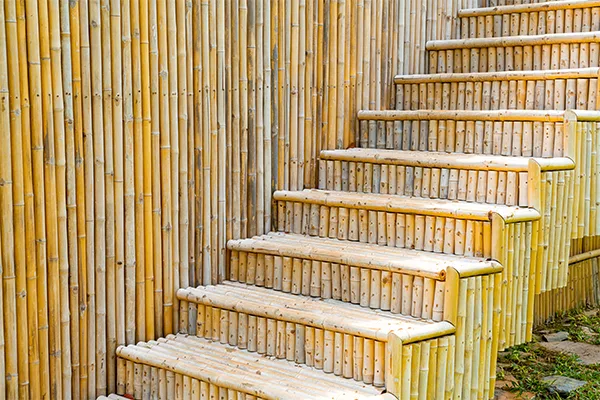
Bamboo could be the perfect alternative for wood as a renewable construction material. Bamboo resembles wood, but it regenerates much faster than trees because it belongs to the grass family. Depending on its type and location, bamboo can grow up to three feet a day, making it one of the fastest-growing plants on the planet. 

Beyond just its quick growth rate, bamboo has many other sustainable qualities. Bamboo is a great biodegradable construction material choice when building arches, curved roofs, and other architectural features requiring some flexibility. Because of its flexibility, it can be bent and curved without breaking, which makes it a useful material for them.

4. Cork

Similar to bamboo, cork grows very quickly. It can be extracted from a live tree still developing and producing fresh bark or cork. Even after being compressed, the cork regains its flexibility and durability, taking on its original form. This environmentally friendly building material is often used in floor tiles because of its durability and toughness. Its superior shock-absorbing qualities also make it perfect for subflooring and insulating sheets. It is also very good at absorbing sound. It is also a good thermal insulator because it doesn’t release any toxic gases during combustion.

5. Straw Bales

It’s another renewable construction material that can be used for framing. They have good insulation properties and can be used as materials for soundproofing. Because it keeps air from passing through, it can also be used as filling material in beam frameworks and between columns. Straws can be easily harvested and replanted without harming the environment. To keep the house warmer in the winter and colder in the summer, straw can also be hung from walls, ceilings, and attics.

6. Rice Husk Ash Concrete

Concrete is frequently used in construction projects because it is sufficiently strong, impermeable, and long-lasting. One of the more expensive ingredients of concrete is cement, which is in constant demand worldwide. Thus, in order to keep building costs under control, it’s imperative to use modern waste materials, mineral admixtures, and other materials to meet the growing usage of concrete. Agricultural wastes such as rice husk ash (RHA) can be used to make concrete that is more effective and has better properties such as impermeability, strength, workability, and resistance to corrosion of steel reinforcing.

7. Hempcrete

An environmentally friendly building material called hempcrete is derived from hemp plant stalks. Its insulating qualities are well-known, and it’s made of hemp, lime, and water. Hempcrete is an excellent material to use when building eco-friendly homes because it is strong and fireproof.

8. Timbercrete

This energy-efficient construction material is a blend of concrete and sawdust. It is lighter than concrete and produces fewer greenhouse gases during transportation. Moreover, sawdust recycles waste and replaces a portion of the labour- and energy-intensive components of traditional concrete. Common shapes for timbercrete include bricks, blocks, and pavers. In addition to being incredibly durable and highly fire-resistant, it is also better at insulation than brick, clay, or concrete.

9. Reclaimed Or Recycled Metal

reclaimed or recycled metal

Recycled steel is a strong, environmentally friendly, recycled construction material. It does not lose its strength due to the recycling process. In addition to being fireproof, steel is resilient to natural calamities like hurricanes and earthquakes.

Conclusion


On a final note, sustainable construction methods and materials are beneficial to human health and the environment. I hope that this guide has been informative and helpful in helping you make environmentally friendly decisions in the future. 

11 Types of Contractors in the Construction Industry

0
Contractors in the Construction Industry

Whether you are building a new home or just renovating your old one, you need a group of people who can handle all the work for you. And that’s why building contractors come to the project. As we all know, the construction industry is vital and involves many tasks to complete a single project. Hence, different types of contractors are in the construction sector to deal with the different tasks. So, you must know about the types of contractors to complete your construction project successfully without facing any hassle.

Hence, Brick&Bolt gives detailed info about the different types of building contractors involved in the construction project so that you can choose your home contractor wisely and take advantage of their skills and potential.

So, let’s start with understanding what a contractor is and its importance in the construction project.

What is a Contractor and its Importance?

A contractor is an individual or company that is hired to perform a particular task for their client. In the construction industry, building contractors are crucial to successfully completing the project. A contractor’s major responsibility is to manage their team of workers and make sure that all work is performed on a timeline and within budget. To perform this duty, contractors must have excellent organisational abilities, along with well-versed knowledge of building codes and safety standards. Apart from these, contractors must have strong technical and communication skills because their duty requires effective communication with the clients, team members, workers, suppliers, etc.

11 Types of Home Contractors in Construction

The following are the different types of contractors:

  1. General Contractors
  2. Design-Build Contractors
  3. Residential Contractors
  4. Commercial Contractors
  5. Civil Contractors
  6. Electrical Contractors
  7. Plumbing Contractors
  8. HVAC Contractors
  9. Painting Contractors
  10. Flooring Contractors
  11.  Carpenters

Let’s dive deep into all types of home contractors –

1. General Contractors

General contractors are not experts in just one field. They oversee teams of different types of contractors working on both commercial and residential construction projects throughout large constructions. They have significant building skills, so they supervise a broad range of work and ensure that everything is completed on time and efficiently.

In simple words, general contractors are the project managers who hire all the suppliers and subcontractors or specialist contractors like electrical, plumbers, carpenters, etc., for the successful completion of the project. They are accountable for providing all of the required materials, labourers, equipment and services for the completion of the project.

2. Design-Build Contractors

Design-build contractors perform a double duty. They hire to make a building design that meets your requirements and then execute the plans. It contrasts with the typical construction process, in which a consultant is recruited first to make a plan before giving it to a contractor or home builder to build according to the plan. 

A design-build contractor is responsible for designing the plan, recruiting subcontractors or specialist contractors, and supervising and managing the construction process to make sure that it matches the client’s requirements.

3. Residential Contractors

Residential Contractors

Residential contractors are those who specialise in home construction and renovation. They have a license and qualification to work on construction projects, and they, as a house builder, collaborate with homeowners, architects, and engineers to ensure a smooth and efficient construction process. Some home contractors specialise in renovation work, also known as home renovation contractors. These home renovation contractors are involved in all phases of home renovation

4. Commercial Contractors

As the name suggests, commercial contractors are those professionals who specialise in commercial construction, such as shopping centres, malls, office buildings, and other commercial projects. They frequently have to deal with multiple levels of legal requirements and have a team that specialises in various parts of commercial construction.

5. Civil Contractors

Civil contractors generally work on large infrastructure projects such as dams, bridges, highways, and water treatment plants. They frequently collaborate with civil engineers to make sure that the project is constructed according to the specifications.

6. Electrical Contractors

Electrical contractors are experts in electrical systems. Responsibilities of the electrical contractors are the installation, maintenance and repair of electrical systems like outlets, fire alarm systems, lighting, fans, etc., in residential, commercial and industrial projects. 

While some electrical contractors work on smaller projects like adding outlets or installing light fixtures, others handle larger projects like upgrading service panels or doing complete wiring.

7. Plumbing Contractors

Plumbing contractors are responsible for the plumbing systems. In the residential project, they install utility closets, bathrooms, kitchens, break rooms, and backflow preventers, along with water supply pipes. They also install drains and connect them to existing septic tanks or sewer systems.

Apart from installation, they maintain and repair all the plumbing systems, such as fixing leakage, re-piping, unclogging pipes, repairing sewers, etc. 

8. HVAC Contractors

HVAC Contractors

HVAC subcontractors are responsible for installing, maintaining and repairing heating, ventilation, and air conditioning systems to keep your home comfortable. In simple words, they install both heating and cooling systems, such as air conditioning systems, heat exchangers, air handlers, and boilers. 

For commercial projects, they might also handle refrigeration tasks for large cold storage warehouses, restaurants, and commercial projects.

9. Painting Contractors

Painting contractors are the most important for the finishing of the home as they give a fresh and attractive appearance to your home by painting it. You can customise the colours to give it a personal touch. They ensure the smooth finishing of your walls and ceilings.

10. Flooring Contractors

The flooring contractor is responsible for laying the well-finished floor throughout the project. They install tiles, vinyl flooring, hardwood, or carpet; however, each may demand its own speciality flooring subcontractor.

11. Carpenters 

Carpenters are the experts in woodworking in home construction. They specialise in certain areas, such as furnishing, cabinetry, framing, crown moulding, etc.

Conclusion

In conclusion, the construction industry depends on the different types of contractors, each with a specific specialisation and skills. From the general contractors who supervise the entire project to specialist contractors, the right group of experts makes your construction project smooth and hassle-free. Hence, it’s crucial to understand the roles and responsibilities of these contractors, whether you are planning to build a home or any commercial project. 

So, always make an informed decision while selecting the building contractors for your dream project because reputed contractors or construction companies like Brick&Bolt ensure your home is built with precision, efficiency, and prime quality. In addition, you can estimate the cost of your dream home using Brick&Bolt’s online home construction cost calculator.

11 Factors Affecting Construction Cost of the House

0
Construction-Cost-of-the-House

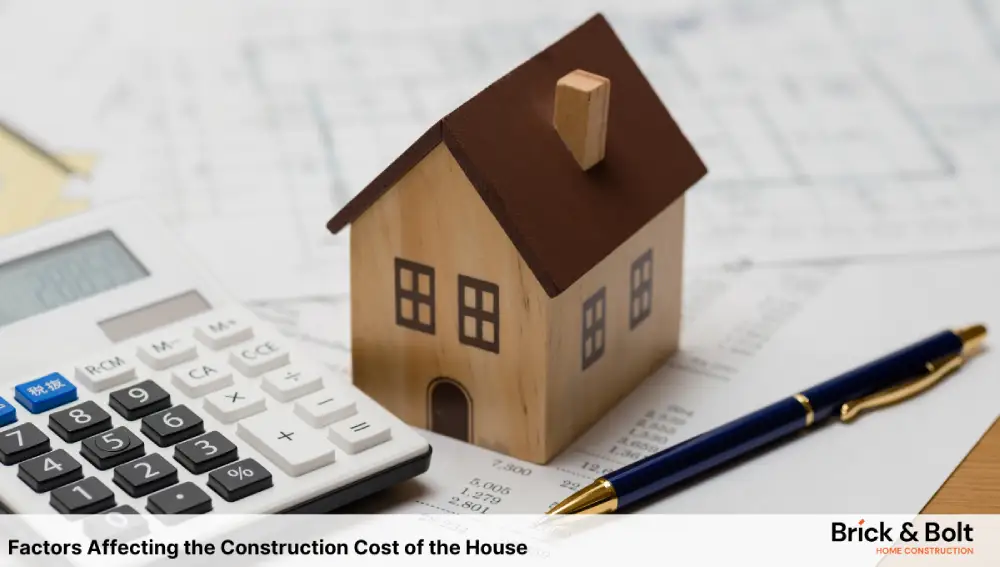
Construction is an expensive endeavour, and anyone looking to calculate the house construction cost needs to be aware of the difficulties involved in the process. Generally, several factors affect the construction cost of the building, including the building’s size to the building’s registration and approval costs, which substantially impact the entire budget of the construction. Hence, we bring the 11 most important factors that influence construction cost.

Factors Affecting the Construction Cost of the House 

Factors Affecting the Construction Cost of the House

The following are the major house construction cost factors:

  1. Size of a House
  2. Physical Condition of a Construction Site
  3. Location of Site
  4. Complexity of Design
  5. Material Cost
  6. Labour Cost
  7. Client’s Requirements
  8. Method of Construction
  9. Delay in Construction
  10. Registration and Approval Cost
  11. Market Fluctuation

Let’s dive deeper into all the factors

1. Size of a House

One of the most common factors that affect construction cost is its size.  The project size considerably impacts the labour and materials requirements, which affects the construction cost. Obviously, if you are constructing a 1000 sq. ft. house, due to differences in construction costs, it costs less than building a 2000 sq. ft. house.

2. Physical Condition of a Construction Site

The site’s physical condition is one of the most influential cost factors for home construction. Conditions like ground blockage, adjoining and existing structures, and aboveground and underground utilities impact the building’s design and construction.

In simple terms, site conditions such as poor soil, uneven terrain, the existence of underground pipes, water bodies, and environmentally hazardous areas on the project site could significantly raise project costs. Because if there are any unfavourable conditions, you need to do extra labour works like site clearance, demolition, and remediation, making building on them more expensive. 

3. Location of Site

Location plays an important role in costing. One of the most simple phenomena is that high-value locations demand high-value construction. Apart from that, if your site is located at an inconvenient location, like at a high altitude, flood-prone area, or rocky area, it makes your construction project difficult, and you require additional labour and resources, resulting in a cost rise.

The availability of resources and capacity of existing services also impact the cost. Because if these services are far away from the site location, connecting to them might be expensive. 

4. Complexity of Design

The building’s geometrical design, including its shape, size and complexity, also influences house construction cost factors. costs. For example, a large built-up area with a standard rectangular shape, average elevation and simple floor plans tends to be less expensive than a small built-up area with curved or complex-shaped buildings.

Moreover, buildings with unique features might need pricey materials, leading to a rise in cost. The client’s perspective on sustainability and total life cycle expenses can also influence the project’s final cost.

5. Material Cost

Your priorities and choices of materials can also impact the cost because numerous alternatives are in the market for materials which you can use for various housing components. If you purchase costly items, your construction material rate will be increased.

The construction material costs include the costs of raw materials, shipping, and taxes. However, depending on the project’s location and size, the cost of each of these three elements may change. For example, if your site location is far from the available resources, you must spend extra shipping and labour for logistics. Similarly, if your project size is bigger, you require more raw materials and vice versa.

6. Labour Cost

The labour costs vary state by state. Furthermore,  in certain areas, labour wages are charged on an hourly basis, whereas in others, they are charged on a daily basis. As a result, it is critical to understand labour standards and estimate building costs properly. But, due to the supply-demand concept, you may have to pay more for labour if there is a large demand for it. 

7. Client’s Requirement

Fulfilling a customer’s requirements is at the forefront of any building project. Client’s requirements might change substantially; for example, what is important to one client might be irrelevant to another. But, their needs mostly revolve around aesthetics, durability, on-time completion, warranty support and overall user appeals. Some of these factors can be addressed during the design process, while others depend on the contractor’s on-site implementation. It is critical to design and build a building in accordance with the needs of the client. However, over-specifying a building and using high-quality materials and craftsmanship will raise the final cost.

8. Methods of Construction 

You can determine the final cost of a project by how much your contractor costs for completing the construction job. It depends on the overall cost of materials and labourers, operation plant cost, subcontractors’ competitiveness, and the cost of executing the individual site. The contractor also adds contingency costs and a profit margin to these prices.

9. Delays in Construction

Delay in construction is also one of the significant factors affecting the construction cost. Because it causes unexpected issues like a rise in equipment rents, storage cost of raw materials, rise in wages of labourers and contractors, etc., that can significantly impact the final construction cost.

10. Registration and Approval Cost

According to your location, your governing authority charges for registration, approval and permits. All these costs vary by each authority. Each authority may have its own rate for such fees. So, it’s crucial to add the approval and permit costs to the end budget along with the other expenses.

11. Market Fluctuation

Market fluctuation is another factor that influences the construction cost. It arises as a result of changes in the supply and demand of resources like construction materials, labourers, equipment rents, etc. Price hikes on these elements can also lead to delays in construction and significantly impact the overall cost of building a house.

Conclusion

On a final note, understanding the various cost factors for home construction is critical for determining a realistic budget and ensuring the project’s success. You must consider these elements during the design and execution of your construction projects.

In addition, you can use the online house construction cost calculator to get a basic estimate for your construction cost. However, it’s crucial to have a well-thought-out construction design before you start estimating the final construction cost of the house. For that, you can visit an experienced architect or reputed construction company like Brick&Bolt to get full guidance or design for your dream house; it will aid in determining the most accurate estimation for your proposed project.

Home Construction Materials: Affordable Options in India

0
low-cost home construction materials

In India, many methods are available to construct low-cost homes compared to other countries. Many builders have devised a solution for low-cost home construction materials through low-cost construction techniques in India to sort out this problem. Cheap home construction materials are nothing, but the cost and materials vary in terms of sustainability, and they are a permanent housing solution for people from low- and middle-income groups.

Best Low-Cost Home Construction Materials in India 

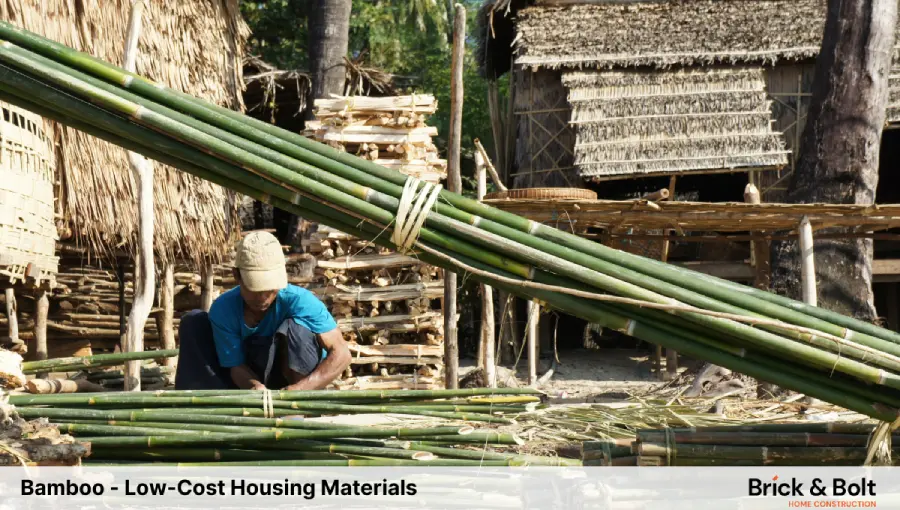
1. Bamboo

Bamboo is one of the most significant crops in India. The average yearly production of bamboo in India is 3.23 million tons. But no one knows the beneficial use of bamboo as a construction material. Some of the rural areas of countries in Asia and Africa are still constructing bamboo homes. Bamboo is a low-cost, low-weight and durable material compared to other materials. However, you should take some precautions when using bamboo in construction, such as treating it with appropriate chemicals to make it termite-resistant. Because its fibres run axially or along the length of the pole, bamboo has been discovered in some studies to have a stronger tensile strength than steel. This makes bamboo a carbon-smart substitute for steel structural members or rebar. People use advanced bamboo sheets as an alternative to housing steel sheets for roofing purposes in homes.

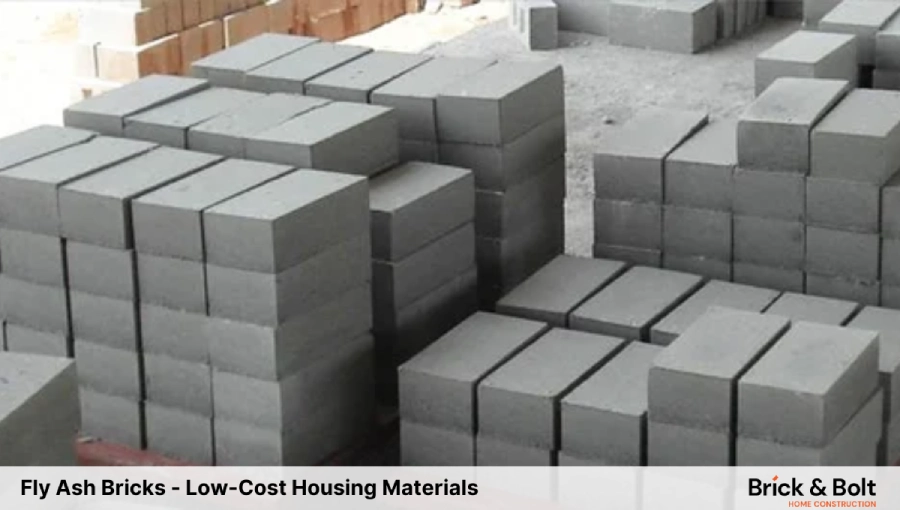
2. Fly Ash Bricks: 

For Home construction, you need to choose the best quality bricks thus Fly ash bricks are high-quality bricks with lighter weight than clay bricks. Fly ash bricks are less porous and absorb less water to reduce dampness or other attacking properties from walls. The main advantages of fly ash bricks are that they are cost-efficient, eco-friendly, fire-resistant, and lightweight construction materials. Using fly ash bricks, you can save money with immense benefits.

3. Hollow Concrete Blocks: 

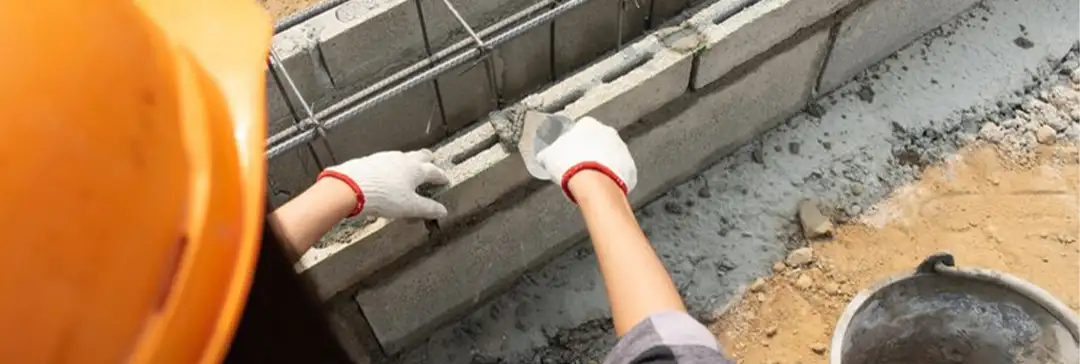
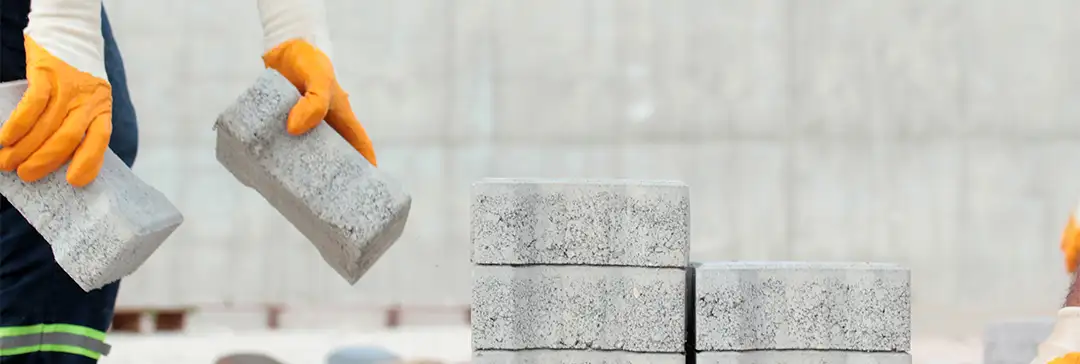
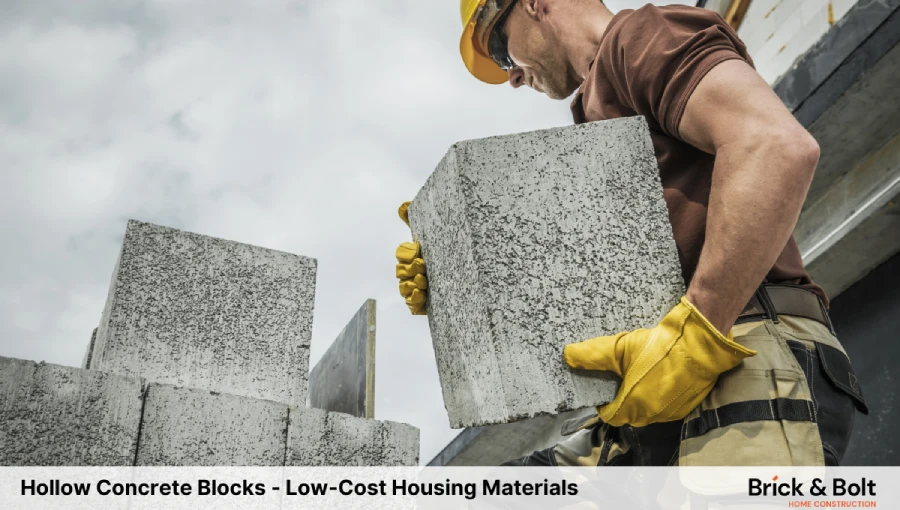
The hollow concrete blocks are one of the most beneficial low-cost building materials. Hollow concrete blocks are precast concrete blocks with open spaces or cavities in their interior. They are made by pouring concrete into a mould shaped to form the block’s exterior surface, leaving the interior hollow. Insulation, electricity, plumbing and other utilities use hollow concrete blocks. Hollow concrete blocks are widely used in buildings, railroad infrastructure, and other large construction projects. Hollow concrete blocks have various advantages, such as being cost-effective, eco-friendly, highly durable and requiring less time to work with.

4. Filler Slab Materials:

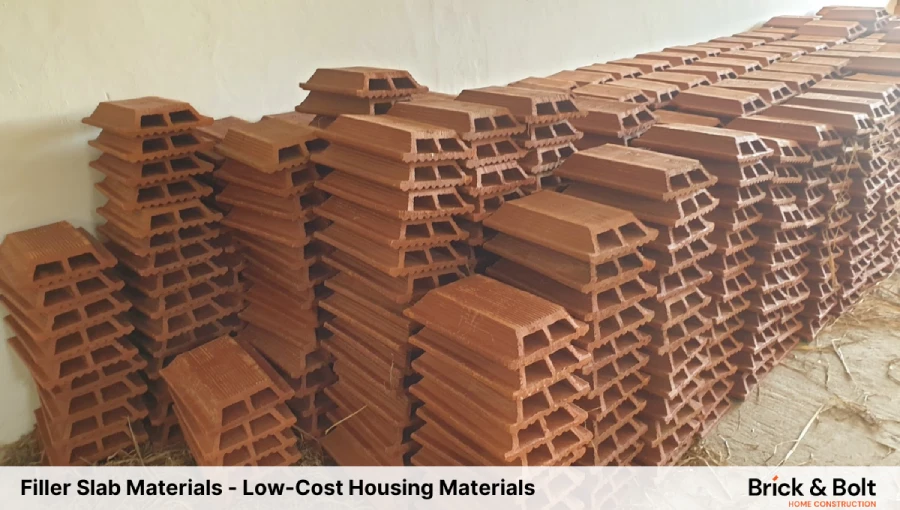
Filler slab materials, also known as lightweight aggregate, are a mixture of sand-sized particles made from various resources, such as crushed stone, glass, and slag. They are used in the production of concrete, as they help to reduce the overall weight of the concrete mixture while still providing structural strength. The main benefits of filler slab materials are that they can be used in a wide range of applications, including in the construction of buildings, highway overpasses, and other large-scale infrastructure projects.

5. Prefabricated Materials: 

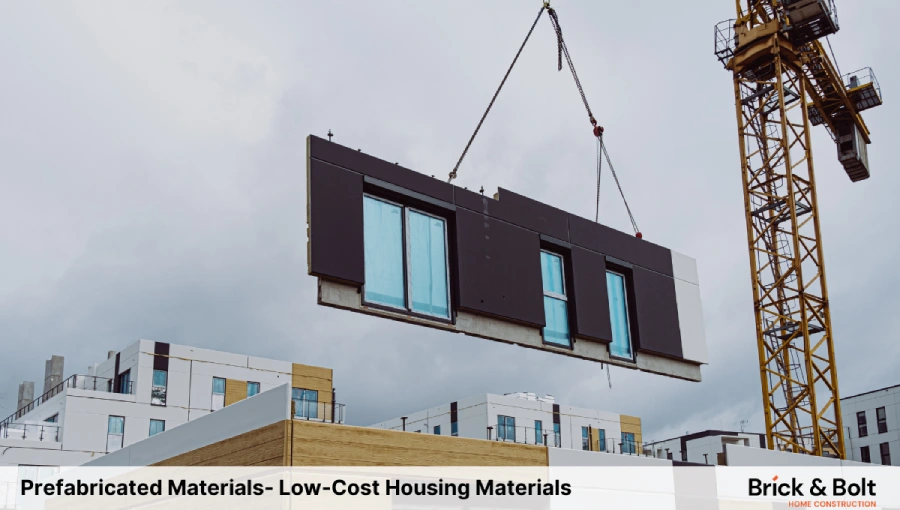
Prefabricated materials are made in a closed place or factory to protect them from exterior elements. They include doors, windows, and floor panels. A significant advantage of prefabricated materials is that they can use recycled materials. Prefabricated materials are eco-friendly construction materials that make construction work easier and faster and are highly durable.

6. Compressed Earth Block: 

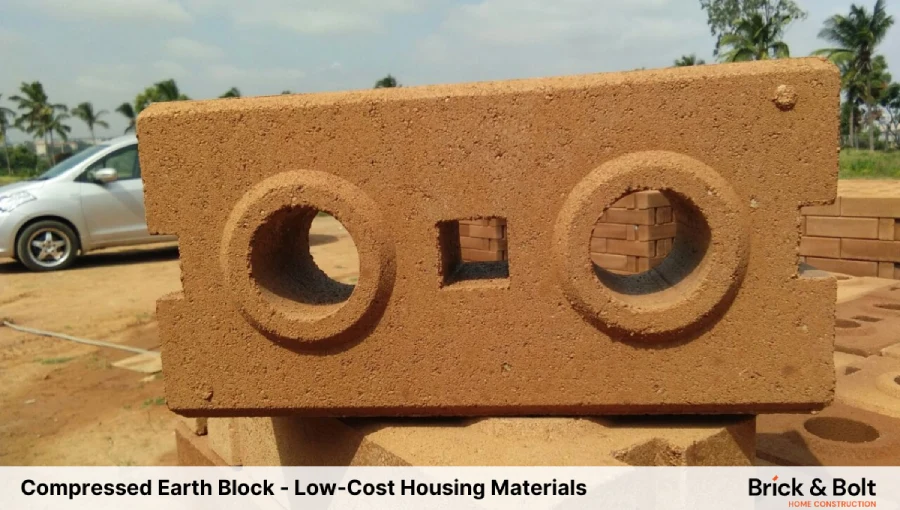
Compressed earth block mixes dry inorganic subsoil, clay, sand and aggregate. It requires dampening and mechanical pressing at high pressure. If you use a chemical cement binder along with these products, you will get a compressed stabilised earth block, which is highly water resistant. The main advantages of compressed earth blocks are fire resistance, insect resistance, mould resistance, temperature control, etc.

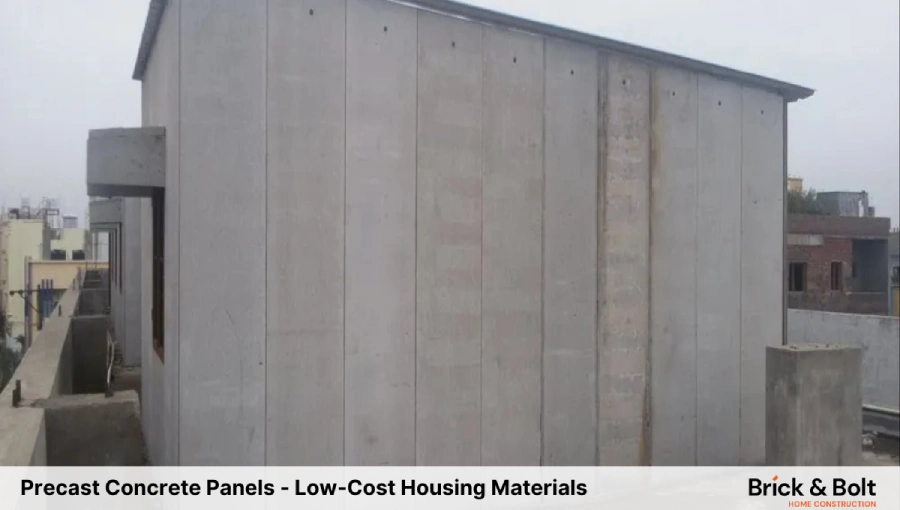
7. Precast Concrete Panels: 

Precast concrete panels are prefabricated, reinforced concrete elements designed for easy installation and cost-effectiveness. These panels can be used in various construction projects for exterior and interior walls, floors, and ceilings. They provide strength, durability, and fire resistance and can be customised to suit specific project requirements. Precast concrete panels are built off-site in a controlled environment, which helps to minimise waste, increase productivity, and ensure consistency in quality. They are often used in multi-unit residential, commercial, and industrial buildings.  

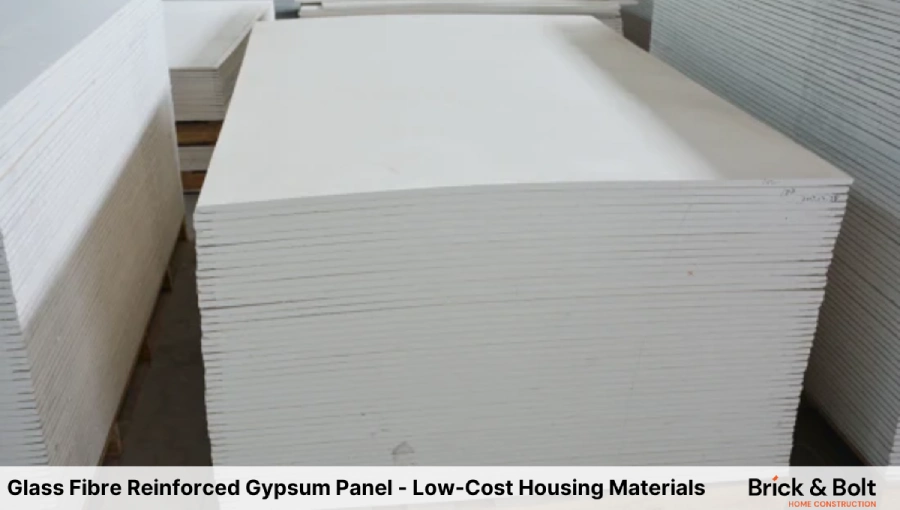
8. Glass Fibre Reinforced Gypsum Panel:

Glass fibre reinforced panel is a construction material that combines gypsum with glass fibres to create a strong, lightweight and durable panel. People commonly use these panels in exterior and interior construction, such as partition walls and decorative elements. The main benefits of glass fibre-reinforced gypsum panels are quick installation, lightweight, fire resistance, sound insulation, etc.

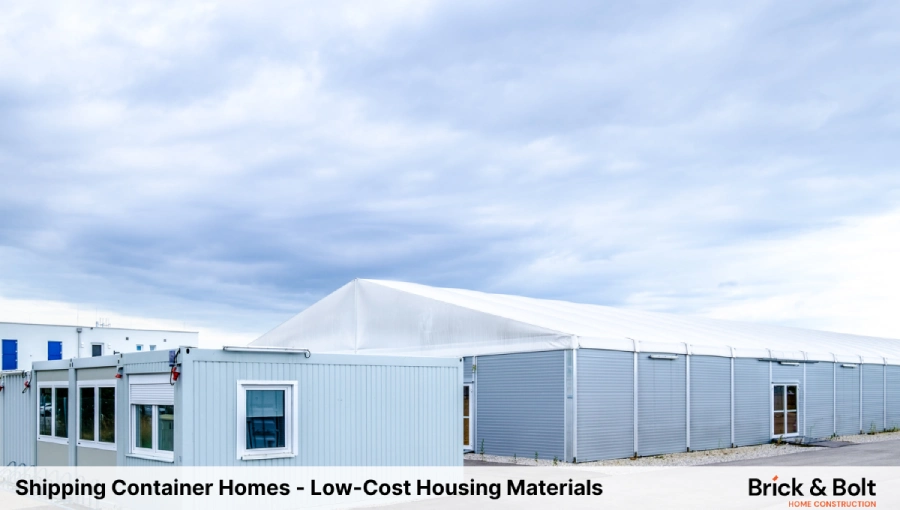
9. Shipping Container Homes:

People construct container homes from repurposed shipping containers. They are often more affordable compared to other low-cost house construction materials.  They are made from the steel containers used for transporting goods on ships. The main advantage of shipping container homes is that they are portable, and you can customise them based on your preference, they are also durable and affordable.

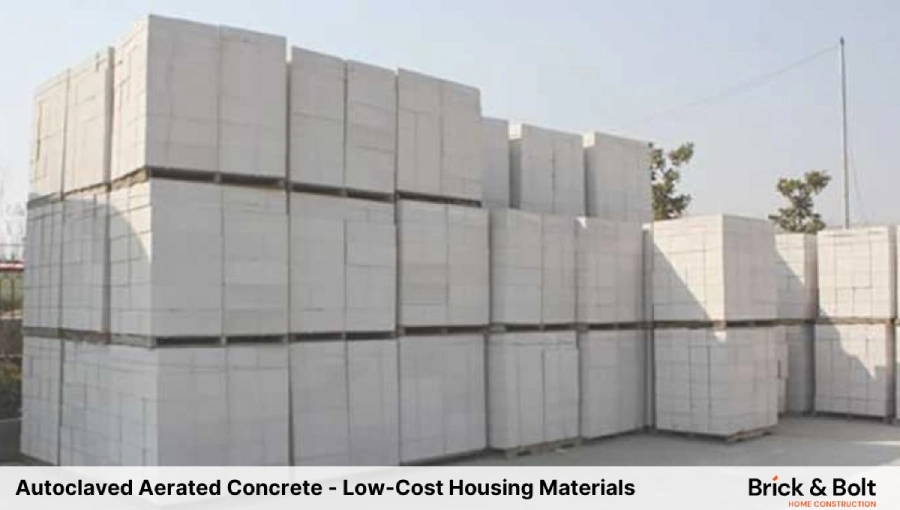
10. Autoclaved Aerated Concrete Or AAC: 

Autoclaved Aerated Concrete (AAC) is a building material produced by air bubbling through a mixture of cement and aggregates, usually sand and gravel. This process results in a lightweight, strong, and durable concrete with better insulation and sound absorption properties. The advantages of  AAC are widely used in the construction industry for various applications such as walls, floors, ceilings, and columns. Autoclaving seals and solidifies the mixture, making it suitable for extreme environments. AAC is often compared to foam boards but is considered more durable and can be used in higher load-bearing structures.  

In one way or another, low-cost home-building materials can help you save time and money. We’ve looked at many different types of low-cost building materials. These materials contribute to long-lasting, environmentally friendly, and energy-efficient building materials while lowering construction costs. To create a house in India using affordable building methods and supplies, you should be aware of Indian contractors or the top building firms in the country.

FAQs

What is the least expensive material to build a house?

Bamboo is one of the least expensive materials for building a house. It is cheap, eco-friendly, and very strong. It suits many construction uses.

What is cheaper than bricks?

Fly ash bricks are cheaper than traditional clay bricks. They are made from industrial waste. This cuts costs. They are lightweight and have better insulation.

Complete Guide to House Construction Cost: Techniques, Tips & Calculators | Brick&Bolt

0
Guide-to-House-Construction

Home !!! 

How soothing this word is !!! And if it comes to owning a home, it’s like a dream of millions of people. But, when it comes to home construction, it sounds like a complex and expensive venture. So, if you want to jump into this venture, you must have a thorough knowledge of house construction costs. It helps you manage your budget effectively and make informed decisions during the construction process.   

Hence, Brick&Bolt presents a detailed guide on home construction costs. It covers all the significant aspects of construction cost, like what it is, its importance, how to calculate the cost, sample calculation, construction cost calculator, low-cost construction techniques, low-cost building materials, etc. 

So, let’s start the journey!!!

What is the House Construction Cost?

As we know, construction is a costly venture; each penny you spend to build a home is your house construction costs. In detail, the following expenses count as a new home construction cost.

  • Architect’s and contractor’s fees
  • Plan approval and permit charges
  • Material cost
  • Labour Cost
  • Equipment and Machinery Cost
  • Site preparation cost
  • Contingency charges
  • Operational charges, etc.

What is the Importance of House Construction Cost Calculation?

It is essential to have a good knowledge of construction costs before starting any building project. Making a comprehensive budget that covers all costs necessary to complete the project gives you a clear idea about managing your finances for your dream project. It also helps in determining the feasibility and scope of your construction project.

You can make an appropriate plan if you are fully aware of the construction expense. That can save you from many problems, such as overspending, delays, compromising quality, financial headaches, etc. Therefore, it is imperative that you calculate building costs precisely for an easy and effortless construction process.

So, let’s look at how much it will cost to build a home.

House Construction Cost Calculation

How Much It Will Cost to Build a House

construction expenses along with the location of your site, the complexity of the design, and the condition of the market. Hence, for your ease, we have listed major expenses to calculate a new home building cost precisely:

Construction cost estimation is a challenging process because you have to consider all the construction expenses along with the location of your site, the complexity of the design, and the condition of the market. Hence, for your ease, we have listed major expenses to calculate a new home building cost precisely:

Design Cost 

You can start your house construction cost calculation from the design cost. For your house design selection, you have two options. 
First, you can hire an architect and get your customised house design; for that, you have to pay architect charges.This cost depends on your location, the architect’s expertise and market value. 

Second, you can choose a pre-designed option for your house design. Nowadays, many readymade home designs are available on different design service platforms, both online and offline. It will cost you less than the customised design optionas it doesn’t require hiring an architect.

Builder or Contractor’s Cost 

You must consider the builder or contractor’s cost; they play the most important role in your construction project. They execute the plan and complete your project within the timeframe and budget. 

Construction Materials Cost 

As we all know, construction demands a huge range of construction materials like cement, aggregate, sand, bricks, steel, etc., and finishing materials like tiles, marble, wood, paint, putty, etc. Apart from these materials, you also need some machinery, like a concrete mixture machine, excavator, backhoe loader, etc., to ease the construction process. You can take these machinery on rent. Hence, the material cost is significant for the overall cost.

Labour cost for house construction per sq ft

You must consider labour costs while cost estimating because you require different types of skilled labour to complete your house construction. In 2024, the labor cost for house construction in India varies significantly based on the region, project complexity, and type of work involved. On average, labor costs range from ₹300 to ₹500 per square foot for standard residential construction. This includes civil work, finishing tasks, and contractor fees.

For example:

  • Basic labor costs for civil work typically fall between ₹140 and ₹200 per square foot.
  • Finishing work, including tasks like plastering, painting, and electrical fittings, can add another ₹70 to ₹100 per square foot​.

Labor rates also vary by the specific tasks involved:

  • Brickwork labor costs around ₹25 to ₹35 per square foot.
  • Plastering labor typically costs between ₹12 and ₹25 per square foot, depending on the type of plaster.

But, before you start the calculation, you must know the factors affecting construction cost.

Factors Affecting Construction Cost

Many factors influence the new home construction cost and significantly impact the entire budget.So, you must have a thorough understanding of all the factors. The following are the major factors that significantly affect the cost. 

  • Size of a house
  • Physical condition of a construction site
  • Location of site
  • Client’s requirements
  • Material cost
  • Labour cost
  • Complexity of design
  • Method of construction
  • Delay in construction
  • Registration and approval cost
  • Market fluctuation

Now, you are ready to calculate your Affordable house construction cost per square feet, but manual estimation is very complicated and tedious. So, let us introduce you to Brick&Bolt’s free house construction calculator for your ease.

Free House Construction Calculator in India

You can estimate constriction costs independently, but as we mentioned, it’s a very complex process. So, you can hire a professional cost estimator to do so on your behalf, but it will cost you more. They will calculate the building cost per square foot as well as the building cost per square meter. Hence, Brick&Bolt presents a House Construction Cost Calculator for you to estimate your construction cost without any hassle and spending money on it. It can calculate your construction cost per square foot.

This calculator is very useful and simple and doesn’t require any construction experience to use. Its only requirement is your location, built-up area, required car parking unit and balcony and utility area. You have to enter all these details in the respective field in the calculator, and your detailed cost estimation will be ready within a few minutes. 

But remember that the calculator’s cost ranges are only for estimation purposes because the actual building cost per square foot could vary based on your area of construction, location and the finishing materials you select. 

The Brick&Bolt team can work with you to modify the project configuration to fit your budget if you are operating under a strict spending plan. 

Please schedule a free consultation appointment with one of our technical experts by calling +91 7505-205-205 or visiting our website at for more accurate pricing information.

For your convenience, below is an example of a house construction cost calculation to help you grasp the idea.

1200 sq ft house construction cost

First, you need the plot size and basic requirements criteria to calculate the construction cost for a 1200 sq. ft. house. So, let’s assume your plot size is 30*40 feet, and you need all the basic facilities such as master bedrooms, a common bathroom, a well-ventilated kitchen, a living room, a balcony, a parking area, a terrace, etc. Then, your basic construction cost of a 1200 sq. ft. house can range between 1200 to 2200 rupees/sq. ft. However, it depends on your location, design complexity, labour cost and quality of materials you choose for the construction. From the overall construction cost, a minimum of 40% goes under labour costs, while the remaining 60% goes under material costs. For instance, your construction cost per square foot is 1500 rupees; hence, your total cost would be (1500*1200) 18 lakhs. In which 40% (7.20 lakhs) would be labour cost and 60% (10.80 lakhs) would be material cost. 

Suppose you want to include some additional work like interior design, woodwork, false ceiling, wardrobes, etc. In that case, you need to add these requirements to the package when you finalize your contractor and design, as these are not included in the construction cost.

Have you found this cost too high???  Are you running with a strict budget??? 

Then, don’t worry!!!

Know how to construct a low-cost house in India.

How Do I Construct a Low-Cost House in India? 

You can minimise construction costs using efficient construction techniques and low-cost home construction materials. In addition, you can also take advantage of low-cost housing schemes to build your dream home at a low cost in India. 

So, first, let’s look at low-cost house construction techniques which you can easily incorporate into the construction process.

Low-Cost Construction Techniques

  • Choose the right property.
  • Choose low-cost building materials.
  • Use load-bearing structure
  • Choose an experienced contractor
  • Choose a reputed construction company like Brick&Blot
  • Use prefabricated building components

Along with these techniques, know some very, very beneficial low-cost housing schemes in India:

7 Low-Cost Housing Schemes in India

  1. Pradhan Mantri Awas Yojana-Urban (PMAY)
  2. Pradhan Mantri Gramin Awas Yojana (PMGAY)
  3. Rajiv Awas Yojana(RAY)
  4. Delhi Development Authority Housing Scheme
  5. Tamil Nadu Housing Board Schemes
  6. Maharashtra Housing and Area Development Authority Lottery Scheme (MHADA)
  7. NTR Housing Scheme

As we discussed, material costs make up a major part of the overall construction cost. Hence, you must know about low-cost construction materials so that you can use them and reduce your overall home construction cost. 

What Are the Low-Cost Building Materials in India?

Most people think of typical building materials like cement, wood, sand, concrete, and bricks when they think about construction. These traditional materials are quite costly, so it’s important to know about their alternatives, which are cheaper than those and help to save cost.

So, here we have listed the top 10 low-cost home construction materials that can reduce your material cost. In addition, some of them are also eco-friendly, so you can contribute to saving the environment as well.

Top 10 Low-Cost Home Construction Materials

  1. Bamboo
  2. Fly Ash Bricks
  3. Hollow Concrete Blocks
  4. Filler Slab Materials
  5. Pre-fabricated Materials
  6. Compressed Earth Block
  7. Precast Concrete Panels
  8. Glass Fibre Reinforced Gypsum Panel
  9. Shipping Container Homes
  10. Autoclaved Aerated Concrete Or AAC 

These are all the cheaper alternatives to the costly traditional construction materials. Some might suit your new stand-alone home, while others are suitable for apartments. It depends on your local building codes, location and weather conditions.

On a final note, the house construction cost term is vital itself. To understand it, you must have a thorough knowledge of the construction materials cost, labour cost, design cost, architect and builder’s cost, necessary permits and approval cost and contingency cost. But that’s not all; along with these costs, you have to understand the factors that affect the construction cost. 

In short, construction cost estimation is a very complex process. Hence, we recommend using a house construction cost calculator for a precise cost estimate. You can also hire an experienced contractor or reputed proffesionals like Brick&Bolt Construction Services to complete your project within budget and hassle-free way.

We hope this detailed guide on house construction costs proves beneficial for you to understand what your dream house costs.

What is a Succession Certificate for Property?

0
Succession Certificate for Property

After a person’s death, his/her properties and the stakes within have to be passed on to the rightful beneficiaries. This procedure is sometimes rather lengthy and can take a very long time, particularly in cases of numerous heirs or properties. 

In Indian law, the method of passing on property after a person’s death is controlled by the Indian Succession Act of 1925. This blog will reflect on what a Succession Certificate is, cover the needed documents, and how to apply for it.

What is a Succession Certificate for property?

The Civil Court grants a succession certificate in a given jurisdiction to a legal heir of the deceased person. This certificate empowers successor(s) to recover debts as well as securities of the deceased person. 

This is needed when an estate is transferred or passed to someone. It is needed to pay a deceased person’s debts and receive their securities. There are 5 steps Procedure to Obtain a Succession Certificate

Who Issues the Succession Certificate?

The District Court granted the Succession Certificate where the deceased person was residing. If the deceased person does not have a permanent home, the petition may be presented before the district court of any place where the deceased’s property is located.

How To Get a Succession Certificate?

How To Get a Succession Certificate

To obtain a Succession Certificate, follow these steps:

Filing a Petition

Petition for Certificate: The petition must contain the following particulars:

  • Time of death of the deceased
  • Residence or details of properties of the deceased at the time of death within which the Judge’s jurisdiction falls under
  • Details of family or other near relatives
  • The rights of the petitioner
  • Absence of any impediment

Submitting the Fees

The court fee for a Succession Certificate is usually 2-3% of the total value of the property.

Publishing of Notice in the Newspaper

A newspaper notice for 45 days is issued by the court. Any person having an objection can file an opposition.

Granting the Certificate

If the court does not receive any objection, it will issue the Succession Certificate.

Signing the Indemnity Bond

The certificate holder must sign an indemnity bond to ensure that all payments made to or dealings had in good faith with a person to whom a certificate is granted are protected.

What are the Documents Required for Succession Certificate?

To obtain a succession certificate in India, you must submit the following documents.

  • Application form
  • Death certificate if the deceased
  • Details of assets & liabilities
  • Identification proof of legal heirs (Aadhar, PAN card, passport, etc.)

Succession Certificate for Property: Why is it required?

1. To grant the ownership of the immovable properties of the deceased.  

  • In case a person dies, the legal process followed is the Succession Certificate to prove the rightful heirs to that person’s property and assets.  
  • They provide the certificate holder authoritative powers to take over and pay the debts and securities of the deceased.  

2. To recover any debts and securities that were owed to the deceased  

  • The succession certificate empowers the holder to recover any debts and securities due to the deceased person.  
  • It enables the holder to earn interest/dividends of the securities and bargain or exchange them.  

3. To pay burial and funeral expenses and other debts.  

  • A succession certificate enables the legal heirs to control the properties and assets along with the liabilities of the deceased person.  
  • It aids in avoiding litigations and makes them secure the transfer of property and payment of debts. 

4. To justify why the heirs have the right to demand.  

  • The certificate has a legal worth as it confirms the transfer of assets of a deceased person to the rightful heirs. 
  • It can be used when you need to make a claim on the assets of the deceased relative.  

Conclusion 

A Succession Certificate is an essential certificate when it comes to succession, payment of some debts, and obtaining some securities of a dead person. We can Transfer Property even without the Succession Certificate. In case of a problem or for more information, go to the local Revenue Office or contact a lawyer of your choice. 

FAQs

Why is a succession certificate required?

A Succession Certificate is required to transfer or inherit property, pay debts, or collect securities on behalf of a deceased person.

What is the cost of a succession certificate in India?

The cost of a Succession Certificate in India is usually 2-3% of the total value of the property.

What is the difference between a legal heir and a succession certificate?

Legal Heir Certificate: Issued by the government to establish the legal heir who will inherit a property once the owner dies.

Succession Certificate: Issued by the court, it authorizes successor(s) to realize debts and securities of the deceased person.

Land Registration Number in Land Document | Deed number

0
Document-number-in-land-registration.

A document number or sale deed number is a specific number that is assigned to a specific piece of property, denoting an agreement between the buyer and seller. The number is often used in real estate dealings and includes overall details of the property. 

In cases of legal allegations, the sale deed number helps identify the actual owner of the property. The sale deed number comes in handy when applying for reselling the property, making a loan application, and maintaining property records.

If you are worried about identifying or retrieving the sale deed number, this blog can help.

What is deed number

A deed number is a unique identifier or reference number assigned to a legal document known as a “deed,” which is typically used in real estate transactions. A deed is a legal instrument that transfers ownership of property (like land or a house) from one party to another.

How to find land registration number (sale deed number)?

The Sale Deed Itself

You can find the sale deed number in the top right corner of the sale deed document. It may be formatted in a combination of letters, numbers, and years.

Certified Copies

If you don’t have access to a physical sale deed document, you can locate the number through registration records of property or records maintained by the government. 

A certified copy is a duplicate of the original sale deed number. Look in the top right corner to find the number. 

How to find sale deed number online

To find a sale deed number online, follow these steps:

  1. Visit the official website of the land or property registration department for your state or region.
    For Examples :

    Tamil Nadu: https://tnreginet.gov.in
    Karnataka: https://landrecords.karnataka.gov.in
  2. Look for the “Deed Search” or “Document Search” section.
  3. Enter the required details, such as property type, owner name, or document date.
  4. Select the appropriate document type, in this case, “Sale Deed.”
  5. The search results will display the deed number along with other details.
  6. If available, you can download or view the deed number directly from the website.

What if the sale deed number is missing on my sale deed?

What if the sale deed number is missing on my sale deed

It is impossible not to have a sale deed number in your sale deed document. However, in the event of an error or a missing sale deed document, you can try the following steps to retrieve it.

Property Registration Number

Check for other documents that you used to get a loan or make claims. These documents often have the property’s register number and include the sale deed number, too. The other way is to check the property’s tax receipt. This document also has a registration number.

Online Records

Some parts of the Indian states have digitized the land record system, which helps in identifying the sale deed number through online search.

Check if the digital land portal is enabled in your state and search with the buyer’s or seller’s name. You can get the sale deed number.

Double-check the document

The sale deed number is generally present in the right corner of the document. However, they may also be hidden between the paragraphs. Look at the document carefully, and you will find the sale deed number.

Consult the seller

You can contact the seller and explain your situation.  The seller might have the sale deed copy number and can share it with you. However, once the property is sold, the seller has no ties to it, and hence they may take some time. 

Contact the Sub-Registrar’s Office

The best way to get your registration number is by visiting the sub-registrar office in person. If you have a tax receipt or certificate of registration, you can submit it along with your request. You can also call or submit an online inquiry through government service portals. 

Seek legal advice

It is advisable to contact any lawyer on your premises who is familiar with property law. They can help you identify and solve the problem through more controlled and entitled channels.

Apply for Rectification Deed

A rectification deed is a legal way of changing errors, including the missing sale deed number. If none of the above retrieval methods work, you can apply for a rectification deed and add it to your original sale deed.

Conclusion 

The sale deed number is an important document for all future requirements. The number represents that you are the owner of the property, and no one has the right to resell or claim it.

Losing your sale deed number can be saddening, but certain methods can help in retrieving the sale deed number. So, don’t worry and see what you can do to find your land registration number. 

FAQs

1: What is a sale deed number?

A sale deed number is a unique number denoted in a legal deed document that denotes that the seller has sold the property to the buyer, and the buyer is now the new owner of the piece of land. 

2 Where to find the sale deed number?

The sale deed number can be identified at the top right corner of the sale deed document.

3 How do I find the document number in Patta?

The document number in Patta can be found in the center of the document’s hard copy.