Home Blog Page 86

How Much Cement is Required for 1 Cubic Meter of Brickwork?

0
Cement is Required for 1 Cubic Meter of Brickwork?

Brickwork is an essential building component that gives durability and strength to the structure. Hence, figuring out how much cement is required to get the right strength and stability is an important part of bricklaying. Read on to know how much cement is required for 1 cubic meter of brickwork. But before you know the brickwork cement requirement per cubic meter, let’s understand what brickwork is, its importance and the required materials.

What is Brickwork & Its Importance?

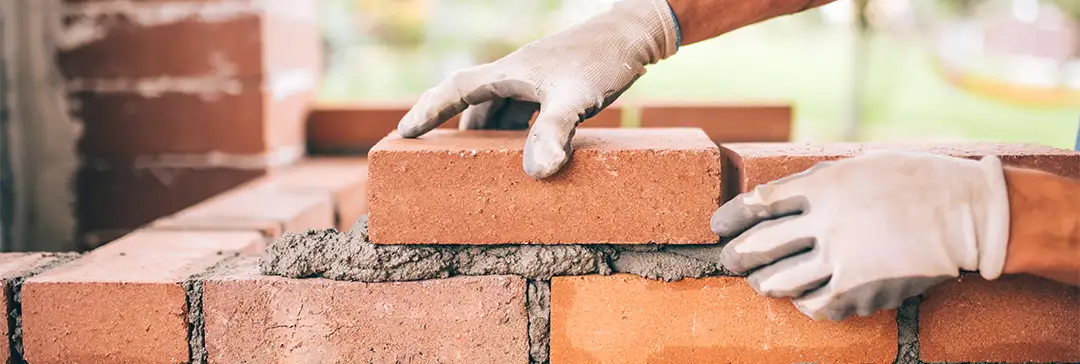
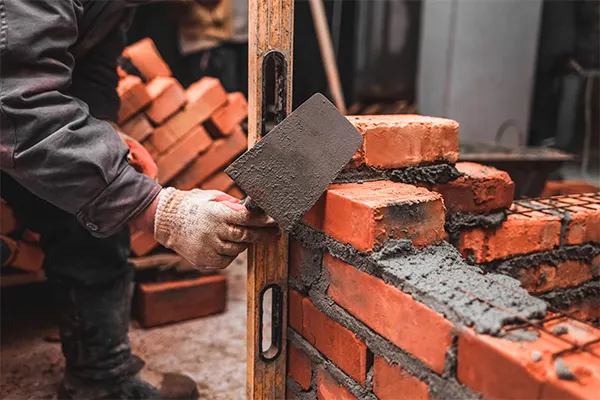
Brickwork is also called brick masonry or bricklaying process. It’s a structural method of construction where a solid structure like a wall is created by arranging the bricks in a methodical pattern and filling the joints with mortar, which can withstand the applied load. It’s an extremely durable construction form. Different types of bricks and mortar are available in the market for the brickwork. Brick masonry relies on a bond that is created when the joints between bricks are filled with the proper mortar. You have to take particular care when mixing and placing mortar because it significantly impacts the functionality and longevity of masonry structures.

Materials Required for Brickwork

You require the following materials for brickwork:

1. Bricks

Bricks are the key component of brickwork, and they come in various types, such as common burnt clay bricks, concrete bricks, sand lime bricks, and more. Standard, modular, and jumbo brick sizes are common for brickwork.

2. Cement

Cement is another important ingredient in brickwork; cement acts as a binding agent when combined with sand to make mortar. Hence, calculating brickwork cement requirement per cubic meter needs careful attention. Depending on your project’s needs, you can use different types of cement, such as Ordinary Portland Cement and Portland Pozzolana Cement.

3. Sand

Sand is essential in mortar because it makes the mixture workable and helps the bricks stick together. However, you must be careful when choosing the type and grade of sand, as it can affect the strength of the mortar and the overall quality of brick masonry.

4. Water

To make mortar, you need water to mix with sand and cement, which helps activate the cement reaction. The right ratio of cement to water is essential for strength.

Brick work mortar ratio

The brickwork mortar ratio is the proportion of cement and sand used to make mortar for bricklaying. Here are the common ratios based on the type of brickwork:

  1. Load-bearing walls (stronger walls):
    • 1:4 or 1:5 (1 part cement, 4 or 5 parts sand)
    • This ratio provides greater strength and is typically used in walls that bear structural loads.
  2. Non-load-bearing walls (partition walls):
    • 1:6 (1 part cement, 6 parts sand)
    • This ratio is used when the wall is not expected to support heavy loads.
  3. Exposed brickwork (to resist weathering):
    • 1:3 (1 part cement, 3 parts sand)
    • This is often used for walls exposed to the elements for better durability.

Each ratio ensures the mortar meets the specific strength and durability needs of the construction task.

How many bricks in 1 cubic meter

To calculate the number of bricks in 1 cubic meter, you need to consider the size of the brick and whether mortar is included in the calculation. Here’s the general method:

Standard Brick Size:

In India, the standard brick size is 190 mm x 90 mm x 90 mm (without mortar).

  1. With mortar:
    The size typically becomes 200 mm x 100 mm x 100 mm after accounting for the mortar layer.

Number of Bricks Calculation:

  • The volume of one brick with mortar:
    0.2×0.1×0.1=0.002 cubic meters
  • To find the number of bricks per cubic meter:
    1/ 0.002 = 500 bricks per cubic meter.

You will need approximately 500 bricks in 1 cubic meter, including mortar space.

Calculate Cement for 1 Cubic Meter of Brickwork
Cement for 1 Cubic

To understand the calculation of the amount of cement needed for a 1m3 brick wall, you must know the following things:

  • Red Bricks or Cement bricks are typically 190x90x90 mm in size.
  • Mortar layers are typically 10 to 12 mm thick.
  • Shrinkage factor (an additional 30% of the dry volume) = 1.3
  • The mortar-to-sand ratio (using cement: sand) is 1:6 for walls.
  • Brick dimensions after adding 10 mm mortar to each side are 200 x 100 x 100 mm, or 0.2 x 0.1 x 0.1 m.
  • Cement weight in units of 1440 kg/m³

Calculation of Cement quantity for 1 M3 Brickwork:

The volume of 1 brick without mortar is,

= 0.19×0.09×0.09 

= 0.001539 m³

The volume of 1 brick with mortar is,

= 0.2×0.1×0.1

= 0.002 m³

Total number of Bricks with mortar required for 1 m3,

= 1/0.002

= 500 Bricks.

Now, 

The Volume of Dry Mortar 

=[Total Vol. of Brick Work – Vol. of Total Bricks Without Mortar]

=1m³ – (500 x 0.001539m³)

= 0.2305 m³

Now, Total Volume of Dry Mortar

= Dry Mortar Volume x 1.3

= 0.2305 x 1.3

= 0.29965m³

≈ 0.3 m³

As mentioned above, the Mortar Ratio is 1:6 

Hence, the Total Mortar Ratio is = 1+6 = 7

Now, the Total Quantity of Cement

= (Cement Ratio/Total Ratio) x Total Dry Volume x Unit Weight of Cement

= (1/7)x0.3×1440 kg/m³

= 61.71 kg, rounding up 62 kg

Now, if you want to calculate the number of cement bags required in 1m³ brick masonry. 

Then, the Number of Cement Bags 

= Total cement required cement/ weight of cement in one bag

= 62/50

= 1.24 Bags

How much sand required for 1 cubic meter brickwork 1:6

Calculation of sand required for 1 cubic meter of brickwork 1:6

Step 1: Understand the Mix Ratio

Mix Ratio: 1:6 means 1 part cement and 6 parts sand.

Total Parts: 1 (cement) + 6 (sand) = 7 parts

Step 2: Calculate the Dry Volume of Mortar

The volume of mortar needed for brickwork is more than the wet volume, so we increased it by about 30% to account for shrinkage and wastage.

  • Dry Volume of Mortar = 1 cubic meter (the volume of brickwork) × 1.30 = 1.30 cubic meters

Step 3: Calculate the Volume of Sand

Now, we calculate how much sand is required based on the mix ratio.

  • Volume of Sand = (Dry Volume of Mortar) × (Sand’s part in the mix ratio) / (Total parts)
  • Volume of Sand = 1.30 cubic meters × 6 / 7
  • Volume of Sand = 1.114 cubic meters

Step 4: Consider Bulking of Sand

When sand is measured, bulking occurs due to moisture, and it’s usually considered by increasing the sand volume by about 25-30%.

  • Bulking Factor: Let’s use 1.3 for a 30% increase due to bulking.
  • Corrected Volume of Sand = 1.14 cubic meters × 1.3
  • Corrected Volume of Sand = 1.482 cubic meters

For 1 cubic meter of brickwork with a 1:6 mix ratio, you need approximately 1.5 cubic meters of sand (Approx).

Factors Affecting the Cement Quantity for 1 M3 Brickwork
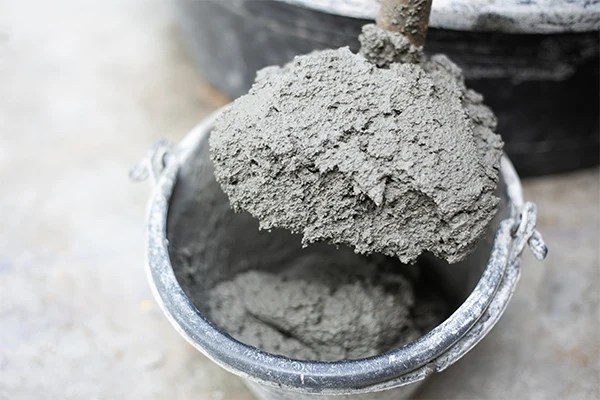
Cement Quantity for 1 M3

1. Types and Size of the Bricks

Brick masonry requires different types and sizes of bricks, which require varying amounts of mortar for proper bonding and finishing. The mortar-brick ratio also influences the cement requirement.

2. Mortar Mix Ratio

The amount of water, sand, and cement in the mortar mix significantly impacts the strength of the brickwork. A typical mix ratio is 1:6 (1 part cement to 6 parts sand). However, this can change depending on the location and requirements of your project.

3. Thickness of Mortar Joints

The thickness of mortar joints is very important to determine the overall volume of mortar used. If you choose a thinner joint, it requires less mortar, but if you choose a thicker joint, it demands more quantity of mortar.

4. Consideration of Wastage and Workability

The cement requirement also depends on the workability and wastage of mortar during construction. Because if the workability is good and wastage is low, it reduces the need for mortar.

Conclusion

In summary, brickwork is an essential component of construction. Hence, to ensure the structural integrity of brickwork, you require a basic knowledge of calculating the cement quantity for 1 m3 brickwork. Numerous factors affect the calculation process, including mortar ratios, thickness, type, and size of the bricks, etc. So, by considering these factors, you can balance strength, cost-effectiveness, and sustainability in brick masonry projects to optimize cement usage. However, it’s always recommended to consult professionals like Brick & Bolt for the exact material estimation for your dream construction project.

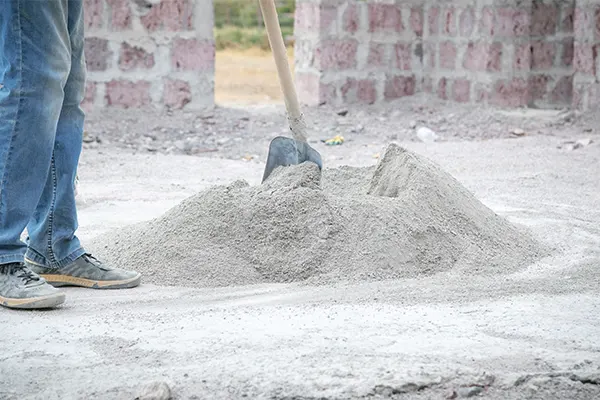
1m3 m20 Concrete Ratio: How much cement is required?

0
Brick&Bolt presents a detailed guide on concrete mix design, the required materials, and the amount of cement needed for 1 cubic meter of M20 concrete mix.

Concrete is the essential material for any construction because of its durability, strength and versatility. Concrete is used in floors, walls, roofs, and foundations for homes. Due to its special qualities, it can support large structures and transfer loads. Cement, water, and aggregates are mixed to create concrete. The ratios of concrete mixes used in various construction projects vary. So, for your basic understanding, Brick & Bolt brings all the basics about the concrete mix design, the required materials, and the amount of cement needed for a 1 cubic meter M20 concrete mix.

What is Concrete Mix Design?

The concrete mix design is the process of making concrete with the right proportioning of ingredients to achieve the required strength and durability. Since every ingredient has unique properties, creating a good, affordable concrete mix is quite challenging. An engineer or other construction expert can design the concrete mix per the specifications and needs of the proposed structure.

You can make appropriate and optimally formulated concrete using the proper mix design that can increase the properties of the structure and ensure its stability and strength. There are two types of concrete mix designs: nominal mix and design mix.

The design mix is used when building special structures or structures with higher strength requirements, on the other hand. In contrast, the nominal mix is essentially applied to the concrete preparation for normal structures. Let’s understand this terminology in detail.

1. Nominal Concrete Mix

The nominal mix concrete has a lower strength as compared to the design mix concrete. Hence, it is used for small-scale, insignificant projects. In nominal mix, the concrete, cement, sand, and aggregates ratio is fixed to achieve a specific strength. For example, for M20 grade concrete, M indicates mix design and 20 indicates the standard strength of concrete- 20 N/mm2 in nominal circumstances. The M20 Concrete Ratio is fixed at 1:1.5:3, which means 1 part of cement, 1.5 parts of sand or fine aggregate, and 3 parts of coarse aggregates. The lower-grade concrete means below M20, such as M15, M10, M5, etc., is prepared this way; higher-grade concrete means above M20, like M30, M50, M80, etc., must be prepared using a designed concrete mix method.

2. Designed Concrete Mix

The purpose of the design mix is to give concrete the necessary strength. Proportions like nominal mix concrete are not derived for the design mix. As a result, you can obtain the required characteristics in both the fresh and hardened stages of concrete. You can modify the properties of fresh concrete, such as workability and setting time, and hardened concrete, such as compressive strength and durability. To enhance the qualities of the mixture, additives such as admixtures, retarders, etc., are added in addition to the basic ingredients.

Materials Required for Concrete Mix Design?

Concrete Mix

1. Cement

Concrete gets its strength from the binding substance called cement. Portland cement is one of the common varieties and is used extensively in buildings. You can also use the different types of cement for Construction as per your project requirements.

2. Fine Aggregates or Sand

Sand or fine aggregate is used to fill in the spaces left by coarse aggregates and give workability to the concrete mix.

3. Coarse Aggregates (Gravel or Crushed Stone)

Coarse aggregates come in different sizes; they give strength to concrete and reduce the quantity of cement required.

4. Water

Water is crucial for activities like the hydration of cement and the setting and hardening of concrete. The strength and durability of the concrete are largely dependent on the water-to-cement ratio.

5. Admixtures

The admixtures are used to modify the properties of concrete in its hardened or fresh stage. Admixtures like retarders, accelerators, water reducers or plasticisers, super plasticisers, etc., are the most common types of admixtures used in the mix design.

M20 Concrete ratio: Cement Needed for 1 Cubic Meter

As mentioned above, for an M20 grade of concrete, the proportion is 1:1.5:3

Now, to calculate cement for the M20 concrete mix. Let’s assume you need a M20 grade concrete for 1 cubic meter,

So, the Wet Volume of Concrete is 1 cubic meter.

If you want to calculate the dry volume of concrete, then you need a factor of safety to prevent shrinkage, and that factor of safety is 1.54.

Hence, Dry Volume of Concrete= 1.54 x Wet Volume of Concrete

= 1.54 x 1 cubic meter

= 1.54 cubic meter

Total of ratio is 1 + 1.5 + 3 =5.5

Hence, the Volume of Cement is,

= (Cement Ratio/ Total Ratio) x Dry Volume of Concrete

= (1/5.5) x 1.54 

= 0.28 cubic meter

Now, the cement quantity for M20 concrete mix is, or you can say the No. of Cement Bags is,

= Volume of Cement x (Density of Cement/Weight of Cement per Bag)

=0.28 x (1440/50)

= 0.28 x 28.8 

= 8.064 Bags

So, round up 8 bags of cement you require for the M20 grade of concrete.

Conclusion

In conclusion, the strength and durability of concrete make it an essential building material. For a given strength and durability, the concrete mix design process requires exact ratios of cement, water, and aggregates. The essential components of a concrete mix design are cement, aggregates, water, and admixtures to achieve the desired properties. To ensure structural integrity, your contractor or engineer must have a solid understanding of concrete mix design. Hence, it’s important to be careful when calculating the amount of cement needed for a 1 cubic meter M20 concrete mix.

FAQs

What is the dry volume of M20 concrete?

To calculate the dry volume of M20 concrete, multiply the wet volume by 1.54. So, if you have 1 cubic meter of wet concrete, the dry volume would be 1.54 cubic meters. This accounts for the space occupied by air voids and other factors.

How much cement is needed for M20 concrete?

For M20 grade concrete, the mix ratio is 1:1.5:3 (cement: sand: aggregates). To make 1 cubic meter of M20 concrete, you need approximately 8 bags of cement, with each bag weighing 50 kg. This equates to about 400 kg of cement.

What is the minimum grade of concrete for M20?

M20 itself is a specific grade of concrete. It is the lowest grade of concrete for structural use. It ensures enough strength and durability. The “M” stands for mix, and “20” indicates that the concrete has a compressive strength of 20 N/mm² after 28 days of curing.

How many Bags of Cement to make 1m3 of concrete 1:2:4

0
Bags of cement

The fundamental construction element is concrete, a versatile material that shapes the built environment around us. Knowing concrete components is crucial when you are building your dream home. Cement is an essential component of the concrete mix, and getting the right amount is essential to building a sturdy and long-lasting structure. This blog explores how many bags of cement are required for one cubic meter of construction and the factors affecting the amount of cement required. But before we start to learn in detail, let’s understand what cement is and its importance. 

How Many Bags of Cement Required for One Cubic Meter 

Bags of Cement

To calculate the cement bags required for one cubic meter, you have to consider the concrete mix design ratio for your construction. The concrete mix design ratio is the ratio of water, cement, sand, and aggregate in a concrete mix. The strength, workability, and durability of your building are all directly impacted by this ratio. Hence, selecting the proper proportion for concrete mixing is essential to guarantee that your building will be strong and durable.

Calculation of how many bags of cement to make 1m3 of concrete 1:2:4

To calculate the cement requirement per cubic meter construction, you must find out the total volume of cement and the volume of 1 bag of cement. 

So, for the cement volume calculation, let’s assume your concrete design mix ratio is 1:2:4, which means that 1 part is cement, 2 parts are sand, and 4 parts are aggregates. Along with the precise ratio, also consider the loss of cement as cement’s particles are too small. Hence, there is a high chance of losing it. So, assume a 2% of cement loss.

If you assume that the output of the mix is 67%, then the required dry mix to achieve 1 cubic meter output is-

1/Total output of the mix

=1/0.67

=1.49 round figure 1.50 cubic meter dry mix.

Now, you also need to add cement wastage to it. So, wastage is 2%,

So, total dry mix + 2% wastage

=1.50+0.02

= 1.52 cubic meters.

Now, you have to calculate the total volume of cement,

= Volume of cement = Total material ×  (cement/cement+sand+aggregate) 

= 1.52 × (1/1+2+4) 

= 0.2171 cum

Now, the standard weight of 1 bag of cement is 50 kg, and the density of cement is 1440 kg/cubic meter. 

Therefore, the volume of 1 bag of cement,

= 50/1440

=0.0347 cum.

Hence, no. of cement bags required for 1 cubic meter of construction is,

= Total volume of cement/ volume of 1 bag of cement 

= 0.2171/0.0347

= 6.25 bags.

So, the number of bags of cement required per cubic meter of 1:2:4 concrete will be approximately 6.25 cement bags.

How many bags of cement to make 1m3 of concrete 1:2:3

To calculate the number of bags of cement needed to make 1m³ of concrete with a mix ratio of 1:2:3 (cement:sand:aggregate), follow these steps:

Step 1: Understand the mix ratio
The ratio 1:2:3 means that for every 1 part of cement, you need 2 parts of sand and 3 parts of aggregate (gravel or crushed stone).

Step 2: Calculate the total parts in the mix
Total parts = 1 (cement) + 2 (sand) + 3 (aggregate) = 6 parts.

Step 3: Determine the volume of cement in the mix
Cement occupies 1/6th of the total volume because it is 1 part out of 6 parts. Volume of cement = 1m³ ÷ 6 = 0.167m³ (cement).

Step 4: Convert cement volume to weight
The density of cement is approximately 1440 kg/m³.

Weight of cement = 0.167m³ × 1440 kg/m³ = 240.48 kg.

Step 5: Calculate the number of bags of cement
Cement bags typically weigh 50 kg each.

Number of bags = 240.48 kg ÷ 50 kg/bag = 4.81 bags.

You would need approximately 5 bags of cement to make 1m³ of concrete with a 1:2:3 mix ratio.

Cement required for 1 cubic meter of brickwork 1:6

To calculate the cement required for 1 cubic meter of brickwork with a mix ratio of 1:6 (cement: sand), follow these steps:

Step 1: Understand the mix ratio
The ratio 1:6 means for every 1 part of cement, there are 6 parts of sand.

Step 2: Calculate the total parts in the mix
Total parts = 1 (cement) + 6 (sand) = 7 parts.

Step 3: Calculate the volume of cement in the mix
The volume of cement is 1/7th of the total volume, as cement makes up 1 part out of 7. Volume of cement = 1m³ ÷ 7 = 0.143m³ (cement).

Step 4: Convert the volume of cement to weight
The density of cement is around 1440 kg/m³.

Weight of cement = 0.143m³ × 1440 kg/m³ = 205.92 kg.

Step 5: Calculate the number of bags of cement
Each bag of cement weighs 50 kg.

Number of bags = 205.92 kg ÷ 50 kg/bag = 4.12 bags.

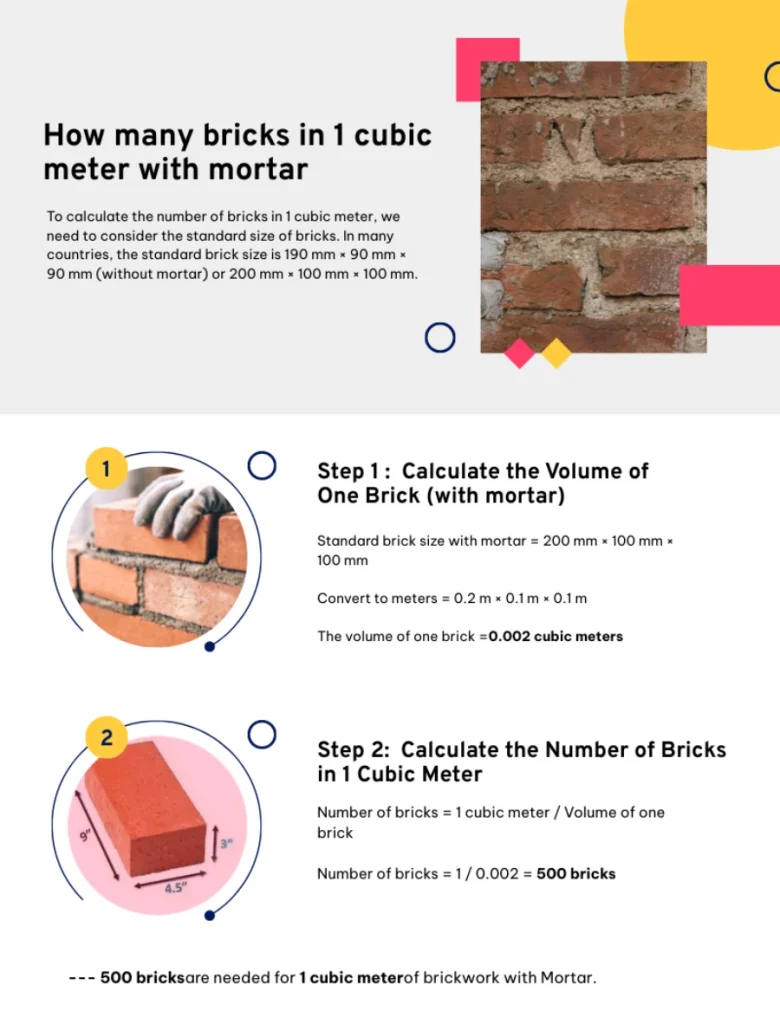
How many bricks in 1 cubic meter with mortar

How many bricks in 1 cubic meter with mortar

To calculate the number of bricks in 1 cubic meter, we need to consider the standard size of bricks. In many countries, the standard brick size is 190 mm × 90 mm × 90 mm (without mortar) or 200 mm × 100 mm × 100 mm.

Step 1: Calculate the Volume of One Brick (with mortar)

Standard brick size with mortar = 200 mm × 100 mm × 100 mm
Convert to meters = 0.2 m × 0.1 m × 0.1 m
The volume of one brick = 0.002 cubic meters

Step 2: Calculate the Number of Bricks in 1 Cubic Meter

Number of bricks = 1 cubic meter / Volume of one brick
Number of bricks = 1 / 0.002 = 500 bricks

500 bricks are needed for 1 cubic meter of brickwork with Mortar.

The calculation for cement required for 1 cubic meter of brickwork 1:4

To calculate the cement required for 1 cubic meter of brickwork with a mix ratio of 1:4 (1 part cement and 4 parts sand), we’ll follow a similar approach:

Step 1: Understand the Mix Ratio

Mix ratio: 1:4 (1 part cement, 4 parts sand)
Total parts: 1 (cement) + 4 (sand) = 5 parts

Step 2: Calculate the Dry Volume of the Mortar

The volume of dry mortar is approximately 30% more than the wet volume of mortar. So for 1 cubic meter of brickwork, the dry volume of mortar required is:

  • Dry volume of mortar: 1 cubic meter * 1.30 = 1.30 cubic meters

Step 3: Calculate the Cement Volume

The cement volume is calculated as:

Cement volume = (Dry volume×Cement part)/Total parts

Cement volume = (1.30×1)/5=0.26 cubic meters

Step 4: Consider Cement Wastage

Assume 2% wastage for cement, so the effective volume of cement needed:

Total cement volume = 0.26 cubic meters×1.02 = 0.2652 cubic meters.

Step 5: Calculate the Number of Cement Bags

The volume of one bag of cement (50 kg) is calculated as:

Volume of 1 bag of cement (in Cubic Meters) = 50 kg/1440 kg = 0.0347 cubic meters

Now, calculate the number of cement bags required:

Number of cement bags (in cubic meters) =0.2652/0.0347 = 7.64 cubic meters/bag.

So, the cement bags required for 1 cubic meter of brickwork 1:4 is 7.64 Bags.

The following factors influence the requirement for cement.

1. Concrete Mix Design Ratio: 

The requirement for cement varies depending on the concrete mix design ratio means 1:2:3 or 1:1.5:3 or 1:2:4, etc. If you want stronger concrete, it typically requires a higher cement content.

2. Water-Cement Ratio: 

The workability and strength of the concrete depend on maintaining a proper water-cement ratio. To maintain workability, you have to increase the water-cement ratio, which influences the cement requirement.

3. Aggregate Size and Type: 

The size and type of aggregates affect the interparticle space, affecting the total volume of the concrete and, ultimately, the requirements of the cement.

4. Concrete Strength: 

The amount of cement used in a concrete depends on its intended strength. You need more cement for high-strength concrete mixes than lower-strength ones.

Importance of the Material Estimation

For the best construction quality and precise budget planning, it is imperative to know how to estimate the construction cost and quantity of material, as the material cost is 60% of the total construction cost. Your build-up area indicates the amount of materials needed for construction, and the costs may differ depending on the contractors and their location. For instance, compared to the internal material supply chain of a reputed construction company like Brick&Bolt, buying cement from regional suppliers through regional contractors might be more expensive.

Conclusion

On a final note, the amount of bags of cement required for one cubic meter of concrete depends on several factors, including the mix ratio, the desired strength, and the properties of the aggregate. It is important to ensure that the final concrete meets structural specifications to achieve an effective balance between strength and cost. Always adhere to industry norms and regulations to get the best possible outcomes for your dream construction project.
Plastering Ratio 1:6 🧱: Cement and Sand for 1 sqm Plastering

0
Plastering ratio

Commencing a home-building project is similar to realising dreams. Not only are walls important, but creating a space for stories and memories is also important. Therefore, you also need an exquisitely built structure in addition to a sturdy and long-lasting one. 

It takes more than just skilled hands to create beautifully finished buildings with smooth ceilings and beautiful walls. To achieve perfection, one must possess a thorough understanding of plastering ratios. Plastering not only makes a building look more beautiful, but it also protects and preserves the surfaces. It is, therefore, an essential part of your home-building projects. 

So, let’s explore what plastering is, its importance, the required materials and the calculation of cement and sand ratio required for plastering.

What is Plastering & Its Importance?

Plastering is the process of applying layers of a paste consisting of cement, sand, lime, and water to give a smoother finish to the surfaces, including ceilings and external and internal walls. Plastering also protects them from the environmental elements in addition to offering them durability.

Materials Required for Plastering

The following materials are used to make a paste for plastering.

1. Cement

Cement is the primary component of plastering, which serves as a binding agent in the plaster mixture that holds all the other components together. It’s crucial to do proper plaster calculations of cement in plaster, as the plaster gains strength and durability from cement. The most popular types of cement used in plastering are Ordinary Portland Cement (OPC), Portland Slag Cement (PSC), Portland Pozzolana Cement (PPC), and White Cement.

2. Sand

Sand is another essential component of plastering, which gives the plaster mixture bulk and workability. You must be careful when choosing the cement-sand mix ratio for plastering, as sand lowers shrinkage and cracking, and the sand’s type and quality affect the plaster’s overall finishing. To achieve the best results, it’s important to select the Best Sand For Plastering from the various grades, such as coarse (type 3), medium, and fine, based on the type of surface you are plastering.

3. Water

In order to activate the cement and produce a workable paste, water is an essential component of the plaster mix. The chemical reactions in the plaster mix that cause it to set and harden are aided by water. Therefore, the plaster mix is made with potable, clean water. Plaster mix performance may be affected if brackish or estuarine water is used in conjunction with seawater. To achieve the ideal consistency and workability, it’s also crucial to carefully control the amount of water used to make a paste.

4. Lime

Lime improves the plaster’s durability and ease of use of the mix. It lowers the possibility of cracking and strengthens the bond between the plaster and the surface.

Cement Sand Ratio for Plastering

Cement and Sand

Cement Sand Plastering Ratio

To calculate the cement and sand requirement for plastering, you must know the area of the wall or ceiling that needs to be plastered, as well as the thickness of the plaster layer. Additionally, you must choose the cement-to-sand ratio for plastering that you wish to employ. 

Plaster of mix ratio for the wall is 1:6, meaning that you need 6 parts of sand for every 1 part of cement. The typical ceiling plastering ratio is 1:4. The plaster has a thickness of approximately 12 to 15 mm. 

So, To understand

Plastering ratio Calculation in Square Meters: A Practical Example

let’s assume you have a 100 square meter ceiling area that needs to be plastered with a 12 mm thickness. It is assumed that the cement plaster ratio is 1:4.

Now you know;

  • Surface Area = 100 sqm
  • The thickness of plaster = 12 mm, so if you convert it in meters, then 12/1000 = 0.012 m
  • The ratio of cement to sand = 1:4, so the total ratio is 1+4 = 5

Total Wet Volume of Plaster = Thickness of Plaster x Surface Area

= 0.012 x 100

= 1.2 m3

Now, to find the dry volume of plaster, you must multiply the total wet volume by a factor of 1.35 because the addition of water during the mixing process will cause the plaster mixture to lose volume. i.e., the actual amount of material required to cast 1.2 m3 of plaster that is wet.

Dry volume = wet volume x 1.35 

= 1.2 x 1.35 

= 1.62 m2

Calculation of the Required Quantity of Cement

You must apply the following formula to determine the required volume of cement:

Volume of Cement = Dry Volume  x (Ratio of Cement / Total Ratio)

= 1.62 x (1 / 5) 

= 0.324 m3

Lastly, divide the volume of cement by the volume of a cement bag to determine the quantity of cement bags required. Typically, cement bags weigh 50 kg and have a volume of 0.035 m³.

Hence, 

The Number of Cement Bags = Volume of Cement/Volume of 1 Bag    

= 0.324/0.035 

= 9.25 Bags

Thus, you would require 9.25 bags of cement, rounding up to 10 bags.

Calculation of the Required Quantity of Sand

Use the following formula to get the required volume of sand:

Volume of Sand = Dry Volume x (Ratio of Sand / Total Ratio) 

= 1.62  x (4/ 5)

= 1.296 m3

Hence, you would require 1.296 m3 sand for plastering.

How much sand and cement is required for 100 sq. foot plaster?

To make it easier to understand, let’s break down the calculation for how much cement and sand you’ll need for 100 square feet of plaster.

Step 1: Assumptions

Plaster Thickness: 12 mm (standard for interior plaster)
Mix Ratio: 1:4 (cement: sand)
Area: 100 square feet

Step 2: Calculate the Volume of the Plaster

The volume of plaster = Area × Thickness
Volume = 100 sq. ft. × 0.04 ft. (12 mm converted to feet) = 4 cubic feet.

Step 3: Calculate the Quantity of Cement and Sand

For a 1:4 mix, the total mix ratio is 1 (cement) + 4 (sand) = 5 parts.

Cement required = (1/5) × 4 cubic feet = 0.8 cubic feet
Sand required = (4/5) × 4 cubic feet = 3.2 cubic feet

Step 4: Convert to Bags of Cement

1 bag of cement = 1.25 cubic feet (approximately)
Cement required = 0.8 cubic feet / 1.25 = 0.64 ~ 1 Bag of cement (Approx)

For 100 square feet of plaster with a 1:4 ratio and 12 mm thickness:

Cement: ~ 1 bag (50 kg) (Approx)
Sand: ~ 3.2 cubic feet

What is the Plastering ratio for Single-Coat Plaster?

The plastering ratio for single-coat plaster depends on the type of surface. For most interior walls, a common mix is 1:4 (cement: sand). You can also use a 1:3 mix for a smoother finish.

  • 1:4 mix is used for normal interior walls, giving a good balance between strength and smoothness.
  • 1:3 mix is used when you want a smoother surface or need extra strength.

For outside walls or areas that get wet, a mix like 1:5 or 1:6 is better. This makes the plaster stronger and more water-resistant. Always use clean sand for a better finish.

Conclusion

In summary, consider plastering as a crucial component that will give your dream home strength, durability, and aesthetic appeal. Therefore, adhering to the detailed process for figuring out plastering quantity guarantees efficiency and minimises waste while aiming for quality work. However, ensure that the units of measurement you use are consistent, such as square meters for area and meters for length. Remember that this calculation is only for your reference to get an idea about the cement and sand calculation; local building laws and customs may vary. Therefore, it is advisable to consult a technical expert or a reputable construction company like Brick&Bolt if you are looking for accurate calculations based on your specific project requirements.

FAQs

1. What is the purpose of plastering in construction?

Plastering provides a smooth, even finish to walls and ceilings, improving the look of a building while protecting surfaces from moisture, wear, and environmental damage. It also strengthens walls and prevents cracks, giving them durability over time, making it essential for both aesthetics and long-term maintenance. elements.

2. What is the ideal plastering ratio for walls and ceilings?

For walls, the standard plastering ratio is 1 part cement to 6 parts sand (1:6), offering durability and strength. For ceilings, a 1:4 ratio is ideal, as it provides a smoother finish. These ratios ensure the plaster adheres well and maintains its quality over time.

3. How do I calculate the amount of cement and sand needed for plastering?

To calculate, multiply the area by plaster thickness to get the volume. For a 1:4 mix ratio, divide the volume by 5. One-fifth is cement, and four-fifths is sand. For example, for 100 square feet at 12 mm thickness, you’d need around 1 bag of cement and 3.2 cubic feet of sand.

4. What are the most common types of cement used in plastering?

The most commonly used cements for plastering are Ordinary Portland Cement (OPC), Portland Pozzolana Cement (PPC), and Portland Slag Cement (PSC). OPC is strong and fast-setting, PPC is eco-friendly and better for humid areas, while PSC is ideal for moisture-prone environments, like coastal regions.

Shallow Foundation and Deep Foundation

0
Deep Foundation VS Shallow Foundation

A foundation is a construction structure that helps support a building and transfers its weight to the earth. It acts as the stabilizing anchor to keep things from settling or collapsing. Additionally, several foundations depend on the soil, climate, and general structure design.

India has a vast range of soil types, from sandy ground in some areas to clayey soil in others. When determining the best foundation for them, one should consider elements like earthquake-prone locations. It’s crucial to remember that in earthquake-prone areas, a thorough seismic analysis and design of a subset of structural analysis that calculates how a building or nonbuilding structure will respond to an earthquake should be carried out by qualified structural engineers to make sure the foundation type selected satisfies the site’s unique requirements and local building codes. A well-designed and sufficiently strong foundation is required for long-lasting, secure homes in India.

Different Types of Foundations Used in Construction in India

Different Types of Foundation

In India, various types of foundations are used in construction, and the choice depends on factors such as soil conditions, building requirements, and local regulations. There are mainly two types of foundations used in India for house construction.

  1. Shallow Foundation
  2. Deep Foundation

1. What is the Shallow Foundation

A shallow foundation transfers a building’s weight to the Earth extremely close to the surface instead of deeper soil or rock layers. Low-rise buildings and smaller, more superficial structures like houses typically employ these foundations. It provides stability without requiring much excavation by distributing a building’s weight across a wider region near the surface. 

Shallow foundations are constructed where the soil can adequately support the structure without deep excavation. The soil type, seismic activity, and project needs affect their suitability. Technical assessments and structural reports are essential for determining which foundation is best for building houses in India.

Types of Shallow Foundations

There are five types of shallow foundations and they include

  1. Individual /Isolated Footings
  2. Combined Footings
  3. Raft or Mat Foundations
  4. Strip Foundations
  5. Slab-on-Grade Foundations

2. What is Deep Foundations

Deep foundations are the type of foundations that transmit the load of the structure further down the earth in comparison to shallow foundations. Typically, the depth-to-width ratio of this foundation exceeds 4 to 5. In practical terms, if the width of the foundation is W, the depth would be at least 4 to 5 times that value, creating a foundation that is deeper in the ground compared to its horizontal dimensions. Deep foundations often use this design consideration to enhance their load-bearing capacity and overall performance. These foundations are employed when shallow foundations are impractical due to inadequate soil strength or when the construction project requires support at considerable depths.

Types of Deep Foundations

Five types of deep foundations are generally used in home construction. They include:

  1. Pile Foundations
  2. Well Foundation
  3. Basement Foundation
  4. Buoyancy Raft
  5. Shaft Foundations

Difference Between Shallow and Deep Foundation

Selecting the appropriate foundation is a crucial choice that every homeowner would make, as it will impact the outcome, quality, and overall satisfaction of your project.

This comparison below aims to clarify how to decide which foundation is better. We seek to present a thorough analysis of shallow and deep foundations, a more dependable and innovative solution for your house construction.

BasisDeep FoundationShallow Foundation
DepthThe depth of a deep foundation is a critical aspect of civil engineering and construction, where the primary goal is to ensure the stability and structural integrity of buildings and infrastructure. Deep foundations are designed to transfer loads from a structure to deeper, more stable layers of soil or bedrock.When designing and constructing buildings and other structures, the depth of a shallow foundation is a crucial consideration. A shallow foundation is placed near the earth’s surface or at a short depth below where the structure will be built. Its purpose is to evenly disperse a building’s or structure’s weight onto the ground near the surface, unlike deep foundations, which bury themselves deeply into the ground or bedrock. 
TypesDeep Foundations include different types such as Caissons, Piles, Basement, Buoyancy Rafts and Shaft Foundations.Deep Foundations include different types such as Caissons, Piles, Basement, Buoyancy Rafts, and Shaft Foundations.
Suitable ConditionsPerfect for applications requiring a higher load-bearing capacity, expansive clay, or weak or compressible surface soils.Shallow foundations are ideal for projects involving hard and stable soil nearer the surface.
Construction ProcessDeep Foundations include different types such as Caissons, Piles, Basement, Buoyancy Rafts, and Shaft Foundations.Involves digging a shallow trench and laying footings made of reinforced concrete directly on the unaltered soil.
AdvantagesThe Deep foundation enhances load-bearing capacity, lowers settling risk, and works well with various soil types. Ideal for providing stability for large buildings. Shallow foundations are more affordable for lightweight constructions, accessible to assemble, and appropriate for stable soil types.
Frequently employed for modest residential constructions.

Factors Affecting the Selection of Foundation

Choosing the proper foundation depends on some decision-making factors, including soil analysis, project load requirements, cost considerations, environmental impact, structural design, regulatory approval, and expert consultation.

Soil Analysis:

To comprehend the soil profile, bearing capacity, and possible settlement, do a thorough soil testing. Having this knowledge is essential for choosing the right type of foundation.

Project Load Requirements:

Analyze the loads the structure is expected to support. A deep foundation could be more suitable for large constructions or difficult soil conditions. 

Cost Considerations:

Compare the financial effects of shallow and deep foundations, considering the price of materials, laborers and machinery requirement, the time requirement for building, and excavation.

Environmental Impact:

Evaluate how each type of foundation will affect the environment, considering excavation, site disturbance, and construction-related activities.

Structural Design:

Consider the structural design requirements of the project. The type and amount of loads and the overall design can influence the choice between deep and shallow foundations.
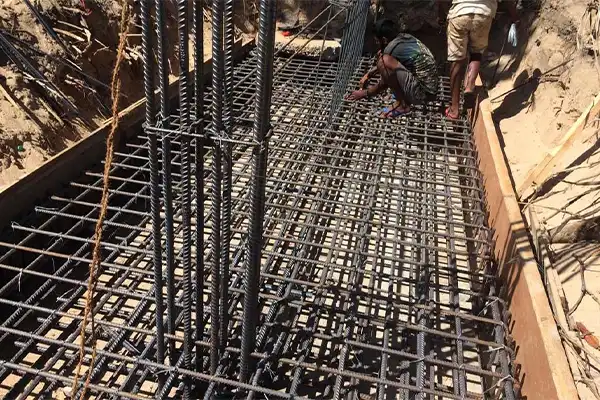
Regulatory Approval:

Check the local building codes and regulations to ensure the foundation standards are met. Specific regulations may influence the decision between shallow and deep foundations in some areas.

Expert Consultation:

Consult geotechnical engineers and foundation professionals for expert advice and recommendations tailored to your construction site’s unique circumstances.

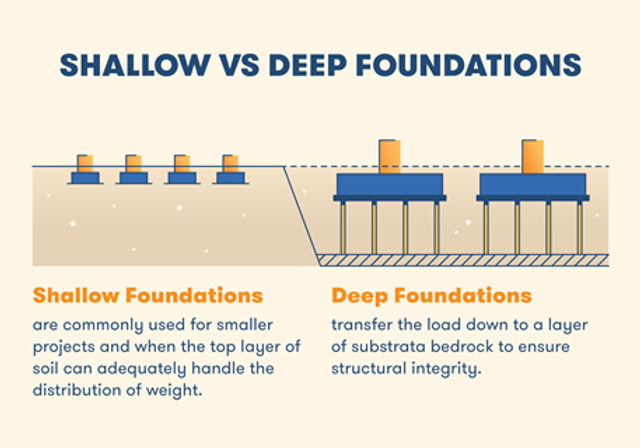
Shallow Foundation and Deep Foundation Diagram

shallow foundation and deep foundation diagram

Conclusion

the decision between deep and shallow foundations depends on many factors, such as the properties of the soil, the structure’s load requirements, the surrounding environment, and financial limitations. Shallow foundations are less expensive and easier to build; they are recommended for constructions where the soil close to the surface has the bearing capacity to support the weight. They work best in lighter and smaller buildings. On the other hand, deep foundations are required when the surface soils are weak or have other constraints preventing them from bearing the structure’s weight. They are appropriate for large, heavy constructions or locations with difficult soil conditions because they extend farther into the ground to disperse the load to more stable soil or rock layers. 

The choice of foundation type should be made after carefully examining the site’s characteristics, structural needs, and finances. Each foundation type has benefits and application areas. Whether a shallow or deep foundation supports a structure, the ultimate objective is to guarantee its lifespan, stability, and safety. Cooperation with geotechnical engineers and foundation professionals is essential to guarantee a dependable and practical foundation that satisfies the unique requirements of your building project.

Types of Foundations for Homes

0
Foundation for Homes

In a home construction, the foundation is the bedrock, supporting the entire structure. The foundation is the lowest part of the building that is in direct contact with the soil, which helps to transfer load from the structure to the ground. First, you should know about all the basic details of a solid foundation and its types to complete your home construction process without any issues. 

In this blog, Brick&Bolt  gives you detailed information about the foundation for homes, types of foundations, and the pros and cons of the different types of foundations. 

So, let’s start the journey!

What is a Foundation and Its Importance?

In construction terms, a foundation is a structure that supports the building and transfers its load to the ground. It serves as the anchor that ensures stability, preventing settlement or collapse. There are two main types of foundations: shallow and deep foundations. You can choose your suitable type based on factors such as soil conditions, climate, and the overall design of the building.

In India, the soil varies a lot, ranging from clayey soil to sandy ground. You should also consider factors such as earthquake-prone areas to decide which type of foundation will suit your location. It’s important to note that a thorough seismic analysis (a subset of structural analysis and is the calculation of the response of a building or nonbuilding structure to earthquakes and design should be conducted by qualified structural engineers to ensure the chosen foundation type meets the specific requirements of the site and local building codes in earthquake-prone areas. A well-planned and adequately strong foundation is a basic necessity in India, ensuring homes that last a long time and are safe.

Let’s dive into the different types of foundations that are commonly used for house construction in India.

Different Types of Foundations Used in Construction in India

There are mainly two types of foundations used in India for house construction.

  1. Shallow Foundation
  2. Deep Foundation

1. Shallow Foundation:

A shallow foundation is a type of foundation that transfers the loads of a building to the earth very near to the surface rather than to deeper layers of soil or rock. These foundations are usually used for small, simpler structures such as houses and low-rise structures.. It spreads the load of a building over a larger area close to the surface, providing support without the need for extensive excavation. 

Shallow foundations are constructed where the soil can adequately support the structure without deep excavation. Their suitability depends on soil type, seismic activity, and project requirements. Structural reports and technical analyses are also vital in determining India’s most appropriate foundation type for house construction.

Types of Shallow Foundations:

There are five types of shallow foundations, and they include

  • Isolated / Individual Footings
  • Combined Footings
  • Raft or Mat Foundations
  • Strip Foundations

Let’s dive deep into the types of shallow foundations:

Isolated /Individual Footings:

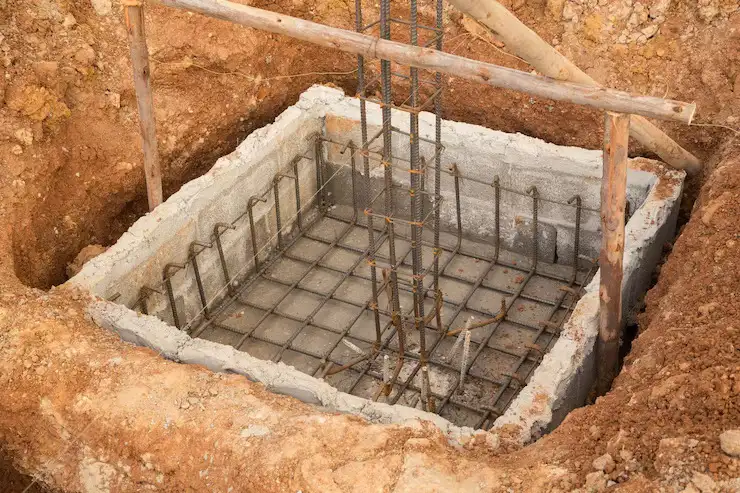
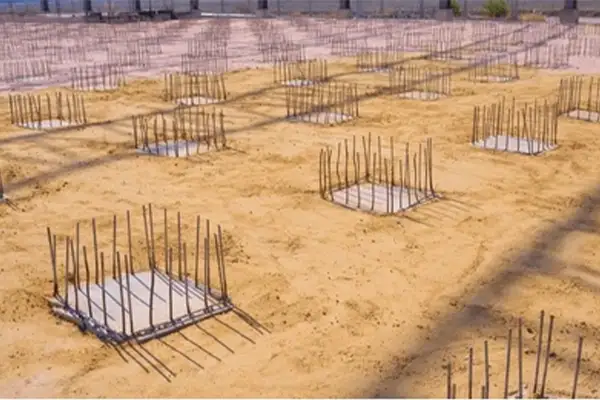
Individual Isolated footing is the most common type of shallow foundation used for building construction. It is also known as a pad foundation, and this kind of foundation is designed to hold up a single column.

Combined Footings:

A combined footing is a foundation that distributes the weight over a larger surface area, thereby supporting two or more columns or walls. When walls or columns are near to one another, and the soil has the potential to be stronger, people use it.

Raft or Mat Foundations:

A raft or mat foundation serves similar to a large, level slab of ground beneath a whole building. It distributes the weight of the construction over the ground and helps in supporting it. In order to ensure that the building remains solid and that the weight is distributed uniformly, raft foundations are a great choice.

Strip Foundations:

The structure that supports a building is made up of closely spaced rows of columns and a long, continuous strip of concrete called a strip foundation, also known as a strip footing. The entire ground is supported by the weight of the columns and walls.

Slab-on-Grade Foundations:

When concrete is poured directly into the site to form a solid slab that serves as the foundation for the structure constructed on it, this type of foundation is known as a slab-on-grade foundation. The phrase “on grade” describes how this kind of foundation can be built directly on the site’s natural grade without requiring expensive excavation work or creating a lower level or basement. It’s a common foundation choice for many types of buildings, particularly in regions where freezing occurs since the ground doesn’t freeze very far below the surface.

Advantages of Shallow Foundation in Indian Soil and Climate:

  • Cost-Effective: Shallow foundations are generally more budget-friendly than deep foundations, requiring less excavation and materials.
  • Speedy Construction: Shallow foundations can be built quickly, making them suitable for projects with tight deadlines.
  • Accessibility: These foundations are easily accessible for inspections, maintenance, and repairs due to their proximity to the surface.
  • Suitability for Light Structures: Shallow foundations are well-suited for supporting light to moderate-weight structures like residential buildings.

Disadvantages of Shallow Foundations in Indian Soil and Climate

  • Limited Load-Bearing Capacity: Shallow foundations may not be appropriate for heavy or tall structures, as the soil near the surface might not bear sufficient load.
  • Sensitivity to Soil Changes: Shallow foundations can be sensitive to soil condition changes, like swelling or settling, affecting their stability.
  • Not Ideal for Weak Soils: In weak or unstable soils, shallow foundations may need more support, leading to structural issues.

Suitability of Shallow Foundation for Indian Soil and Climate:

In India, shallow foundations, including spread footings and slab-on-grade foundations, are well-suited for various soil conditions. They can be effectively designed for cohesive soils like clay and granular soils like sand. The adaptability to diverse soil types makes them versatile for construction projects in regions with varying geological profiles.

Shallow foundations are commonly used in densely populated urban areas with limited space, and construction must often occur near existing structures. Cities like Mumbai, Chennai, and Kolkata frequently employ shallow foundations due to their practicality and efficiency in constrained spaces.

Shallow foundations are generally more cost-effective compared to deep foundations. The reduced excavation depth and simplicity of construction contribute to lower overall project costs, making them an attractive option for many construction projects.

Deep Foundations

Deep foundations are the type of foundations that transmit the load of the structure further down the earth in comparison to shallow foundations. Typically, the depth-to-width ratio of this foundation exceeds 4 to 5. In practical terms, if the width of the foundation is W, the depth would be at least 4 to 5 times that value, creating a foundation that is deeper in the ground compared to its horizontal dimensions. This design consideration often uses deep foundations to enhance their load-bearing capacity and overall performance. These foundations are employed when shallow foundations are impractical due to inadequate soil strength or when the construction project requires support at considerable depths.

Types of Deep Foundations:

There are five types of deep foundations generally used in home construction. They include

  1. Pile Foundations
  2. Well Foundations
  3. Basement Foundation
  4. Buoyancy Raft
  5. Shaft Foundations

Pile Foundations:

A pile foundation is a type of deep foundation that uses vertical columns or piles that are drilled, cast, or driven into the ground. These piles transfer a structure’s weight into the foundation or deeper, more stable soil layers.

Caisson or Well Foundations:

Large-scale structures like bridges and piers are supported by foundational parts called caisson foundations. Most of the time, they are cylindrical. In order to offer stability and support in trying circumstances, these foundations are submerged underwater during construction.

Basement Foundation:

A basement foundation supports a house or other building site that is located one or more layers below ground level. Except for basement foundations, all foundation types are largely covered. One special feature of a basement foundation is the capacity to construct a “finished” basement, which may be used as a regular room or multipurpose area beneath the main building.

Buoyancy Raft:

The buoyancy raft foundation is a type of deep foundation design that takes the theory of buoyancy effects into consideration. As a result, the resulting net weight on the ground is decreased, reducing the total and differential settlements of the foundation.

Building buoyancy rafts involves excavation to a depth where a hollow foundation structure is formed, and the weight of the removed soil is either equal to or slightly less than the combined weight of the substructure and superstructure.

Shaft Foundations:

Shaft foundations, also referred to as drilled piers, are a common and adaptable architectural element found all over the world. A drilled shaft foundation is constructed, in the most basic case, by digging a cylindrical hole, adding a reinforcement cage, and then filling the opening with concrete. Deeper than 76.0 m and shaft diameters up to 6.0 m are possible when drilling and other supporting arrangements are available at the site.

Advantages of Deep Foundations in Indian Soil and Climate:

  • High Load-Bearing Capacity: Deep foundations support substantial loads, making them ideal for large structures.
  • Enhanced Stability: It is particularly effective in weak or variable soils, providing superior stability.
  • Settlement Control: Minimises the risk of uneven settling, ensuring consistent support across the structure.
  • Versatility: They are well-adapted to various soil conditions, making them suitable for diverse environmental contexts.

Disadvantages  of Deep Foundations in Indian Soil and Climate:

  • Higher Cost: Due to increased material and labour requirements, deep foundations are more expensive than shallow foundations.
  • Complex Construction: The construction process for deep foundations can be intricate and time-consuming.
  • Dependent on Depth: The effectiveness of deep foundations relies on reaching competent soils or bedrock at a significant depth.

Suitability of Deep Foundations for House Construction in  India

Deep foundations are often used in urban areas where the soil conditions are challenging or buildings require additional support to resist heavy loads or adverse geological conditions. 

Deep foundations are excellently suited for areas with seismic activity, providing stability during earthquakes. It is also effective in coastal areas where high water tables or soil erosion might impact stability.

Conclusion

the foundation for homes in India must be designed and constructed carefully considering the local geological and climatic factors. A holistic approach that combines traditional wisdom with modern innovations can contribute to creating resilient, sustainable, and safe housing for the diverse population of India. Shallow foundations are preferable for lightweight structures on stable soils. Deep foundations are used for larger projects or in cases where the soil is not strong enough since they ensure adaptability and suitability across India’s diverse terrain. 

How Much Cement is Required for a 1000 Sq. Feet Area

0
Cement

You require a considerable amount of building materials for the construction of your dream home. However, some materials are used in all types of construction. For basic house construction, you require cement, sand, and aggregates to make concrete, cement plaster, and mortar. You need bricks for masonry work, though you can also use concrete blocks instead of bricks. Steel bars and ties are necessary for reinforcement in the RCC structure. You also need tiles and paint for the finishing work of your house construction process.

As we all know, building materials can make up as much as 60% of the overall cost of construction. So, if you are building a house, it requires an in-depth understanding of and analysis of the qualitative criteria of the materials. Hence, in this blog, we explore one of the key construction materials- cement. How much cement is required for a 1000 sq. feet area of your construction? Before jumping into details, let’s understand what cement is and its importance.

What is Cement & Its Importance?

cement

In construction, cement is a binder- a material that binds other materials together by setting, hardening, and adhering to them. Cement is one of the key components of RCC concrete and ordinary cement concrete. When it is combined with sand and gravel, it creates cement mortar, which is primarily used for plastering and brickwork or blockwork, which means brick/block wall laying. When mixed with sand, aggregate and water, it makes concrete, which is used for casting slabs, RCC structures, bridges, roads, dams, pre-cast concrete elements, etc.

There are different types of cement available in the market, such as, 

  1. Ordinary Portland Cement (OPC)
  2. Portland Pozzolana Cement (PPC)
  3. Rapid Hardening Cement
  4. Extra Rapid Hardening Cement
  5. Quick Setting Cement
  6. Low Heat Cement
  7. Sulphate Resisting Cement
  8. Portland Slag Cement (PSC)
  9. High Alumina Cement
  10. White Cement
  11. Coloured Cement
  12. Air Entraining Cement
  13. Hydrophobic Cement
  14. Masonry Cement
  15. Expansive Cement
  16. Oil Well Cement

How Much Cement is Required for a 1000 Sq. Feet Area

Cement is Required for a 1000 Sq. Feet Area

If you calculate the cost of the construction materials, cement can make up as much as 16 percent of the total cost of the materials. If you do cement volume calculation for construction, around 0.4 cement bags are required for every square foot of construction for a house. So, the result will be = 1000 * 0.4 = 400 Cement bags.

It’s rough and a basic idea about the cement requirement for construction. But remember, if you want a precise amount that how much cement required for your 1000 sq feet area, you have to consider the following things-

  • Type of your structure means complete RCC structure or normal one
  • Type of the cement you used in your construction like OPC, PPC
  • Grade of the concrete you used, such as M20 or M30
  • Height and length of your beams and columns
  • Your selected type of foundation, etc.

Once you determine all the above things, you must understand the requirement of concrete, which means how much concrete you need for your construction. To determine the total wet volume of concrete, you must calculate your footing size, column size, plinth beam size, roof wall beam size, and roof slab size. Based on the wet volume, you can calculate the dry volume of concrete and the precise cement calculation for house construction.

How much cement required for 1000 sq ft slab 5 thickness

We can follow a step-by-step approach to calculate the amount of cement required for a 1000 sq ft slab with a thickness of 5 inches. For this calculation, we’ll assume the mix ratio is 1:2:4 (1 part cement, 2 parts sand, 4 parts aggregates).

Step 1: Convert Slab Area and Thickness into Volume

First, convert the thickness from inches to feet:

Thickness in feet = 5 /12 (inches/foot) = 0.4167 feet

Now, calculate the volume of concrete required:

Volume of slab=Area×Thickness

Volume of slab=1000 sq ft×0.4167 feet=416.7 cubic feet

Convert the volume to cubic meters:

Volume in cubic meters = 416.7/35.3147 = 11.80 cubic meters.

Step 2: Calculate the Dry Volume of Concrete

To account for the voids and wastage in the mix, increase the volume by approximately 50%:

Dry volume = 11.80 cubic meters×1.54 = 18.17 cubic meters

Step 3: Calculate the Cement Volume

For a mix ratio of 1:2:4, the total parts are:

Total parts=1+2+4=7

The volume of cement required is:

Cement volume = (Dry volume×Cement part)/Total parts

Cement volume = (18.17 cubic meters×1)/7 = 2.596 cubic meters.

Step 4: Calculate the Number of Cement Bags

The volume of one bag of cement (50 kg) is:

Cement has a density of 1440 kg/cubic meter. This means that one cubic meter of cement weighs 1440 kg. When you have a specific weight of cement (e.g., 50 kg, which is the standard weight of one bag of cement), you need to calculate the volume that this weight occupies.

The volume of 1 bag of cement = 50/1440 = 0.0347 cubic meters.

Now, calculate the number of cement bags required:

Number of cement bags = 2.596/0.0347 = 74.82 bags.

So, the cement required for a 1000 sq ft slab 5 thickness is 75 bags.

Importance of the Material Estimation

It’s essential to understand how to estimate the cost and quantity of cement and other Construction Material Quantity Estimation for 1000 sq.ft, to get the best outcome and accurate budget planning. Your build-up area indicates how much materials are required for construction, and the estimates may vary from different contractors or builders and their locations. For example, purchasing cement from local vendors through local contractors may be expensive compared to the in-house material supply chain of a standard construction company like Brick&Bolt.

Conclusion

In summary, you need to use various materials to build your dream home, and cement is an essential component of them. It functions similarly to the glue that holds other construction materials together. Knowing how much cement you’ll require is crucial because it can account for a significant portion of the total cost. Hence, the appropriate quantity estimation of cement is a critical component of your budget planning. Therefore, knowing these fundamentals about cement and building supplies will help you stay within your budget and make wise decisions if you plan to build a home.

FAQs

how many cement bags required for 1000 sq ft slab

For a 1000 sq ft slab with a thickness of 4 inches, approximately 62 to 65 cement bags (50 kg each) are required, assuming a standard mix ratio of 1:2:4 (cement:sand:aggregate). The exact number may vary based on the mix design and slab thickness.

In 1 bag cement how much sq ft will Cover ?

The coverage of 1 bag of cement (50 kg) depends on the mix ratio and thickness of the application. For plastering with a 1:4 mix ratio at a thickness of 12 mm, 1 bag of cement typically covers about 40 to 45 sq ft. For concrete with a 1:2:4 mix ratio and 4-inch thickness, 1 bag of cement can cover approximately 16 to 20 sq ft. The exact coverage may vary based on factors like surface type, wastage, and workmanship. Always calculate based on specific project requirements for accurate estimates.

cement required for 300 sq ft slab ?

For a 300 sq ft slab with a standard thickness of 4 inches and a 1:2:4 mix, approximately 18 bags of cement (50 kg each) are required. This estimate may vary based on the specific mix design and slab thickness.

House Construction Step by Step Process

0
Beautifully constructed house

Building a home is like a milestone in the life of most people; it reflects an individual’s personality and lifestyle. Hence, people are very particular about the construction of their dream homes. But when it comes to the construction process, it would be extremely difficult to visualize the stages of house construction from beginning to end if you are a new homeowner. Every construction project has its own unique scope, size, budget, and delivery methods. However, the project procedure is always the same, whatever the kind of construction.

Every construction project is a tedious, demanding, and hectic process. Hence, with clear and sensible project management guidelines, you can make an informed decision at every stage of the building process, from planning to execution to completion. Having a working understanding of every stage of your construction process helps you to turn your ideas into reality.

In today’s blog, Brick & Bolt outlines the step-by-step building construction process. Here, you will find everything you need to know about the construction process, from pre-construction to post-construction, to make your construction project smooth and efficient.

Building Construction Step-by-Step Process

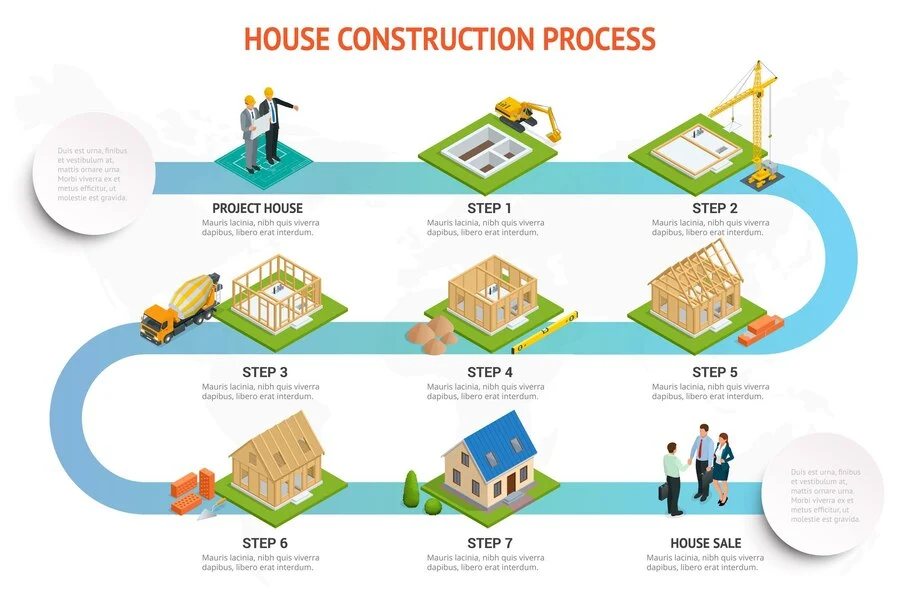
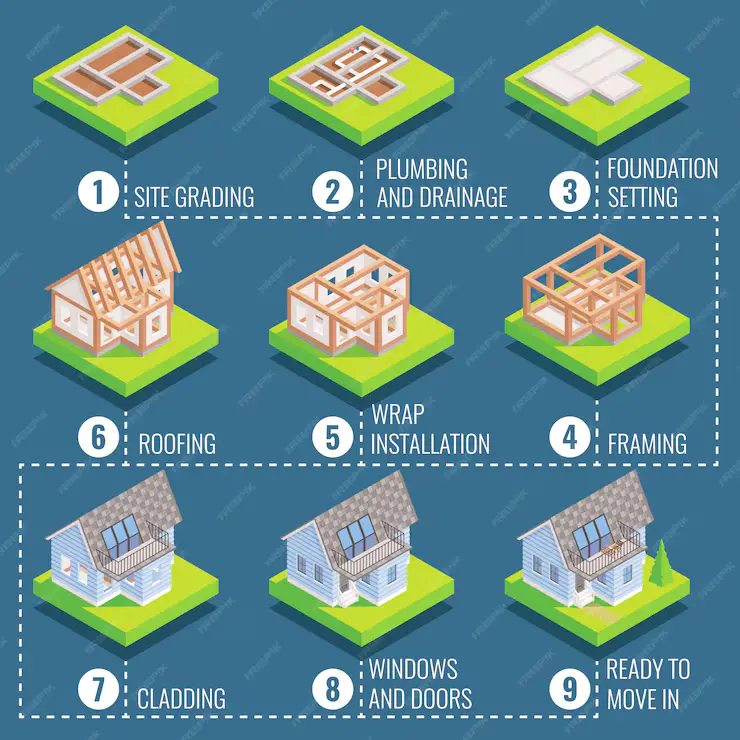
House Construction Step-by-Step Process

Every construction project has five phases: planning, initiation, execution, monitoring and controlling, and closing, which fall under three main phases: pre-construction, construction, and post-construction. The step-by-step process of building a house follows the same five house construction stages. 

  1. Pre-Construction Stage
  • Step 1: Initiation
  • Step 2: Land Survey and Soil Testing
  • Step 3: Design and Specification
  • Step 4: Approvals from Respective Authorities
  1. Construction Phase
  • Step 5: Site Preparation
  • Step 6: Laying the Foundation of the Building
  • Step 7: Laying Plinth Beam and Slab
  • Step 8: Column and Beam
  • Step 9: Masonry Work Or Brickwork
  • Step 10: Lintle and Roof
  • Step 11: Electrical Wiring and Plumbing
  • Step 12: Flooring Work
  1. Post-Construction Phase
  • Step 13: Interior and Exterior Design Work
  • Step 14: Painting Work
  • Step 15: Quality Checks

Let’s have a look at all the phases-

Pre-House Construction Phase

The pre-construction phase is your building project’s idea initiation and planning phase. The pre-construction phase consists of the following steps:

Step 1: Initiation

Initiation is the first step in the planning process, which helps the owner clearly state the objectives and vision of the undertaking. This step primarily aids in determining whether the project is feasible or not. Here, the project managers, architects, and owner have their first conversations about outlining the plan of action for the project. 

The owner shows his or her expectations to make a house a dream home, such as unit requirements like 2bhk or 3bhk, balconies, parking area, open space, carpet area, floors, etc. The owner also set the source of financing and the initial budget.

Step 2: Initial Land Survey and Soil Testing

After the initial step, once you finalize the contractor, it’s time to do the initial land survey and soil testing. This house construction step examines any possible dangers or constraints and helps to prevent delays and overspending due to some land issues. 

The following things are included in the land survey-

  • Plot and boundary measurements 
  • Entry-exit points
  • Marking off all the existing amenities like electric lines, poles, water lines, and sewerage lines.
  • Leveling requirements.

The following things are included in the soil testing-

  • Grain size analysis
  • Liquid limit, plastic limit, and plasticity index
  • The moisture content of the soil
  • Consolidation and settlement tests
  • Shear strength tests (e.g., triaxial or direct shear tests)
  • Soil-Bearing Capacity (SBC) and more.

Step 3:  Designs and Specification

After the initiation and preliminary survey and testing, the architect and their group assisted in generating ideas for the conceptual home design on paper. Even the engineers are involved in ensuring the structure’s safety. After the conceptual design, they make a detailed design with structural and architectural requirements. 

Along with the architectural design, they also make comprehensive material quality specifications. The architects create a drawing of the area that features the desired textures, colors, and materials. It will help in finding out the availability of materials needed for construction. 

Step 4: Approvals from the Respective Authorities

After deciding on your home design, some legal requirements must be considered. Before starting your construction process, you require the government’s approval and permits and must ensure you get all the necessary approvals to avoid legal issues and delays.

The following approvals and permits you need from legal authorities-

  1. Land Title Certificate
  2. Land Clearance Certificate
  3. Zonal Clearance Certificate
  4. Building Approval Certificate
  5. Completion Certificate
  6. Services and Utilities Installation Certificate
  7. Occupancy Certificate

House Construction Phases

House Construction phase Step-by-Step Process

The construction phase is the execution phase of your building project. The following steps fall under the construction phase-

house construction process phases

Step 5: Site Preparation

Site preparation is the very basic and first step of building a house or construction execution. A “site” is an area of land you have acquired to construct a house. If the land has some undesired plants, trees, and debris, then first, you need to clear that land to avoid obstructions during the construction process. At this point, you might also need to perform some earth moment and levelling if necessary. To complete the task, you can hire experts like those who operate landmowers or bulldozers.

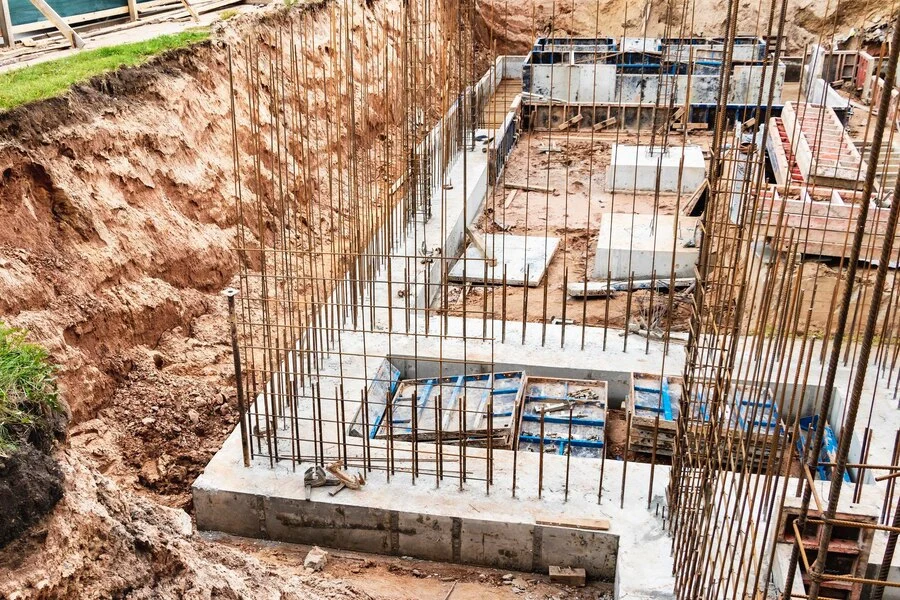
Step 6: Laying the Foundation of the Building

Laying the Foundation of the Building

The foundation is the lowest load-bearing part of any building or structure. It is laid on the earth to transfer load from the structure to the soil safely. The house will collapse if the foundation is weak because it cannot support the weight of the structure. Every building needs a strong foundation to last long without any settlement and collapse. Hence, engineers make their best effort to provide the necessary manpower and materials to lay the foundation of the building. To lay the foundation for a house, they mark the area according to the type of foundation. Then, using excavating equipment, the foundation is excavated as per the footing markings. 

Step 7: Laying Plinth Beam and Slab

The next house construction step is to reinforce the foundation by adding a plinth beam and slab on top of it after it has been laid. This is done to strengthen the foundation further and prevent it from any impacts and cracks. Additionally, it makes the foundation more resilient to earthquake damage.

Building a home on a structure that is prone to water seepage is not a good idea. Therefore, waterproofing at the plinth is also a crucial task. You can speak with professionals to lay a damp-proof course that controls moisture movement.

Now, it’s time to construct a super-structure. The portion of a building visible above ground is called the superstructure. It begins on the ground floor and goes all the way to the top. In other words, the superstructure is any structure that is above the plinth level. 

Step 8: Column and Beam

In the superstructure of a house, the construction of columns is a crucial stage. Columns are vertical supports that transfer the building’s weight from the roof and floors to the foundation. Using the architectural house design plan, column layout, and positioning are completed; this makes it easier to mark the locations of columns on the foundation. Similarly, a beam is the horizontal support that transfers the load to the columns. Beam and column construction require skilled labor.

Step 9: Masonry Work or Brickwork

Masonry Work or Brickwork

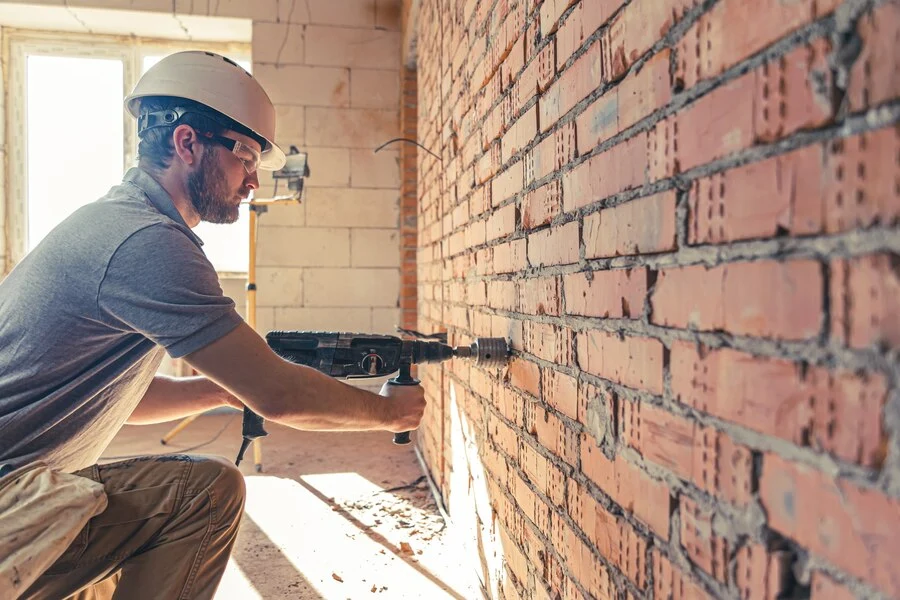
In building a new home, masonry or bricklaying is the next step. There are two options for building the walls: the first ad traditional is bricks, and the second one is concrete blocks, depending on your preference. Many people prefer concrete blockwork because it has a hollow center that makes it much lighter to work with. Sand and cement are combined in a cement mortar mixer to help hold the bricks together. When the walls are built, the openings for the doors and windows are carved out.

Step 10:  Lintel and Roof

Once the walls are completed, the lintel needs to be built on top.  Similar to a plinth, a lintel is a beam that is positioned across all windows and doors to support the weight of the structure that rests above it. After it’s finished, roofing comes next. The term “roof” describes the topmost section of a house that covers the whole thing and safeguards it from external influences.

Step 11: Electrical Wiring and Plumbing

Electricians working on an Electrical Wiring work in a newly constructed house

Nowadays, pipes and wires are concealed, meaning they are hidden in newly built homes. This is because these wires and pipes are only successfully installed during the building phase. The slabs and the walls thus conceal them. This contributes to improving the overall aesthetics and beauty of the entire house.

Step 12: Flooring Work

Flooring Work

When the wiring and plumbing are almost finished, the flooring work usually begins. There are various flooring options available in the market. As an example, you can choose epoxy flooring, wooden, clay, marble, Italian marble, granite, and ceramic or vitrified tiles. You can choose according to your taste and budget.

Post-House Construction Phase

Post-Construction Phase

The post-construction phase is the last phase of the construction and consists of finishing works and quality checks to ensure the highest quality of the structure.

Step 13: Interior and Exterior Design Work

Interior design of a newly constructed house

After the completion of the construction phase, it’s time to plaster the walls to give them an even surface. Mortar, a mixer of cement and sand, is used for plastering. Apart from even surfacing, plastering strengthens the structure as a whole and shields it from the outside environment.

You can take the help of a professional interior designer to do the interiors of your house, including the furniture and the wall decor. 

Step 14: Painting Work

Painting Work

Painting is the last step of the house construction process. In addition to providing beauty and an aesthetic appeal, it prevents the walls from the damaging rays of the sun and rain. Paints for interior and external walls come in a variety of types. You can select the perfect shade for each room in your house based on your choice and interior design.

Step 15: Quality Checks

Quality checks are the most important part of the construction process. They entail thorough inspections to ensure that everything adheres to the necessary standards and specifications. Quality checks ensure that your house construction is safe and durable. It’s an ongoing process from the beginning to the completion of the construction process, from the building materials used to the final finish. However, quality checks are even more important after construction is finished to evaluate the overall integrity and functionality of the newly constructed structure. Hence, a reputed construction company like Brick&Bolt has a patented quality assessment system- QASCON, in which they give 470+ quality checks on each floor of your building to ensure high-quality and durable construction.

Conclusion

Building a house is an intricate and fulfilling undertaking that turns an idea into a physical reality. Each step of building a home demands extreme care for detail and expertise, from the initial planning and design stages to the careful construction and finishing touches. It takes a team effort from architects, builders, engineers, and talented designers to create a safe, cozy, and comfortable environment.

Comprehensive Guide to Deep Foundations in Construction: Types, Benefits, and Challenges

0
Guide to Deep Foundations in Construction

A foundation is a structure that helps to support a building and transfers its weight to the earth. It acts as the stabilising anchor to keep things from settling or collapsing. Additionally, the foundation depends on the soil, climate, and general structure design.

India has a vast range of soil types, from sandy ground in some areas to clayey soil in others. When determining the best foundation, one should consider elements like earthquake-prone locations. It’s crucial to remember that in earthquake-prone areas, a thorough seismic analysis and design, a subset of structural analysis that calculates how a building or nonbuilding structure will respond to an earthquake, should be carried out by qualified structural engineers to make sure the foundation type selected satisfies the site’s unique requirements and local building codes. A well-designed and sufficiently sturdy foundation is required for long-lasting, secure homes in India.

Types of Foundations

In India, two types of foundations are used in construction, and the choice of the type of foundation depends on the soil type and other factors, such as building requirements and local regulations. They are

  • Shallow Foundation
  • Deep Foundation

In this blog, Brick&Bolt gives you detailed information about deep foundations, their types, advantages, and disadvantages of deep foundations.

What is a Deep Foundation?

Deep foundations are the type of foundations that transmit the load of the structure further down the earth in comparison to shallow foundations.  This foundation’s depth-to-width ratio is usually more than 4 to 5, meaning the foundation is submerged deeper than its horizontal dimensions. This design factor is frequently used by deep foundations to improve their overall performance and load-bearing capacity. These foundations are used when the project requires support at significant depths or when shallow foundations are not feasible because of insufficient soil strength.

Deep Foundation

Types of Deep Foundations

There are 5 types of deep foundations normally used in home construction. They include 

  1. Pile Foundations
  2. Caisson or Well Foundations
  3. Basement Foundation
  4. Buoyancy Raft
  5. Shaft Foundations

1. Pile Foundations:

Pile foundation are a form of deep foundation involving vertical columns or piles, either driven, drilled, or cast into the ground. These piles transfer the loads of a structure to deeper, more stable layers of soil or bedrock. Pile foundations are vital in deep foundations, adapting to different soil types and ensuring stability in varied environmental conditions. Their suitability in India relies on soil type, climate conditions, and specific construction project requirements. Professional engineering assessments are imperative for determining the most appropriate type of pile foundation for houses.

2. Caisson or Well Foundations:

Well foundations are structural elements that support massive constructions like piers and bridges. They are usually cylindrical. These foundations are immersed underwater during construction to provide stability and support in difficult situations. When building in India’s difficult terrain and climate, caisson foundations provide a solid option, particularly in regions with elevated water tables and soil erosion. The environmental problems unique to each site determine their acceptability, so expert technical evaluations are necessary for the best possible implementation.

3. Basement Foundations:

A house or other construction site situated with one or more floors below ground level is structured by a basement foundation. All types of foundations, except basement foundations, are partially hidden. The ability to build a “finished” basement, which can serve as a regular room or multipurpose space beneath the main building, is a special feature of a basement foundation.

4. Buoyancy Rafts:

A foundation design that considers the principle of buoyancy effects is the buoyancy raft foundation. Because of this, the foundation’s total and differential settlements are reduced by lowering the resulting net weight on the soil.

Buoyancy rafts are built by constructing a hollow foundation structure with a specific depth after excavating to soil where the weight of the removed soil equals or is slightly less than the combined weight of the substructure and superstructure. Compensated foundations are an alternative name for buoyancy raft bases.

5. Shaft Foundations:

Shaft foundations, also known as drilled piers, are a versatile building component that is used extensively throughout the world. In its most basic form, a drilled shaft foundation is built by boring a cylindrical hole, inserting a reinforcement cage, and then filling the borehole with concrete. When drilling and other supporting arrangements are available at the site, shaft diameters up to 6.0 m and depths exceeding 76.0 m are feasible.

Advantages of Deep Foundations

Deep foundations offer several advantages in construction, mainly when dealing with challenging soil conditions or heavy structural loads. 

Here are some of the key benefits of deep foundations:

Load Bearing Capacity: Deep foundations transfer loads from a structure to deeper, more competent soil or bedrock. This is especially helpful in weak or unstable soils when the weight of the building cannot be supported.

Stability in Weak Soils: Deep foundations provide stability and integrity of the structure by reducing weak or compressible soils to more stable layers. This is essential to avoid settlement and guarantee the long-term stability of structures.

Mitigation of Settlement: In regions with expansive or compressible soils, settling problems can be a major worry. Deep foundations assist in minimising these problems. By reaching stable soil layers or bedrock, deep foundations lower the likelihood of uneven settlement and related structural damage.

Flexibility in Design: Deep foundations offer flexibility in design, allowing engineers to tailor the foundation system to the project’s specific needs. Different types of deep foundations, such as piles or caissons, can be used based on the site’s characteristics and load requirements.

Seismic Resistance: Buildings with deep foundations, especially those extending into bedrock, are more seismically resistant. When there is deeper support, the effects of ground shaking during an earthquake can be lessened.

Resistance to Lateral Forces: Sheet piles and diaphragm walls are deep foundations that resist lateral forces. This is especially important for constructions near slopes or bodies of water, where lateral soil movement is common.

Disadvantages of Deep Foundations

While deep foundations are essential in many construction projects to provide stability and support in challenging soil conditions, they also come with disadvantages. 

Here are some of the main drawbacks associated with deep foundations:

Cost: Deep foundations tend to be more expensive than shallow ones due to the additional materials, labour, and equipment required for installation. The cost of excavation, drilling, or driving piles can significantly increase the overall project expenses.

Time-Consuming Installation: Deep foundation placement is typically a time-consuming procedure. Project timelines are impacted when piles are driven or drilled into the earth more slowly than shallow foundations.

Noise and Vibration: Significant noise and vibration can be produced during the installation of deep foundations, mainly driven piles. This might interfere with sensitive equipment, disrupt surrounding structures, and possibly result in complaints from adjacent residents.

Risk of Subsurface Unknowns: There may be occasions when it is impossible to fully know or forecast the underlying conditions beneath the construction site. Unexpected disturbances in the soil’s composition or the presence of boulders complicate the installation process and raise costs.

Maintenance Challenges: Accessing and maintaining deep foundations can be challenging. If issues arise, repairs or modifications may require specialised equipment and expertise, adding to the overall maintenance costs.

Conclusion

Deep foundations are essential to civil engineering since they offer a strong option for buildings in difficult soil conditions. Even though they provide the necessary stability and load-bearing capacity, it’s critical to recognise the drawbacks that come with them. Engineers must carefully weigh the advantages of improved structural support against the increased expense, labour-intensive installation process, possible environmental impact, and requirement for specialised maintenance.

Whether in piles, caissons, or another structure, deep foundations are selected by carefully considering site-specific factors, such as soil properties, groundwater levels, and project specifications. Despite their challenges, deep foundation systems are extremely versatile and can be used for various construction projects, including high-rise buildings, bridges, and other vital infrastructure.

Strip Footing in Construction: Types, Advantages, and Considerations

0
Strip Footing in Construction

The foundation is a strong base that supports the entire structure by distributing its weight evenly across the ground beneath it. Generally, there are two types of foundations: shallow and deep. Shallow foundations are used when the surface ground is solid.

Several kinds of shallow foundations exist, including mat foundations, isolated footings, combined footings and strip footing.

Choosing the proper foundation is similar to choosing the best support for a building; it depends on the structure’s weight, the state of the ground, and particular construction specifications. A structure’s long-term strength and stability depend critically on carefully selecting a foundation.

In shallow foundations, strip footings are often used in residential and small commercial constructions.

In this blog, Brick&Bolt  gives a detailed information about strip footing, its types, suitability,  advantages, and disadvantages of strip footing.

Now, let’s delve into the journey …

What is Strip Footing?

Strip footing, continuous footing or wall footing or strip foundation is a type of shallow foundation commonly used in construction. It is a long, continuous concrete strip that supports the load of a wall or a row of columns. The strip footing is typically reinforced with steel bars to enhance its strength.

Strip foundations are good because they spread the weight well, save money, and work well in different soils. In India, they can be a good choice if the soil, climate, and specific needs of the construction project are considered. Having professionals for design and construction, along with checking the ground, is important for successful strip foundations in India.

When is strip footing used?

Strip footing is commonly used for load-bearing walls and when the soil has a high bearing capacity. It is recommended for low- to medium-rise residential buildings. In this instance, the load is distributed from the walls to the ground by a concrete strip that runs underneath the whole length of the wall. This increases the stability of the building. The footing should, therefore, be at least twice as wide as the wall. A row of columns spaced closely together can occasionally be supported by strip foundations. In this instance, continuous footings would be less expensive than spread footings that overlap.

If the soil’s bearing capacity is low, broader strip foundations might be required. In these situations, plain concrete might not be enough, it requires a reinforced concrete strip foundation. The state of the soil determines the precise width of the load-bearing wall and footing. The structural engineer ought to be qualified to provide advice based on the results of the soil tests conducted on your plot. 

Strip footing

Types of Strip Footing

There are two varieties of strip foundations based on their qualities, and they are as follows:

  • Deep Strip Footing
  • Wide Strip Footing


In this blog,
Brick&Bolt  gives a detailed information about strip footing, its types, suitability,  advantages, and disadvantages of strip footing.

Now, let’s delve into the journey …

Deep Strip Footing

A deep strip footing is the most common type of strip footing, and it works best on soil that is well stabilised. Strips of reinforced concrete support the walls. Although the depth of the groove is subjective, it should be at least 24 inches broad and 40 inches deep. There should be at least nine inches of concrete.

Wide Strip Footing

Wide strip footings are found when the soils have a low bearing capability. A regular strip footing cannot be installed on poor-quality soil. It is not economically justified to overridden or deepen a structure in order to avoid tearing down barriers. Reinforced concrete can be a good option for the foundation. For the whole structure to sustain stress and compression, reinforcing bars give foundations tensile strength.

Suitability of Strip Footing

Strip footings are chosen based on particular project requirements and construction scenarios. 

Several factors impact the suitability of strip footings, including

  • Load Distribution: Wall footings are an excellent choice when a wall or row of columns must be supported evenly over a large soil area. This guarantees that the weight is sufficiently supported without putting unnecessary strain on any area.
  • Continuous Support: As continuous, extended structures, strip footings provide continuous support along the length of a load-bearing wall. This constant support is beneficial for maintaining stability and preventing differential settlement.
  • Construction Simplicity: Strip footings are economical and practical for many projects because of their simple design and construction. Their ease of use makes them ideal for simple applications on building sites.
  • Adaptability to Soil Conditions: The design of strip footings can accommodate different soil conditions. Based on the bearing capacity and properties of the underlying soil, engineers can modify the strip footing’s dimensions and reinforcement.
  • Closely Spaced Columns: Strip footings are a practical solution when columns are closely spaced apart, and separate footings for each column would cause overlap or interference. In such cases, they provide a cost-effective and space-efficient solution.
  • Suitability for Expansive Clay Soils: Because of their T-shaped cross-section, inverted or trough strip footings work well in expansive clay soils. In such soil conditions, this design aids in mitigating the effects of swelling and shrinking.
  • Architectural Freedom: The versatility of strip footings permits architects to be creative with their layout designs and accommodate closely spaced columns without sacrificing the stability of the foundation.

Advantages of Strip Footing

The following are the main benefits of using strip footings:

Load Distribution:

Strip footings ensure stability by uniformly distributing a structure’s weight over a larger area, preventing isolated soil settlement.

Cost-Effectiveness: 

Strip footings can be a more economical option than individual footings for every column, particularly when columns are closely spaced.

Versatility: 

Strip footings are adaptable to various soil types and load-bearing specifications, making them appropriate for multiple construction projects.

Ease of Construction: 

Strip footing construction is frequently simple, which improves building process efficiency. Time and money can be saved as a result of this simplicity.

Space Utilisation: 

The continuous strip footings maximise available space and make it possible to arrange load-bearing walls and columns effectively.

Structural Stability: 

Strip footing’s long, continuous design improves structural stability by offering dependable support along the load-bearing elements.

Flexibility in Design: 

Engineers can choose from different types of strip footings, such as deep or wide, based on the project’s unique requirements.

Reduced Risk of Overlapping: 

In closely spaced columns, strip footings help avoid overlapping issues that may arise if individual footings are used.

Disadvantages of Strip Footing

The following are some key disadvantages of strip footings:

Limited Load-Bearing Capacity:

Strip footings may have limitations regarding the maximum load they can support. Other foundations might not be more appropriate for large structures or heavy weights.

Challenges in Alterations:

Renovations and changes to the building layout can be challenging because modifying or altering the structure supported by strip footings can be more complicated.

Not Ideal for Tall Structures:

In the case of tall or high-rise structures, the relatively small size of strip footings might not provide adequate support against potential settlement or tilting.

Site-Specific Challenges:

Site-specific challenges, including environmental factors and potential changes in soil conditions over time, can influence the suitability of strip footings.

In conclusion, strip footings provide durability,  stability and even load distribution for various structures, making them an essential and commonly used foundation solution in the construction industry. Due to their versatility, they are appropriate for various building types.

To ensure a sturdy foundation, strip footing design considers variables like soil bearing capacity, load distribution, and structural requirements.

Strip footings are a helpful solution, but it’s important to be aware of potential drawbacks like challenges in alteration and site-specific conditions. Strip footings are successfully implemented when these factors are carefully considered and engineering best practices are followed.