Home Blog Page 120

GHMC Building Plan Approval Procedure In Hyderabad

0

Hyderabad is a rapidly growing metropolitan city with a multitude of administrative bodies that assist in the development and planning of the city. If you are planning to invest their funds in plots or planning to construct a house on the acquired land in Hyderabad then it becomes extremely important to know that under which jurisdiction your land or plot falls. The land or plot jurisdiction in Hyderabad can fall either under the Directorate of Town and Country Planning (DTCP) or Hyderabad Metropolitan Development Authority (HMDA) or Greater Hyderabad Municipal Corporation (GHMC). 

However, the Greater Hyderabad Municipal Corporation (GHMC) is usually considered the regulatory body that takes care of all the building approvals in Hyderabad. It serves as the regional authority that controls all the construction projects that take place in the city in its jurisdiction. Therefore, everyone who wishes to start any construction be it commercial or residential in Hyderabad will be required to abide by the GHMC authorization rules. 

GHMC building plan approval checklist

Source

GHMC is essentially regarded as a civic organization that administers all the construction-related activities in Hyderabad, Telangana. The Indian Parliament has granted the absolute rights to this local authority to watch all the construction activities in the city and further holds the power to approve and reject ant construction if it feels that all the set guidelines are not followed properly. 

Hence, to make you aware of how the GMHC works, mentioned below are some of the most essential checklist points that the authorities in Greater Hyderabad Municipal Corporation (GHMC) take into consideration for approval of your building plan.

  • Type and nature of the building

The type and nature of the building is the initial thing that GHMC (Greater Hyderabad Municipal Corporation) checks at the time of providing a building plan approval. Under the type of building criteria, the GHMC looks at the point that whether the building for which you are seeking approval is an apartment or an independent house. 

On the other hand, under the nature of the building criteria, the GHMC takes into consideration whether the building for which you wish to take approval is commercial or residential. For instance, if you wish to take the approval for a commercial building then you must ensure that you follow all the set guidelines for a residential property else the GHMC will not approve your submitted plan. 

  • Proposed layout

Another thing that the GHMC checks before providing building approval is the proposed layout. A proposed layout is basically a blueprint that you present to the Greater Hyderabad Municipal Corporation informing them about your construction design. 

Once you submit the proposed layout, the GHMC checks it against the set criteria and further ensures that it meets all the stipulations laid down by the building permission rules in Hyderabad. If the proposed layout that you submitted is according to the laid guidelines then you will be granted approval else the authorities can ask you to make the required modifications in the plan. 

  • Infrastructure development 

Right after checking the proposed layout, the next thing that the GHMC takes into consideration while providing a building plan approval is the infrastructure development. Under this point, the authority requests you to submit what kind of infrastructure development you wish to opt for. If the infrastructure development plan that you submitted is coherent with the set municipal guidelines, then the plan is approved. 

  • Fees collection

Once all the above-mentioned points are thoroughly checked by the GHMC, the authorities then calculate the fees that are usually imposed according to your building plan. Once the calculation is done, the Greater Hyderabad Municipal Corporation can collect fees such as development charges, regularization charges, admission fees, scrutiny fees, building license fees, demolition fees, and other costs before granting the plan approval. 

The procedure to apply for GHMC building approval

In the earlier times, getting a building plan approval in Hyderabad was challenging and time-consuming. This was why the Greater Hyderabad Municipal Corporation decided to ease up the entire process to apply for the building approval. Mentioned below is a detailed procedure for how you can apply for the GHMC building approval. 

  • The initial step under this procedure is to fill up an application form for the building or the floor plan approval and present all documents demanded with the required processing charges. 
  • Once the ACP (Assistant City Planner), who is the concerned officer receives the submitted application form for review. Under the review, the ACP visits the actual building site to click site images and reports his findings to the upper authorities. 
  • The submitted application is then examined at distinct levels and passes through different levels of officers such as the Additional Commissioner and Commissioner along with the Building Committee. 
  • After moving through all these levels, the Building Committee evaluates the proposals and either rejects, approves, or recommends a review of plans. 
  • Once the Building Committee approves your submitted plan, you will be required to pay the GHMC building permit charges.

Documents required to obtain GHMC building plan approval for constructions above 10mts height 

If you are planning for a building construction above a height of 10mts then you will be required to submit the documents listed below:

  • Properly endorsed building application by the Builder, Owner, Structural Engineer or Architect. 
  • Auto CAD designs of your building to be submitted in a PreDCR format, the comprises the location or site plan, rainwater harvesting pits, Terrace and Mortgage Plan duly signed by the Builder, Owner, Architect, Surveyor or Structural Engineer along with accurate representations of every floor, building elevations, parking floors and many more. 
  • A license fee or building permit of Rs.10,000/- should be paid as a primary fee. 
  • Disclosure forms duly signed by the landlord and verified by the Gazetted Officer. 
  • License copy of Structural Engineer, builder, or Architect attested by Gazetted Officer.  
  • Up-to-date encumbrance certificate issued by the department of registration. In case you hold an existing structure on the site that was sanctioned earlier, then you will be required to submit a copy of the same. 
  • Up to date receipt of the GHMC property tax
  • No objection certificate and approved plans from the Fire Department, for constructions of 10 meters and above.  
  • Report of the soil test 
  • No objection certificate from AAI (Airport Authority of India) 
  • Structural durability certificate attested by an accredited structural engineer. 
  • Mutual undertaking to be furnished by builders, owners, and licensed technical personnel.  

Documents required to obtain GHMC building plan approval for constructions below 10mts height 

If you are planning for a building construction below a height of 10mts then you will be obligated to submit the documents enumerated below:

  • Lawfully endorsed building application form by the architect, owner, or engineer. 
  • Auto CAD designs of your plan to be submitted in a PreDCR format, the comprises the location or site plan, rainwater harvesting pits, Terrace and Mortgage Plan duly signed by the Builder, Owner, Architect, Surveyor or Structural Engineer along with accurate representations of every floor, building elevations, parking floors and many more. 
  • Disclosure forms duly signed by the landlord and verified by the Gazetted Officer.
  • No objection certificate and approved plans from the Fire Department, for constructions below 10 meters. 
  • Structural durability certificate attested by an accredited engineer. 

Procedure for submitting an application form online for GHMC Building Permission for plan approval

If you wish to submit an online application form for GHMC Building Permission for building plan approval then you can easily take the assistance of the steps mentioned below. 

  • To begin with, you will be required to visit the official GHMC website (www.ghmc.gov.in) and click on an option that states “DPMS – Submission of Building Applications Online.”
  • Once clicking on that option, you will be required to login into DPMS (Development Permission Management System) using your login credential. If you are a new user, you can easily register yourself by entering your email address and password. 
  • Once logging in, you will be required to click the “New Application” alternative in the Applications Tab.  
  • When the “New Application” tab opens, there are distinct data tabs on the top of the webpage that you will be required to fill. 
  • Under this general information tab, you will have to fill in all the information concerning the proposal (proposed plan or floor plan) along with site details. You must note that all the fields that are highlighted with an asterisk (*) are compulsory to fill. 
  • Now you need to move to the applicant information tab. Under this tab, you will be required to fill in all information regarding the engineer or architect or Survey along with the information, Applicants, Structural Engineer and Developer Information. This data shall further be backed with necessary documents as considered important and stipulated in the application form. 
  • In the next step, you can move to the application checklist section to review the information entered and the records submitted to complete the fundamental section of the application. You can then tap on the “Save” option to create a temporary building plan file number that you can utilize for all your future references during the process of building approval application submission. 
  • This temporary file number generated will continue to remain valid till the final payment is done after which you will be given a permanent file number. 
  • After saving the above-mentioned details, you can now click open and enter all the information required in the “Land Details”, “Plot Details” along with the “Building Details” tabs separately. You can then easily save each tab separately before proceeding to the subsequent tab so that the entered data is not lost. 
  • Once you are done with entering all the details, choose the Geo Location Tab and pick the map coordinates of the plot that are displayed on Google Map. 
  • The longitude and latitude coordinates are entered automatically. Hence, you will only be required to insert the plot dimensions according to the coordinates and save the tab. 
  • Now insert the Auto Cad design of the plans in Pre DCR format to submit the building plan proposal. 
  • Once all the above processes are finished, you can click on the payment tab and pay the processing charges of the application form through Online Integrated Payment Gateways.
  • Once you are successfully done with the payment, you will be presented with a permanent file number. You will also be informed of this file number via an SMS on the registered mobile number. 
  • The applicant can monitor the status of their application by logging into the DPMS system and monitoring the “Submitted Applications” folder.
  • The status of the approval or rejection will also be conveyed to you over an SMS. 
  • Once the plan approval is done by the GHMC, then, in that case, you will be sent a copy of the sanction plan and building permission order over an email that you can use to download or view purposes. 

GHMC timelines to issue building permissions in Hyderabad

The Greater Hyderabad Municipal Corporation (GHMC) is always obligated to follow stringent and appropriate timelines for the approval of the building and floor plan in Hyderabad. The process of approval should always be concluded within 21 days from the date of obtaining an online application for the plan approval. 

However, you must note that if the Greater Hyderabad Municipal Corporation requires to reach out to other agencies for obtaining a No-Objection Certificate (NOC), the timeline can be increased. 

The bottom line 

With the assistance of the points mentioned above, you can easily make an application to the GHMC for the approval of your residential or commercial building plan. However, to make your plan easily approved, you must always ensure to take the assistance of a reliable construction company that holds the best architects and designers.

 If you are looking for a reliable house construction company in Hyderabad then look no further than Brick&Bolt. Brick&Bolt is a prominent house construction company that can take charge of all your construction stipulations along with ensuring that your building plan gets approved in one go. 

FAQs

ghmc building permission fee calculator

The Greater Hyderabad Municipal Corporation (GHMC) does not provide a specific online calculator for building permission fees. However, you can estimate the fees based on the type and size of your construction project. For instance, processing charges for building applications are typically ₹5 per square meter of the proposed built-up area. GHMC Additional fees may include development charges, scrutiny fees, and other applicable costs. For precise calculations, it’s advisable to consult the GHMC’s official guidelines or contact their office directly.

How to Design Your Kitchen With Smart and Small Remodel Ideas

0

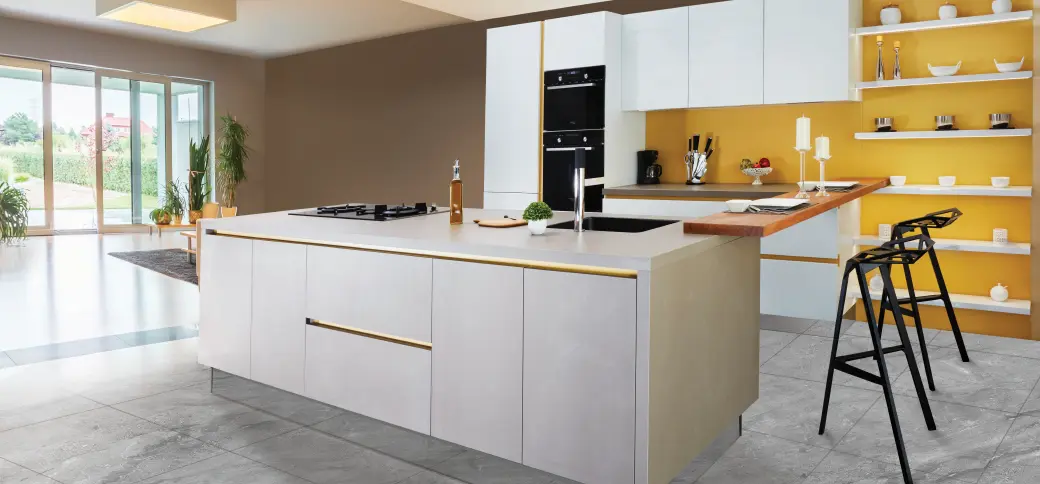
A kitchen is the heart of the house. Delicious smells of food wafting in the air are an everyday occurrence in every household. But don’t you think the kitchen doesn’t get its due respect when we try to renovate the house? It’s always ignored. Every family tends to shell out the least for their renovations. This makes it gloomier and more claustrophobic for the cook. But the look of the kitchen can be changed by incorporating small and smart ideas. All this without putting a dent in the pocket. So hop on, because we are brimming with ideas. 

Throw In Some Light 

The most basic tip to making a small space look a bit bigger is to add sunlight. Yes, the one thing that comes at ZERO cost. There are simple tricks that can help you. For example, you can adjust your dining table to the window, where you can get maximum sunlight. Also, the dining table is a farm table that will make your kitchen look like a dream. Adding to the charm would be natural blue lights from the window, which will make the table look stunning.

You can also adjust your countertop near the window.

With the ample amount of light pouring in, the kitchen space would look bigger and larger. Also, with natural light blending with the correct shade of paint on the walls, it will make your space look ethereal and homely. Add some flowery pots to the window or on top of the refrigerator (where sunlight reaches), which will help in eradicating the presence of carbon dioxide. If you aren’t too big a fan of sunlight, you can always use sconces over the countertop or sink area. Or you can use some statement lighting over the dining table, giving it a retro feel. 

Play With Colors 

No one likes a boring colour in the room. You can mix it up with splashes of colours like blush pink and aqua lacquered countertop. This gives it a larger feel. The same can be said about the colour white. It is always said the whiter, the brighter. At the same point, add the colour of your serving ware to the nooks and handles. There you go, you have got your customised kitchen. 

If you are given a fresh coat of paint, you can also paint ceilings. With the correct light fixtures, the paint on the ceiling will glow, giving the kitchen a chic look. When painting, choose a colour that will complement both your dining room and your living room (if you have an open kitchen plan). The idea is that the kitchen should not have a pink colour while the living room area is coloured green. Both the colours should blend in with each other. 

Utilize Every Available Space.

One thing is always guaranteed: as homeowners, we don’t use every nook and cranny of space. Don’t believe me? Just look at the space around your refrigerator. I am sure movable cabinets can fit in right there. Now, what to put in that movable cabinet? For starters, you can throw in your daily essential groceries. Also, there is a lot more space in your kitchen. You don’t believe me again, do you? The space below the sink can be used for keeping kitchen supplies. You can cover it up with a makeshift curtain. I am sure there is one more space that you are avoiding using as a countertop. Did you find any? Well, let me in on the secret space. The sink!!! Yes, by just putting a hardwood plate on top of it (when not in use), you can use the sink area as a countertop as well. 

You can also remove upper cabinets and make use of shelves. An open shelf makes it so much easier to access dishes and glasses. Whenever you are renovating your kitchen, plan to renovate it architecturally. This will give you ample space to design and play in.

Breakfast Bar- A Life Savior 

If you have a studio apartment or your kitchen doesn’t have any doors, it opens up into the living room. There is a very smart thing that can be done. You can build a dining space that can be doubled up as a countertop. This can be lined up with one of the walls of the kitchen. When not using it for cooking, you can just use it for enjoying breakfast. 

If you have less space at your disposal, then you can customise the breakfast bar as a door. It can be built in the pathway of the exit and can work as a breakfast bar and a door. A tall table can also do wonders for your kitchen. It can be level with the kitchen island and can be added to as a countertop and can be used as a dining table as well.

Add Showpieces 

Who says the showpieces are for the living room or the paintings for the master bedroom? To add character to your kitchen, you can hang the showpiece on the wall. It would only make your kitchen look more personal. You can also go all out by adding wallpapers. A metallic sheen wallpaper gives the room a more contemporary look. Also, if you don’t want it running throughout the entire space, you can always use it on one wall. It gives the feeling of an accent and makes the kitchen look chic. The idea behind this is not to cover the entire kitchen area with one painting or mural, but to concentrate on one wall. This can also be incorporated by adding a clock on one of the spare walls, which can give a star effect to your kitchen. The murals can be inserted on the floors. With intricate patterns, it will give the illusion of a larger area. 

Showcase Your Appliances

If you have got it, flaunt it. Everyone has that vivid collection of appliances in dramatic colours. The food processor will be black, the hand blender will be parrot green, and the ice cream maker will be hot red. With so many vivid colours at hand, it should grace the countertop when not in use. Also, you can show off the cutlery that you are collecting from around the world. Place it on the single stand atop the sink. In that way, it can be easily accessible and put on exhibition for all to see. 

Hang Pots 

There are innumerable pots in the pantry, and adding to the healthy mix are coffee mugs, different types of spatulas, and woks. Where to keep all this? Simple, on your head. Not literally. Just raise a handlebar above the countertop and extract it whenever you are in need. Copper pipe shelving or a brass rod looks super chic and gives an ultramodern look to the kitchen. The gold fixture on the rod, inspired by the retro ship, makes the space cosier and complements the space. It will also make extra space for all the appliances. 

Monochrome never goes out of fashion. Black and white never go out of fashion. If you are confused with the designs on the walls or what should be the colour of the floor, Or maybe the architect has just given you too many options. Always go with monochrome; it will not fail you. With criss-cross designs of white and black on the floor and with white cabinet colours, the kitchen will look super chic. But if you want to add a bit of elegance to it, you can always use the design details of the ship. Also, you can go with glass doors on the cabinet and on the main door. It will give it a more vintage Italian feel, as well as make your space seem larger.

Keep the countertop clean.  

No one wants a clumsy kitchen top with bits of appliances here and there. In addition, numerous oil bottles are also strewn in one corner. Overall, it doesn’t look good and it quashed all the hard work done by you in designing this area. To solve this problem, you can always park these appliances in the garage. Yes, they can have their own garage with a door that opens like a garage. It will be helpful in two ways (we have discussed the first one). You can use the appliances in the garage section itself with the help of built-in sockets. Therefore, you don’t have to carry it to multiple places and it can be used at your convenience.

Accessories make everyone’s day

You are dreaming of that mug, which you have seen in the new IKEA store. It is multicoloured with earthy colours at the bottom. It is just the mug in which you would like to have coffee on a rainy day. Then what are you waiting for? Add it to your treasure. Or if you want to be budget-friendly, you can always go to the nearest street shopping market and add it to your treasure. It will be great to see so many textures and hues on the rod strewn on top of the countertop. 

Multifunctional Cabinets

Cabinets are used for storage purposes. But can cabinets be used for anything else other than storage? Yes, like a countertop, but only when it can be movable and adjustable. With so many options on the market and a lot of DIY videos, you can easily construct a cabinet. It will be movable and can be added to a kitchen island. Therefore, it makes your work easier and reduces storage problems. It can also double up as a wine cabinet if constructed to serve the purpose. In this way, you are getting your very own movable wine bar. 

The organisation is The Key

Messy plates are overloaded in the sink. Used pots are still on stoves. Napkins are, I don’t know where they are? This is a regular scene at one of the brunches or family dinners at night. But it should not be the case. It takes little effort to be organized. The pots can be thrown in the sink when the cooking is done. Family members can put the plates directly into the dishwasher. One person can take charge of loading the dishwasher with utensils and running it. Simultaneously, the garbage on the countertop can be cleaned up and deposited in the bags. The responsibility can always be rotated. But with little effort, the kitchen would look purely sanitised and clean. 

Carpets: A feeling of warmth 

You are from hilly areas where cold weather is just the norm. You can add the Iranian rugs to the floor. You can add a runner in galley kitchens and with matte tile to contrast. It will give you an uber-chic look. as well as separating and designing the partition of your kitchen area from the dining area (if you have only one wall and a dining bar to separate the two areas). You can always add a jute rug, which will blend in with the old coffee spill on the floor. Basically, it will take every splash and still look new. 

Retro never goes out of style.

Do you remember the 80s TV series? Where were the kitchens so detailed that there was an extra cabinet for the fridge also? This is a retro look for you. It never goes out of style. Decorators do get that odd request once in a while to design the kitchen with black and white silhouette colours. The patterns should resemble a chessboard. The dining table has ornate, intricate designs and is predominantly white, with golden fixtures on the side of the table. That looks super cool and adds drama to the house. 

There are at least 100 ways to go wrong with the decorations. But with a lot of inspiration, you can hit the bull’s eye. Keep in mind the above tips and we are sure you can navigate your way. Don’t forget, it is the kitchen that will give nutritious food to your family. It is also a space for you to experiment ON and IN.

Hacks to Keep Your House Cool During Summer – Tips & Tricks

0

Summer has arrived, and the days of scorching weather are rapidly approaching. With this heat and temperature, keeping your house cool on a hot day this summer would be a real challenge. Although fans, coolers, and air conditioners can all help, dealing with the summer requires a little more caution. And if you’re wondering how to cope with the summer’s hotter days, look no further.

In the summer, homes get even hotter, more like an oven, making it unbearable to sit inside. The majority of the houses we stay in are constructed of concrete. In the summer, concrete retains a significant amount of heat. Even if you turn on your fan, it won’t help much because of the heat and hot air circulation inside the building.

Few Useful Ways to Keep Your House Cool During Summer

1.     Window Planters for Home

Window planters can help to cool and humidify the hot air in your home. They will purify and refresh your home by detoxing it. Apart from being aesthetically appealing, plants like aloe vera, areca palm trees, Ficus trees, and ferns will help keep indoors cooler by purifying the air and having a high transpiration rate, which will help keep the temperature down.

To stop extra daylight from getting into your house, you can hold some plant life in flower pots, in the grill outdoor your windows, plenty of inexperienced money plant, Tulsi, Croton (one of the most colorful evergreen shrub that we grow indoor). Water the flowers typically both morning and evening.

2.     Ventilation at Home

Ventilation can be moved by strategically opening windows. The best times to take advantage of the breeze are from 5 a.m. to 8 a.m. and 8 p.m. to 10 p.m. The air is pleasantly cool in these situations, and by opening windows, a natural breeze can be produced, keeping the indoors cool. Since the temperature drops in the summer, keep the windows open, particularly at night, to allow the air to circulate

3.     Choose Mild Colours for Home

Summer is the first-class time to opt for a seasonal upgrade that can be final throughout the year. Consider mild colors for your partitions that mirror warmness and light (say sky blue, pastel yellow, aqua, beige) These will keep the indoors cool and even give your home a fresh, new look. Plus, mild colorations make interiors appear brighter.

4.     Choose Breathable Curtains

Unwanted heat usually enters the residence through windows and investing in shades, curtains can assist decrease indoor temperature vastly. Close your blinds from late morning to early night-time and make investments in breathable curtains like cotton, sheers, jute displays, or bamboo shades. Dark synthetic drapes are not advisable in summer. Instead, choose white or pastel hues that are made of mild and ethereal material.

5.     Have a Dehumidifier

The indispensable function of a dehumidifier is to not cool the room by means of producing cool air like an air conditioner however to draw out the moisture from the air. This can keep the domestic notably at ease with the aid of reducing the temperature. Dehumidifiers also dispose of environmental risks (dust, grime, pet dander) from any room and defend valuables that can be damaged by moisture.

6.     Avoid Black Curtains and Black Pipes

To keep your house, cool during summer avoid black curtains and limit black pipes. On your roof keep some coconut tree branches and leaves and pour water on it because these don’t allow water to evaporate easily. Keep the doors and home windows open of your house. This will keep your house cool during summer.

7.     Follow an Old school Method

If possible, you can pour water on the terrace on the region of your pinnacle roof in the evening, so that it remains cool in the course of the night.

8.     Install a Programmable Thermostat

Introducing a programmable indoor regulator can help keep your home cool. In case you’re out of the home the entire day, your indoor regulator can be modified to decrease the temperature a couple of degrees before you get back home.

More Hacks That Can Be Incorporated to Keep House Cool During Summer

Summer might seem unliveable without air conditioners today, but people used a variety of hacks to keep their homes naturally cool in the pre-air conditioner period.

  1. For natural shade, plant trees in the front yard or backyard.
  2. If you’re building a new home, make sure it has thick walls and high ceilings to keep it cool.
  3. If you’re building a new home, Luke Coutinho recommends marble or wood flooring to keep it cool. He advises that carpets be removed. Mats made of straw (chatters) or cloth can be used in their place.
  4. Place a bowl of ice in front of a table fan to create a cooling effect.
  5. To keep your home airy and light, declutter your room, use minimal furniture, and get rid of unnecessary items.
  6. In the afternoons or at night, hang wet mats or sheets on windows/doors to let cool air in.
  7. At home, use LEDs or white lights instead of vivid, yellow lights.
  8. To let air in, use light-colored cotton curtains, bamboo shades, or jute screens instead of thick curtains.
  9. Infuse lemongrass, other essential oils, or cucumber juice into water to make your own sprays and mists.
  10. While fans, air conditioners, and coolers are useful, nothing beats new, natural air. Simple tricks like timing the opening and closing of windows and placing water pots in front of windows will make a big difference.

If you’re tired of coping with the oppressive sun, try some of the tips listed above to keep your home cool on a hot day.

Few Ways to Help Reduce or Contain Heat from Within and Keep House Cool During Summer

1.     Lights that are incandescent should be turned off

Just 5% of the energy used in a standard incandescent bulb is converted to light. The remaining 95% is converted to heat! Switch to energy-saving LED bulbs, which emit 90 percent less heat and use 75 percent less energy. While they are initially more costly, they are generally less expensive in the long run than incandescent bulbs because they use less energy and last so much longer.

2.     Cook in the microwave, on the grill, or in a pressure cooker

The microwave produces virtually no heat and uses much less energy than a stove or oven. With its low energy consumption, the pressure cooker produces less interior heat. Of course, the barbeque holds the heat outside.

3.     Electronics should not be placed near your air conditioning thermostat

Because of the heat generated by these appliances, the air conditioner would have to run longer.

4.     Reduce Humidity Sources

When you lower the humidity in your house, fewer condensation forms on your air conditioner coils, saving you money and reducing this secret source of heat. To minimize humidity, do the following:

  1. Use exhaust fans in the kitchen and bathroom
  2. Cover pots while cooking
  3. If you have a crawl space, cover some bare dirt with a plastic ground-moisture barrier

5.     Using a Window Fan to Ventilate

A window fan may be used to replace hot indoor air. Place the fan on the downwind side, with the fan blades pointing outwards. Open a window in each room and make sure all interior doors are open to improving airflow.

6.     Switch off the gas supply to the fireplace and heaters

The pilot light creates a lot of heat and should be turned off during the summer. In most units, re-lighting the pilot light in the fall is as simple as pressing a button. During the hotter months of the year, fireplace dampers should also be closed to prevent the loss of cool air from inside the house.

7.     In the summer, turn off the hot water circulation pump.

Consider turning off your hot water circulating pump for instant hot water at all faucets during the summer. Since most households lack insulated water pipes and you pay to heat the water as well as remove heat from your home with your air conditioning, the minor inconvenience is well worth it in terms of energy savings.

Ways to Keep Your Room Cool During Summer

Here are a few tips to help you beat the heat and keep your home cooler

  1. Use Cotton Sheets on the Bed
  2. Use Ceiling Fans
  3. Try Out A bamboo mat
  4. Create a Cross Breeze
  5. Add Some Permanent Shade
  6. Use Energy Efficient Bulbs
  7. Use Your Exhaust Fans
  8. Invest in a Bedside Fan
  9. Invest in a Bedside Fan and
  10. Keep the Blinds Closed

With some easy ways enjoy your summer at home and create great memories that you’ll look back fondly for the years to come.

Single Floor House Design: Ideate, Plan, and Elevate

0

What is a Single Floor House Design and the Magic of Elevation?

Step into your dream home, encompassed within a single floor

Have you been dreaming of a home that is easy to navigate, low maintenance yet oozes charm and style? Let us introduce you to the world of single floor house design. Imagine stepping into a home where every room unfolds on a single level. That is what a single floor house design is all about.

Often referred to as one-floor house design, it allows all living spaces to exist cohesively on one plane. But that is not all. Have you noticed how every home has a distint character that stands out when you first lay eyes on it? That is the magic of elevation design! An integral part of the architectural design, elevation offers a front-on view of the house, revealing the exterior facade. A perfect blend of a simple single-floor house design with an enchanting floor plan can create a beautiful and practical home.

Brick&Bolt specializes in bringing your dreams to life. As India’s No. 1 technology-based construction company, we focus on creating single floor house designs that embody your unique tastes and lifestyle. They ensure that it is not just visually appealing but functionally outstanding too.

Features of Single Floor House Design

Watch as a kitchen co-exists as a dining area

Now that you have a grasp of what single floor house designs entail, it is time to delve deeper. This type of design comes with a host of features that make it a practical and appealing choice for many homeowners. Let us explore these in detail to understand why single floor homes are increasingly becoming a preferred choice.

  • Space Saver: Single floor house designs offer a clever utilization of area. With an open floor plan and fewer walls, it creates an illusion of more space.
  • Easy to Maintain: With no stairs to clean and fewer rooms, a single floor house design is relatively easier and less time-consuming to manage.
  • Cost-Effective: House construction for a single house design tends to be more budget-friendly, as it requires fewer materials and less labor compared to multi-story houses.
  • Easy Accessibility: Single-floor houses offer greater ease of movement, making them an ideal choice for families with children, the elderly, or individuals with mobility restrictions.
  • Flexible Design: The simplicity of single floor house design provides flexibility for customization, making it easier to adapt to an evolving lifestyle or family needs.

Single Floor House Designs to Consider for the Modern Charm

Equipped with large windows that bring forth sunlight, 

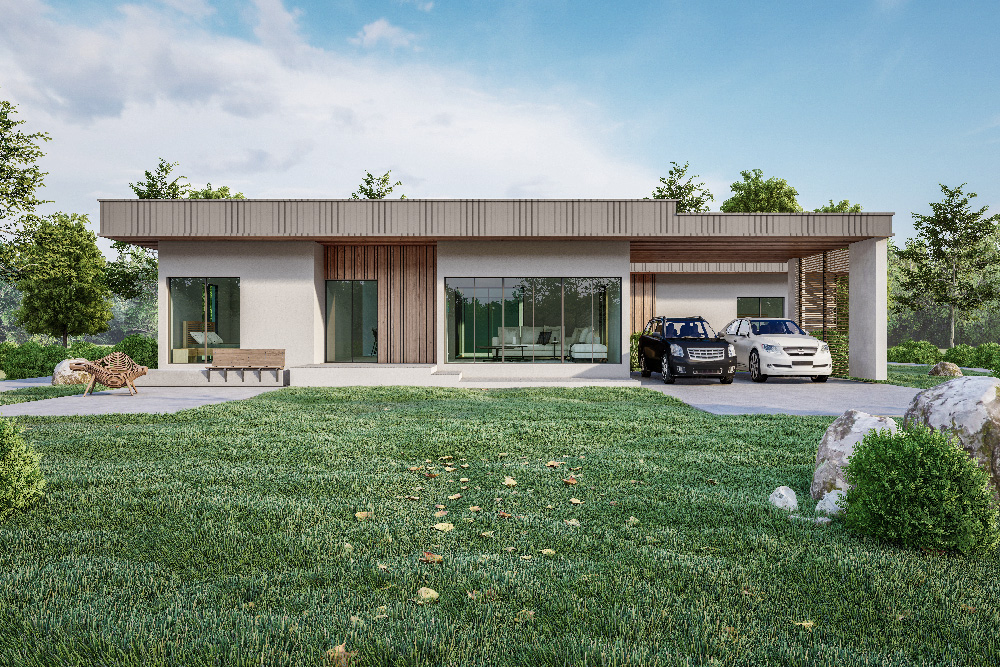
a modern house exudes a minimalistic aesthetic

With the basics of single floor house designing covered, it is time for the fun part – exploring the various design options at your disposal. There is a wide spectrum of options to consider, each with its unique allure. Whether you are inclined towards a modern house design or a charming bungalow vibe, Brick&Bolt is your partner in curating a design that embodies your dream home. Remember, our passion is to design homes that reflect your personality and lifestyle. So let us look at some exciting designs that could be the blueprint of your future home.

  • Modern Single Floor House Design: The modern single-floor house design embraces minimalism, sleek lines, and large windows for natural light, resulting in a sophisticated aesthetic.
  • Contemporary Single Floor House Design: Contemporary designs merge current trends with traditional elements, creating a harmonious blend of old and new.
  • One-Storey Built Bungalow Design: A one-storey bungalow design often includes a wide porch, low-slung roof, and open floor plan, radiating charm in bedroom with beautiful false ceiling and homely warmth.
  • Simplistic Single-Floor Design: A simplistic single floor house design focuses on functionality over frills, perfect for those seeking an efficient, practical layout.

Factors to Consider for Choosing a Single Floor House Design

How do you choose a single floor house design that caters to your needs?

Choosing the perfect single floor house design is not just about aesthetics. Several other factors come into play to ensure your home meets your lifestyle needs and preferences. Our team of experts at Brick&Bolt guide you through these considerations, helping you make informed decisions. We commit to making the house construction process as seamless and personalized as possible. Now, let us uncover the key elements you should consider for creating your ideal single floor home design. Take these factors into account to ensure your home meets all your needs.

  • Size and Layout of Plot: The size and shape of your plot can significantly influence the design of your single-story home. Finalizing the layout and size will allow you to determine how you want the walls and rooms to look. It will also show you how the appliances and furnishings fit accurately into your single floor house design.
  • Number of Bedrooms: Consider your family’s needs in terms of personal space when deciding the number of bedrooms.
  • Number of Bathrooms: Factor in the number of family members, guests you frequently have, and personal preference while deciding the number of bathrooms.
  • Budget: Remember, the complexity and size of your house design can directly influence the cost of construction.
  • Lifestyle: Your floor plan should cater to your lifestyle, be it minimalistic, luxurious, or family-oriented. With Brick&Bolt, build your perfect single floor house design where superior creativity meets modern living.

Create Efficient Floor Plans with Brick&Bolt

A design that reflects you, from the outside and within

A well-conceived single floor house design can offer a myriad of benefits ranging from easy maintenance to cost-effectiveness. Whether you prefer a modern, contemporary, or simplistic style, it is crucial to have a design that reflects your personality and caters to your lifestyle needs. At Brick&Bolt, we pride ourselves on bringing your dream home to life. With our seasoned architects and builders, we are dedicated to delivering bespoke single floor home designs that are not only aesthetically pleasing but also functional. We understand that a home is more than just a structure; it is a space where memories are made. So, let us help you build a space that is truly yours. Get in touch with us today and embark on a journey to create your ideal single floor house design.

Vastu for Home: Invite Prosperity and Wellness into Your Spaces

0

Do you wish to invest in a home that can bring you success and wealth? If so, a Vastu-compliant home would be the ideal solution. Vastu is an ancient architecture and design system developed in India that focuses on creating a balanced living environment. It bases its principles on the arrangement and alignment of elements within a space that can influence the energy flow. Thus, Vastu for home and other spaces impacts its occupants’ well-being and prosperity.

What are the Basic Principles of Vastu Shastra For Home?

Brick&Bolt is dedicated to helping you build a home perfectly in sync with your sensibilities, design needs, and real estate trends. A market case study has indicated that about 90% of homeowners gravitate towards building a Vastu-compliant home. Fortunately, we are here to guide you on your home construction journey. But before we dive deep into how you can enhance your home’s energy, let us first understand what we mean by a Vastu-compliant home.

What is a Vastu-Compliant Home?

A vastu-compliant home leads to wealth and happiness


A home should be designed and constructed to optimize the flow of positive energy, or prana. A Vastu compliant home promotes the well-being, happiness, and prosperity of the occupants. It is believed to be in accordance with the following principles: 

  • The shape and orientation of your home
  • The placement of rooms
  • The direction of the main entrance
  • The positioning of furniture
  • The use of colors and materials 

Each of the principles of Vastu for homes listed above gravely impacts how spaces draw energy. Allow us to elaborate further in the sections below.

Basic Vastu for Houses and Other Recommendations

  • Room Shape: The principles of Vastu for home indicate that certain room shapes are more favorable for the betterment of the occupants than others. Whether it is a 1 BHK house plan with Vastu concerns or any other space, a square or rectangular shape draws in positive energy, believed to promote stability and balance. 
  • Orientation of the Bedroom: Whether it is a single-floor house design or a multi-story building, each room holds great significance in the principles of Vastu for homes. For example, the bedroom should be located in the South-West portion of the house for stability and a sense of security. The bed should be placed against a solid wall and positioned to allow a clear view of the entrance while lying down. 

Best Vastu Tips for a Happy Home

Our construction company allows you to connect with a team of experienced individuals who ensure the happiness and prosperity of your spaces with an immaculate understanding of Vastu. Here are a few techniques to help your home comply with the best practices.

Vastu Tips for Main Entrance

The main entrance of a home facing towards the north

  • Placement: The home entrance should face in an auspicious direction, such as east, north, or northeast, to allow positive energy to enter. A South-facing entrance is not recommended. And make sure that the dimensions of pooja room abide by vastu guidelines.
  • Positioning of Furniture: The entrance area should be clean, well-lit, and free of clutter. Avoid placing any heavy furniture that can obstruct the entrance, as it may hinder the flow of energy. You can decorate the entrance with auspicious symbols or images to attract positivity.
  • Use of Colors and Materials: Soothing colors such as light shades of green, blue, or yellow are recommended. As per the principles of Vastu for homes, avoid dark hues as they are known to absorb negative energy. Use sturdy and good-quality materials for the door, such as solid wood. Ensure that the door opens smoothly in a clockwise direction and does not creak.

Vastu Tips for Living Room

A living room bathed in sunlight

  • Placement: As per the principles of Vastu for homes, the living room should be located in the northeast, north, or east direction of the house. This allows for the entry of auspicious energy and sunlight.
  • Positioning of Furniture: Position the furniture in the living room to promote conversation and interaction. The seating arrangement should be such that it allows for easy movement and a clear view of the main entrance.
  • Use of Colors and Materials: Choose light and soothing colors for the living room, such as pastel shades of white, beige, or light green, as they are inviting. Avoid using dark or bold colors that can make the room feel heavy or overwhelming. Use natural materials for furniture and decor, such as wood, cotton, or silk. 

Vastu Tips for Kitchen

Love grows in the kitchen as the scents of spices wafts in, against a background of cream and brown

  • Placement: The kitchen should be located in the South-east corner of the house. Avoid placing the kitchen in the North-East or South-West corners, as it can lead to imbalances in energy.
  • Positioning of Furniture: As per the principles of Vastu for homes, the stove should be placed in the South-East corner of the kitchen. Place the refrigerator in the southwest or northwest corner. Keep the kitchen well-organized and free from clutter.
  • Use of Colors and Materials: As per the principles of Kitchen colour as per the vastu – Use bright and cheerful colors in the kitchen, such as yellow, orange, or green, as they promote a positive and energetic atmosphere. Opt for good-quality materials for kitchen cabinets and countertops. 

Vastu Tips for Bedroom

Soft and soothing colours enable one to sleep peacefully undeterred by nightmares

  • Placement: The bedroom should be located in the southwest corner of the house. Avoid building the bedroom in the northeast corner, as it is considered inauspicious. 
  • Positioning of Furniture: Place the bed in the southwest corner of the room, with the headboard against the wall. Avoid placing the bed under a beam or a window, which can disrupt the flow of light. Principles of Vastu for home also recommend positioning the furniture in a way that allows for easy movement and a sense of spaciousness. Another critical thing to note is that there should not be any reflective surfaces visible when lying on the bed.
  • Use of Colors and Materials: As per the principles of Vastu for homes, choose soft and soothing colors, such as pastels. Avoid using dark or vibrant hues. Use comfortable and natural materials for bedding and furniture. 

Vastu for Pooja Room

A well-lit brown diya is focused upon with pink wax melting as the candle flames burn

  • Placement: As per the principles of Vastu for homes, the room should face the North-East direction for spiritual and positive vibrations. Avoid placing it in the bedroom or kitchen, as it can create imbalances.
  • Positioning of Furniture: Place the idols of deities in the northeast corner of the room. Avoid placing them on the floor. Keep the pooja room clean, well-lit, and free from clutter. Ensure that it is peaceful for praying and meditating.
  • Use of Colors and Materials: Use soft and light colors for the pooja room, such as white, light yellow, or light blue. Use natural and pure materials for the altar, such as wood or marble. Decorate the room with flowers and incense to create a sacred atmosphere.

Vastu Tips for Balcony

A woman stands on the balcony facing towards the east and drinks a cup of chai

  • Placement: According to the principles of Vastu for homes, having a balcony in the east direction is considered auspicious. This location allows for the morning sunlight to enter, which brings positive energy into the home.
  • Positioning of Furniture: As per the principles of Vastu for home, arrange the furniture in the balcony to allow for a comfortable seating area while taking advantage of the natural views. Position chairs or seating towards the East or North. 
  • Use of Colors and Materials: Choose light and calming colors for the balcony, such as shades of green, blue, or white. These create a refreshing and peaceful ambience. Use natural materials for furniture and decor, such as wood or rattan. Consider decorating the balcony with plants and flowers to enhance the positive vibes.

Make the Most of Vastu Tips for House with Brick&Bolt

Are you looking for a construction partner who can ensure that each home they construct is Vaastu compliant? Then you’re at the right place! Here at Brick&Bolt, we have a dedicated design team, efficient at creating Vastu floor plans that meet all parameters perfectly. With 390+ quality checks and over 2700 successful design implementations, your dream project is in safe hands.

The image features a floor plan designed by the architects at Brick&Bolt for a home that is Vastu compliant.

Brick&Bolt’s Vastu Compliant Floor Plan for the Ground Floor

FAQs

1. How does Vastu benefit a home?

The principles of Vastu for homes are associated with harmonizing the energy of a space to channel prosperity and good health. Therefore, a home that is Vastu compliant with the entry door in its proper position and bedrooms and other spaces with the right furniture placement can truly benefit its occupants.

2. Is Vastu applicable only to newly constructed homes?

No. The principles of Vastu for homes do not only apply to newly constructed homes. Factors such as the placement of objects and use of color theory can also be used effectively to invite positivity and prosperity. 

3. Is a south-facing home good according to Vastu?

A South-facing home is considered less favorable compared to other orientations. However, it is important to note that the interpretation and application of Vastu principles can vary, and there are differing viewpoints on the matter. Consider taking an expert’s advice for guidance.