Home Blog Page 82

Best Paint for Home: Top Picks for the Perfect Makeover

0
Paint For Home

Giving your home a fresh coat of paint can revitalize its look and feel. However, various options are available, so choosing the right paint can be stressful. 

This blog provides a clear guide about the best paints for the interior and exterior of your home to simplify your decision-making process.

Top 7 Best Types of Paints for Interior walls of a home 

Paints for Interior walls

Some of the best paints for the interior walls of a home are as follows

Distemper paints

It is a budget-friendly paint that comes with trade-offs. Distemper paints are water-based and also give a matte finish. They are easy to apply and a good economic choice. These paints are mostly ideal for ceilings and less trafficked areas. Distemper paints can give your look a classic look.

Emulsion Paints 

This is a supreme paint used for the interiors of your home, as they are water-based, contain low levels of volatile organic compounds, and are easy to clean up. 

They come in a wide range of finishes, such as satin, matte, or even eggshells, that help you achieve the desired look for all rooms. They are commonly known for their washability and durability. They have a quick dry time and are perfect for living rooms and bedrooms.

Lustre Paints

Lustre paints give a rich, shimmy look and add elegance to any room. They sit between a flat and eggshell finish. They are good for hallways, children’s rooms, and living areas. They are highly durable and very easy to clean. 

Enamel Paints

Enamel paints are mainly oil-based and provide a hard and glossy finish. They are moisture-resistant and durable. They can be used for woodwork, trim, and areas that need tough, long-lasting paint. Synthetic enamel paints also available in the market which is made up of synthetic resins and solvents

Bathrooms and kitchens benefited greatly from their gloss finish, excellent removal of stains, and fighting properties of mildew.

Textured Paints

If you are interested in adding visual interest and hiding imperfections, textured paintings are a creative solution. They can add depth and dimensions to your walls, but they can also be challenging to clean.

Top 10 Best Paint Brands for Exterior walls of home 

It is very important to choose the correct exterior paint for your home. This helps keep your walls safe from other elements and increases appeal. Some of the options are given below, and they highlight the strengths and weaknesses of empowering your decision.

Paint Brands for Exterior walls of home 

Berger Walmasta Antifungal Exterior Wall Paint

Pros

They have excellent fungal and algal resistance with good breathability and affordability.

Cons

They may not have a long lifespan compared to premium paints.

Apex Ultima Weather Proof Exterior Paint

Pros

They have superior weather resistance and crack-bridging properties and are available in a large variety of colors.

Cons

They are more costly.

Berger Weathercoat Anti Dust Paint

Pros

They are dust-resistant and very easy to clean. They have good color retention.

Cons

They may not be a proper choice for extreme weather conditions.

Paint Emulsion Nerolac

Pros

They are budget-friendly and resistant to mildew. They are very easy to apply.

Cons

There may be a higher risk of potential fading.

Dr. FixIt Raincoat

Pros

They have excellent waterproof properties and are mostly used for high moisture areas. They also have crack-filling capacities.

Cons

They may have a slightly strong odor compared to other paints.

Ace by Asian Paints

Pros

It is an eco-friendly type of paint that has good stain resistance and is affordable.

Cons

They may not be durable like premium paints.

Asian Paints Apex Weatherproof Paint

Pros

It has a long-lasting effect and vibrant color with weather-resistant formulas in them.

Cons

Compared to other options, they can be more expensive. 

Dulux WeatherShield Max 

Pros

Dulux WeatherShield Max is an advanced UV protection paint with self-cleaning properties. They are resistant to mold and mildew.

Cons

They may need a longer time for drying than some other paints. 

Indigo Exterior Emulsion Paint 

Pros

They are very affordable and have good color selection. They have UV protection properties in them.

Cons

They are not as durable as other premium paints in terms of weather.

Nippon Exterior Paint

Pros

Nippon Exterior Paints are extremely resistant to cracks, have good color retention, and are easy to apply.

Cons

The availability may be limited in certain regions.

Conclusion

It is important to remember that factors like color selection, gloss, durability, and any special needs that need to be addressed are essential when selecting paint for your home.

FAQs

1. When should I use enamel paint?

Enamel paints can be used for bathrooms, kitchens, trim, and areas that need durable, easy-to-clean areas.

2. Are textured paints difficult to maintain?

Yes, textured paints hide imperfections but can be trickier to clean due to their rough surface.

3. Is Berger Walmasta Antifungal Exterior Paint a good choice?

Yes, it is affordable, breathable, and resistant to fungus and algae. However, it may not be as long-lasting as premium paints.

4. What factors should I consider besides brand and color?

Surface type, durability, VOC content, and finish.

5. How can I dispose of leftover paint responsibly?

Never pour paint down the drain; check with your local municipality for proper disposal guidelines.


Can Foreigners Buy Property In India?

0
Can Foreigners Buy Property In India

Foreign nationals looking to buy property in India have to abide by certain obligations and regulations. While buying a property directly is not possible for foreigners, there are, luckily, certain exceptions. 

This blog helps you discover the rules, exceptions, don’ts, and processes for buying property in India as a foreigner. A key note to remember is to stay updated with government regulations and seek legal help. If you are not able to buy a property, then make an investment and reach your goal.

Can foreigners buy property in India? What will be the process?

As a foreigner buying property in India, it may be a roller coaster ride. However, there are few ways in which foreigners can buy property in India.

In general, foreigners on tourist visas and foreigners living outside India cannot buy property in India. But there are a few exclusions.

Resident Foreigners

If you are a foreigner who is on a long-term visa and has spent around 180 days residing in India annually, then you are eligible to buy a property in the country. 

Officials can purchase property in India. For other foreigners, there is one restriction. They can purchase the property from an Indian resident but will face difficulty selling it. 

Non-Resident Foreigners

Foreigners who don’t hold citizenship in India cannot buy property in India unless they are an NRI or a person of Indian origin. Non-resident foreigners are people who don’t stay in India and are restricted from purchasing any property in India. 

Exclusion

Non-resident India

NRIs can purchase any type of property in India freely with no restrictions. However, they cannot buy agricultural properties, plantations, or farmhouses.

Persons of Indian Origin

PIOs enjoy all the rights that a NRI has related to buying properties.

The Process of Buying Property in India as an NRI/PIOs/Foreigner/and Long-term Visa Holders

The Process of Buying Property in India

As mentioned above, only PIOs and NRIs are eligible to purchase property in India. Additionally, other foreigners who have the privilege of long-term visas and have settled in the country for one hundred and eighty days can purchase property in India.

Seek a lawyer.

Make sure to seek out a lawyer after researching. Look for a local lawyer in the area of the property who is aware of international property policies and state regulations. Make sure you have legal navigation throughout the process.

Get the legal documents.

The legal documents include a PAN card, bank statement, PIO card, passport, passport-size photocopies, present address proof, tax proof, and housing society agreement (if applicable).

Property picking and negotiation

Research the value of the property of interest and negotiate the price. Make sure you tag an attorney or some local friend you trust. 

Verification of the Title Deed

The title deed should be carefully verified to prevent any obstacles during the purchase. Your lawyer will take care of the verification process.

Agreement of Sale

Once the terms and conditions are revised and concluded by both parties, the lawyer will work on the outline regarding the details of the purchase and payment schedule.

Payment

According to the regulations of the RBI, the funds for an NRI to purchase the property must be transferred from the NRI’s authorized banking channels.  

Registration

Once the payment is completed, the registration process will be carried out in the local sub-registrar’s office. There is a registration charge, and stamp duty has to be paid.

Possession

After registering the sale agreement, the property is now yours. 

This is the general process for a foreigner to buy property in India.

Types of Property Restricted for Foreigners

Foreigners cannot buy three types of property in India. These are plantations, farming houses, and agricultural properties. 

Agricultural property

Agricultural properties include the soil that is used for the cultivation of fruits, vegetables, crops, and other products. It is restricted for foreigners to buy agricultural properties. 

Plantation

Plantations, including tea, coffee, chocolate, rubber, and other plantation products, cannot be purchased by foreigners.

Farmhouses

Farmhouses are properties that are used for rearing cattle or allied activities. Foreigners cannot buy these properties.  

You can also check with real estate lawyers and look up the Foreign Exchange Management Act to understand the regulations.

Exceptions for NRI/PIOs/Foreigner/and Long-term Visa Holders for Purchasing Property

The exceptions to purchasing property as a foreigner in India include:

Long-term visa residents

Residents staying in India for more than 180 days can get a residential property by obtaining approval from the government.

Inheritance

Foreigners can purchase and inherit property from an Indian citizen if possible. However, there are certain complications when selling the property. 

Diplomatic Status

Under unique, well-sorted guidelines, diplomats and particular foreign officials can buy property for personal use in India. 

NRIs and PIOs

NRIs and PIOs can purchase property seamlessly, except agricultural, plantation, and farmhouse property.

Benefits of Investing in Indian Real Estate for Foreigners

As a foreigner, there may be several obligations when purchasing a physical property. However, investing in real estate can benefit you in the long run.

The Indian real estate market can help you increase portfolio diversification, have a high capital appreciation, friendly government policies, fast urbanization, simple taxation procedures, and a stable policy environment for foreigners. Hence, it is suggested that foreigners invest in real estate.

Conclusion

In the end, foreigners who are not PIOs and NRIs cannot directly purchase property in India. However, NRIs and PIOs also have certain obligations and rules to follow when purchasing a property. It is important to seek help from a legal advisor and move forward with the procedure. Investing in real estate can be beneficial, as it helps in the long run. 

FAQs

1. Can I buy a house in India without citizenship?

In general, you cannot buy a house in India without citizenship unless you are an NRI or PIO. 

2. Can overseas citizens of India buy property?

Yes, citizens of India living outside the country can buy property in the country by following certain rules.

3. Can I buy property in India as a Canadian citizen?

Canadian citizens living outside India cannot directly buy property in the country.

How To Get Patta Chitta Adangal

0
tamil nadu

If you have ever bought land in Tamil Nadu, you must have heard these three words: Patta, Chitta, and Adangal. These three words are names of documents that serve a separate purpose in maintaining land records.

  • A Patta proves your ownership of the property.
  • A Chitta contains details about the property (size, area, etc.)
  • An Adangal is an extract from the village record that contains more details about the property.

All three documents are necessary to buy a property in Tamil Nadu. This article will look at how to buy these three documents online and offline. 

What is Patta Chitta?

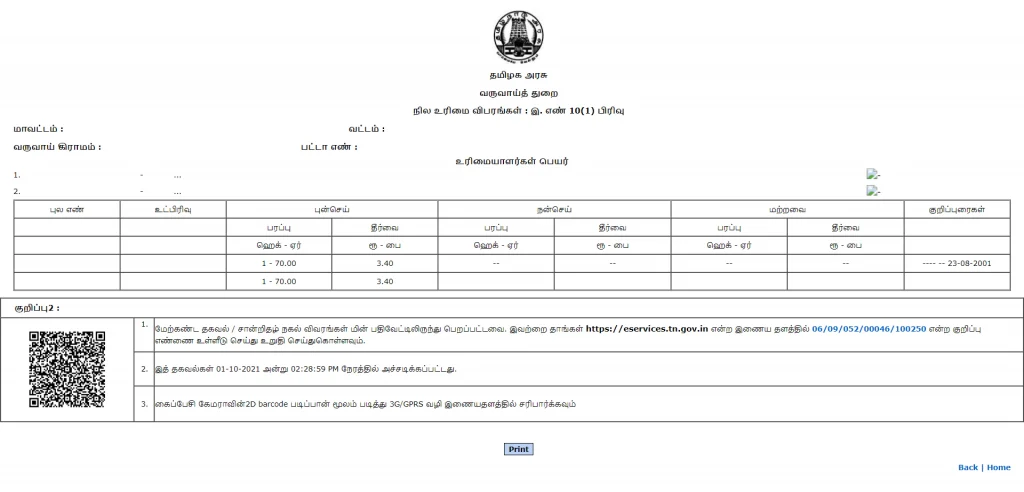
Patta chitta sample

Patta is a government document that shows who owns a piece of land in Tamil Nadu. It has details like the owner’s name, the land’s size, and what the land is used for (e.g., farming, housing).

Chitta is another document that tells whether the land is wet or dry. This is important for knowing how the land can be used and taxed.

Together, Patta and Chitta help prove land ownership and understand the land’s type and usage.

How To Get Patta Chitta Adangal

There are two ways you can obtain the adangal , patta and chitta documents:

  • Online method
  • Offline method

Before that, Let’ see Is there any application fees for getting documents or There any documents required for verification purpose.

Application Fees and Required Documents

Application Fees:

  • Usually, there is a small fee for processing requests for patta, chitta, and adangal documents. The exact amount may vary based on the state or local authorities. You should check the official government website. Or, contact the local tahsildar office for exact details.

Required Documents:

  • Proof of Identity: Aadhaar Card, Voter ID, Passport, or any other government-issued ID.
  • Proof of Address: Aadhaar card, ration card, utility bills, and so on.
  • Proof of Ownership: Sale Deed, Tax Receipts, or any document proving ownership of the land.
  • Application Form: The form must be filled out. You can get it from the government office or download it online.

Let’s look into a step-by-step process of getting these documents through both methods. 

Online Method

  1. Visit The E-Services Portal
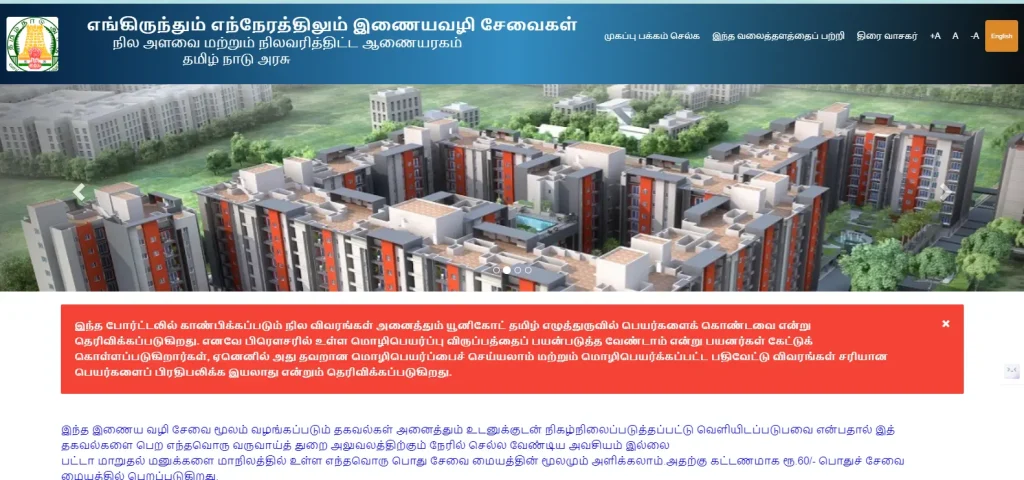
Eservice Tamil nadu government portal home page

The first step is to visit the official Tamil Nadu e-service website . All the land records of the state will be present in this website. 

  1. Navigate To Land Records
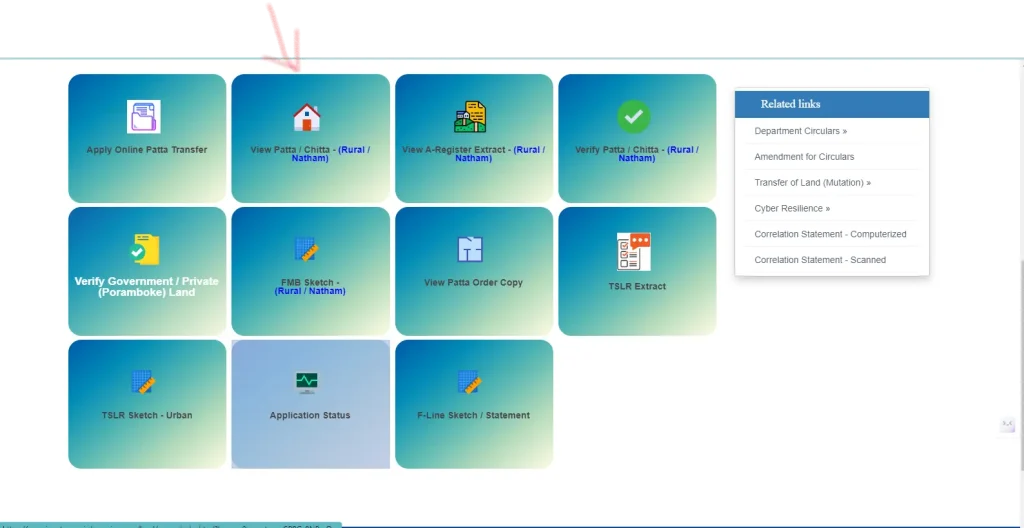
e service portal in TN for patta chitta apply

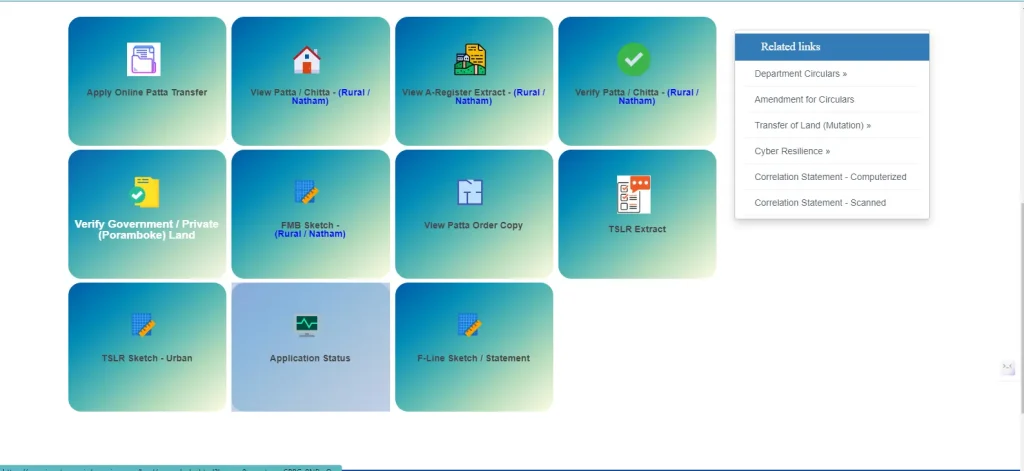
Go to land records. There, you will find many options for land records, like “Apply online patta transfer,” “View patta/chitta – (Rural/Natham),” “View A-Register Extract – (Rural/Natham),” “Verify patta/chitta,” etc. 

In that, select “View patta/chitta – (Rural/Natham)” to view your Patt or Chitta and select “View A-Register Extract – (Rural/Natham)” to view your Adangal.

  1. Select Your District
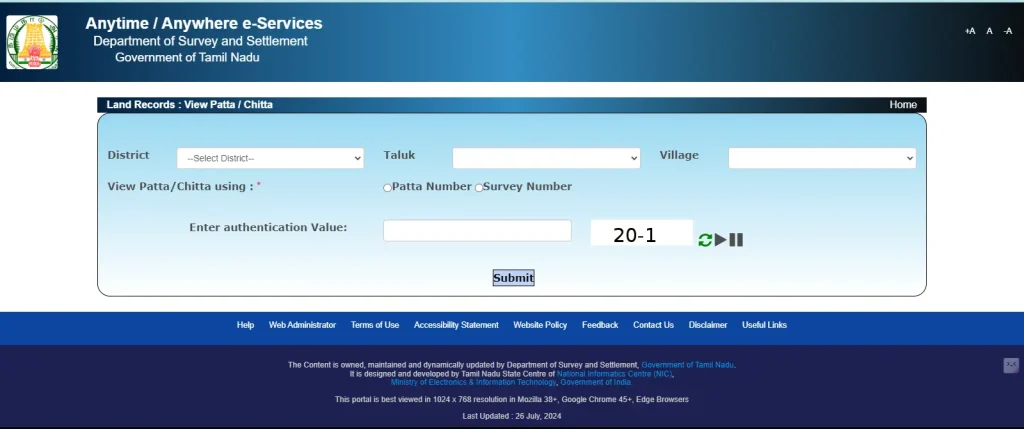
Land records View patta chitta application form

Enter details of your land like District, Taluk, and Village. You will also have to enter your patta number or survey number. Click “Search” after entering the authentication value given in the form. 

You can find your survey number in your property documents. 

  1. Download Your Document

You will then be taken to the document page. You can view the document and download it if you wish to for future reference. 

The online method is simple: You only need the location details of your property and the patta or survey number to download your documents in minutes. 

Offline Method

  1. Visit Your Local Village Administration Office

Visit the local Village Administrative Office (VAO) or Taluk office in your area. 

  1. Inquire About Patta Chitta Adangal

Consult the designated personnel and collect all details about the procedure involved in getting patta, chitta, and adangal documents from the office. Understand clearly what documents and details you need to provide. 

  1. Provide Property Details

Submit your application form along with the required documents. Clearly explain the purpose of obtaining the document and whether you require a patta, chitta, or adangal extract. If you need all the documents, mention them clearly. 

  1. Pay Applicable Fees

You will be charged a nominal fee to collect the documents. It may vary from district to district. So enquire how much you need to pay and pay the fees along with your documents and application letter. 

  1. Collect Your Document

You might be given a processing time required to receive the document. You will be notified once the document is ready, and you can get them from the office. 

Conclusion

Getting your patta, chitta, and adangal documents is an easy process that involves very few steps. Also you can Change Your Name in Adangal even after Documentation is done. It is best to get the documents online instead of going to the office. It can save you time and can get you the documents very quickly. 

FAQs

1. What is a patta, chitta, and adangal?

  • A Patta proves your ownership of the property.
  • A Chitta contains details about the property (size, area, etc.)
  • An Adangal is an extract from the village record that contains more details about the property.

2. How to get patta, chitta, and adangal documents online?

Follow the below steps if you wish to get patta, chitta, and adangal documents online.

  • Visit The E-Services Portal
  • Navigate To Land Records
  • Enter the necessary details (district, taluk, village, survey number, etc.)
  • Download Your Document

3. How to get patta, chitta, and adangal documents offline?

Follow the below steps if you wish to get patta, chitta, and adangal documents offline.

  • Visit Your Local Village Administration Office
  • Inquire About Patta Chitta Adangal
  • Provide Property Details & Application Form
  • Pay Applicable Fees
  • Collect Your Document

4. Adangal meaning

In Tamil Nadu, an Adangal is a vital land revenue record maintained by the Village Administrative Officer (VAO). It details specific information about a land parcel, including:
Owner’s Details: Name and ownership particulars.
Land Classification: Type of land (e.g., wetland, dryland).
Survey Number: Unique identifier for the land.
Extent and Assessment: Area and valuation of the land.
Crops Grown: Types of crops cultivated during different seasons.
Irrigation Sources: Details about water sources for cultivation.
Trees and Wells: Information on existing trees and wells.
Tenancy and Liabilities: Details of any tenancies or liabilities associated with the land.

Patta Chitta FMB Map: How to Obtain and Correct it

0
Field Measurement Book

The FMB map in Patta Chitta stands for the Field Measurement Book (FMB), a map-based land document crucial in determining land measurements and providing details about a property.

A working knowledge of the FMB map can help you understand the details of a land property more thoroughly. So, delve into this article to learn more about the FMB map, how to obtain it online or offline, and other details.

What is a Patta Chitta FMB Sketch?

Field Measurement Book

An FMB sketch or FMB map is a map-based data set that holds records of land measurements. It uses standard measurements at scales of 1:1000 or 1:2000 to facilitate uniform measurement aidance and seamless support to land surveyors, civil engineers, owners, and other related stakeholders.

Surveyors and engineers use FMB to develop site maps and verify different property dimensions, such as boundaries, locations, land holdings, type of land, and other details. 

The document is usually stored along with Patta Chitta in the Village Administrative Office or the Tahsildar’s office at the District Collectorate. 

How to Obtain FMB Sketch Offline?

Traditionally, FMB sketches are obtained offline. You can still get FMB sketches offline by visiting the relevant Taluk office or Village Administrative Office, though online facilitation is also available.

You can apply for FMB maps in person through the following steps:

  1. Visit the respective Taluk office or the Village Administrative Office.
  2. Book an appointment with the Tahsildar, Village Administrative Officer, or the authority in charge.
  3. Submit the needed documents and request form along with the survey number, applicant signature, proper attestation, if required, and other details.

If the request is valid, the authority will provide a photocopy or duplicate of the FMB record alongside a unique reference number after reviewing the application.

If the application is denied for unexplained reasons, you can appeal to the District Collector or other relevant higher authority.

How to Obtain FMB Sketch Online?

You can apply for FMB maps online through the following steps:

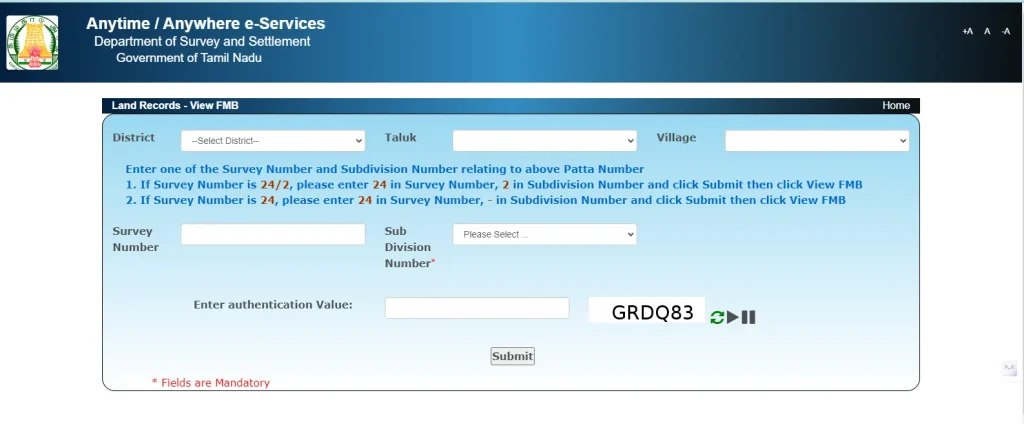
  • Visit the official online website: e-Services of Land Records (Anytime/Anywhere e-services website for Tamil Nadu survey and settlement services) built to apply for the FMB sketch.
  • Enter the required information, such as the district’s name, taluk’s name, village’s number, survey number, sub-division number, patta number, and other needed information.
  • Enter the security authentication details, like the captcha, before clicking the submit button.
  • A copy of the requested FMB sketch will be displayed on the screen.
  • Click the “Print” option to get the hard copy of the FMB sketch.
  • You will be directed to the payment page.
  • Choose the convenient payment option.
  • Upon payment, you will get the hard copy of the FMB sketch along with a unique reference number generated for the FMB copy.

Fees for FMB Map Application in Tamil Nadu

The fees for an FMB map or sketch application in Tamil Nadu are very nominal, both online and offline.

The online application for FMB sketches costs Rs. 60 per application, while offline applications do not cost more than Rs. 100.

The application, review, and distribution process for FMB sketches has been made transparent and easier than in previous days.

How to correct an incorrect FMB map in Tamil Nadu?

You can have your FMB maps corrected officially by submitting the required documents and application form to the respective authority in charge. 

Submit an appropriate request to correct an incorrect FMB map or sketch to the respective Tahsildar, who will then direct the authorized personnel to measure the land upon reviewing the request form.

If the request for FMB map correction is dismissed on unreasonable grounds, you can sue the concerned Tahsildar in court.

Conclusion

FMBs are important documents while managing land properties. It is essential to ensure that the details in the FMBs are recorded correctly to prevent unnecessary misinterpretations in the future. You can also rectify any mistakes in the FMB maps through online and offline methods.

Applying for FMB map extraction and corrections has been made easier today through many online and offline facilitations.

Go through the proper channels to get your FMB maps scam-free. Also, regularly check the government’s updates regarding FMB map applications for hassle-free courses.

FAQs

1. Is there a website where you can apply for FMB maps online in Tamil Nadu?

Yes, you can apply for access to FMB maps or sketches online in Tamil Nadu through e-Services of Land Records, the government website at Anytime / Anywhere E-Services. There are Common Service Centres (CSCs) across the state where you can apply for FMB sketches or maps online.

2. Where are the FMB sketches or maps maintained?

The Village Administrative Office usually maintains the FMB sketches or maps. However, you can also contact the district Tauk office to obtain the required FMB sketches or maps.

3. Is the FMB sketch highly important?

Yes, the FMB sketch is an essential record as it gives a clear record of measurements of land property and is highly useful for landowners, engineers, surveyors, and other stakeholders while managing and putting the land property to use.

Wall Moulding Designs to Transform Your Home Interior

0
Wall Moulding Designs

Wall moulding is the easiest way to elevate your home interior. From traditional to trendy styles, you have vast collections to explore. Whether you prefer simple or detailed designs, the market contains them. Undoubtedly, you can find the style that suits your taste.

The availability of customized styles makes these moulding designs even more popular. Homeowners are open to enhancing their interior space with unique and creative designs. 

Let us take a look at the most wanted wall moulding designs that provide the expected look and durability.

Top 10 Wall Moulding Designs

1. Crown Moulding

Crown Moulding

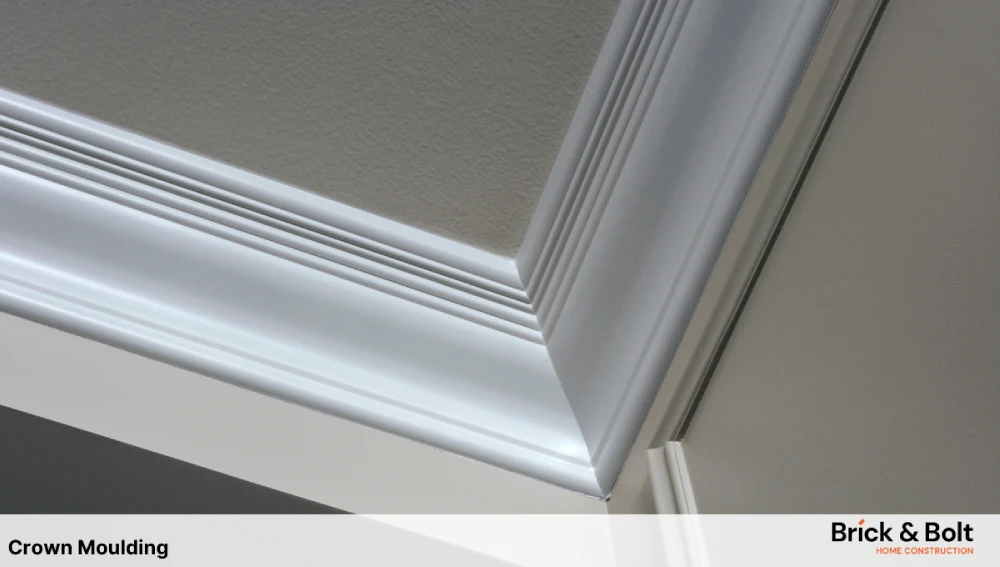
Crown Moulding offers a timeless beauty look to your home if you combine the moulding with PVC Wall Panel Designs it will hold a rich look to the room This kind of moulding is more likely to be made up of plaster or wood, giving a perfect classy look to any room. It is one of the versatile options that arrive in various styles and sizes. The installation is simple and meets the design aesthetic you want.

2. Baseboards

Baseboard moulding is a perfect choice for places where the wall is adjoined with the floor. Apart from improving the elegance, this is apt for protection against furniture scuffs. You can choose the width of the wall moulding according to your preferences. Surprisingly, homeowners can pick out simple or intricate patterns by their home infrastructure.

3. Chair Rail

Improve your living room space with a chair rail moulding design that gives a classy, pleasant, and sophisticated appearance attached horizontally to the wall. Chair rail is your ultimate option, if you would like to cover the whole edge of the space. This design is around 2 to 3 inches and seems thin and lightweight.

4. Picture Frame Moulding

A border around the wall gives a unique touch to your home. You can install it in a rectangular or square pattern made of PVC. Paint the borders in contrasting colors to add extra beauty to your place.

5. Wainscoting

Wainscoting is a great way to bring a classic look to your home. Both the flat and raised panels can be elegantly transformed with wainscoting. It is ideal for improving the lower halves of the wall with futuristic elements.

6. Board and Batten

If you are looking to jazz up your space without spending a ton of money, then the board and batten is a pretty smart choice. This design can be vertically installed with wide boards and narrow battens. It is made with different sizes of plywood boards to obtain a chic and slim look.

7. Beadboard

Add a charming cottage style to your space with a beadboard wall moulding design. It gives a fresh, cool, and cozy look suitable for kitchens and bathrooms. Consider using this design to achieve stylishness.

8. Shiplap

Achieve a long-lasting décor in homes of any style and age with shiplap moulding design. It drives a versatile and modern look in any color you want. Even a simple shiplap design can transform the vibe of your interior that seems inspiring.

9. Coffered Ceiling

Coffered Ceiling

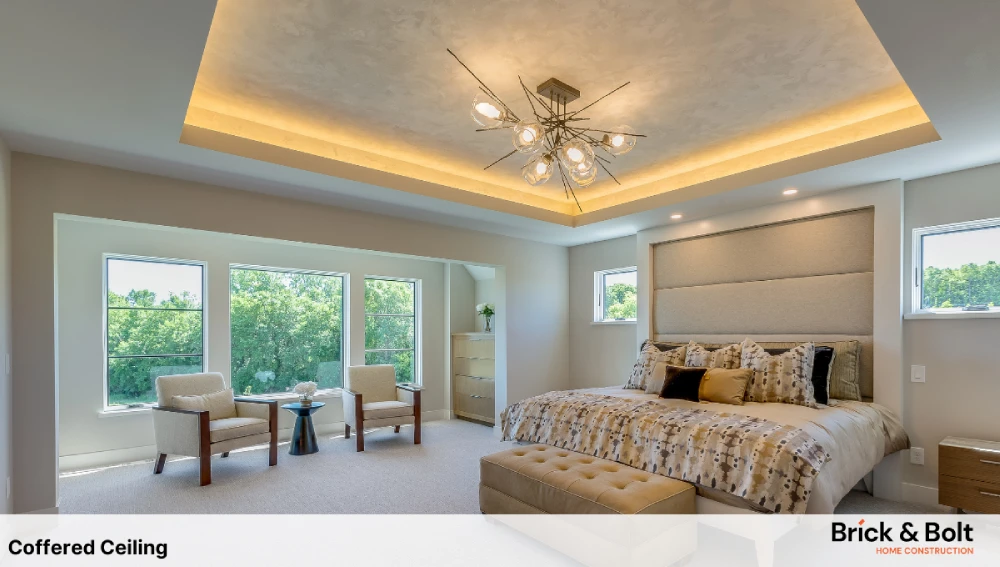
Opt for a coffered ceiling moulding design to acquire a traditional and colonial style. If you would like depth and attractive patterns, this design fits the bill. It reduces noise levels, echoes, and sound waves inside the room.

10. Tray Ceiling

Tray ceiling designs are customizable and best for the kitchen, living room, dining room, and even bathrooms. The right design with successful execution adds a special touch to your home. Besides, you have numerous tray ceiling ideas to utilize suits for any room size and style.

Conclusion

Wall moulding designs are the simplest way to enhance your space elegance. With the wise choice, you can add value to your home. Explore the available designs and choose the one that seems unique and ideal. Hopefully, with this article, you can get to know the designs that align with your budget and home infrastructure. 

Modern Boundary Wall Design: Top 12 Contemporary Ideas

0
Modern Boundary Wall Design

In today’s world of architecture and landscaping of houses and other facilities, the walls have become not only the functional structures that divide space but also the amazing ornaments that complement the general concept of the territory. 

Here are the 12 contemporary styles of boundary walls that would give you ideas on how to enhance the appearance and functionality of your home exterior spaces. 

Best 12 Modern Boundary Wall Design 

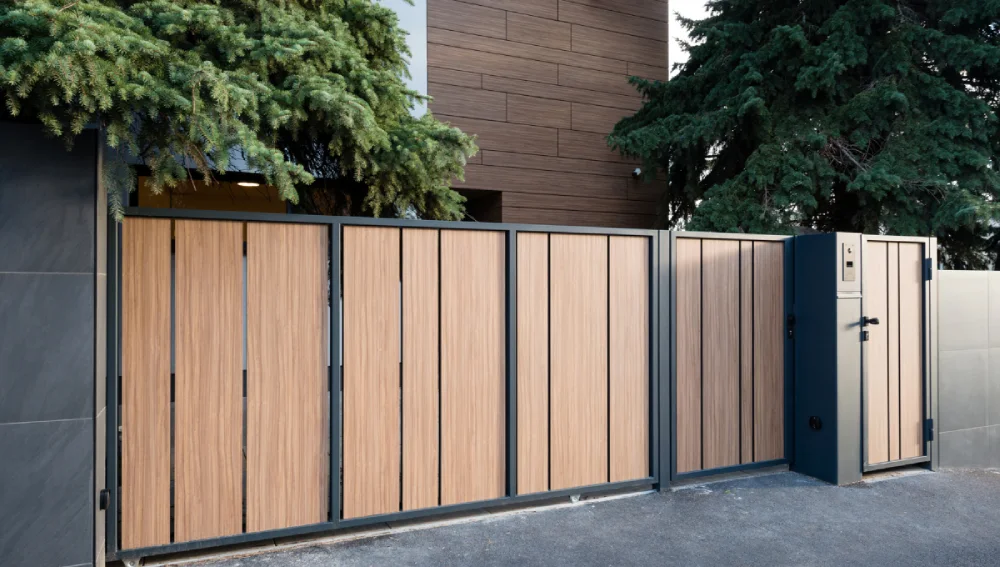
1. Minimalist Precast Panels 

Description: Precast concrete panels are smooth and plain with a very contemporary look and feel because they are produced in a factory.  The precast panel will look good when you combine Parapet Wall Designs

Tips: To complement the appearance of the design, one can use different colors or textures.

Benefits: It has a long life. 

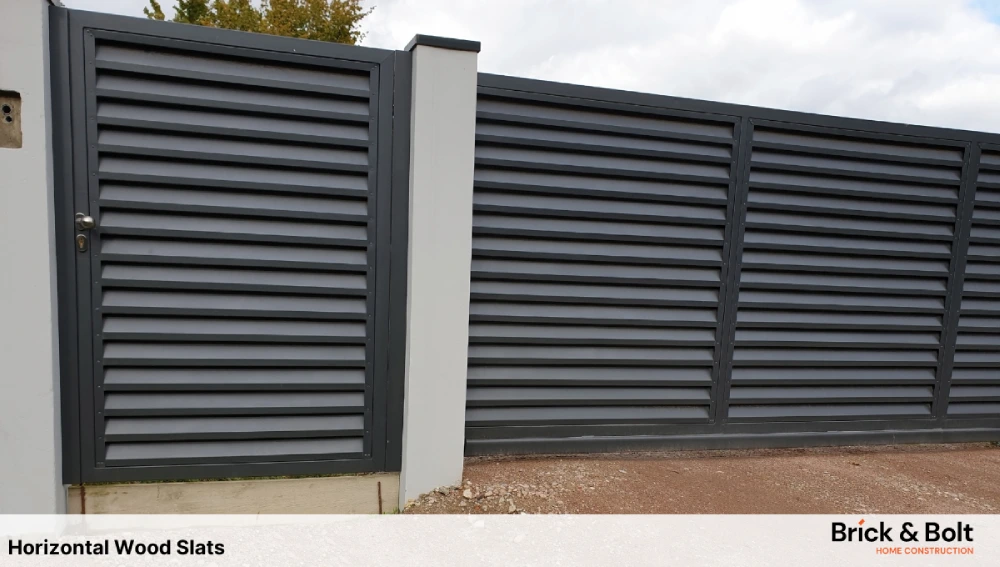
2. Horizontal Wood Slats 

Horizontal Wood Slats

Description: Horizontal wooden slats give a cottage-like feel that goes well with the contemporary and mid-century modern buildings. 

Tips: Choose a type of wood like oak or pine and make a design of your choice; it is also possible to add molding or trim. 

Benefits: It brings an element of the natural environment.

3. Corten Steel Walls 

Description: Corten steel, also known as weathering steel, has a rust-like finish that accumulates over time and gives the boundary wall a modern industrial feel. 

Tips: To give a distinct look try to incorporate different textures or finishes and one can even add elements such as metal or light. 

Benefits: It is a very sturdy material. 

4. Stacked Stone 

Description: Stacked stone walls create a very aesthetically appealing structure that complements any design theme of the landscape. 

Tips: With the stones or rocks, come up with a different design, and you can also include other things like plants or water features. 

Benefits: It can be installed in different designs and shades. 

5. Gabion Walls 

Description: Gabion walls are made of interlinked wires and filled with stones or rocks to give a rather industrial look. 

Tips: You can incorporate other decorative items, such as plants or lights. 

Benefits: Requires minimal upkeep. 

6. Vertical Garden Walls 

Description: Incorporating greenery in the form of plants into the design of the boundary wall creates a green vertical garden wall. 

Tips: It can be done with the help of different plant species or color combinations, and to make it even more interesting one can add more elements such as light or water. 

Benefits: Adds an aesthetic value to the space. 

7. Water Feature Walls 

Description: Water feature walls are much like water wall fountains in that they include a water element flowing down the wall of a building’s exterior. 

Tips: You can use different materials or colors in order to make it different and as for the interior design, you can add plants or lamps. 

Benefits: This brings about some tranquility. 

8. Metal Grid with Climbing Plants

Description: Having metal grid walls, plants can climb up and give the look of a living fence or wall. 

Tips: One can use different types of metal finish or planting scheme to define the space and incorporate functional and aesthetic elements such as lighting or water features. 

Benefits: It gives a very natural effect.

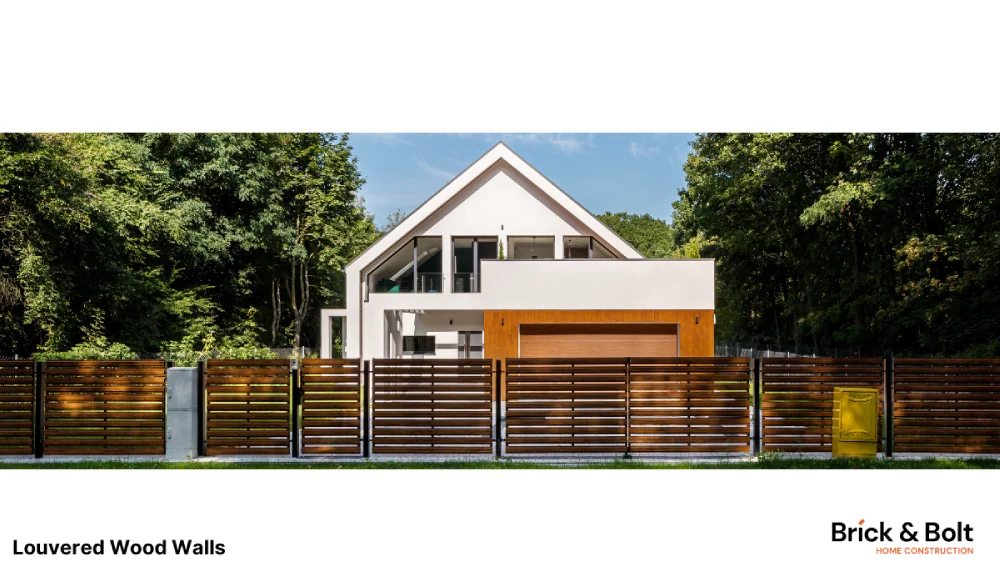
9. Louvered Wood Walls 

Louvered Wood Walls

Description: Louvered wood walls consist of wooden panels that are tilted to open or close to allow more privacy or light. 

Tips: One can opt for different types of wood or even different shades of the same wood to come up with a design that is unique. 

Benefits: Provides an artistic feature in the interior décor.

10. Shoji Screen Walls 

Description: Shoji screen walls are a nod to the traditional Japanese architecture and have a slim and semi-translucent frame. 

Tips: One can use different materials or colors in the design and even incorporate things like plants or lighting into the design. 

Benefits: Used as a divider or partition wall.

11. Corten Steel and Wood Combination

Description: The use of Corten steel with wood gives the structure a modern industrial look with the warmth of wood. 

Tips: You can also use different types of wood or steel finish to come up with a distinguished design and you may also include features such as metal handles or lights. 

Benefits: It gives the room an industrial appeal.

12. Painted Brick Walls 

Description: Painted brick walls are simply elegant and timeless, giving a contemporary feel to the house. 

Tips: To give your room a more distinct appearance, apply different paint shades or sheen levels, and you may also incorporate special details like molding or trim. 

Benefits: Gives it that old feel, makes the space warm

Conclusion 

As a result, the modern boundary wall designs help you to improve the looks and the usability of your outdoor space in numerous ways. No matter the style you are going for, whether it is the modern industrial look or the more natural look, there is a modern boundary wall design for you. 

What is CMDA Approval: Guide for Real Estate Projects

0
Chennai Metropolitan Development Authority

Over the last two decades, Chennai city is witnessing tremendous growth in the real estate market. It causes demand for plots and residential properties for sale.

Before embarking on any construction project, it is crucial to obtain CMDA (Chennai Metropolitan Development Authority) approval. The CMDA acts as the regulatory body administering all the construction activities that take place within Chennai.

This article explains the CMDA approval in detail, making it easier for you to plan and obtain real estate projects and permits in Chennai.

What is CMDA?

The Chennai Metropolitan Development Authority was initiated to plan and develop the capital region of Tamil Nadu (Chennai). The CMDA was officially passed in 1972 to ensure the zoning regulations, environmental guidelines, and safety standards.

Under this regulation, the local authorities of the Chennai Metropolitan Area are empowered to provide planning permissions for real estate projects in several categories. These include institutional, residential, industrial, commercial, and other relevant subdivisions. Specific guidelines must be followed strictly before a builder commits to developing a project.

What Does CMDA Approval Signify?

The CMDA-approved plot or property denotes that it has already been verified thoroughly for land titles. So, if you are about to purchase that plot or property, you are guaranteed that the land title is neat and free from any disputes.

Importance of CMDA Approval

CMDA approval is compulsory for all real estate projects in Chennai. It is the first and foremost step in property development plans to ensure that the particular property is verified under all legal regulations. Real estate agents, builders, buyers, developers, and promoters must acquire CMDA approval.

Benefits for Property Buyers

Opting for CMDA-approved properties or plots provides buyers with financial, legal, and infrastructural protection. It ensures clear land titles, provides security and credibility to the purchase, and safeguards investments.

Benefits for Developers and Builders

Getting plan approval and building permits is generally challenging for developers and builders. However, it can be easier with CMDA approval. Local authorities are more likely to issue the approval smoothly if the properties are situated in CMDA-sanctioned areas. Builders will not experience trouble or delays in construction projects.

When is CMDA Approval Required?

CMDA approval is mandatory before undertaking any development projects in the real estate sector. It confirms that the area is facilitated with proper roads, infrastructure, power supply, water supply, sewerage management systems, etc. The approval is valid for only three years from the date of issue.

CMDA Approval Process

CMDA Approval Process

Here are the lists of steps you need to take when applying for CMDA approval:

Site Inspection

As an initial step, CMDA officials will conduct an on-site assessment to ensure the property meets estimated zoning laws and regulations. They thoroughly verify the zone or area of projects located in different parameters.

Application Submission

After the site visit, the applicant must submit a formal application form for CMDA approval. It should contain all relevant information including specifications, intended property use, building design, cost of budget, etc.

Technical Review

Reviewing is a crucial part where the officials will look at the project’s technical facets to confirm that it aligns with estimated construction standards and regulations. They put extra effort into verifying the structural computations, building plans, and specifications.

Fee Payment

If the project is designed per the norms, the CMDA officials issue an approval letter. The applicant can obtain the final approval by paying the applicable charges mentioned.

Document Submission

Document submission is paramount to getting CMDA approval. The applicant must submit the documents, including the encumbrance certificate, the project’s layout plan, and the NOC (No Objection Certificate) from the local authorities.

Plan Approval

Once the required documents are submitted, the officials provide a plan approval letter. It includes detailed information such as clear specifications, sanctioned building design, and relevant information.

Building Permit

After obtaining the plan approval, the applicant needs to apply for a building permit with additional documentation, such as a fire safety plan, electrical layout, structural stability certificate, etc.

Final Inspection

Once the construction work has been completed, the CMDA officials will visit the site physically. This inspection ensures that you have followed all the rules and regulations as estimated.

CMDA Approved Layout

Potential buyers need to verify the status of a CMDA approval Layout to make informed decisions. It can be done by :

  • Checking out the website or CMDA office to ensure the approval status of a layout
  • Verifying the certificate issued by CMDA officials
  • Consulting any experts to verify the property or plot in all aspects

Conclusion

Investing in CMDA-approved plots or properties safeguards your investment and ensures that it has clear titles and enhanced security and credibility. Any real estate projects without CMDA approval have many legal consequences in Chennai city. 

Overall, the buyers, developers, or real estate agents for Residential buildings who adhere to regulations are free from risks and uncertainties.

FAQs

1. What is the Meaning of CMDA Approved?

CMDA acts as a regulatory body concerned about all construction activities in the Chennai Metropolitan City. It is applicable for Chennai and its surrounding suburbs. 

2. What is the Purpose of CMDA?

CMDA is a statutory organization that was developed to regulate the physical development of Chennai. It is aligned with constructed standards and regulations. CMDA approval ensures that the property is completely safe with clear land titles.

3. What is the CMDA Limit?

CMDA organization handles town planning and development within the Chennai Metropolitan area. In 1974, the area was limited to 1,189 sq km; in 2022, it expanded to 5,904 sq km.

4. Are Patta and CMDA the Same?

No, both the parameters are different. Patta will apply only for the land, whereas CMDA approval is mandatory for the flat or house plan and land you intend to buy.

Vastu for Study Tables: Optimal Direction, Materials, and Benefits

0
Study table vastu

In many Indian households, adherence to Vastu Shastra principles is pivotal when selecting and positioning furniture. Among these, determining the correct direction for study tables holds significant importance. Aligning the study table according to ancient architectural principles can enhance positivity and productivity.

This article delves into the optimal direction for study tables as per Vastu, offering insights into its benefits and practical tips for effective use.

Benefits of Optimal Study Table Direction

Placing the study table in the right direction, as per Vastu, yields several benefits:

  1. Enhanced Concentration: Correct positioning fosters a positive environment conducive to focused work.
  2. Improved Memory Retention: Students experience enhanced ability to grasp and retain information.
  3. Enhanced Academic Performance: Better concentration translates into improved academic outcomes.
  4. Reduced Stress: A conducive study environment helps alleviate exam-related stress and anxiety.
  5. Boosted Confidence: Students feel more confident and prepared to tackle academic challenges.

Optimal Directions for Study Tables According to Vastu

According to Vastu Shastra, the ideal directions for study tables in bedrooms or study rooms are north and east. Here’s a breakdown based on specific fields of study:

  • East Direction: Ideal for students of political science, fostering better academic outcomes.
  • South of Southeast Direction: Beneficial for courses like physical education and yoga, enhancing energy levels and focus.
  • Southeast Direction: Recommended for law students and UPSC aspirants, promoting concentration and success.
  • North Direction: Associated with wealth and success, making it suitable for competitive exam preparation.
  • West of Southwest Direction: Ideal for school students, supporting a conducive learning environment.
  • Northwest Direction: Suitable for home science and courses related to retail and investments, promoting practical learning.

Directions to Avoid for Study Tables

Certain directions should be avoided as per Vastu Shastra, including east of southeast, east of northeast, south of southwest, north of northwest, west of northwest, and due south. These directions may hinder concentration and impact academic performance negatively.

Additional Vastu Tips for Study Tables

  • Shape: Rectangular or square shapes are recommended for study tables, ensuring positive energy flow.
  • Material: Opt for high-quality wood to ensure durability and positive vibrations.
  • Placement: Leave some space between the study table and the wall to facilitate airflow and maintain cleanliness.
  • Colors: Choose calming colors like pastel blue, light green, white, or cream to enhance concentration and positivity.

Practical Tips for Study Table Arrangement

  • Cleanliness: Maintain a clutter-free environment around the study table to avoid distractions and negative energy buildup.
  • Lighting: Ensure proper lighting to activate the mind and improve productivity.
  • Decor: Adorn the study table area with motivational quotes or inspiring artwork to foster a positive study environment.

Conclusion

Choosing the right direction for your house, pooja room, & study table as per Vastu principles not only enhances academic performance but also promotes overall well-being. By aligning with these ancient guidelines, families can create a harmonious and productive study space conducive to learning and personal growth.

Comprehensive Guide to Bhoomi RTC Karnataka

0
Karnataka Bhoomi record

The Bhoomi Karnataka portal, launched in 2000, has revolutionized land record management in the state of Karnataka by digitizing land records. This initiative aims to provide citizens with easy and transparent access to land information, thus enhancing the efficiency and reliability of land record management.

What is Bhoomi RTC Karnataka?

Bhoomi Karnataka is the official digital platform for land records in Karnataka. It offers a range of services, primarily centered around the Record of Rights, Tenancy, and Crops (RTC) documents. These documents are essential for landowners and agriculturalists, as they contain vital information about land ownership, soil type, crop details, and land usage.

Key Features of Bhoomi Portal

  1. RTC (Record of Rights, Tenancy, and Crops):
    • Ownership Details: Information about the owner of the land.
    • Soil Type: Classification of the soil in the land.
    • Crop Information: Types of crops grown on the land.
    • Land Use: How the land is being utilized.
  2. Mutation Services:
    • Mutation Register: Tracks changes in land ownership due to sale, inheritance, or other transfers.
    • Application and Tracking: Users can apply for mutations and track the status online.
  3. Revenue Maps:
    • Visual Representation: Provides detailed maps of land parcels.
    • Accessibility: Users can view these maps online to understand land boundaries and layouts.
  4. Tippan Services:
    • Land Surveys: Detailed surveys of land to verify boundaries and ownership.
    • Access Tippan Documents: Users can view and download Tippan documents.
  5. Citizen Registration:
    • Service Access: Register to access various services on the portal.
    • User-Friendly Interface: Easy registration process for all citizens.
  6. Conversion Requests:
    • Land Use Change: Apply for conversion of agricultural land to non-agricultural land.
    • Track Applications: Monitor the status of conversion requests.

Using the Bhoomi Portal

To access land records through the Bhoomi portal, follow these steps:

  1. Login:
    • Visit the official Bhoomi Karnataka website.
    • Log in with your credentials.
  2. Navigate:
    • Click on the Bhoomi icon.
    • Proceed to citizen services.
  3. Enter Details:
    • Select district, taluk, hobli, and village.
    • Enter the survey number, period year, and owner details.
  4. View Records:
    • The portal will display the relevant land records based on the entered details.

Bhoomi Mobile App

The Bhoomi mobile app extends the convenience of the portal to smartphones, allowing users to access land records on the go. Key features include:

  • Access RTC and Mutation Details: View detailed records from your mobile device.
  • Check Restricted Land Details: Verify if the land is subject to any restrictions.

Contact Information

For any assistance with the Bhoomi portal, you can reach out to the Bhoomi Monitoring Cell:

Benefits of Bhoomi Portal

  1. Loan Processing:
    • Land records are crucial for applying for agricultural loans.
    • The digitized RTCs facilitate quick loan approvals.
  2. Mutation Services:
    • Users can submit and track mutation requests online.
    • Enhances transparency and efficiency in updating land records.
  3. Crop Insurance:
    • Provides accurate land and crop data for insurance claims.
    • Facilitates quicker processing of claims.
  4. Status Tracking:
    • Monitor the status of mutation applications.
    • Ensures timely updates and reduces the need for physical visits to government offices.

Fees and Charges

The Bhoomi portal charges minimal fees for various services:

  • RTC Documents: Rs. 10 per copy.
  • Tippan: Rs. 15 per copy.
  • Mutation Extracts: Rs. 15 per copy.

Additional Services

The Bhoomi portal also offers several other valuable services:

  • Dispute Resolution: Mechanism for resolving land disputes.
  • Land Conversion: Apply for converting agricultural land to non-agricultural purposes.
  • Grievance Redressal: Lodge complaints and track their resolution.

Security and Privacy

The Bhoomi portal ensures that all data is securely stored and accessible only to authorized users. Robust security measures are in place to protect user information and prevent unauthorized access.

Future Developments

The Karnataka government continues to enhance the Bhoomi portal by integrating advanced technologies and expanding its services. Future updates may include:

  • Blockchain Integration: For increased security and tamper-proof records.
  • AI and Data Analytics: To provide more insights and improve service delivery.
  • Expanded Mobile Services: Enhancements to the mobile app for more comprehensive access.

Conclusion

The Bhoomi Karnataka portal has set a benchmark in land record management by digitizing and simplifying access to essential land information. Its user-friendly interface, wide range of services, and robust security measures make it an invaluable resource for citizens of Karnataka. Whether you need to check land records, apply for mutations, or access revenue maps, the Bhoomi portal provides a seamless and efficient solution. For more detailed information and to utilize these services, visit the Bhoomi Karnataka portal.

By leveraging the Bhoomi portal, Karnataka is paving the way for a more transparent and efficient land record management system, benefiting landowners, farmers, and government agencies alike.

Prefab Homes Bangalore- Also know its Advantages and Disadvantages

0

In Bangalore construction is getting expensive day by day. Stop worrying about investment in resources.

Thankfully a lot of people are drawn towards building prefab houses. There is a huge demand for prefabricated homes in Bangalore. 

But remember you need to own the land where you want to set up a prefab house.

After owning the land, you should be able to get water and electric connection for your prefabricated home. So, stop worrying about investment in resources.

Once you have made your mind that you want to have a home the two options that you have are:

  • To build a stick-built home or
  • To assemble a prefabricated home

Stick-built houses are twice as expensive compared to prefabricated house.

Why Prefabricated homes Bangalore?

prefab houses

Prefabricated homes use modern technology to build structures that look beautiful and strong. 

  • It can be designed according to the style of your choice and is suitable for your needs.
  • Prefabricated homes are very quickly built.
  • Prefab houses are good for home expansions and have several advantages compared to the conventional method of construction.
  • Building Prefab houses are also the cleanest method of construction as it requires no cement or blocks.

Benefits of having prefab houses

  • Cost-effective
  • Time-saving
  • Environmentally friendly
  • It’s durable

Prefabricated homes are beneficial in many aspects since it protects from thermal variation, earthquakes, and fire.

Prefabricated homes can be made under budget and can be completed on time. 

The general rule of thumb is that prefab houses are cheaper than stick-built homes by an average of 10 to 25 percent.

Mass-produced materials cut down costs because factories buy supplies in bulk.

Prefabricated homes are easy to set up and maintain but still, it is not so popular as people still consider it to be a temporary construction and cannot be used for generations.

In a city like Bangalore, eco-friendly housing is very important.

Most of the work is done off-site and a lot of money is saved on raw materials, time, etc. Prefabricated homes can save you money because it requires very fewer construction laborers. Transporting different parts can be a little expensive.

There are many Prefabricated home builders in Bengaluru, you can choose the best one according to your need.

The prefabricated home construction builders would offer the best budget to construct your home.

Companies build prefabricated buildings depending on their requirements.

Prefabricated home panels last longer and have a low maintenance cost compared to conventional means of construction.

Also, for your information Prefabricated homes are very popular in hilly regions especially where construction materials are expensive and not easily available.

The beauty of prefab houses is that it doesn’t waste time or pollute the environment or cause traffic due to house construction.

With proper maintenance, a prefabricated home can last longer and can last for decades.

Prefabricated or Modular homes are constructed by assembling the modular components that are manufactured off-site. They can be based on the concept of either modular, paneled or mobile homes.

Advantages –

Fabrication

The components required to build prefabricated homes can easily be manufactured and transported to the site without problems.

Finishing

The prefabrication makes the finishing of the homes extremely fine and composed. There are rarely any defects found in the factory-made component.

Speed up construction time

Due to easy manufacture and transportation, most of the work is done off-site. The components can be easily assembled on-site with minimum requirements of skill and labor, which speeds up the construction process.

Fewer delays

The manufacturing and assembling are not affected by weather conditions so the time delays are less as compared to RCC and timber construction.

Energy efficient

The use of recycled materials led lights and solar panels to help to make these pre-fabricated homes energy efficient.

Zero waste production

As the components to be assembled are factory-made, there is no waste being produced on-site. All the modules and pieces to be installed arrive on-site completely in stacks which just have to be assembled like solving a puzzle.

Disadvantages –

Limited design options

Due to certain conditions and availability of materials, there are limited design options available for now. Moreover, these constraints also vary from company to company that builds modular homes & traditional homes

Mortgage problems

Early finance is required before ordering for the manufacturing of components. Financial problems usually arise due to an extra advance payment being necessary.

Management of utilities

The assembling of modular components requires proper management of land and other resources in the surrounding as per the considerations. Mostly, the company making the fabricated home take care of all the requirements. But in case they do not then various problems arise on site.

Affordable housing construction, economical construction, pre-cast concrete, concrete, pre-fabrication, transportation cost, mass production

Pre-cast concrete or prefabrication of concrete is highly used in the economical construction of affordable housing construction. The cost is low in the case of mass production and may increase due to transportation costs.

Precast concrete or pre-fabricated concrete involves the casting of concrete in certain sizes in a factory instead of preparing in-situ concrete on site. The concrete is cast in a reusable mold off-site and is then cured in a controlled environment. Later it is transported to the construction site and assembled into place. Pre-cast concrete is considered highly economical as it produces no waste on-site and no problems take place in the concrete as it is already cured in controlled situations. But, even after these advantages, the pre-fabricated concrete doesn’t seem to be that economical and there are various reasons for the same.

High initial investment

However, prefabricated concrete is thought to be economical, but the initial cost of investment for manufacturing is very high. The molds used for casting are costly and thus prove to be economical only when mass production of concrete is required.

Transportation cost

The cost of transportation of the concrete slabs may be high depending on the location of the site. Moreover, various other situations such as bad weather conditions and unavailability can cause the transportation cost to increase too.

Limited size problematic for transport

The size of the prefabricated slabs of concrete is fixed. If the size of these is larger, then it causes difficulty in transporting them to the site. In such cases, transport cost drastically goes up.

Damages caused during transportation

When the cast concrete is cured in the factories and then transported, the possibility of members breaking during transportation is high. Such damages add to the overall increase in the cost.

Problems with joinery

Connections while assembling the concrete slabs prepared in the factories need to be perfectly made. Any deviation or irregularity in the placement would cause problems which in turn need extra efforts to be fixed and increase the cost.

High cost for repair work

Once the cast concrete is assembled on-site, it becomes pretty inconvenient to repair any damages made. So, to repair these damages after fixation additional amount is needed.

Expensive in case of different sizes

Usually, pre-cast concrete slabs of the same size are produced in large numbers and turn out to be economical. But, when the buildings are not modular, then the manufacturing of different sizes of concrete slabs is required, which is encumbering and leads to an immense increase in the production cost.