Home Blog Page 69

How to get a Home Loan easily

0
How to get a Home Loan easily

Building or buying a new house is still a dream for many millennials today. Though most of their situation is upside down, still follow the same routine of going for a job, and saving money, thinking that their dream will come true one day.

The only way to make your dream come true is to get a home loan easily.

If you planning to build your own house but struggling financially?

Don’t worry. Here is a simple way to take your dream to the next level. If you are thinking about getting a home loan, several checklists might help you.

Having an idea of taking a home loan is easy. But a single mistake might result in rejection.

14 Checklist to get a home loan easily

14 Checklist to get a home loan easily

1. Maintain a High Credit Score

The credit score is crucial to buying a home loan. Before entering into the credit score, check your financial status and capability of getting a loan.

Follow these guidelines to maintain a high credit score:

  • Always have a reminder to pay your loan on time as it reduces risk.
  • Maintaining a good level of transaction history by paying loans on time. 
  • Having more old credit cards helps to show more transaction history, which simplifies the procedure.
  • Have a policy of one loan at a time. Paying more than one loan troubles you at some level and reduces your credit score.
  • A clear financial record is essential to maintain your CIBIL score. 
  • Here are the various ways to increase your credit score.

2. Stable Employment Record

Employment record helps to give assurance to the lender that they can provide a loan for you. It reduces risk to the lenders as the borrower can pay the loan easily if they have a stable job.

Generally, lenders expect the borrower to need a minimum of 3 years of experience in the same working field and the minimum salary should be above Rs. 25,000. Business people need a minimum of 5 years of the same business experience.

If the borrower has a stable employment record, there is a chance to reduce the interest rate. 

3. Adequate Income

Having enough income for the buyer builds confidence in the lenders as they can afford money to them. It helps the lenders to decide and give how much money they can lend you without any hesitation.

The age group of 21 to 65 is eligible with a minimum income of Rs. 2,00,000 per annum. The level of income decides the loan amount provided for the borrower.

4. Lower Your Existing Debt

While you are applying for a home loan, you should reduce other debts gradually. The borrower can take measurable actions such as making a budget plan, planning for additional income, ask suggestions from creditors as how to reduce the interest rate. Reducing the debts helps to maintain the financial stability of the borrower.

5. Save for a Higher Down Payment

If you pay a larger amount at the initial time of purchase of property, there will be a reduction in the loan amount. The interest rate reduces gradually as there is a lower loan amount. It helps you to stay financially independent.

6. Choose Your Property Wisely

Before choosing the property, review all the legal documents to ensure that the mentioned details are correct.

As the value of a loan depends on the location of the property, it is an important factor in choosing the property to get a higher amount of home loan. Decide to choose the location based on resell value and plans.

7. Documentation

As documentation is involved in the main process of lending a loan, various documents involved are

  • Aadhar Card – basic identification of an individual
  • Pan Card –  ten unique numbers involved for transactions.
  • Driving License – provides authority to drive a vehicle
  • Passport size photo – proves the individuality
  • Sale deed document – legal document where property title is transacted.
  • Approved building plans – blueprint or sketch of the house before building
  • No objection Certificate from society – legal document provided that there is no objection to building a home on that property.

8. Apply with a Co-applicant

If the borrower shares their loan with another person, then it is easy for them to save money and share their financial burden. Both the co-owners have the common right to rule the property.

The procedure for co-applicants is the same as for the borrower. The co-applicant can either be

  • Spouse
  • Children
  • Parents
  • Relatives
  • Friends

9. Compare Loan Offer

Nowadays as there is a rapid increase in financial institutions, most of them come forward to provide loans.

Here you should make a wise decision as to which institution is better for you.

You need to compare various factors such as interest rate, tenure offered by the loan, loan to value, and processing fee.

10. Aware of all terms and conditions

Various terms and conditions such as income, work experience, age limit, and interest rate are mentioned in the loan application that the borrower should follow.

Before signing the loan, the borrower needs to go through the terms and conditions and make clear sense of them to avoid conflict in future.

11. Prepare for the Interview

If you are trying to get a loan from a financial institution, it is compulsory to prepare for some common interview questions conducted by the lender.

Needs to know what are the documents to be submitted, and their importance, and should have a clear knowledge of their documentation. If you have any doubts regarding the loan, you can note the questions and clear the doubts at the time of the interview.

Example: What attracts you to get a loan in this company?

14 Checklist to get a home loan easily

12. Ensure Legal Clearance on property

The property in which the borrower is lending a loan for a particular property needs clear legal documentation. The various legal documents are 

  • Title Deed – mentions the name of the owner of the property.
  • Approved building plans – mentions the property was constructed in the correct structural way.
  • No Objection Certificate – mentions there is no restriction for the property.

13. Professional Qualifications

Generally, professional qualification indirectly impacts the home loan as it is connected with the Income. This is often preferred by lenders as they need a qualified employee to provide the loan.

If you have an excellent professional qualification and a high pay package, there is a chance of getting high loan amounts.

14. Opt for Pre-approved Loans

It is a beneficial process for the borrowers, where they need not visit the lenders for the amount. Lenders come forward to provide loans for the borrower because of their stable credit records. 

As it is decided by the lenders, it reduces half the process such as investigation for getting a loan amount from them.

Turn your dream house into reality from fantasy. Selecting the best loan for your property and having a smooth home loan verification process helps you to navigate into a better future. 

FAQs

1. What are the types of loans?

The different types of loans are

Adjustable Loan – changes in the benchmark rate directly involve changes in interest rates.

Fixed ratio Loan – the interest rate is fixed.

Combination Loan – two separate loans given by the same lender to the same borrower.

2. Can I freeze my home loan?

It depends on your lender as the repayment policy varies from each of them. You can freeze your principal and interest for a particular period for specific reasons if your lender permits you.


Understanding and Managing Cash Flow in Construction

0
Cash Flow in Construction

Cash flow is crucial to running a construction business and acts as fuel to smoothly drive the engine of construction companies. From paying the workers to investing in the materials, lots of things depend on cash flow. 

With the right cash flow management, you can lead the construction game and rule the competitive market. The better your cash flow management, the greater your flexibility to undertake high-end constructions that will attract VIPs and high-paying customers. However, investors always keep those construction companies as their first preference and manage their cash flow impressively. Here, Brick&Bolt will help you understand cash flow management in construction. 

About Cash Flow in Construction

Cash flow means the inflow and outflow of funds at every step of the construction process, from installing the equipment to paying the staff involved in the process. It is important for the construction site managers and owners to keep cash flow as the top priority to drive the success of the construction project.

Constructing building a long way process and demands lots of funds. When you keep track of every transaction, you can keep up with the budget without compromising on the quality of the construction.

Importance Of Cash Flow In Construction

Cash flow management continues to play an important part in leading success for your construction project. Here are some of the important reasons that showcase the importance of cash flow in construction:

  1. Completes projects on time

Most project managers do not realize that cash flow management plays an important role in ensuring the timely completion of projects. If you do not maintain a suitable cash flow level, you may compromise the construction, such as stopping the project due to a shortage of funds. 

With the right cash flow management, you can predict and identify the flow of cash, which ensures that all your construction bills and expenses are paid on time. Hence, you can avoid delays caused by labor or material shortages. Additionally, it helps you meet your payroll obligations.

  1. Enhances financial health

It is not possible to engage in new construction projects with 100% confidence unless your current construction cash flow is on course for the existing projects or for the whole company as a whole.

  1. Maintains good relationships with suppliers

As you build your construction business, you must maintain a positive cash flow to pay all of your vendors and suppliers’ bills on time. This will serve as a basis for future collaborations and ensure the smooth execution of the project.

Construction Cash Flow Calculation

How have you calculated construction cash flow? For your convenience, here is a quick reference formula:

Cash Flow = Cash Inflows – Cash Outflows

To run a successful business, you need this value to be positive.

Among the cash inflows are:

  • Upon completion of milestones, clients make progress payments
  • Upon completion of the project, retention percentages are released
  • Salvaged materials sales

Among the cash outflows are:

  • Purchases of materials
  • Costs of labor
  • Rental and maintenance of equipment
  • Fees for permits
  • Costs of overhead

Top 12 Strategies To Improve Cash Flow in Construction

  1. Use of Cash Flow Management Software

The projection of your future cash flow is not an easy task. The construction industry is more complex owing to the variety of jobs and the changes that must be made to meet current project requirements. It is possible to accomplish this by using a cash flow management software program. 

It is possible for construction companies to use these tools to get a better understanding of how their future income and expenses will be compared to those of the past. By planning, you will be able to avoid these events.

  1. Payroll Management

The construction industry is different from most other businesses. There is almost an every-other-week pay cycle for construction workers. To improve cash flow, subcontractors can be hired. It is common for them to be paid every four weeks. If possible, avoid doing this under any particular circumstances.

Permanent employment and working full-time improve employees’ ability to deliver results on time. The higher the quality of work, the less likely you will run into setbacks or accidents during the project, and the more likely you will be referred by your current clients and asked for repeat business.

  1. Spread the cost to improve cash flow

If you receive a significant discount on materials and supplies, don’t use cash to purchase them. Financing should be used instead for these purchases. Suppliers offer contractors various financing options, such as credit cards, lines of credit, and loans. Finance charges and interest will still apply.

Payments can be made regularly, so you don’t have to pay the entire amount upfront. The more cash you have available, the more likely your business will be able to continue operating. If you charge interest and other fees to your business, you may be able to deduct them.

  1. Compare prices

It is always a good idea to compare suppliers so that you can be sure you get the best price. There is no doubt that every supplier wants your business in order to stay in business. If the supplier knows that you are looking for the best deal, he or she will most likely offer you the best deal to meet your needs. As a result, you’ll be able to save money.

To boost your cash flow, shop around for the best deals when purchasing supplies and materials. Pay with a credit card rather than cash when making purchases.

  1. Change in Activity orders processed quickly

It is common for change in construction activity orders to be issued in construction. It often results from a project needing more resources, time, or money than expected. Weather extremes can also be a factor. As soon as the project manager receives a change order, he or she should process it instead of waiting for the project to be completed. Cash flow will be positively impacted by this.

  1. Automatically send invoices

Invoicing can take a lot of time. Your company’s cash flow depends on it. Manually writing invoices is still possible, but you’ll save time by using software. It is important to send all invoices electronically and as soon as possible. Getting your invoices out beforehand will help you maximize your cash flow.

  1. Accept electronic payments

Cash is the king of payments, but it’s also important to occasionally accept electronic payments. This method can increase cash flow, payables, and capital for growth and day-to-day operations.

  1. Training the Project Manager in Cash Flow Management

The construction industry generates about 85% of its cash from the work being performed on projects currently in progress. Therefore, the success of cash flow management depends on the effectiveness of cash flow management. Furthermore, you can also offer training and incentives based on the performance of the cash flow of the company. It is highly likely that this will be successful.

  1. Avoid overbilling and underbilling

Some project managers enjoy the pastime of overbilling. Essentially, this means that the invoice will be larger than the job has been completed, resulting in a higher cash flow for the company. It will also reduce cash flow at the end of the project. If a company underbills its clients, it will negatively impact its cash flow in the short run. Is there a better way to go about this? Billing according to how much work has been done is the best way to do it.

  1. Strive for outstanding day sales

Having a goal can greatly increase your chances of succeeding in your endeavours. For construction projects, it usually takes 60 to 90 days for the money to be received. As a realistic objective, it might be a good idea to set a goal of reducing that time to 50 days. 

The easiest way to do this are-

  • send invoices to non-paying customers immediately, 
  • provide incentives for them to make payments, 
  • write clear terms of agreement, 
  • run credit checks before making any deals,
  • renegotiate terms with non-paying customers.

Because each project is different, construction companies differ from other businesses. Different strategies can improve cash flow. The project manager will have a significant role in managing cash flow effectively. 

Therefore, current project managers must be trained in cash flow management or be hired as qualified project managers. Increasing cash flow in construction companies is possible through good project management and improving receivables’ speed.

Conclusion

To witness your construction project touching height, always keep cash flow as the top priority. Besides that, do not forget to take your walk towards choosing the best construction company to give reality to your construction concept. 

Brick&Bolt is the best construction company in India, always ready to shape your construction project. We have a dedicated team of real estate builders who will sit with you to understand your construction requirements and build the best space that meets them.

From residential to commercial construction, we build the best space for you to adhere to the top-of-the-line quality standards. Contact us today to shape the best construction for you. 

Smart Real Estate Investment Strategies for Beginners: Start Building Your Wealth

0

The real estate market is driving wonders, opening lots of room for excellent returns. Every investor looks forward to investing in properties that offer greater ROI. Whether you are looking at residential or commercial space, it is essential to consider growth factors and plan out the right strategies to invest in ideal properties. 

According to market reports, the Indian real estate market is estimated to generate $1 Trillion by 2029. These figures are impressive, but it is all about the right timing and strategies for successful real estate investment.

But when you are new to the real estate investment market, you may have to overcome challenges to make ideal investment decisions. Therefore, to help you make the right investment, we have prepared an article that covers property investment tips for beginners to land an ideal investment that will set the perfect financial future. 

About Real Estate Market in India

A report by the Indian Brand Equity Foundation (IBEF) projects that Indian property sales will surpass $1 trillion by 2030. Approximately 7% of India’s GDP is generated by the sector and this industry leads to the generation of over 50 million jobs in the country.

Population growth, urbanization, and infrastructure investment have all contributed to the demand for housing and commercial space.

Tips for Beginners to Ace Real Estate Investment in India

Investing in the real estate market is an important decision and every beginner entering into the play needs to be very careful while making any investment decisions. Real estate investment is about current and future growth so secure a great financial stand. Here are some of the real estate investment advice for beginners to bet on a successful real estate investment:

Decide on a budget

Setting a budget is a crucial real estate tip for beginners which plays an important role before you start figuring out an investment in the real estate market. This factor becomes even more important for beginners as they do not want to keep a lot of money at stake with first ever real estate investment.

While planning your budget, it is important to start by analyzing your personal finances and risk tolerance to determine the amount of investment you can afford. Never make an investment that you cannot afford. 

Gain a deeper understanding of the market

When planning your first real estate investment, it is important to gain the best understanding of the nearby market. Once you know the real estate market, you can make the right investment decisions. 

From studying the recent market reports, and understanding the localities, choosing a reliable construction company like Brick&Bolt will help you understand the market better. 

However, exploring fundamental concepts such as rental property cash flow, appreciation, and leverage will allow you to make the ideal investment choice. 

Get a better understanding of financing options

Financing options play an important role in bringing you every step closer to real estate investment. Even beginner investors who are short on funds can still invest in real estate properties with the right financing options. 

New investors are generally required to pay only 20-30% as a down payment, making it an attractive option. Nonetheless, learning about all the options for financing real estate in India is a must for a newcomer.

Take a look at financing options such as loans, schemes, and partnerships. Make sure you are familiar with the interest rates and loan terms. Figuring this out will give you an edge in negotiations with sellers and even lenders.

Identify the right property for you

There is a bit of a challenge in this part. As long as you follow the above steps, determining low- and high-investment properties will be easy for you. Finding the perfect property for you does not have a one-size-fits-all solution. While reputed builders such as Brick & Bolt offer safe and low-risk options.

Analyze the local market thoroughly, taking into account factors like location, condition of the property, appreciation potential, and the market’s current conditions.

Check the property thoroughly and perform due diligence to identify hidden issues that could affect the property’s value. However, properties built by trusted builders like Brick & Bolt are usually more likely to grow in value over time, which makes them ideal for first-time buyers.

Ask for help

Don’t hesitate to seek help from specialists along with the research that you conduct. Brick & Bolt, for instance, can be of assistance to you if you have questions or concerns about investment. You only need to reach out to us. A veteran investor can also provide valuable insight into the investment process.

How Can You Invest Without Buying A Property?

You can invest without purchasing physical real estate in several ways. Here are a few examples:

Real Estate Investment Trusts (REITs)

A REIT is an investment fund that owns and manages real estate assets that generate income. The Real Estate Investment Trust (REIT) is similar to a money box, except that it holds real estate instead of money.

REITs are essentially pools of money where many people invest. You are all shareholders of the REIT and own a share of its properties. 

As savings accounts grow in value over time, real estate investments are likely to do the same. Throughout the years, REITs have become increasingly popular as investment options.

Real Estate Wholesaling

If you do not want to invest a large amount at first, the best way to start investing is through real estate wholesaling. Generally, real estate wholesalers find a property to purchase, contract to buy it for a fee, and transfer the contract to other investors (called buyers). The wholesaler is then paid when the buyer closes on the property.

It is unknown when real estate wholesaling began, but several decades have passed since its founding. In recent years, real estate investing and online listing platforms have made it easier to find properties.

With little to no money down and minimal risk, wholesaling can be an excellent way to get into real estate investing.

Real Estate Mutual Funds

An investor can invest in real estate mutual funds without having to own and manage real estate properties. An investment fund that invests primarily in real estate investments, such as REITs, real estate stocks, and other securities related to real estate, is known as a real estate mutual fund.

Mutual funds invested in real estate have various investment objectives and strategies. Real estate mutual funds exist in many types, such as,

  • Equity REIT Funds, 
  • Mortgage REIT Funds, 
  • Real Estate Sector Funds, etc.

Online Real Estate Investment Platforms

Investing in real estate without owning physical property has rapidly become popular among investors seeking a way to own property without owning it. A platform like this allows investors to pool their funds to invest in real estate projects, making the market more accessible and convenient.

With online real estate investment platforms, it’s possible to invest in real estate without owning and managing properties yourself. This is especially attractive to investors who are seeking passive investment opportunities to increase diversification without having to deal with the complexities and risks of real estate. 

Hard Money Loans

Hard money loans are one of the most common financing options for real estate buyers and investors. Real estate transactions typically use hard money loans as a type of short-term loan. Contrary to traditional loans from banks or other financial institutions, hard money loans come from private lenders who will take on a higher level of risk for a potentially higher return.

Conclusion 

Investing in the real estate market is no longer a headache for beginners. All they need to do is follow the right property investment tips for beginners and choose a reliable construction company to develop the perfect space that meets all their requirements. 

When it comes to leading construction companies, Brick & Bolt always leads the game with a team of the best real estate developers with significant resources and quality control standards in hand to develop the best property for you. 

We do not let any beginner investor disappoint with high cost as we develop the property as per the end users and make sure that it does not surpass the budget without compromising quality. With us, you will rest assured that build the best space for you. Contact us today and give an expert hand to your construction idea. 

Can a Home Loan be Transferred to Another Person

0
Can a Home Loan be Transferred to Another Person

Buying a dream house is not an easy task for everyone. To increase the opportunities of individuals, home loans come as the solution. The interest rate of home loans is pretty low as people can manage it efficiently if they have a constant income. But life unexpectedly throws curveballs.

Yes, you might have a situation to relocate to another city, met with a tight financial crisis or any other sudden changes that will make you feel burdened. Though it secures minimum interest rates, handling it on a monthly basis may seem difficult.

Yet, fear not! You can take advantage of the home loan transfer procedure. The lender will be the same, the ownership can transfer to another person. Read below to learn more about the process in detail.

Is it possible to transfer a home loan to another person?

Yes, you can transfer the ownership to another person with the process called mortgage assumption. The type of loan and lender’s approval will be taken as the major consideration.

Meanwhile, the new borrower should meet the lender’s determined criteria and financial requirements, still, the fees may be involved. The loans like Federal Housing Administration (FHA), U.S. Department of Agriculture (USDA), and Department of Veterans Affairs (VA) are often assumable, while conventional loans are not.

transfer a home loan to another person

Procedures to Transfer Home Loan

With these simple steps, you can change the borrower’s name on the home loan:

Consider Loan Terms: Not all types of home loans are eligible for transfer. It is advisable to review the loan agreement to ensure whether the mortgage is assumable.

Inform your Lender: The Lender’s approval is paramount to transfer the borrower’s name. They may ask for certain documentation and financial criteria.

Application of New Borrower: The person who is suggested for name transfer must apply with the lender to evaluate their financial status and creditworthiness.

Documentation Procedure: If the application is approved, the lender will provide some documents for both parties to sign. It includes legal agreement guidelines as per their company regulations.

Fee Structure: Transferring the head of a home loan includes certain cost structures such as administrative fees, assumption and legal fees.

Finalization: Once all the documentation procedures and fees are done, the lender will transfer the responsibilities to a new borrower who will take charge of the balance loan amount and terms.

Procedures to Transfer Home Loan

Factors considered before approving the loan transfer from one person to another

When a lender looking to transfer the home loan borrower, they will evaluate your repaying capacity based on the following factors:

1. Age

The new borrower should be aged between 23 to 70 years. At last, the minimum age limit is 18 years, younger heads may take longer repayment periods so the lender won’t prefer them the most.

2. Income

A new head must have stable and sufficient income to ensure that they are capable of repaying the loan amount on the determined time period.

3. CIBIL Score

A good CIBIL score denotes the creditworthiness of a borrower, which is far essential for a home loan.

4. Credit History

A clean and neat credit history is key to convincing your lender for a home loan transfer. It ensures that there are no late repayment and defaults.

5. Stable Source of Income

Consistent business income or employment provides confidence to the lender that the new borrower can maintain regular payments.

6. Monthly Expenses

The lender needs clear details of your monthly expenses to ensure that you can afford the loan repayment without any trouble caused.

7. Work Experience

The lender will evaluate your work history and experience in your current job to make informed decisions. If you have a stable job and salary, it positively influences them to transfer the borrower.

8. Documents Produced

The lender or financial institutions will demand some crucial documents like identity, income proof, residence and some others, which are essential for the transfer process.

9. Collateral/Guarantee

In some cases, the lender may ask for collateral to secure the loan, when the borrower’s profile is not wealthy enough.

Conclusion

Transferring a home loan to another person is beneficial for people suffering from unexpected troubles. It may be a financial crisis or a situation to relocate to another city, you can make use of this process to cut down your expenses. However, ensure that your chosen borrower should meet the aforementioned criteria to make the thing possible.

FAQs 

1. What is the procedure to transfer a home loan to another person? 


Here are the lists of the typical processes involved: 
* Find a willing and trustable person to take over your home loan 
* Get approval from a lender for the new borrower 
* Complete the essential paperwork and legal formalities 
* Pay any fees applicable for the documentation work 

2. What are the eligibility criteria to transfer a home loan? 

The new borrower needs to meet the eligibility criteria such as income stability, repayment capacity, and credit score for home loan.

3. What documents can be required to transfer a home loan? 

The commonly required documents for home loan transfer are: 

* Bank Statement of last 3 months 
* The original loan agreement copy 
* Identity proof and address proof 
* Income proof
* Any other documents demanded by the lender

OPC vs PPC Cement: Understanding Key Differences for Your Construction Project

0
OPC vs PPC Cement

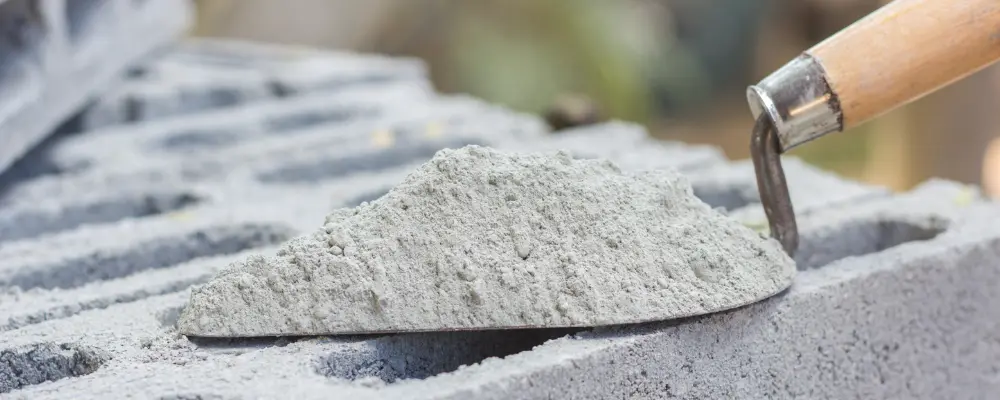
Cement is the fundamental material of the construction industry used in manufacturing and other construction activities. Understanding the different types of cement is important for selecting the appropriate cement. The two most widely used cement in various projects are Ordinary Portland Cement (OPC) and Portland Pozzolana Cement (PPC). 

They serve similar functions, but they have varied properties, compositions and applications. For strong buildings to mega structures, the primary concern of engineers and builders is to ensure strong concrete foundations. And for the concrete structure to be robust, the right type of cement choice is vital. Basically, OPC is the most used cement. If you study the difference between OPC and PPC, you can make the right decision by picking the best cement for your project. In this article, we examine the differences between OPC and PPC cement and discuss their uses in various construction applications.

Difference Between OPC and PPC Cement You Must Know

The basic OPC & PPC cement difference is in their chemical composition. so, let’s explore their differences below-

Ordinary Portland Cement (OPC)

OPC consists of chemical components like calcium silicate, aluminate, and ferrites. OPC attains early strength due to the rapid hydration of clinker minerals resulting in a denser microstructure. During the hydration, a quick reaction takes place between water and calcium silicates leading to faster strength development. In addition, it has higher fineness, which contributes to its faster strength gain and higher initial strength. OPC is available in three grades such as OPC 33, OPC 43, and OPC 53. This grade represents different categories of strength, such as 33 MPa, 43 MPa, and 53 Mpa respectively after 28 days of curing.

It’s higher early strength, making it suitable for projects that need a quick removal of framework and a faster construction schedule. The workability of OPC is good, but it requires more water compared to PPC for the same level of workability. Ordinary Portland cement has lower resistance to sulfate attack and other chemical reactions.

OPC is more expensive than PPC because of the higher cost of clinker production. It generates a higher carbon footprint due to the energy-intensive clinker production process.

Portland Pozzolana Cement (PPC)

PPC is mixed with OPC clinker and pozzolanic materials like fly ash, volcanic ash, or silica fumes. The development of a denser microstructure happens over time as the pozzolanic reactions proceed, which leads to reduced porosity and increased durability. It has a slower reaction, which involves the reaction of pozzolanic materials with calcium hydroxide released during OPC hydration. PPC has low strength gain, but it eventually reaches similar or higher strength than OPC over a long curing period. It has lower fineness compared to OPC resulting in slower strength development. PPC does not have grades, its strength matches with the OPC33 grade. 

In PPC, because of the pozzolanic materials, it offers greater workability, which enhances its cohesiveness and reduces bleeding. It has greater resistance to chemical attacks, including sulfate and chloride penetration. Because of the pozzolanic reaction that reduces porosity and permeability, PPC is different from OPC in the case of chemical resistance. 

Considering the price difference between OPC and PPC cement, PPC is more economical as it uses industrial by-products that reduce production costs. Industrial by-products like fly ash, reduce the reliance on clinker. Thus, PPC lowers the overall carbon emissions by being more environmentally friendly.

Comparison Table of  Portland Cement and Pozzolana Cement 

All the details about the difference between pozzolana and Portland cement are provided in the following table.

DescriptionOrdinary Portland cement (OPC)Portland Pozzolana Cement (PPC)
Composition It is composed of clinker produced by heating limestone and clay at high temperatures and a small amount of gypsum to control setting time. It is made by mixing OPC clinker with silicious or aluminous substances that react with calcium hydroxide to form compounds having cementitious properties.
Components / MaterialsIt has calcium, silicates, aluminates and ferrites.Pozzolanic materials include volcanic ash, fly ash and silica fume.
Setting TimeIts initial setting time is around 30 minutes, and the final setting time is about 10 hours. Its initial setting time is roughly 30 minutes to an hour and a final setting time of up to 12 hours.
FinenessHigher fineness and higher initial strength.Lower fineness and much higher final strength. 
Early Strength Higher early strength.Lower early strength.
Chemical ResistanceLess resistant to sulfate attack and other chemical reactions.Greater resistance to chemical attacks. 
Resistance to CrackingMore prone to thermal and shrinkage cracks due to higher heat of hydration.Has lower heat of hydration, resulting in a reduced risk of thermal and shrinkage cracks.
Carbon FootprintHigher carbon footprint.Less carbon footprint.
CostMore expensive.Less expensive.
Grades OPC is available in three grades.PPC does not have grades.
DurabilityThe difference between OPC and PPC is that OPC is less durable compared to PPC.PPC has more durability than other cement.

Uses of OPC and PPC 

Uses of OPC 

  • OPC is ideal for high-rise buildings because of the high early strength gain, which is important for the construction speed and load-bearing requirements of these structures.
  • It can be used in road pavements, bridges and flyovers. These structures need fast setting time, which is necessary to open them for use quickly.
  • OPC is ideal for precast concrete products like beams, columns and slabs.
  • It is suitable for concreting in colder climates where cold weather may slow down the setting process for other types of cement. 

Uses of PPC

  • PPC can be used for mass concrete work like dams, retaining walls, and foundations. It has lower heat of hydration, which reduces the risk of thermal cracking.
  • Another OPC and PPC difference is that PPC is highly resistant to sulphate and chloride attacks. Thus, making it suitable for marine structures like piers, docks, and underwater construction. 
  • PPC has a reduced risk of cracking and slower setting time. So, PPC is suitable for masonry and plastering work. PPC provides a smoother finish and enhanced durability. 
  • OPC and PPC difference is that PPC has resistance to aggressive environments and good durability. It is essential in the construction of hydraulic structures like canals, reservoirs, and sewage treatment plants.

Conclusion 

When choosing cement for the construction project, depending on specific requirements, consider OPC and PPC cement differences before selecting. PPC is ideal for constructions that require improved durability and long-term strength, while OPC is better suitable for projects requiring quick setting and strong early strength. By being aware of OPC & PPC cement differences, engineers and builders can choose the appropriate cement type, enhancing the life and sustainability of their constructions. For further guidance before starting your project, don’t forget to consult the experts at Brick & Bolt, as they will provide you with correct information, and the team of engineers and contractors can help you build your dream project.

Understanding Human-Centred Design in Architecture

0
Human Centred Design in Architecture

In today’s digital age, “human-centred design” is a phrase that is rapidly gaining momentum and increasingly given more importance in design fields. Although the term was first used by Irish Engineer Mike Cooley in his publication “Human-centred Systems” in 1987, the principles of HCD have been embodied in architecture for much longer. Read on to learn more about the term that forms the very essence of all aspects of design.

What is Human-Centred Design (HCD)?

Human-centered or Human-centric design, as the name suggests, refers to design that puts people and their needs at its forefront. Although architecture originally evolved to accommodate the basic requirements of shelter, it has since evolved to encompass various other aspects including the importance of people and how we experience spaces. Every space, built form, structure and room that we come across every day is created to be experienced by humans. The core concept of HCD is centered around enhancing these experiences to have a positive and memorable impact on humans. 

A simple example to understand the difference between normal design and HCD is ‘Smart Homes’. While smart homes often make our lives more convenient and simple with voice assistance and automation, elderly people may find such tools difficult to understand and operate. HCD ensures that spaces are designed based on the actual users of the space and not on changing trends.

Understanding the Human-Centred Design Process

The HCD process in theory may seem simple- designed for humans. However, the theory is much harder to put into practice and involves various steps to ensure implementation of successful and meaningful design.  

  • Study of User Groups

This forms the basis of HCD and involves exploration into how users may actually use the spaces that will be designed for them. It includes studying day-to-day activities of users, along with their movement in and utilisation of different spaces, in order to ensure functionality. 

  • Community/User Participation

Involving the people who will actually experience the spaces on a daily basis ensures a user-centred design process. They must be predominantly involved during the design process to provide valuable insights into the requirements and objectives of the design. A cooperative system between designers and users can lead to the creation of sensible and meaningful spaces.

  • Case Studies

Studying similar projects that have been successful in the past can be a significant step for sparking initial design concepts. Examining failures in past designs can also prove to be a learning tool for things to be avoided.  

  • Ideation and Implementation 

During each step of the ideation and implementation process, it is vital for designers to put themselves in the shoes of users or think like them. “How would I use this space?”, “What do I want from this space?” and “Why do I need this space?” are some of the important questions that need to be asked to generate initial design concepts for ideation.

Why is Human-Centred Design Important?

Every built form must prioritise humans and their activities in order to ensure the proper utilisation of spaces. HCD has several benefits, which make it an essential aspect of design that cannot be overlooked. 

  • Inclusivity

Universal design refers to design that caters to every individual, including senior citizens, specially-abled people, children, minorities and other vulnerable sections of society. This is a core aspect of HCD, which incorporates inclusivity and assures non-negligence of any section of society. Some representative aspects of Universal Design are ramps for wheelchair access, texture differentiations for the blind and slip-resistant surfaces for the elderly.

  • Integration of Technology

Technology is often integrated into built forms as a USP (Unique Selling Point). However, technology was developed by humans to make their lives easier and HCD ensures that it is incorporated solely for this purpose into buildings. People remain the focal point of design with technology meant to serve and assist with their needs.

  • Convenience, Comfort and Functionality

Study of user groups as a basis for designing allows human-centric designs to evolve into spaces that maximise the convenience and comfort of their users. Non-integral spaces are eliminated from designs to ensure functional built forms that cater specifically to the requirements of users.

  • Sensory Stimulation

HCD leads to the design of spaces that invoke the senses of sight, touch, sound and feel, achieved by the use of characteristic textures, colours, forms and other elements. This helps in creating spaces that have unique identities, are memorable and form emotional connections with their users.

  • Sociological Wellbeing

Habiting spaces that are designed with focus on the users result in increased productivity and cognitive performance. These lead to the generation of positive feelings of overall satisfaction and enhance sociological and emotional well-being.

  • Physical Wellbeing

Vital requirements for human sustenance, such as abundant natural lighting and ventilation, good air quality, thermal comfort and livability, are prioritised in HCD. Focus on safety and security of users also ensures the physical wellbeing of long-time users of the space.  

  • Community Development

HCD embraces local cultural and historical identities, which leads to the creation of a sense of belonging among users. It often involves the design of spaces that maximise social interactions and encourage communal harmony, while emphasising the concept that people are responsible for the creation of their own communities. This ultimately results in the overall development of the community.

Projects Based on the Human-Centred Design Approach

  • Desired Paths

Among human-centred design examples is the concept of ‘desired paths’ for walking. This refers to pathways that are created by people frequently walking along routes that are most convenient. For example, across large lawn areas, unintentional walking paths that did not initially exist, can always be observed. 

  • Park de la Villette

Architect Bernard Tschumi’s ‘Parc de la Villette’ is a 135 acre park in Paris, which uses ‘follies’ as points of reference and remembrance for its users. The enormous park does not have any organisational structure, but instead relies on people to “stumble upon” spaces that they want to use for playing, meditation and relaxation. This emphasises the organic and free flow pattern in which parks are generally used by people.

  • Quinta Monroy Housing

Architect Alajendro Aravena designed the Quinta Monroy Housing for economically backward sections of society in Chile. In this project, in-depth community consultations were made to create ‘participatory designs’. ‘Half houses’ were built for the people, with the potential to be expanded by their users based on the needs of their growing families. 

  • Kapaclajui Indigenous Training Centre

This educational institute in Costa Rica by Architects Entre Nos Atelier, was designed after a series of participatory design workshops were conducted for local people. Users were consulted in order to design spaces that accommodated their needs and respected local cultures, identities and environment.

Towards a More Human-Centric Tomorrow

Prominent architect Le Corbusier was famously quoted as saying “The house is a machine to live in”. However, our homes and cities are so much more than just machines. They are spaces where we spend the majority of our time, have life experiences and make memories. Italian architect and theoretician Aldo Rossi explains how architecture should be dynamic and alive, formed by individual senses associated with places and objects. HCD ensures that this essence of architecture is retained.

Rapid advancements in technology have led to social isolation of human beings, with a large part of our days spent staring at digital screens. In such times, HCD provides a vital sense of connectivity with our spaces and communities. The ultimate purpose of design is to serve humans and their needs and this is a guiding principle for all forms of design. Human-centred design thinking is thus a fundamental aspect of creating a better future for people, with meaningful spaces that serve their functions. 

Affidavit-Based Land Conversion status

0
Affidavit-Based Land Conversion

In India, converting agricultural land for non-agricultural purposes can be complex and bureaucratic. However, in some cases, the government has introduced an affidavit-based system for ease in this process. In the affidavit-based conversion procedure, land use conversion is certified by the landowners, which generally makes the procedure easier.

What is Affidavit-Based Land Conversion?

Affidavit-based land conversion is an easier procedure. It changes the status of agricultural land from non-agricultural use. You do it by filing an affidavit instead of a tiled application. This affidavit-based system is currently adopted in a few states in India like West Bengal, Karnataka, etc.

The key aspects of affidavit-based land conversion are:

1. Self-Certification: 

The landowner affirms, under penalty of perjury, that land use has changed. They affirm that zoning laws have been met and that the provided data is correct. This does away with the significant necessity of government checks and initiation.

2. Online Application:

Most states allow land conversion through affidavit filing. They process it with web applications, which adds to the ease.

3. Reduced Fees: 

Affidavit-based land conversion is cheaper than formal conversion. The latter has a bureaucratic process, making it costly for landowners.

4. Faster Turnaround: 

The affidavit-based mechanism speeds up land use’s turnaround time. It avoids long government approval procedures.

The Process Of Affidavit-Based Conversion of Land

1. Preparation of Affidavit: 

The landowner makes an affidavit. It describes the land’s features, its current and potential usage, and how it does not violate the zoning ordinances.

2. Online Application: 

Often, the landowner can start the affidavit-based land conversion process through an online form on the state’s land record website.

3. Document Submission: 

The landowner submits soft copies of the affidavit and other documents, including certificates of title, survey plans, and records of title deeds.

4. Verification and Approval: 

The Deputy Commissioner or Collector specialized in the specific area, or the Proper Officer referred to in the application, may check the applications and documents. In this case, the info that led to the land’s conversion is true. The planned use is legal under zoning laws. This led to the authorities’ approval.

5. Payment of Fees: 

Other conversions may require fees per the law and filing costs. But, the landowner pays the state’s prescribed fees and the property’s fees.

6. Issuance of Conversion Certificate: 

The government sends the land conversion certificate to the applicant. They do this once they approve the application. They send it through the quez system. The landowner can print it.

Affidavit-based land conversion status

Land conversion based on affidavits is a simpler process. It allows Indian landowners to legally change the use of their agricultural land. They can change it for non-agricultural purposes, like residential, commercial, or industrial development. This method removes the need for long government approvals. It is a more efficient option for landowners.

Karnataka: Landowners can check the status of their affidavit-based land conversion application on the Bhoomi portal (https://bhoomionline.co/)  by selecting the ‘View RTC and MR’ option and then ‘Mutation Status’.

a.

Checking Land Conversion Status

b.

Checking Land Conversion Status 
Bhoomi online

c.

Checking Land Conversion Status 
Mutation status

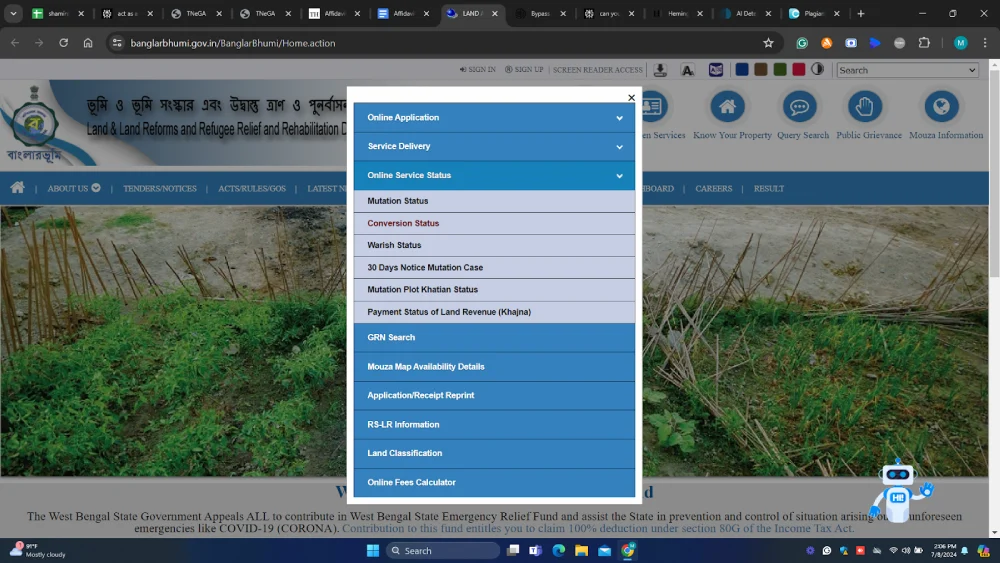
West Bengal: Landowners can log into the Banglarbhumi portal (https://banglarbhumi.gov.in/)  go to the ‘Citizen Services’ tab, and then click on ‘Online Service Status’ and ‘Conversion Status’ to check the status of their application.

a.

land & land reform and refugee relief and rehabiliation department

b.

converion status - Checking Land Conversion Status

Tamil Nadu: Landowners in Tamil Nadu can check the status of their land conversion applications through the TN e-Sevai online portal (https://www.tnesevai.tn.gov.in/) by providing the application number or other details. They can also visit the local revenue office or contact the Town and Country Planning Department.

The land conversion process is governed by the Tamil Nadu Change of Land Use Rules, 2017, but the state lacks a centralized online platform to track application status.

Other States: The process may vary, so landowners should check with the relevant state revenue or land records department.

Benefits of Affidavit-Based Land Conversion

1. Simplified Procedure: The use of affidavits makes it easier to change land use. They do away with bureaucracy and paperwork in the process.

2. Time-saving: It would have taken a government ministry a long time to verify and approve the land use change. The new affidavit-based system replaces the old, cumbersome procedures.

3. Cost-Effective: Affidavit-based conversion has lower fees than standard procedures. This helps landowners, especially those with small areas.

4. Increased Transparency: The self-certification in the affidavit-based system also helps transparency because the land owners themselves give the information hence ensuring that the information is correct.

5. Improved Land-Use Planning: The proposed system uses affidavits. It can help in land-use planning and management because the government can approve the switch from farm to non-farm uses.

Challenges and Considerations

1. Compliance with Zoning Regulations: A farmer has to ensure the land’s planned non-agricultural use complies with local zoning laws. The following are the consequences of failing to follow the rules that have been set for a student: Legal consequences may be imposed on a student. 

2. Accuracy of Information: The affiant gives details on the subject. So, the landowner is responsible for their accuracy. Fraudulent documents come with severe legal repercussions, and one can be charged in court for filling in fake documents. 

3. Verification and Monitoring: Though affidavits decrease the government’s role in the preliminary assessment, it has the right to do instant checks and inspections. 

4. Disputes and Objections: Nearby land owners and others may cause controversies. They can make the process slow or hard. 

5. Coordination with Local Authorities: Every landowner should consult with the local authorities. They must ensure that communication with the revenue department and the town planning office is constant and proper. 

Conclusion 

Affidavit-based land conversion in India has proven to be a step forward. It helps convert agricultural land for non-agricultural use. But the point is that some procedures the landowners must follow to convert the land. These procedures include legal and regulatory rules to be met.

Maximize Natural Light in Your Home | Design Tips & Benefits

0
Natural lights in home

In today’s lifestyle, where a large majority of time is spent indoors, natural light provides a vital connection to nature. It plays a crucial role in determining the livability and thermal comfort of any home. Read on to learn more about how this resource can be utilised to increase the aesthetic value of your home.

Benefits of Natural Light in Homes

Abundant natural light in a home has several psychological, emotional, physical and environmental benefits. These make it a basic necessity and an invaluable asset that needs to be inevitably and strategically planned for. 

Energy Efficiency

Increased natural light in the house results in reduced dependency on lighting fixtures in the daytime, leading to lower electricity costs and reduced carbon footprints. Sufficient natural light in colder regions can also aid in creating more comfortable internal temperatures and lower reliance on heating devices. 

Building Durability and Health

Exposure to sunlight prevents chemical and physical damages to buildings such as termite infestations and mould, which thrive in the dark and cause allergic reactions and rotting. Dampness can also cause structural damages, which can reduce the building lifespan.

Natural Light in Interior Design

The right amount of natural light can make a space seem larger than it actually is, which can be particularly beneficial for small-sized rooms. It can also brighten up spaces, as it makes colours appear more vivid.

Impact on Mental Health 

Having ample natural light in the house increases endorphins and serotonin levels, creating a sense of happiness and increasing productivity. It also helps in regulating sleep cycles and increasing energy levels, resulting in overall improvement of mental health. 

Impact on Physical Health

Vitamin D is an essential element for human sustenance, for which sunlight is the most important source. With the increase in time spent indoors, it is necessary to have sufficient natural light in enclosed spaces, including homes, in order to avoid deficiency.

Architectural Design Tips to Ensure Sufficient Natural Light in Homes

There are several techniques and design principles that can be incorporated to ensure maximum natural light in a home. These can be utilised in the planning stages as general guidelines for home design.  

Building Orientation and Site Planning

Building surfaces must be properly oriented to allow maximum natural light while preventing harsh sunlight with harmful UV rays. Therefore, studying sun-path charts or diagrams of specific regions is a crucial element of home design. In India, Western and Southern directions receive harsh sunlight, while Northern light is generally the softest. Thus, larger exposed surfaces must face the North and East, while Southern and Western-facing surfaces can be minimised. In cases where this is not possible, passive shading elements like overhangs and vegetation can be incorporated towards the West and South, which will help in diffusing harsh light.

Floor Plans

Open floor plans with minimal interior partitions not only aid in creating visually larger spaces but also allow maximum light penetration between different spaces. In case open floor plans are not preferable, room dividers made of translucent materials or perforations and openings can be utilised. Reducing clutter and unnecessary furniture can help transmission of natural light across different rooms. ‘Vertical open plans’, which include floor slab openings spanning across different floors and topped with skylights, also help in flooding light into multiple levels of a house.

Room Organisation and Size Ratios for Planning

Rooms in a home can be organised based on their time and duration of use, in order to permit maximum natural light and have optimal thermal conditions in the house. This also enables controlled degrees of light in different spaces. 

  • Rooms that are used throughout the day, such as living rooms or kitchens, can be placed towards the North, to ensure ambient natural light.
  • Rooms that are mostly used during the night, such as bedrooms can be placed towards the South and West, to avoid excess heat during the day and ensure warm conditions at night. 
  • Balconies and terraces can be oriented to have better views of sunrises and sunsets. They also act as buffer spaces that diffuse harsh rays at these times before transmitting them inside.

The size of spaces is another factor to be considered. Walls facing windows must not be placed too deep into a room, so that light can be transmitted uniformly all across. Having very deep rooms with fewer windows can result in dark or gloomy areas. However, the depth must also not be minimised, in order to prevent excess daylight and glare, which can make spaces visually and thermally uncomfortable. 

The Daylight Thumb Rule can be used to calculate optimum depth. It states that the maximum depth of daylight entering a space is 2.5 times the difference between lintel height (h1) and task or sill height (h2), i.e.,

Maximum Depth of Daylight = 2.5 (Lintel Height – Task or Sill Height)

                                                         = 2.5 (h1 – h2).

Thumb rule for natural light

The Daylight Thumb Rule

Source: Link

Positioning and Sizing of Windows

Similar to the building orientation, windows also need to be oriented to ensure optimum natural light. Windows on the Western and Southern sides can be smaller to avoid harsh sunlight, while Northern ones can be comparatively larger to allow soft light. Windows on the East side can be avoided in rooms that are used majorly during the early parts of the day to eliminate harsh early morning sunlight. If these cannot be avoided, they can be substituted with clerestory windows (windows that are above eye level), to allow diffused midday rays. 

Colour Schemes

Natural light in interior design also plays a significant role in ensuring thermal comfort of homes. The use of lighter colour tones can help in diffused internal reflection of natural light, resulting in brighter looking spaces, while darker colours absorb light and create dim spaces. Colours of all interior elements—including furniture, fabrics like curtains and carpets, wall paint and flooring materials—have an effect on the luminosity of a room. However, highly reflective elements can cause irritating glares and must be avoided.

Alternative Strategies for Maximising Natural Light in Homes

In cities with smaller plots and fewer exposed surfaces, it is often difficult to incorporate large windows to allow natural light. In such cases, it is advisable to include alternative strategies. 

  • Skylights 

These are openings in the roof slab generally covered with glass and allowing the entry of direct sunlight into a home. This glass can be frosted or incorporate additional screening elements to avoid harsh UV rays. 

  • Reflectors 

Materials or objects like mirrors and glossy laminates that can be placed in different locations for controlled reflection of the available natural light are termed as reflectors. These can be placed opposite to windows and other openings to double the amount of daylight entering the room.

  • Increase in Area Exposed to the Sun

Saw-tooth shaped or staggered roofs and walls with glass or other transparent materials increase the surface area that is exposed to the sun, thus bringing in more natural light. 

  • Screens

Perforated and latticed dividers or screens can be created as a substitute to solid walls for allowing diffused light into a room.

  • Light wells/ Sun Tunnels/ Sun Pipes

These are roof openings that are similar to skylights but are relatively smaller and have additional reflecting elements lined along a tube or box shape that help transmit the light into specific zones, such as darker spaces like basements and storage rooms. 

  • Light Shelves

A light shelf is a horizontal element fixed above eye level, close to glass windows. It is made up of reflective materials that reflect light to the ceiling, which then reflects back diffused light into the room.

Designing For Optimum Lighting Conditions

While having abundant natural light in a home has several benefits, it may not always be an ideal condition, for example in very hot regions. In these cases, it may be more important to block out excessive and harsh sunlight with passive shading elements and design methodologies. Strategies for use of light diffusers, reflectors and filters need to be incorporated as required in the region, to ensure ideal conditions. 

Therefore, it is vital to study solar charts for specific regions while designing, in order to optimise the amount of natural light in homes. It is advisable to hire experts who can assure the right lighting conditions for your home. Contact Brick & Bolt to build your dream home with ideal natural lighting today.

Permanent Solution for Roof Leakage

0
Roof Leakage

Roof leakage is a common problem encountered by homeowners and building managers. It causes inconvenience and structural damage and is not rectified. This blog provides you the information for understanding, identifying and providing some permanent solutions for roof leakage. 

Understanding Roof Leakage

Roof leakage happens when the water goes into the roof system. That is, water penetrates through the building’s interior. This may occur because of various reasons. Some of the reasons are poor installation, weather damage and so on. 

Some of the common signs of roof leakage include,

  • Water stains that are visible on ceilings and walls
  • Formation of moulds in attics or walls
  • Damp spots or water puddles in attics
  • Peeling of paints or wallpapers
  • Musty odours 
  • Increased humidity levels in the buildings.
Understanding Roof Leakage

Common Causes of Roof Leakage

There are certain causes that leads to leakage in roofs and the causes are explained below:

Poor Installation

The main cause of roof leakage is poor installation technique. This may be due to incorrect placing of shingles, faulty flashings, vents and skylights. Improper sealing in roof penetrations.

Weather Damage

Weather is another important factor that causes damage to roofs. The heavy rains can cause water to pool in the roof and can seep into the roof. Storms and high winds lift shingles or break the roof. Snow and ice will accumulate and cause problems in drainage. Freezing and thawing cycles can lead to cracks in the roof.

Ageing of Roof Materials

All materials used in the roof have expiry dates. After a long time, they will degrade and become less effective. 

Clogged Gutters and Downspouts

Clogged Gutters and Downspouts can cause roof leaks.  

Permanent Solutions for Roof Leakage

The below steps helps you to permanently prevent the roof leakage and are described below:

Regular Maintenance and Inspection

The first line of defence against roof leaks is regular maintenance. That is a biannual check for any signs of damage to the roof. Minor issues need to be addressed immediately. Maintaining proper water flow by cleaning the gutters and downspouts.

High-quality Roofing Material

It is a good choice if you can use high-quality roofing materials. This can help increase the life of the roof and prevent leaks. Metal roofings can be used for protection from weather damage. Synthetic shingles can be used for improved performance. High-grade asphalt shingles can be used for long-term performance and resistance properties. 

Proper Installation Techniques

Correct installation is required for your roof. So hire experienced and reputable roofing contractors. It will be great to follow the manufacturer’s guidelines. Pay special attention to the leak area. 

Effective Waterproofing

This gives extra protection to the roofs against leakage. Different types of waterproofing can be used. Liquid-applied membranes help in forming barriers over the roof. Sheet membranes like bituminous and rubberized asphalt, can provide strong waterproofing. Spray polyurethane foam can help in continuous and insulated barriers. 

Sealing and Flashing

Proper sealing and flashing are needed for the prevention of roof leakage. Use of high-quality sealants, installing flashings properly and regular inspections can help in preventing leaks. 

Attic and Ventilation Considerations

For the maintenance of roof health proper attic and ventilation is necessary. This can help in the reduction of moisture. Extends the roofing materials’ lifespan and improves energy efficiency (temperature regulation). 

Advanced Roofing Technologies

Some advanced roofing technologies can help in the prevention of roof leakage.

Modern Roofing Systems: It includes cool roofs, built-up roofs and modified bitumen roofing.

Smart Roof Monitoring Systems: Here sensors are used. Also integration of home automation systems used for monitoring.

Green Roofing Solutions: They provide environmental benefits. Their key benefits are improved insulation. Management of stormwater and UV and temperature protection.

Advanced Roofing Technologies

Step-by-Step Guide to Fixing Roof Leaks

Some common steps in fixing roof leaks are 

  • Source identification
  • Temporary Fixes
  • Permanent Repair Process
  • Safety Considerations

In the Permanent Repair Process, certain steps can be followed.

Preparation  

Gathering necessary tools and materials. Ensuring that safety measures are in place.

Remove Damaged Materials

Carefully remove damaged shingles, flashing, or other roofing materials.

Repair or Replace  

Installing new materials and making sure that they are properly aligned and sealed.

Waterproofing  

Apply a waterproof membrane or sealant to protect the repaired area.

Inspection 

Conduct a thorough inspection to confirm the repair is effective and watertight.

Preventive Measures for Future Protection

Some important preventive measures can be followed for future protection. They are regular inspections, maintenance according to seasons and proper checking by homeowners. 

Conclusion

Roof leakage can cause serious problems. They can cause more damage and repairs are costly. So they need to be addressed immediately. Roof leakage must be inspected regularly and the repair must be done immediately. This can help in maintaining a healthy roof for a long time. 

FAQs

1. How often should you inspect your roof? 

At least twice a year, also during spring and fall. Additionally after major weather events.

2. What are some temporary fixes for roof leaks? 

Some temporary fixes are by applying roofing cement or tape and covering damaged areas with a tarp.

3. What are some recommended roofing materials? 

Some roofing materials are metal, synthetic shingles and asphalt shingles that are of high grade.

Know Properties of sand with its types and uses

0
Sand in Construction

Sand is a vital and multipurpose natural material. Sand is used in various manufacturing and construction activities. It is made up of finely divided rocks and mineral particles, which have a range of properties of sand that make it important in diverse applications. The particle size, shape and composition of sand can differ greatly, influencing their behaviour and suitability for different uses.

The unique properties of sand, like its ability to compact under pressure and provide stability, make it an important ingredient in concrete, mortar and asphalt. Sand is a key component for construction, but it also affects soil health and coastal dynamics in environmental and geological contexts. This article discusses the technical properties of sand, like the physical and chemical properties of sand and highlights its role in the construction environment.  

Properties of Sand

Look at the properties of sand in construction that make it an ideal construction material.

1. Particle Size and Distribution

2. Shape and Texture

3. Composition

4. Adhesiveness 

5. Cohesiveness 

6. Density and Specific Gravity

7. Permeability and Porosity

8. Thermal Conductivity

Let’s have an overview of each of these properties of sand.

1. Particle Size and Distribution

(i) Grain Size

The diameter of sand particles ranges from 0.0625 mm to 2 mm. Sand can be divided according to size on the geological scale between silt, which has finer particles, and gravel, which has coarser particles. For a sand sample to be used in a particular application, the uniformity or gradation of particle sizes is an essential physical property of sand.

(ii) Gradation

Gradation is the distribution of various particle sizes within a sand sample. Sand that has been graded properly offers good compaction and stability, and it also has a range of particle sizes, which makes it perfect for construction. For applications demanding high permeability, sand with uniform particle sizes but poor grading is used.

2. Shape and Texture

(i) Grain Shape

There are four types of sand particle shapes, such as angular, sub-angular, rounded, and sub-rounded. Sharp-edged angular grains give construction materials greater interlocking and durability. In situations where smoother textures are beneficial, like playground sand, rounded grains with smooth surfaces are frequently chosen. 

(ii) Surface Texture

Sand grains have two different surface textures: smooth and rough. Because they have more surface area for the binding agents to stick to, sands with a rough texture improve bonding in mortar and concrete.

3. Composition

(i) Mineral Content

Sand mainly consists of quartz (silicon dioxide, SiO2), which is known for its chemical stability and hardness, which is one of the core sand properties. However, depending on the source of the rock, sand can also contain other minerals like magnetite, feldspar, and mica.

(ii) Impurities 

The quality of sand can be affected by impurities, like silt, clay, and organic matter. The strength and durability of the sand can be affected by high impurity levels in them.

4. Adhesiveness 

The capacity of sand particles to stick to other materials is known as adhesiveness. This chemical composition of sand is important when sand is used with binding substances like cement or clay in manufacturing or construction processes. Adhesiveness affects concrete and mortar workability. The physical properties of sand, like the shape and surface texture of the grains of sand, also impact it.

5. Cohesiveness 

Cohesive sand particles tend to bind together because of intermolecular interactions. This property of sand is necessary for sand’s stability and compaction in a variety of applications. 

6. Density and Specific Gravity

(i) Bulk Density of Sand 

The moisture content and level of compaction of sand affect the bulk density of sand. Wet sand can have a bulk density of up to 2000 kg/m³, but dry sand density is around 1600 kg/m³.

(ii) Specific Gravity

Generally, sand has a specific gravity of 2.60 to 2.80, which is the ratio of its density to that of water. Specific gravity is the core sand property and is vital for figuring out how much sand is needed for a specific mass.

7. Permeability and Porosity

(i) Permeability

The ability of sand to permit liquids to move through it is referred to as permeability. The permeability of poorly graded sand with uniform particle sizes is higher than that of well-graded sand with a range of particle sizes. Sand permeability is essential for uses such as water filtration and drainage systems.

(ii) Porosity

Porosity measures a material’s void content. Sand’s porosity impacts how well it holds and transfers air and water. In agricultural applications, high-porosity sand enhances soil aeration and drainage.

8. Thermal Conductivity

Sand is useful in applications that need insulation because of its moderate thermal conductivity. Because of its capacity to store and transfer heat, sand can also be used in concrete to provide thermal mass for buildings.

Types of Sand

Primarily six types of sand are used in construction, and each has unique features, advantages, and disadvantages. Let’s examine them briefly.

  1. River Sand: A naturally occurring sand that is collected from riverbeds and is popular for its smooth texture and high quality. The river sand’s chemical composition gives it very good strength and binding properties. 
  2. M-Sand: M-sand, or manufactured sand, is sand that is made artificially by crushing hard granite stones. The properties of sand in construction make it a suitable substitute for river sand. It is known for its consistent qualities and environmental benefits.  
  3. P-Sand: Sand specifically designed for plastering tasks is called plastering sand or P-sand, and it’s a fine-grade sand that guarantees a smooth wall finish and strong adhesion.
  4. C-Sand: Coarse sand also known as concrete sand, is added to concrete mixtures to give construction projects stability, strength and bulk.
  5. Filter Sand: To ensure a clean and safe water supply, filtration systems use this specially graded sand to remove impurities and contaminants from water.
  6. Bedding Sand: It serves as a bedding layer for laying paving stones, bricks, and other materials by providing an even and stable base.

Uses of Sand in Construction

The properties of sand play a vital role as it is used in different construction processes.

  1. Concrete: When cement, water and aggregate are combined to make concrete, the properties of sand in the mixture provide a homogeneous mixture that reduces voids.
  2. Mortar: Again, the mixture of cement, sand and water bond masonry units together by creating a smooth, workable and easily applicable mixture.
  3. Plaster: To finish interiors and exterior walls and is sometimes added to plaster. Sand provides additional strength to the plaster because of the chemical properties of sand.
  4. Masonry: Sand used in masonry provides strength and stability. It is placed between the blocks during the brickwork to help level them and create a surface on which the mortar will stick.

Conclusion

Sand is a versatile material with a wide range of applications in the construction industry. It is essential to understand the bulk density of sand, the chemical composition of sand, and the physical properties of the sand to use it appropriately for certain tasks. The type of sand used has a big impact on the quality, durability, strength and stability of building components. Whether sand is used to create moulds for metal casting, produce concrete, or build structures, it is vital to study the properties of sand. At Brick & Bolt, you can get a professional team for construction-related knowledge and projects, and you can rely on the team of specialists for your next construction project to bring your dream project to reality.