Home Blog Page 67

Types of Beams in Construction and Civil Engineering

0
Types of beam in construction

Introduction

Beams are an important structural element in any construction, whether simple or complex. They are essential to conferring both protection and strength to any type of construction. Understanding beams and their functionality can be a great asset when you are thinking of building or renovating. In today’s Brick & Bolt blog, you’ll delve into the concept of beams, the main types of beams, how they work, and what to consider before opting to choose them. Understanding the basics can help you make wise choices that assure your project is safe and effective.

What is a Beam in Construction?

A beam is a structural element, responsible for bearing bending loads laid upon an open span and transferring them to the supports at the end of the member. The importance of a beam in construction is more than vital, carrying supporting floors, roofs, and other structural members—though not exposed to any type of bending and shear force. Beams can be made from different sorts of materials according to specifications, such as wood, types of steel, concrete, or a combination.

Different Types of Beam in Construction

There are numerous types of beams in construction, each designed to carry specific types of loads and serve different purposes. Here are the most common types:

  1. Simply Supported Beams
  2. Cantilever Beams
  3. Fixed Beams
  4. Overhanging Beams
  5. Continuous Beams
  6. Plinth Beams
  7. Truss beams
  8. I-beams
  9. Box beams
  10. T-Beam
  11. Compound Beam

Simply Supported Beams

Simply supported beams

Simply supported beams are the most widely utilised type of beam in building construction. Supported on both ends, they span the load, transferring it to the supports and creating upward forces that resist bending. Common applications include floor beams for buildings, bridges, and crane girders. However, these beams bend when a load is applied over the span. Their basic nature makes them a fundamental part of bridges, residential buildings, and small-scale industrial constructions.

Cantilever Beams

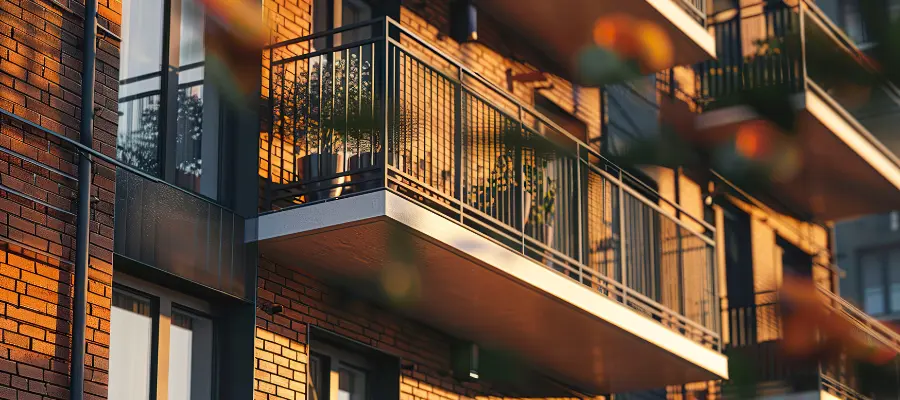
A cantilever beam is a special type of beam fixed at one end and projecting horizontally at the other. These beams are commonly used in balconies, towers, and bridges. This design has one end cast or anchored to a vertical support. Cantilever beams can be made of either concrete or steel.

Fixed Beams

A fixed beam is one that is fixed and restrained at both ends; it is also called a fixed-end beam, built-in beam, or restrained beam. Such a beam does not allow rotations at the supports and is very effective in case of resisting moment loadings. These are very common in continuous structures, like multi-span bridges and large buildings where no or only very minimal rotation occurs at the supports.

Overhanging Beams

The beam having two different supports and extended up to some distance at one end or both ends is called an overhanging beam. The end of the extended side of the beam does not have any support. It is used to balance the axial moment at the support of the column. It raises the life span of the column and beam reduces one sided load The general uses of overhanging beams are bridges, balconies, and canopies.

Continuous Beams

Continuous beams are made up of several beams joined together to provide a single, uninterrupted span over a number of supports. The key advantage of continuous beams is their ability to provide more even load distribution, resulting in reduced bending moments and increased stability in a structure. They can be used very effectively in structures with very large openings like bridges.

Plinth Beams

A plinth beam is a reinforced concrete beam that sits between the wall and its foundation. Its main job is to stop cracks from spreading from the foundation into the walls above if the foundation settles. Plinth beams help evenly distribute the wall’s load across the foundation, keeping everything stable and secure.

Truss beams

A truss beam is a framework structure, simply known as a truss, which supports loads by means of distributing forces through its interconnected elements. It is made up of straight members, which are arranged in the form of a triangle and connected together at the endpoints. The truss beam design is such that it ideally fits both compression and tension forces, making it ideal for large spans and heavy loads in various structures like bridges, roofs, and towers. 

I-beams

This type of beam has two horizontal flanges connected through a vertical component; hence, the cross-section is in the form of the letter “I” It is very commonly used in the construction industry, and I-beam excellent load-carrying capability makes it ideal for large construction projects.

Box beams

Box beams are stronger and more rigid as they distribute weight over four different surfaces. Their construction has a rectangular cross-section; hence, it’s also called a rectangular beam. When large loads and extensive spans are required, box beams are employed.

T-Beam 

T-beams are a major type of beam in civil engineering, which look like the letter “T” from a side perspective, and are used in floors and roofs to prevent bending. When it comes to construction, they are more effective than rectangular beams.

Compound Beam

A compound beam consists of two basic beams joined by a strut, which is a third piece that connects them. This design is used when an exceptionally large span is required, providing the necessary support and stability for extensive openings.

Factors Influencing Beam Selection

The selection of beams is an important consideration in any structural design. The following are the major factors that need to be considered:
Cantilever beams

Load requirements

The load-bearing capacity of the beams is the first and most crucial consideration when choosing the right type of beam for your construction. The weight of the building, its furnishings, and along with th dead loads any live loads —such as occupants and furniture—must be supported by the beams. The size, shape, and material of the beams will determine how much weight they can support. This is also a key factor in obtaining a structural stability for your building.

Span Length

The distance between a beam’s supports is known as its span length. The longer the span, the more force the beam will be required to support. Generally, it is best to keep spans as short as possible to lessen the load on the beams. Yet, there may be cases where longer spans are required, such as in large open spaces. In such cases, larger beams may be necessary to add extra supports

Aesthetic Considerations

Generally, beams are one of the strongest structural features in a building and may highly influence its appearance. With certain design aims in mind, it will either be more desirable to obscure the beams or minimise their presence.

Cost Considerations

The cost of beams can vary significantly based on the material, size, and shape. It’s important to include the expense of beams in the overall building budget to ensure that construction stays on track financially.

Why Are Beams Important?

One way beams work is by making buildings, bridges, and other structures safe and sturdy. Without the beams functioning on these structures, the edifices may collapse from their weight—if not from an earthquake. They ensure the engineers and builders that, respectively, the right type of beams has everything built to last strong and long.

Conclusion 

Beams are the most important entities in a construction site as they give strength and load-bearing capacity to different structures. For a common man, understanding different beam types is essential since it will have all the effects related to his house’s safety, cost, and maintenance. Beams are key components in a building’s structure; they support loads and transmit the same to the foundation, while at the same time ensuring that stability is achieved. Knowing all the types of beams will save you from costly errors and ensure your home renovation meets building standards. For expert advice regarding the selection and use of beams, you can consult a range of established construction companies in your locality. One of Hyderabad’s top construction firms is Brick&Bolt. They can work with you to find out what type of beam will serve the needs of your particular building, while still being responsive to concerns regarding loads and architectural design. To find out more about how your decisions in beams will cost or save you money in the long run, try our innovative building cost estimator tool.


What is a Legal Heir Certificate? Importance, Process, and Requirements

0
Legal Heir Certificate

If one faces the complexities of inheritance after the loss of a loved one, a legal heir certificate might be the crucial document you need. This certificate is an official document issued by the government that identifies the rightful heirs of a deceased person. This allows them to claim ownership and transfer assets such as property, bank balances, insurance benefits, and other financial assets.

In this blog post, we are going to discuss what a legal certificate is, why it is important, and how one can get it.

What is a Legal Heir Certificate?

What is a Legal Heir Certificate

A Legal Heir Certificate is an official document issued by government authorities to establish the rightful heirs of a deceased person. This certificate is essential for the heirs to claim the deceased’s assets. It can be property, bank accounts, insurance benefits, and other financial claims. The certificate typically lists the names, ages, relationships, and addresses of the legal heirs, thus serving as proof of their entitlement to the deceased person’s estate.

They are particularly important in situations where the deceased did not leave a will, or when there is a need to transfer ownership of assets or settle disputes among heirs. 

To obtain the certificate, various documents, such as the deceased’s death certificate, identity proofs, and an application form, should be submitted. In India, a legal heir certificate is required to determine property transfer for people who die before leaving a will.

Who are the Legal Heirs?

Legal heirs are the relatives of the deceased person who are entitled to inherit their properties as per the Indian succession law. The term legal heirs differs according to the religious and personal laws prevailing in the case of the deceased.

For Hindus, Sikhs, Buddhists, and Jains, the Hindu Succession Act of 1956 defines the order of succession. Class I heirs have the first right to inherit,these include the deceased’s spouse, children (including adopted children), and parents. 

In the absence of Class I heirs, Class II heirs, such as grandchildren, siblings, and other relatives, can claim the property.

As per Islamic law (Sharia), the inheritance rules are different and follow Islamic teachings.

Who are the Legal Heirs

Importance of a Legal Heir Certificate

1. Claim and Transfer of Property and Assets: 

The heir certificate helps the rightful inheritor in taking control of the deceased’s property, bank accounts, and other money.

2. Closure of Accounts of Deceased People: 

The certificate helps freeze or close the accounts and other financial records of the deceased to enable better administration.

3. Proof for establishing legitimacy:

This certificate officially recognizes the legal heirs of a deceased person. It provides an authoritative confirmation of the relationship between the deceased and the heirs.

4. Resolution of Inheritance Disputes: 

The heir certificate helps resolve inheritance disputes by clearly identifying the rightful heir(s) to the property of the deceased.

Requirements for Obtaining a Legal Heir Certificate

To apply for a legal heir certificate, the applicant must provide the following documents:

1. Death certificate of the deceased.

2. Proof of relationship with the deceased (birth certificate, marriage certificate, etc.).

3. Identification documents of the applicant (Aadhaar card, PAN card, etc.).

4. An affidavit stating the applicant’s relationship with the deceased and their claim to the inheritance.

5. No-objection certificates from other potential heirs (if applicable).

Process of Obtaining a Legal Heir Certificate

To get a legal heir certificate, the applicant needs to ask the Taluk Tahsildar or the district civil court. They must go to the one in the area where the deceased person lived. 

The process typically involves the following steps:

1. Filling out the application form: 

The applicant must complete a standard application form, which must include explicit information on the decedent’s name, date of death, and relationship to the deceased.

Submitting required documents: 

The applicant must enclose the necessary documents with the application, including the death certificate, the heirs’ IDs, address proof, and a list of all living members.

1. Paying the fees: 

For this type, the applicant is required to make some payment, which may differ depending on the state and the issuing authority.

2. Undergoing an inquiry: 

The issuing authority checks the validity of the information in the application and  confirms the relationship between the deceased and the legal heirs. An inquiry is conducted for this purpose.

3. Receiving the certificate: 

In case of favourable response to the inquiry with all the papers being correct, the legal heir certificate can be released to the applicant.

It might take about 30 days to obtain a legal heir certificate, depending on the state and the concerned legal authorities. In case there are some problems or there is a need for alterations, the applicant may turn to the Revenue Division Officer (RDO) or the sub-collector.

Legal Heir Certificate Vs Succession Certificate

AspectLegal Heir CertificateSuccession Certificate
PurposeIt establishes the relationship of the heirs with the deceased.It establishes the authenticity of the heirs and authorizes them to inherit debts, securities, and assets.
Primary UseTransfer of movable assets such as bank balances, fixed deposits, shares, insurance claims, and service benefits.Transfer of movable and immovable properties, debts, and securities of the deceased.
Issued ByLocal government authorities.Civil court after a legal process, including public notice and verification.
Common Requirements– Death certificate of the deceased<br>- Identity proofs of heirs<br>- Application form– Death certificate of the deceased<br>- Identity proofs of heirs<br>- Application in court<br>- Legal process including public notice.
Movable PropertyYes, it is used to transfer movable properties.Yes, it is used to transfer movable properties.
Immovable PropertyNo, it is not valid for the transfer of immovable properties.Yes, it is required for the transfer of immovable properties.

Conclusion

An heir certificate is a legal document used to ensure that the property and assets of the deceased go to the correct heir. Indian nationals should know the rules and procedures for getting this certificate to help avoid issues during inheritance. Understanding the differences between a Legal Heir Certificate and a Succession Certificate is crucial for a smooth and legally compliant transfer of assets.

What is a Modular Home?

0
Modular Home

Are you a prospective homebuyer, architect, or construction pro? You may wonder what a modular home is. How does it differ from traditional site-built homes? The modular homes are factory-built, pre-engineered structures. They are carefully transported to the building site and assembled there. They offer a range of benefits. These benefits are attracting the attention of various housing industry stakeholders.

Modular Home

Pros and Cons of Modular Homes

Pros

Shorter Building Time:

  • One big advantage of these homes is the much shorter construction timeline. 
  • Most of the building process happens in a factory. 
  • So, on-site assembly is much faster than for a site-built home. 
  • It often takes weeks, not months.

Flexible Specifications: 

  • Modular home designs offer much customization. 
  • Homeowners can customize the layout, finishes, and features to their needs and preferences. 
  • This flexibility also applies to the ability to easily change or expand the home future. 
  • This makes it a versatile choice.

Reduced Waste:

  • The modular homes are built with precision and factory control. 
  • They have less waste than site-built homes. 
  • This helps the homes be more sustainable and eco-friendly.

Potentially Better Construction:

  • The modular homes often use better materials. 
  • They also have stricter quality control compared to traditional site-built homes. 
  • This can result in a more durable and energy-efficient final product.

Cons

Customization Limitations:

  • The modular homes offer much customization. But, they may have some limits compared to a fully custom-built home. 
  • Certain design elements or features may be restricted by the modular construction process.

Additional Costs:

  • Modular homes’ upfront costs can be higher than those for traditional homes. 
  • This is due to the specialized manufacturing process and transportation needs. 
  • But, these costs may be offset. There will be savings in energy efficiency and maintenance.

Preconceived Notions:

  • Some homebuyers may have preconceived notions about the quality or looks of such homes. 
  • These average ideas can be a barrier to their widespread adoption. 
  • Aware the public about the progress in modular home design and construction can fix these views.

How Much Does a Modular Home Cost?

How Much Does a Modular Home Cost
  • The cost of a modular home can vary a lot. It depends on factors like size, features, and location. 
  • On average, it tends to cost Rs. 4,000 to Rs. 12,000 per square foot. The lower end is for basic, entry-level models. The higher end is for luxury options.
  • The total cost includes the base price of the home. It also includes the cost of site prep, the foundation, utilities, and any upgrades. 
  • Homebuyers should weigh these factors. They should do this when budgeting for a modular home project.

What Is a Modular Home’s Resale Potential?

  • The modular homes have had strong resale value. 
  • They often perform as well as or better than traditional site-built homes. 
  • This is because of the high-quality construction and energy efficiency. 
  • Also, these homes are now more accepted and desired in the housing market.
  • However, the resale value of a modular home can be influenced by factors including the location. 
  • Also, the local real estate market matters. So does the level of customization and upgrades made to the home. 
  • Like any real estate investment, buyers must research the local market. 
  • They should ask real estate pros. They need to know the potential resale value of a modular home.

Who Is a Modular Home Right For?

The modular homes can be an attractive option for a wide range of homebuyers, including:

  • First-time homebuyers: Looking for a more affordable and efficient housing solution.
  • Families: Seeking a customizable and flexible living space that can grow with their needs.
  • Environmentally-conscious individuals: Interested in sustainable and energy-efficient construction.
  • Homeowners in remote or rural areas: Where traditional site-built construction may be more challenging.
  • Investors or real estate developers: Seeking a cost-effective and time-saving construction method.

Modular Homes Vs. Manufactured Homes Vs. Mobile Homes

FeatureModular HomesManufactured HomesMobile Homes
Building CodeConstructed as per the mentioned building codes as site-built homesBuilt as per federal Manufactured Home Construction and Safety Standards (HUD code)Built as per the same HUD code as manufactured homes
FoundationTransported to the noted site and rightly assembled on a permanent foundationTransported to the site on a permanent chassisDesigned to be easily transported and relocated
CustomizationCan be customized and integrated into the local architectural styleGenerally less customizable comparativelyCustomization opportunities are less but possible.
LifespanTypically, 50 years or more with proper maintenanceTypically, 30-35 years or more with proper maintenanceTypically, it has a limited lifespan based on age, condition, and maintenance

Conclusion

The modular homes are a compelling alternative to traditional site-built construction. They offer homebuyers, architects, and construction professionals many benefits. These include faster build times. They also have flexible customization and may be more energy-efficient and durable. The modular home industry is evolving and gaining acceptance. It is likely to become more popular. People seeking innovative, sustainable, and cost-effective housing will choose it.

How to reduce the Home Loan Tenure?

0
Home Loan Tenure

Buying a home and holding the keys in hand was a blissful moment to which every millennial could aspire. It is one of the milestones in their life that they try to achieve, even by getting a loan. On the other hand, it keeps getting overwhelming while repaying it for a long tenure with huge interest payments, which might become quite tough and stressful. 

In this blog, you’ll learn a few ways to reduce your Home Loan Tenure and close the EMI quickly.

13 Tips to Reduce Home Loan Tenure

13 Tips to Reduce Home Loan Tenure

1. Increase EMI Payments

One basic approach that you can adopt to reduce your home loan tenure is increasing your EMI payment. If you have such financial capacity in your family, plan to pay a higher EMI than the minimum required. This will help you pay off the principal amount faster, reducing the interest over the loan period.

Let’s take your current EMI to Rs. 20,000 and you increase it to Rs. 25000; the extra Rs.5000 will go towards the principal amount. This way reduces your principal faster, cuts down the overall interest you pay, and reduces the loan tenure.

2. Make Partial Prepayments

Partial prepayments can sometimes help reduce the tenure period. They involve paying a lump sum towards your loan whenever you have extra money. This reduces the principal amount and, consequently, the interest of the loan.

Let’s say you receive a yearly bonus, but instead of spending the entire amount, use part of it to make a partial prepayment toward your loan. If you pay Rs.1,00,000 in advance each year, you will save quite a sum in interest and shorten your loan term by a few years.

3. Opt for Bi-Weekly Payments

Normally, an EMI is paid based on the loan amount due each month. The main advantage of choosing the bi-weekly payments option is you’ll make 26 half payments in a year, which will equal 13 full payments.

To be precise, if your monthly EMI is Rs. 20,000, the bi-weekly payments will work out to Rs. 10,000 every two weeks. With this method, you end up making one extra EMI payment over the course of a year, which actually helps you repay the loan a lot more quickly.

4. Refinance for a Lower Rate

In case the interest rate is more than usual, you are bound to face problems in its repayment. You can opt for a new loan at a lower interest rate for payment of the existing ones instead of repaying the existing loan at this time. This is what we call Refinancing. It allows you to lower your monthly payments or retain them while cutting the borrowing term. 

In order to do that, you need to seek out banks or other registered financial institutions (RFIs) that have interest rates on housing loans lower than those charged to your current one. When comparing different lenders, calculating the savings or interest saved, therefore requires you to plan for the repayment period of your loan.

Doing this lets you manage your home loan and achieve financial freedom sooner.

5. Switch to a Bank with Lower Interest Rates

If your current bank does not offer the interest rates like others, consider switching to another bank that does. 

Example:

If you are paying 8.5% interest with your current bank and another bank offers 7.8%, switching can save you a significant amount in interest payments, reducing your loan tenure.

Switch to a Bank with Lower Interest Rates

6. Dedicate Windfalls to Loan Repayment

If you receive windfall profits like tip-offs, tax refunds, or presents, channel them to servicing the loan. Like, when you get an annual bonus of Rs. 1,50,000, use part of it to settle some debts instead of spending it all. It reduces your principal and makes servicing it faster. Minimize Unnecessary Costs

7. Cut Down on Non-Essential Expenses

It might be new to you and your family to adapt to this necessity all of a sudden. Before planning, you must communicate with family members to coordinate with you along the process. 

For Instance, if you spend Rs. 5,000 a month on dining out, try reducing it to Rs. 2,000 and use the saved Rs. 3,000 towards your EMI. Small savings like these can make a big difference over time.

8. Set Short-Term Repayment Goals

If you find a way to reduce the home loan tenure, it is important to figure out the short-term and long-term goals. This can be achieved by setting deadlines for each goal. Calculate your EMIs, and list all your loans along with their tenure periods. Categorize them into short-term and long-term goals to prioritize paying off the smaller loans first.

For Example, if your goal is to reduce your loan tenure by 5 years, set a target of making a partial prepayment of Rs.50,000 every six months. Achieving these smaller goals will keep you on track for the bigger goal.

9. Automate Savings for Prepayment

Between the juggling responsibilities, it is difficult to remember the date you planned to save. It is better to set up an automatic transfer to a dedicated savings account every month. This will accumulate funds for partial prepayments.

For Instance, you set up an automatic transfer of Rs. 5,000 from your salary account to a savings account each month. After a year, you will have Rs. 60,000 to make a partial prepayment on your loan, which is huge, right? Instead of forgetting the time to save, start automating the savings account.

10. Use Salary Hikes for EMI Payments

When you receive a hike or promotion, use a specified amount to increase your EMI payments instead of your spending.

Imagine that your monthly salary increased by Rs. 10,000 more than usual. And your original EMI is Rs. 20,000. After receiving the salary increase, you will now be able to pay Rs.30,000 per month. 

This extra payment will make you repay the loan quickly, reducing the interest you need to pay.

11. Review Loan Agreement for Best Terms

Getting a loan is not a one-time commitment. It never ends until the EMI payment is complete. Until then, you should be aware of things regarding the loan document, and you need to review it periodically to understand the best possible terms.

These are a few mandatory things you need to look for in our Loan Agreement:

i) Firstly, check the interest rate type (fixed or floating) and the current rate.

ii) Check whether there is a penalty for prepayment or early payment of the loan.

iii) Know about the options applicable to change the tenure during the loan period.

iv) Check whether there is flexibility to pay the loan at your convenience based on your financial situation.

v) Check out any fees associated with the loan, such as processing fee, late payment charges, and administrative fees.

vi) As per Section 80C and Section 24(b) of the Income Tax Act, check whether the loan structure allows you to maximize tax benefits.

12. Educate Yourself on Tax Benefits

As far as finance are concerned, you should keep yourself updated with the tax benefits, which can save quite a bit of money and result in a good reduction in your tenure.

Among these, Section 80C of the Income Tax Act was one. You never know, you can avail a deduction upto Rs.1.5 lakh on the principal repayment, and under Section 24(b), you can get up to Rs. 2 lakh on it. Use these savings to make extra payments on your loan.

13. Stay Disciplined

Everyone overlooks discipline today. But to reduce your loan tenure, stick to your repayment plan and avoid the temptation to spend extra funds on non-essential items. More than planning, following consistently could get you the result you dreamt of.

Disciplined planning for closing a home loans can help you out with the ways you can close due on time.

Conclusion

Reducing your home loan tenure can offer financial benefits, including lower overall interest payments and easy home loans. By making higher EMI payments, opting for part-prepayments, increasing the loan EMI with your salary hikes, and choosing shorter loan tenures from the start, you can effectively shorten your home loan tenure. 

Additionally, implementing these methods requires discipline and careful financial planning, but the long-term savings and financial freedom make it a worthwhile endeavor. Regularly review your repayment plan so that you can achieve the goal of reducing your home loan tenure and securing your financial future.

HMDA Land Use Certificate: Essential Guide for Applicants

0
Metropolitan Development Authority

HMDA is abbreviated as the Hyderabad Metropolitan Development Authority (HMDA). The HMDA land use certificate is an important document that all property owners and developers should have in the Hyderabad Metropolitan Region. 

The certificate ensures that the piece of land is within the regulations of the zonal region and is under the area’s rules. It is a mandatory process that constructors and developers should have, as it outlines and validates the HMDA’s plan for the building.

Purpose of an HMDA Land Use Certificate

The applications for an HMDA land use certificate are listed below.

Purpose of an HMDA Land Use Certificate

Notification of Investment:

The HMDA certificate protects the land from any misuse. Imagine a property intended for residential purposes, but the ambitions are towards building a commercial complex. The HMDA certificate prevents such missteps.

Loan Process:

To get a loan for construction or to purchase a property having an HMDA certification adds strength to the approval process.

Permits of Construction:

The HMDA certificate allows you to have a clear understanding of the permits for the property. This helps to envision and execute a clear plan for the property.

Fair Price Evaluation:

Having a land use certificate will help you to claim the desired price for the land while selling it or while purchasing it.

Trust:

The land use certificate indicates transparency and builds trust between both the buyer and the seller. The land potential is known, and further disputes are prevented.

These are some of the important reasons why having a land use certificate can help you.

Eligibility For Applying for HMDA Land Use Certificate

Eligibility For Applying for HMDA Land Use Certificate

To get an HMDA land use certificate, the applicant must have certain eligibility criteria.

Proof of Ownership: The applicant should have clear and valid proof of ownership of the property. 

Compliance: The use of the land proposed should abide by the zonal regulations and stick to the HMDA master plan.

Documents: The owner or proprietor must have all the legal documents, including the deed title, plans, and identification proof, and submit them to the application.

Having these eligibility criteria will smooth the process of getting an HMDA land use certificate.

Application Process to Get an HMDA Land Use Certificate

The application process to get an HMDA land use certificate is as follows:

  • Gather Documents: Collect all the documents, including the proof of ownership, plan for development, and property details.
  • Submission: You can use an easy way to submit your application. After gathering all the necessary documents, just utilise the e-portal website https://dpms.hmda.gov.in/BPAMSClient/ to apply.
  • Review by Officials: The HMDA is then reviewed by officials to make sure that the land use sticks with the regulations of that particular zone. 
  • Site Inspection: In rare-case scenarios, when there is a doubt or if the documents have certain problems, a site inspection may happen to verify the information. 
  • Approval: Meeting all the required documents and legal laws will help you to approve the certificate at the end of the process. 

The application process makes sure that all the documents are right, and providing an HMDA land use certificate will not cause any disputes or misuse in the future. 

Fees for the HMDA Land Use Certificate

The HMDA land use certificate has three types of fees. The fees include the application fee, inspection fee, and certificate fee. These fees may vary, and to check the exact amount, you can visit the fee structure on the HMDA website https://www.hmda.gov.in/ease-of-doing-business-eodb/ or contact the office directly. 

Issues and Resolutions

The HMDA land use certificate has certain issues that can be resolved during the application process.

  • Missing Documents: Incomplete or missing documents can delay the process. Make sure you visit the official website and get all the documents in the checklist. By applying for these certificates, you can overcome the other problems.
  • Non-Compliance: Your proposal will be rejected on the spot if it does not follow the zonal rules. Do visit the office and learn about the rules in advance to make sure that the project aligns with the regulations.
  • Follow-Up for Inspection: Book an appointment beforehand and follow up with the officials to avoid delay in any inspection. 

Paying keen attention to the website and following the checklist, will help you to keep the delay at bay.

Contact Details

Website: https://www.hmda.gov.in/

Help Desk: 27018115

Address: Swarna Jayanti Complex, Sanjeeva Reddy Nagar, Ameerpet, Hyderabad. 

Email: applicantsupport@hmda.gov.in

Conclusion

The HMDA land use certificate is an important document that is provided by the Hyderabad Metropolitan Region and aligns with the regulations of urban planning. To have a smooth process, make sure you have all the documents and check the official website for further details.

FAQs

1. How do I apply for an HMDA certificate online?

To apply for an HMDA certificate online, visit the official website https://www.hmda.gov.in/ and click on the online dpms” link. You can also access a PDF file on the application process for the HMDA certificate. 

2. What is an HMDA approval?

HMDA approval is exclusively for approval on building layouts in the metropolitan region of Hyderabad. 

3. What is the difference between DTCP and HMDA approval?

The DTCP approval is for developments all over Tamil Nadu, while the HMDA is specifically for approval of buildings in the Hyderabad Metropolitan City.

Gypsum Plaster vs. Cement Plaster

0
Gypsum Plaster vs. Cement Plaster

Plaster is an important material, mainly used at the final stage of walls and ceilings. It gives a smooth finish that is suitable, especially for the interior. Based on the needs, proper care should be taken when selecting plaster to ensure overall durability and strength in the building setup. 

There are two major types of plasters, mostly chosen by engineers and architects: cement plaster and gypsum plaster. Knowing the properties, benefits, and applications of each can help you choose the perfect fit for your requirements.

This blog will give you an idea for choosing the right choice.

What is Gypsum plaster?

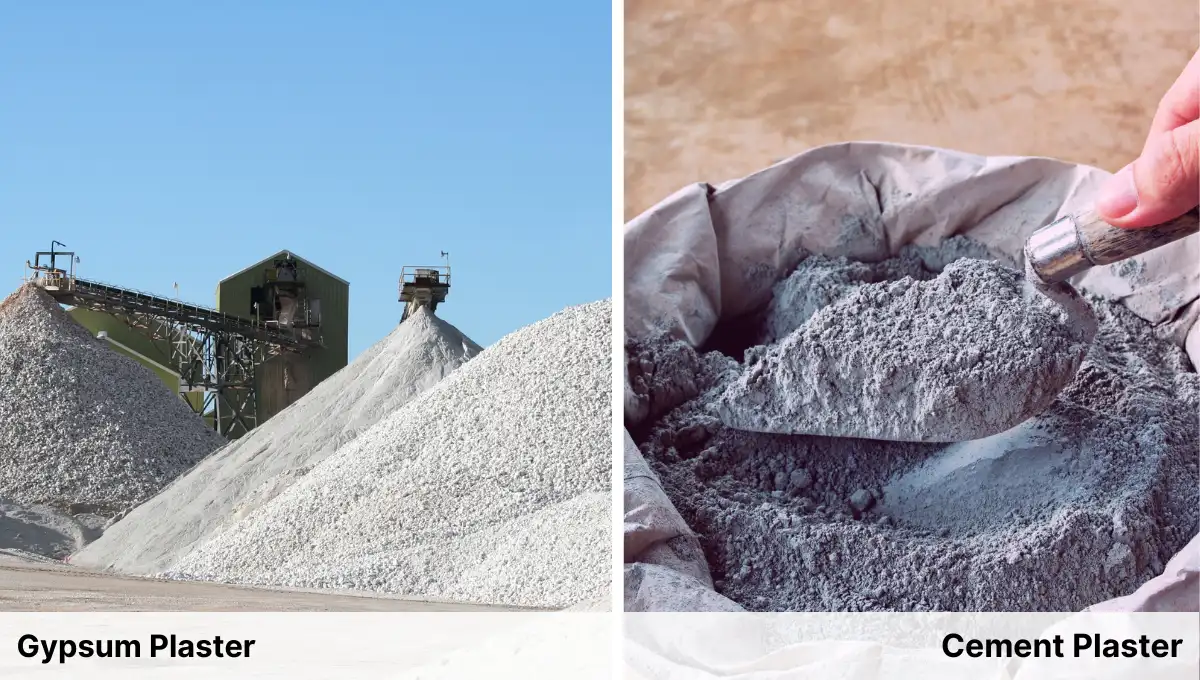
Gypsum plaster, or plaster of Paris, is a building material used for coating walls and ceilings. It is made by heating gypsum to a temperature of about 150°C (300°F). This process removes water and converts the mineral into a fine powder, which can be mixed with water to form a paste. This paste hardens upon drying, providing a smooth and durable finish.

Gypsum plaster is the first to-go choice when working on a construction or renovation project, especially for interior purposes. 

Gypsum plaster

Ingredients of Gypsum plaster

The main component of gypsum plaster is gypsum, a naturally occurring mineral. When heated to around 150°C (300°F), gypsum loses water molecules and transforms into calcium sulfate hemihydrate (CaSO₄·0.5H₂O), known as plaster of Paris. Along with this, various additives and water are added to it.

Pros

  • It gives a smooth and fine finish, which is ideal for painting and decorating. 
  • Gypsum plaster sets and dries faster, between 25 and 30 minutes, than any other alternative. This reduces the time it takes to complete the project, making it better suited, especially in structural construction, where the deadlines are very tight.
  • It is also a bit lighter than cement plaster, which imposes a lesser load on the building and reduces the weight constraints.
  • It provides an extra layer of protection for structures from fire as it contains fire-resistant properties.
  • Compared with cement plaster, Gypsum plaster has better thermal insulation factor by keeping the house cool in summer and warm in winter.
  • Unlike cement plaster, Gypsum plaster has sound insulation, which is excellent for housing and commercial buildings where noise insulation is required.

Cons

Gypsum plaster proves to be highly beneficial. However, there are a few disadvantages as well that one needs to take care of when choosing a building for construction work.

  • Gypsum plaster is not highly suitable for high-moisture regions like bathrooms and kitchens or for external surfaces. This material has the potential to absorb water and degrade slowly.
  • High moisture for a prolonged time may cause mold to grow in them, which may further degrade their quality, as well as the quality of the inner air.
  • It is more expensive than cement plaster. This directly impacts the overall cost of project work.
  • A high moisture area may require regular maintenance or an additional coat of paint.
  • If not properly prepared, it will have bonding issues with certain surfaces. The substrate needs to be grease-free and clean to adhere well to the building.

What is Cement plaster?

Cement plaster

Cement plaster is a mix of suitable plaster, sand, Portland cement, and water. It is applied to masonry interiors and exteriors to achieve a smooth surface. 

Many engineers and builders choose it for its durability, affordability, and moisture resistance. 

Ingredients of Cement plaster

Cement plaster is mainly composed of cement, sand, water, and optional admixtures. Ordinary Portland Cement (OPC) is the preferred choice for its strong binding properties, while clean, well-graded fine sand adds bulk, reduces shrinkage, and enhances workability. 

The typical mixing ratio ranges from 1:4 to 1:6 (cement to sand), depending on the application.

However, as much as it has benefits, it has some drawbacks. Let’s examine this.

Pros

  • It is durable and does not wear out when the weather turns bad.
  • Since it doesn’t allow any moisture to percolate, cement plaster can be used even in wet areas like bathrooms and kitchens.
  • Cement plaster is generally less expensive which can be the best option for large-scale projects.
  • Cement plaster can be used on various substrates, including brick, block, and concrete, and can be finished in different textures and patterns, giving it an aesthetic appearance.

Cons

  • It can develop cracks over time if it’s not applied properly or if the underlying structure moves or does not settle. One main reason is improper curing or a high water-cement ratio.
  • Cement plaster requires more time for drying and curing when compared to other plasters. 
  • It is relatively heavy which adds the structural load to the building. This can be a concern in high-rise buildings with weight constraints.

Which type of plaster works better, cement or gypsum?

For interior walls and ceilings, if a smooth finish and faster application are preferred, then Gypsum plaster is advisable. It is ideal for dry environments. For exterior applications and with high moisture levels, Cement plaster should be applied.

You need to consider some other factors, based on your specific needs, before choosing these two types of plasters.

FeaturesGypsum PlasterCement Plaster
Application speedFaster, quick settingSlower, takes longer to set and cure
Quality of finishingSmooth and fine finishRough finish, may require additional work
WeightLightweightHeavier
Thermal insulationBetter thermal insulationLesser thermal insulation
Moisture sensitivitySensitive to moisture, not suitable for wet areasMore resistant to moisture, suitable for exteriors
DurabilitySuitable for interiorsHighly durable, suitable for both interiors and exteriors
CrackingLess shrinkage, fewer cracksMore prone to shrinkage cracks
CostMore expensiveGenerally cheaper than gypsum plaster
Usage AreasIdeal for interior walls and ceilingsIdeal for exterior walls and damp areas
Environmental SuitabilitySuitable for dry environmentsSuitable for all environments

Which type of wall suits gypsum plaster?

Gypsum plaster is well known for internal walls as it provides a smooth surface and better thermal insulation for indoor use. However, it is sensitive to moisture and can damage the wall when exposed to outdoor elements, hence it is not recommended for exterior walls.

Which type of wall suits cement plaster?

Cement plaster benefits both inner and external walls. Due to its extreme durability and moisture resistance, it is appropriate for outdoor applications and damp environments. Though additional finishing work would be necessary to obtain a smooth surface, it can also be utilized for interior walls.

FAQ

1. Which plaster is suitable for wall construction?


Both gypsum plaster and cement plaster are applied in wall construction, but their suitability depends on the application:

Gypsum Plaster: Best fitted for interior walls because of the smooth finish and faster setting time, suitable only for dry environments.

Cement Plaster: Very suitable for both internal and external walls. It is durable, water-resistant, and can stand up against strong situations.

2. Does Gypsum plaster expire?

Yes, gypsum plaster does have an expiration date. Normally, it can expire within 3-6 months from the date of manufacturing if it undergoes good storage. Generally, gypsum plaster is to be stored in a dry, cool place and has to be used within its given time frame for the best results.

3. What is the best finish plaster?

The best finish plaster is gypsum plaster. It provides a smooth, fine finish which is ideal for interior walls and ceilings. In addition, it sets quickly and has superior thermal insulation, which gives a polished look indoors.

4.Which is more in cost: gypsum or cement?

Gypsum plaster is costlier than cement plaster. Because it sets slowly and consumes greater labours, cement plaster is normally economical.

What Happens If You Build Without A Permit

0
Build Without A Permit

In India, getting construction permits can be a bureaucratic hurdle. This puts pressure on some homeowners and builders to think of avoiding them. Nevertheless, the penalties for construction without a permit are quite steep. It is common to have significant consequences that may be bothersome for many years. 

In this blog, the risks of undertaking construction activities without permits in India are discussed.

The Importance of Building Permits in India

Building permits in India are vital safeguards for homeowners. They make sure that the construction is done according to the laws and regulations of the country and the specific site region. Such codes are intended to safeguard the welfare and lives of residents including the homeowner and the neighbours. 

To be sure, that your home meets the necessary norms, you need to obtain the necessary permits. They mandate structural, electrical, and fire protection standards to be followed.

The Importance of Building Permits in India

Potential Consequences of Building Without a Permit in India

Legal Issues and Fines: 

In India, building without permission is often seen as breaking construction and planning laws.

This can lead to massive penalties and lawsuits. It also may cause the local authorities to demand the removal or even demolition of the unauthoriszed construction.

According to the Ministry of Urban Development, the average fine for a building permit violation in India is between ₹50,000 and ₹ 1,000,000. 

The cost varies depending on the level of infraction and geographical location of the offender.

Safety Concerns: 

Some buildings in India do not have building inspectors. So, they may lack safety measures. 

This exposes occupants to risks of structure collapse, electrical shock or short circuit, and other such risks.

The report released by the NDMA ( National Disaster Management Authority ) states that houses that are constructed without proper permission are at a higher risk of collapse during natural calamities. 

Difficulty in Selling or Refinancing: 

When it’s time to sell your home or refinance your mortgage in India, the lack of a building permit can be a big problem. 

Lenders and buyers will be wary of the legal and financial risks. This could lead to lower offers or the inability to complete the transaction.

Insurance Complications: 

Many Indian homeowners may have insurance. But, it does not cover losses from unapproved additions. You would bear all expenses in any related matters.

At its worst, insurers may simply decline to offer plans at all. This will happen if they find some work has been done by unauthorised persons.

Retroactive Permit Challenges: 

In some cases, you may be able to get a retroactive permit. This is for unpermitted construction in India. 

However, this process takes time and money. It may still result in fines. 

Also, the permit is not guaranteed. Local authorities may require the removal or change of the unauthorised work.

Exceptions and Exemptions

Exceptions and Exemptions

There are some exemptions to be made to the permit provision above. These depend on the type of project  undertaking and its general characteristics 

For example, to paint your house a different colour, or to change the doors of your house, you don’t need a permit in most Indian states. Even in cases where one has to repaint the wall, put up new wallpapers, or change flooring, a permit is not required.

Furthermore, any project of a limited size and scale like a new fence or even a small shed, may not require a permit. It’s advisable to consult the local building department for accurate information on the additions or changes required 

Navigating the Permit Process in India

The permit process in India may seem daunting. But, it is’ essential to work closely with your local building department to ensure you’re following all the necessary steps. 

This requires producing strategic plans that include detailed working documents. Some states require certain inspections, and you need to ensure that you get them. But it will involve dealing with concerns or code issues where they exist.

One way to speed up getting permits is to involve the right professionals. Also, be in active talks with authorities. This will guarantee a successful construction project which does not. violate the set standards.

The Role of Architects and Engineers

It is equally important to have qualified architects and engineers on board when undergoing the permit process in India. 

They can be informative in creating a project incorporating all the required codes and rules, which will help it gain approval without any issues.

They can also help prepare the needed documents. These include plans and area calculations, which are necessary to get a permit.

The Importance of Zoning Regulations

In India, laws on land division and use are outlined in the Zoning regulation and city master plans. They dictate the kind of structure that can be built in a zone. Failure to adhere to the law regarding zoning can pose legal consequences and penalties may be given out.

The Consequences of Unpermitted Additions and Renovations

It’s important to note that the construction of a structure without a permit is not limited to a new structure only. It also applies to adding to and renovating existing structures. 

It’s a good example of how even small changes to a structure can greatly impact the safety of its occupants. 

Any change or renovation to the house that violates the permit rules has the same impact as not having a permit to build the house or a room. 

These are legal problems, security concerns, or difficulties with the sale or Mortgage-backed securities of your home.

Conclusion

It is strongly advisable for all homeowners and aspiring homebuilders in India to follow the proper permit procedures and work closely with local authorities to ensure a safe, compliant, and successful construction or renovation project. Prioritisze the permit process to protect your investment, your family’s safety, and your long-term financial well-being.

Low-Cost Farm House Design

0
Farm House Design

A farmhouse is a functional, simple residential place that connects with nature and cherishes the environment. However, building or designing a farmhouse can be made cost-effective with careful planning. A farmhouse design adds a touch of royalty, and the designs are listed below.

Types of Low-cost Farm House Designs

Different types of farmhouse design can fit into your budget. Some options are listed below:

Types of Low-cost Farm House Designs

Modern Farmhouse Design

The modern farmhouse is a mix of traditional with a modern touch to it. Unlike traditional farmhouses in the countryside, a modern farmhouse design has neutral or woody colours. The modern design contains wooden decorations and some rustic fixtures with sharp lines. This can be customised depending on your vision. 

The square feet of a modern farmhouse start from a small area of 1,500 to a larger space of 3,500 square feet. 

Small Farmhouse Design

A small farmhouse design has a natural essence that has a small footprint. They typically range from 1,000 to 2,500 square feet, creating a cosy yet functional atmosphere. Bunk beds, a convertible dining area into the living room, large windows, and wood for accent walls are some of the aesthetic designs for farmhouses.

Rustic Farmhouse Design

A rustic farmhouse design is more oriented towards the country’s charm. They have wear, age, and connect to simpler times. A smaller rustic farmhouse starts at 1,000 square feet, and the larger farmhouse will start at 4,000 square feet.

These houses have reclaimed wood, emphasising the raw beauty of the bricks. Natural stones in countertops, vintage knobs, and warm colours are the highlights of rustic farmhouse design.

Ingenious Low-Budget Farmhouse Design

An ingenious farmhouse is an unusual design that uses full space, improves functionality, and includes DIYs as its key essence to create magic in the house. A small-budget ingenious farmhouse starts with 800 square feet and can go up to 2,400 square feet.

For multifunctionality, an ingenious low-budget house design can include folding furniture, design rooms with multi purposes, incorporate built-in storage, large windows, and incorporate rainwater harvesting systems. 

Choose Cost-effective Building Materials

Choose Cost-effective Building Materials

Replacing certain building materials with other materials can help you achieve your low-budget farmhouse dream.

Recycled or Reclaimed Materials

Getting products of wood, bricks, and fixtures from the demolition site or other marketplaces can help you to reduce the cost. Additionally, these materials can quite enhance the front look of a farmhouse.

Choose Alternatives Instead of Traditional Materials

Look for alternative materials that give the same functionality as traditional ones. A typical example could be choosing metal roofing instead of shingles. They can reduce the cost without affecting the aesthetics of the house.

Make Use of Eco-Friendly Options

Bring on the natural essence of nature instead of artificial ones. For instance, installing big windows can bring in natural sunlight and air and making an Eco-Friendly home, helping you to save on artificial lights

You can also consider using DIY from bamboo or cork to make your farm home a little more creative. This reduces your utility bills and paves the way for a sustainable environment.

Benefits of Building a Low-Cost Farmhouse

A low-cost farmhouse design benefits are listed below:

Financial Independence

Using budget-friendly materials for your farmhouse will help you reduce the footprints and contribute to sustainability. Additionally, you still have money after building the house. A smaller farmhouse gives you a space for other ideas and requires less energy, low maintenance, and construction materials.

Sustainability

Incorporating reclaimed materials and utilising discarded items will lead to greater sustainability. Moreover, they consume less energy and embrace the natural environment.

Creativity 

Low-cost farmhouses allow you to indulge in DIY projects. They give you the freedom of personalisation and create your unique style.

Comfort and Connection

Low-cost farmhouses are built on compact spaces that help you connect with your loved ones. They need less time for cleaning, and one can enjoy their time wisely.

A Diversion from Ordinary Experience

Investing in a low-budget farmhouse will help you get a solid foundation for your plans. Additionally, you can spend your money on travelling and experiencing other things in life. 

Conclusion

A farmhouse is everyone’s dream. A farmhouse has all the functional properties of a normal house but with better aesthetics and nature. However, you don’t have to go broke by building one. Low-cost farmhouse designs with alternative options on materials will help you to save money, achieve your dream, and let you taste the wildness of life. 

FAQs

1. How much does it cost to build a farmhouse?

Generally, a farmhouse can be built for a price of Rs. 4000 per square foot. However, there can be certain adjustments that can reflect the cost.

2. How to design a farmhouse?

To design a farmhouse, start by defining your vision, including style and purpose. Select a suitable site with good drainage and scenic views. For exterior use natural materials and inside create an open floor plan with high ceilings and durable flooring

3. How much area of a farmhouse is needed?

The farmhouse can be built on a land area that ranges from 1,500 square feet and spreads across a vast range of 2 acres.

Low-Cost Simple Rooftop Design

0
Low-Cost Simple Rooftop Design

A well-designed rooftop can completely transform a home, but the idea of a rooftop makeover often brings to mind expensive renovations. Fear not, my design-savvy friends! 

Well, in this blog I intend to tell you how to have a beautiful rooftop retreat. If you desire, you can turn your rarely used roof into a great home for relaxing and fun. And, you can do it while spending little money.

Low-Cost Rooftop Design Tips: Maximizing Space with Modular Furniture

Maximize Your Square Footage

Modular Furniture for Flexible Layouts

First of all, there is always an obstacle of a small roofed area; thus the selection of appropriate furniture is of paramount importance. For example, a layout of sectional sofas and ottoman tables is versatile. You can move them around based on the type of occasion. It could be a party or a cozy night on the patio.

Vertical Gardening for Lush Greenery

Loose space is a luxury you don’t always get when you live in tiny apartments and condos and small downtown studios? Go vertical! Shelving, wall fixtures, and tiered stands allow stacking many plants without taking lots of floor space.

Vertical Gardening for Lush Greenery

Embrace DIY and Upcycling

Repurposed Materials for Unique Touches

The best and easiest sources of materials may just be a thrift store, the flea market, or even your own backyard. The mediums are old wood, crates, and metal sheets. When used well, they would become benches, planters, or mere accent items.

Custom Cushions for Comfort and Style

Purchasing new and custom outdoor cushions is one of the best ways to help upgrade the style of an outdoor roof. You can choose bright-colored fabrics to get attention. Or, you can choose plain-colored fabrics for a peaceful and classy look.

Lighting for Ambiance and Function

String Lights for Magical Evenings

String lights make any place and any time perfect for almost anything you want to do. Hang them over your roof during a special event to get that romantic look. Or, add them creatively. Have them pass through trellises or be suspended from the ceiling.

Solar-Powered Lanterns for Eco-Friendly Illumination

Solar lanterns are the way to go. They need little cash and are eco-friendly. They can be placed around the rooftop in any way you would like, the fixtures are very versatile. They give out what many would consider as cool, and somewhat soft relaxing romantic light. 

Why Are Rooftop Designs in Demand?

Why Are Rooftop Designs in Demand

Interior design has accompanied the society for some time now. However, rooftop designs appeared quite recently to completely change the way we live. Before the change happened people just went to the rooftop to chill. It has now become a room which serves a number of uses, one of them being a living area.

A roof terrace is the modern and desired additional space that is chosen by many people to live in residential buildings.

Low-Cost Simple Rooftop Design Ideas You Can Try

1. The Eco-Friendly Bamboo Rooftop Design

  • Unlike corrugated roofing, bamboo stays quiet in the rain. It also stays cooler under the sun. This makes it an ideal choice for rooftops.
  • You can use bamboo cool roof products to cut pollution. They protect the terrace from weather. 
  • Bamboo benches and flooring can add a natural and cozy touch to your rooftop. They create a comfy space for morning or evening tea and snacks.

2. Incorporate a Water Feature

  • It can also help you unwind. The look of the water can make your rooftop prettier.
  • Pair the water feature with comfortable seating. This can include a coffee table, chairs, and sofas. Doing this creates a cozy and inviting outdoor living area. 
  • You can also add wall designs. You can use artificial plants or creepers to add beauty.

3. Transform it into a Dining Area

  • One of the most popular low-cost simple rooftop ideas is to turn it into an outdoor dining area. 
  • The rooftop has ample space. A rooftop bar can be a great addition, especially when you have guests or want to host events. 
  • You can build a bar or use a cabinet with storage space that fits well with your rooftop design.

4. Utilize Customized Steel Planters

  • Give your rooftop a polished and cohesive look with custom steel planters. 
  • Many steel planters are available in the market. It’s easy to find the perfect ones to suit your style.
  • Steel planters add elegance to your rooftop. They also provide a practical way to grow plants, herbs, or small trees. 
  • This can help create a lush and verdant oasis on your rooftop.

5. Opt for Cool Roofing Materials

  • Consider cool roofing materials. They can make your rooftop more efficient and comfortable.
  • Cool roofs reflect more sunlight and absorb less solar energy. 
  • Some cool roofing options include single-ply membranes. There are also built-up roofs. 
  • You can color these materials at the factory with light or cool pigments. Or, you can add a reflective coating to the surface.

6. Explore Metal Roofing Options

  • Another low maintenance and elastic type of roofing is the metal roofing that you may use for your rooftop design.
  • It varies in numerous types of metal roofing and each type has its advantages and disadvantages.
  • Continuously fastened as well as clip-in roof profiles are both identifiable. 
  • The whole cost is low and varies from Rs 560 to Rs 1280  per square foot. 

7. Consider Solar Panel Integration

  • If you want to incorporate fashionable construction into your rooftop design make then consider installing solar panels.
  • However, there are a lot of different kinds of roof shape, and solar systems can be affixed to a variety of different roof styles.
  • You can either replace the present panels with more powerful ones or install new additional panel.

Conclusion

With a little imagination and these cheap, simple design ideas, you can turn your rooftop into a private retreat. It will reflect your style and not cost much. So what are you waiting for? Get out there and start designing your dream rooftop oasis!

Property Transfer Affidavit Filing

0
Property-Transfer-Affidavit-Filing

Transferring a property from one person to another is not easy. You might have to fulfill many legal proceedings before buying or selling a property.

One such legal requirement is the Property Transfer Affidavit. A property transfer affidavit is a legal document that a buyer files to notify the local government of the property transfer. 

This responsibility often falls under the buyer. So, if you are going to buy or inherit a property, learn what a property transfer affidavit is and ensure you file it within the stipulated time. 

What Is A Property Transfer Affidavit?

A Property Transfer Affidavit is a legal document filed whenever a real estate or personal property is transferred from one person to another. This is to notify the local government or assessor that the property has been transferred so that they can put it in their records. 

Who Needs To File A Property Transfer Affidavit?

The responsibility of filing the property transfer affidavit belongs to the new owner, that is, the person to whom the property is being transferred. It must be filed with the city or town assessor within 45 days of the property transfer. 

Here is a breakdown for your understanding:

  • Buyer: In standard real estate terms, the buyer of a property becomes the owner and is responsible for filing the affidavit. 
  • Inheritor: If you inherit the property from your father or other family members, you become the owner and must file the affidavit. 
  • Owners through other means: If you become a property owner through means like land contracts or other legal documents, you must file an affidavit. 

Information Required In A Property Transfer Affidavit

Information Required In A Property Transfer Affidavit

The information you provide in the affidavit is important for the assessor to determine the correct tax value for the property and apply for exemptions. The specific information you need to provide may vary depending on your locality. However, here are the general details you might have to fill in the affidavit form. 

  1. Seller & buyer’s full name and address
  2. Detailed address of the property (including legal details like plot number, survey number, etc.)
  3. Transfer details, like date of transfer, mode of transfer (sale, inheritance, etc.), and consideration amount (sale price in case of sale)
  4. Declarations 
  • A statement from the seller confirming their sole ownership of the property and the right to transfer.
  • A statement confirming that there are no outstanding dues on the property (mortgages, unpaid taxes, etc.)
  • A statement from the seller and the buyer that all the details provided are complete and true. 

Where To File A Property Transfer Affidavit

A property transfer affidavit is generally submitted to a local government agency responsible for property records and taxation. 

You can file the affidavit with the office of the Sub-registrar or District Magistrate, or you can even file it with the local municipal corporation.

Note: The affidavit filing location might be different in some areas. You can contact the local government office or consult a lawyer to know where you should file the affidavit. 

Consequences Of Not Filing A Property Transfer Affidavit

Remember, a property transfer affidavit should be filed within 45 days of the property transfer. Failing to do so can lead to consequences such as the ones below. 

  • It can cause a delay in updating the ownership of property in government records. This can lead to incorrect tax assessments and difficulties in obtaining property-related clearances. 
  • You might even be penalized for not filing the affidavit on time. The amount may vary depending on your locality. 
  • The absence of a proper affidavit can cause ownership issues in the future. 
  • If you don’t have an affidavit to prove the property is yours, buyers will hesitate to buy your property if you wish to sell it in the future. 

These are all the complications you might face if you don’t file a property transfer affidavit. So, be on time and file your affidavit in your local government office soon to acquire complete ownership of the property.

FAQs

1. What Is The Affidavit Of Buyer Of Land?

The Affidavit of Buyer of Land is a legal document used by the buyer to satisfy a lender or meet government requirements. It shows the buyer’s financial ability and intent to follow legal regulations.

2. How To Transfer Property From One Person To Another In India?


Here are the steps that you need to follow to transfer property from one person to another in India.
1. Due diligence
2. Agreement to sell
3. Sale deed execution signed by both parties
4. Payment of stamp duty and registration and local government office
5. Mutation & update of ownership records
6. Handover and possession of property through sale agreement

3. What Is The Cost Of Property Transfer?

The cost of property transfer varies from place to place depending on the property type, location, etc. But generally, it comes to around 7–10% of the property value. This covers stamp duty (5–7%) and