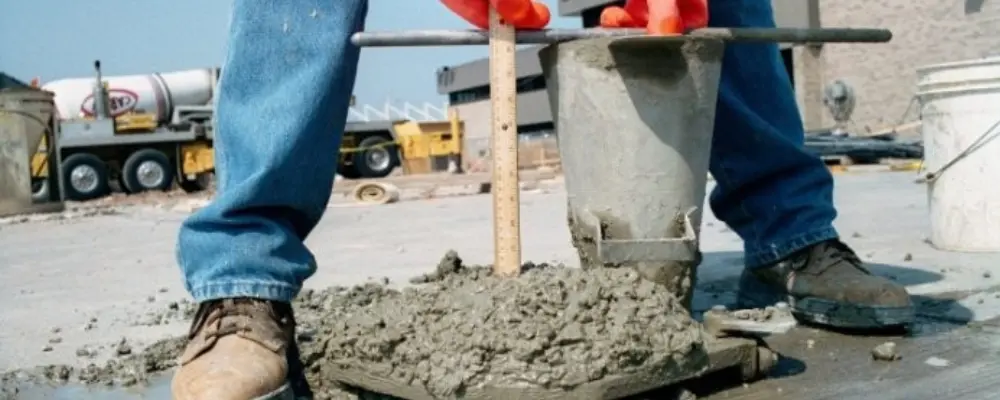
Plastering is an important step in any construction or home improvement project due to its aesthetic and protective function for walls and ceilings. Sand plays a big role in determining plastering results. So, choosing the right sand is important for homeowners, DIY enthusiasts, and construction pros.
In this blog, we will examine the types of plastering sand, what makes each type different, and the key factors for choosing a specific type for your plastering job.
Types of Sand Suitable for Plastering
There are various types of sand for sale for plastering. Each type has its traits and is recommended for a certain purpose. Choosing the right sand for plastering is crucial. It can greatly affect the results of the work.
Plaster sand has fine and even particles. It has consistent quality. That’s why it’s preferred for plastering.
Let’s have a deeper look at the most common options:
Plaster Sand
Plaster sand is a product of crushing and refining hard rocks like granite or limestone into fine particles. Plaster sand is also called P sand or plastering sand. It mimics natural sand and can be used for various purposes.
Plaster sand or fine sand is best for plastering.
They have small, uniform sand particles.
This type of sand is particularly useful in rendering on walls and ceilings as well as in giving a perfect finish due to the small grain size.
The common grading for plaster sand ranges from 0 to 2 mm of particle size.
Masonry Sand
Masonry sand also known as mortar sand or mason sand is slightly larger and more angular than sand making it ideal for use in mortar and concrete.
It has larger particles that can be used as the base or scratch coat of plaster where a rough surface is okay.
How is it Made?
Initially, the source can be derived from river sand or M-sand. River sand are naturally sourced from riverbeds, riverbanks, and deposits, known for its fine texture and smoothness.
Meanwhile, M-sand is produced by crushing hard rocks like granite or basalt.
Step 1: River sand is extracted using dredging equipment, excavators, and loaders. It is then crushed using jaw crushers and cone crushers.
Step 2: The raw sand is passed through mesh screens to remove larger particles, stones, and debris. The screens vary in size to ensure only fine particles are retained.
Step 3: The screened sand is washed using water sprays to remove impurities such as silt, clay, and organic matter. This step is crucial to achieve the cleanliness required for masonry sand.
If the sand particles are too coarse, additional grinding is performed using ball or rod mills to achieve a finer texture suitable for masonry applications.
Step 4: The washed sand is identified by blowing cyclones and vibrating screens to ensure a uniform particle size distribution.
Step 5: The samples of the sand are tested in laboratories for evaluating particle size distribution, strength, and cleanliness of the sand particle.
Step 6: The sand is dried using rotary dryers to reduce moisture content.
Step 7: The processed sand is stockpiled in dry, contaminant-free areas.
River Sand
Another type of sand used for plastering purpose is river sand. It is taken from riverbank deposits.
This sand has round and smooth grains. This feature helps make better, more even plaster.
One issue is that the river sand has impurities and organic matter.
They need to be washed and screened to get the sand we need.
How is it Made?
Step 1: The source sand is extracted using dredgers, excavators, and loaders from riverbeds and banks using dredging or pit mining.
Step 2: The raw sand is passed through mesh screens to remove larger particles, stones, and debris.
Step 3: The screened sand is then transformed for cleaning with water sprays to remove impurities.
Step 4: The sand is sent for grading by particle size using vibrating screens.
Step 5: To check the quality of the sand, the sample is sent for a lab test to ensure the particle size and cleanliness.
Step 6: Once all of the above process is done, the sand is stored in a dry, contaminant-free area, which is transported to construction sites in bulk when needed.
Manufactured Sand (M-Sand)
Manufactured sand, also known as M-Sand, is relatively new.
It has been used widely in the construction industry as an alternative to river sand.
M-Sand is made by crushing natural rock, such as hard granite stones.
This makes the particles more angular and consistent.
People prefer this sand type due to its high compressive strength, high density, and low impurity levels.
How is it Made?
Step 1: The sand is sourced from crushing hard rocks like granite or basalt where the large rocks are crushed into smaller pieces using jaw crushers.
Step 2: Secondary cruising is undergone further to finer particles using cone or impact crushers.
Step 3: Unwanted particles are removed to achieve the desired size with vibrating screens.
Step 4: The sand is then cleaned with water to remove dust and impurities.
Step 5: Followed by quality check, like the other two types of sand, M-Sand is dried and stored to prevent moisture for future usage.
Is Plaster Sand the Best Option for Plastering?
Among all the types of sand used for plastering, plaster sand is regarded as one of the best options. It can be utilized or applied evenly on surfaces due to its uniform size of particles, which gives the surfaces a good finish.
Also, plaster sand ensures that it has no contaminants or organic matter, thus making it a standard sand material.
However, the use of sand in plastering may vary depending on the project and its features. It depends on the type of stucco finish and construction scheme.
At times, a blend of different sand types may work well, such as when using plaster sand and masonry sand in a project.
Comparing Plaster Sand with Other Options
To help you make an informed decision, let’s compare plaster sand with the other types of sand commonly used for plastering:
Plaster Sand vs. Masonry Sand
Plaster sand is usually smaller, with more even particles in a consistent size range, which makes for a smoother surface. Masonry sand is more jagged, and it is better for base coats or grainier finishes.
Plaster Sand vs. River Sand
Plaster sand is finer. It is well-sieved and washed to remove undesirable particles. River sand contains foreign elements, like organic matter, silt, and debris, found in all-natural aggregates. These elements can harm the plaster and its appearance.
Plaster Sand vs. Manufactured Sand (M-Sand)
Plaster sand and M-sand are man-made. They are made to achieve target quality. But, in most cases, M-sand has well-graded shapes and sizes. This implies that M-Sand can be recommended instead of plaster sand. This is especially true where plaster sand is unavailable or expensive.
So, when choosing a filler, consider the tasks and how to solve them. Also, think about the look of the filler in the end and the cost of using different sands. You can notice the specifics of each sand type. Then, you can make the right decision about further plastering work.
Conclusion
Remember, the key to achieving a beautiful, durable, and high-quality plastered surface lies in carefully selecting and properly using the right sand. With this knowledge, you can confidently tackle your next plastering project and create the stunning, polished look you’ve been envisioning.
Clay bricks are used in a wide range of construction. It is important to understand the importance and process of clay bricks that best suit your project. Leave the hassle and read a blog to become an expert in clay brick.
What are Clay Bricks?
Clay bricks are rectangular blocks of clay that are used for construction purposes. These bricks are made when clay, along with other materials like sand, is heated at high temperatures.
Clay bricks have been used for several thousand years and are known for their durability and strength. The standard dimension of clay bricks is 190×90×90 mm. The brick is usually red or brown in color, depending of the type of clay used for the process.
Clay Bricks: Types
Different types of clay bricks vary depending on the construction. The types of clay bricks are listed below.
First-class Clay Bricks
First-class bricks are top in quality. These bricks have a uniform shape, size, and colour and are free from defects. These clays are fixed into the table moulding and are burned in large kilns.
These bricks are used for long-lasting structures and exterior-facing walls. The general dimensions of first-class clay bricks are 190 ×90×90 mm.
Second-class Clay Brick
The second-class bricks lack regular shape, size, and colour. As the name suggests, these bricks are of lower quality compared to the first-class bricks. These bricks undergo a ground moulding process and are burnt in kilns.
These bricks can be used for bearing loads but cannot be used for exterior walls. The general dimensions of second clay bricks are 190 ×90×90 mm.
Third-class Clay Brick
Third-class clay bricks are of poor quality. They are irregular in shape, colour, and size and have cracks. These clay bricks also have defects and related distortions.
The bricks are burned in clamps and are not suitable in places with rainy weather. The bricks can be used largely in landscaping. The general dimensions of second clay bricks are 190×90×90 mm.
Clay Bricks: Properties
There are several properties associated with the clay bricks.
Size and Shape: The size of the clay bricks varies depending on the purpose. But the common size is 7.48×3.54×3.54 inches. The shape of the clay brick is rectangular, which is useful for construction.
Color and Texture: The colour of the brick depends on the clay and the type of burning process used. The common brick colours include brown, yellow, and red. The texture of the brick should be smooth and round.
Hardness: Hard bricks can withstand any damage. These clay bricks should be long lasting and are long-lasting.
Water Absorption: The water absorption capacity of clay bricks differs based on the type of clay brick and its manufacturing process. The average water absorption rate of face bricks is 4.5–12% and for clay plaster bricks, it’s around 12–20%.
Thermal Conductivity: Thermal conductivity determines a brick’s capacity to transfer heat. Bricks with low conductivity help to maintain a standard temperature in the building.
Clay bricks: Manufacturing Process
Preparation of Soil
The soil under 200 mm is removed as it contains impurities and loose soil not suitable for use for construction. The clay is obtained only after digging and spreading the soil at 600 to 1200 mm.
Cleaning
In the process of cleaning, the soil is washed and screened to remove any pebbles or any non-clay materials. This process is time-consuming and expensive. After cleaning, the lump of the remaining clay is crushed into powder.
Weathering
The powdered soil is left to dry in the atmosphere as it can influence the plasticity and strength of the soil. The time of the process normally depends on the type of soil used; however, generally, they are left for a week.
Blending
In the process of blending, calcareous clay and sand are added to increase the soil quality. The ratio for fire clay includes sixty percent fire clay, twenty percent grog, and twenty percent silica or flint.
Tempering
Tempering is done using cattle or human feet. Water is added to make sure the earth is mixed uniformly. For soft plastic clays, about 20 to 30% of water is added. But, to prepare a clay brick of number 20,000, the soil is tempered using a pug mill.
Brick Moulding
The moulding of brick size should be followed according to the Bureau of Indian Standards. The general size of the brick is 190×90×90 mm. With mortar thickness, the size of the bricks becomes 200×100×100 mm.
Brick Drying
The moulded bricks will be damaged if they are burned directly in a fire. The bricks are dried either naturally or artificially for two weeks.
The natural process of brick drying includes sun-dried bricks and air-dried bricks. The artificial drying of bricks includes specific dryers that receive heat from the furnace.
Burning of Brick
During burning, the brick undergoes both physical and chemical changes. Clay bricks are usually heated at temperatures between 900-1200°C. The brick is mixed with silica and alumina to make sure that the brick is strong and free from cracks.
Sorting and Transportation
The bricks are then sorted, packed, and transported to desired locations.
Clay bricks: Advantages
The advantages of clay bricks include:
They are secure and an investment for a lifetime.
They are energy-efficient.
They require low maintenance.
They offer a wide range of colours and styles.
They are an environmentally friendly option.
Clay bricks: Disadvantages
The disadvantages of clay bricks include:
High cost
Durability issues
Require high maintenance
They don’t offer a variety of aesthetic options.
Conclusion
Clay bricks play an important role in construction. The bricks have evolved along with technology. The making of clay bricks goes through different processes before it reaches its purpose. Clay bricks can give a house or a commercial space the desired aesthetic features the buyer is looking for.
FAQs
1. How are clay bricks made?
Clay bricks are made by mixing water and clay at specific ratios.
2. What are the benefits of using clay bricks for construction?
In construction, clay bricks are highly durable, low maintenance, and provide insulation.
3. What is the lifespan of clay bricks?
The average lifespan of clay bricks is five hundred years; however, they can last up to six hundred and fifty years.
4. How do you clean clay bricks?
A simple way to clean a clay brick is with plain water. But soap can also be used to clean clay bricks.
When planning a construction project, understanding the cost per square foot is crucial. Brick & Bolt, a leader in the construction industry, offers detailed and transparent pricing through their four comprehensive packages. Whether you’re building a home, an office, or any other structure, these packages are made for various needs and budgets, ensuring you get the best value for your investment.
Based on the user’s need, we categorized the packages into four:
Basic Package: It is mainly designed for people seeking cost-effective and durable construction solutions.
Classic Package: This package provides a balance between both cost-effectiveness and also increased quality without any significant increase in expenses.
Premium Package: This package is mainly for clients who aim for a high standard of living and additional features for a luxurious construction experience.
Royal Package: This package is mainly for people who like to be at the pinnacle of luxury and quality. This package ensures that every aspect of the construction meets the highest standards.
Construction Rate Per Square Feet With Material In Bengaluru
Basic package
The cost of the basic package per square foot is ₹1,810.
Steel: Sunvik or Prime Gold or Kamadhenu or equivalent
Cement: Dalmia, Bharathi or equivalent of 43 or 53 grade
Wood: Waterproof flush doors or WPC for bathroom, for main door flush door with veneer and sal wood frame of 5 inch by 3 inch, worth Rs.20,000 including fixtures.
Other Accessories: Window grills is basic MS grill with enamel paint at Rs. 195 per Sqft, Overhead tank is double layered tank of 1000 Litre of Apollo make, Underground Sump is 4000 Litre, Staircase Railing is MS Railing.
Paint: Interior Painting – JK Putty + Tractor Emulsion or equivalent, Exterior Painting – Asian Primer + Ace Exterior emulsion Paint or equivalent
Overall, the Basic Package is an excellent choice for those seeking cost-effective construction solutions.
Classic Package
The Classic Package is priced at ₹1,940 per square foot. This includes high-quality materials that ensure both durability and aesthetic appeal.
Steel: Jindal or equivalent
Cement: Dalmia, Bharathi or equivalent of 43 or 53 grade
Wood: Waterproof flush doors or WPC for bathroom, for main door teak Door With teak frame of 5 inch by 3 inch, worth Rs.30,000 including fixtures.
Plumbing Fixtures: Ceramic Wall Dado up to 7′ height is up to Rs.60 per Sqft, Sanitarywares & CP fittings up to Rs. 50,000 per 1000 Sqft of Hindware or Parryware make, CPVC Pipe is APL Apollo or Equivalent.
Other Accessories: Window grills is basic MS grill with enamel Paint at Rs. 195 per Sqft, Overhead tank is double layered tank of 1000 Litres of Apollo make, Underground Sump is 6000 Litres, Staircase Railing is MS Railing.
Paint: Interior Painting is JK Putty + Tractor Shyne Emulsion or equivalent, Exterior Painting is Asian Primer + Apex Exterior Emulsion Paint or equivalent
This combination of materials makes the Classic Package an excellent choice for those seeking a balance between quality and affordability.
Premium Package
The premium package from Brick & Bolt is priced at ₹2,250 per square foot. This package includes high-quality materials to ensure a luxurious and durable construction.
Steel: Jindal or equivalent
Cement: ACC or Ultratech or equivalent of 43 or 53 grade
Wood: Waterproof flush doors or WPC for bathroom, for main door teak Door With teak frame of 5 inch by 3.5 inch, worth Rs.40,000 including fixtures.
Plumbing Fixtures: Ceramic Wall Dado up to 7′ height is up to Rs.80 per Sqft, Sanitarywares & CP fittings up to Rs. 70,000 per 1000 Sqft of Jaquar make, CPVC Pipe is APL Apollo or Equivalent.
Other Accessories: Window grills is basic MS grill with enamel Paint at Rs. 195 per Sqft, A Sintex Double layered overhead tank of – 2000L shall be provided. Any Additional capacity shall be chargeable at INR 9 per L. Platforms for the OHT shall be charged additional based on the design and specifications, Underground Sump is 7000 Litres, Staircase Railing is SS (Stainless) Railing of SS 304 grade profiles.
Paint: Interior Painting is JK Putty + Apcolite Premium Emulsion or equivalent, Exterior Painting is Asian Primer + Apex Exterior Emulsion Paint or equivalent.
Royal Package
The Royal Package is priced at ₹2,480 per square foot and includes premium materials to ensure a luxurious and durable construction.
Steel: Jindal or equivalent
Cement: ACC or Ultratech or equivalent of 43 or 53 grade
Wood: Waterproof flush doors or WPC for bathroom, for main door teak Door With teak frame of 5 inch by 3.5 inch, worth Rs.50,000 including fixtures.
Plumbing Fixtures: Ceramic Wall Dado up to 7′ height is up to Rs.90 per Sqft, Sanitarywares & CP fittings up to Rs. 80,000 per 1000 Sqft of Jaquar make, CPVC Pipe is APL Apollo or Equivalent.
Other Accessories: Window grills is basic MS grill with enamel Paint at Rs. 195 per Sqft, A Sintex Double layered overhead tank of – 2000L shall be provided. Any Additional capacity shall be chargeable at INR 9 per L. Platforms for the OHT shall be charged additional based on the design and specifications, Underground Sump is 8000 Litres, Staircase Railing is SS (Stainless) Railing of SS 304 grade profiles.
Paint: Interior Painting is JK Putty + Royale Luxury Emulsion or equivalent, Exterior Painting is Asian Primer + Apex Ultima Exterior Emulsion Paint or equivalent.
Construction Rate Per Square Feet With Material In Chennai
Basic Package
The basic package costs ₹2,150 per square foot.
Steel: Kamachi or GBR or equivalent.
Cement: Dalmia or Zuari or equivalent of 43 or 53 grade.
Wood: Waterproof flush doors or WPC for bathroom, Sal wood frame for main door (5 inch by 3 inch), worth Rs. 20,000 including fixtures.
Other Accessories: Overhead tank is double layered tank of 1000 Litres of Sunplast make, Underground Sump is 4000 Litres, Staircase Railing is MS Railing, Window grills is basic MS grill with enamel Paint at Rs. 220 per Sqft
Paint: Interior Painting is JK Putty + Tractor Emulsion or equivalent, Exterior Painting is Asian Primer + Ace Exterior emulsion Paint or equivalent
Classic Package
The classic package is priced at ₹2,370 per square foot.
Steel: Vizag or equivalent
Cement: Dalmia or Zuari or equivalent of 43 or 53 grade.
Wood: Waterproof flush doors or WPC for bathroom,for main door teak Door With teak frame of 5 inch by 3 inch, worth Rs.30,000 including fixtures.
Other Accessories: Overhead tank is double layered tank of 1500 Litres of Sunplast make, Underground Sump is 6000 Litres, Staircase Railing is MS Railing, Window grills is basic MS grill with enamel Paint at Rs. 220 per Sqft
Paint: Interior Painting is JK Putty + Tractor Emulsion or equivalent, Exterior Painting is Asian Primer + Ace Exterior emulsion Paint or equivalent
Premium Package
The premium package costs ₹2,630 per square foot.
Steel: Vizag or equivalent
Cement: Coromandal or Ultratech or equivalent of 43 or 53 grade
Wood: Waterproof flush doors or WPC for bathroom, main door is teak Door With teak frame of 5 inch by 3.5 inch, worth Rs.40,000 including fixtures.
Other Accessories: A Sintex /Supreme Double layered overhead tank of – 2000L shall be provided. Any Additional capacity shall be chargeable at INR 9 per L. Platform for the OHT shall be charged additional based on the design and specifications, Underground Sump is 7000 Litres, Staircase Railing is SS (Stainless) Railing of SS 304 grade profiles, Window Grills is Basic MS Grill with enamel Paint at Rs. 220 per Sqft.
Paint: Interior Painting is K Putty + Apcolite Premium Emulsion or equivalent, Exterior Painting is Asian Primer + Apex Exterior Emulsion Paint or equivalent.
Royal Package
The royal package is priced at ₹2,890 per square foot.
Steel: Vizag or equivalent.
Cement: Coromandel or Ultratech or equivalent of 43 or 53 grade.
Wood: Waterproof flush doors or WPC for bathroom, main door is teak Door With teak frame of 5 inch by 3.5 inch, worth Rs.50,000 including fixtures.
Other Accessories: A Sintex /Supreme Double layered overhead tank of – 2000L shall be provided. Any Additional capacity shall be chargeable at INR 9 per L. Platform for the OHT shall be charged additional based on the design and specifications, Underground Sump is 8000 Litres, Staircase Railing is SS (Stainless) Glass Railing of SS 304 grade profiles, Window grills is basic MS grill with enamel Paint at Rs. 220 per Sqft
Paint: Interior Painting is JK Putty + Tractor Emulsion or equivalent, Exterior Painting is Asian Primer + Ace Exterior emulsion Paint or equivalent.
Construction Rate Per Square Feet With Material In Hyderabad
Basic Package
The basic package in Hyderabad costs ₹1,890 per square foot.
Steel: Shree or equivalent
Cement: Ramco or Zuari or equivalent of 43 or 53 grade
Wood: Waterproof flush doors or WPC for bathroom, main door is flush door with veneer. Sal wood frame of 5 inch by 3 inch, worth Rs.20,000 including fixtures.
Plumbing Fixtures: Ceramic Wall Dado up to 7′ height is up to Rs.40 per Sqft, Sanitarywares & CP fittings up to Rs. 30,000 per 1000 Sqft of Hindware make, Pipe is Astral or Equivalent.
Other Accessories: Overhead tank is double layered tank of 1000 Litres of Duratank make, Underground Sump is 4000 Litres, Staircase railing is MS Railing, Window grills is basic MS grill with enamel Paint at Rs. 180 per Sqft.
Paint: Interior Painting is JK Putty + Tractor Emulsion or equivalent, Exterior Painting is Asian Primer + Ace Exterior emulsion Paint or equivalent
Classic Package
The classic package is priced at ₹2,050 per square foot.
Steel: Vizag or equivalent
Cement: Ramco or Zuari or equivalent of 43 or 53 grade
Wood: Waterproof flush doors or WPC for bathroom, main door is teak Door With teak frame of 5 inch by 3 inch, worth Rs.30,000 including fixtures.
Plumbing Fixtures: Ceramic Wall Dado up to 7′ height is up to Rs.60 per Sqft, Sanitarywares & CP fittings up to Rs. 50,000 per 1000 Sqft of Parryware make, CPVC Pipe is Ashirwad or Supreme or Equivalent
Other Accessories: Overhead Tank is Double Layered tank of 1500 Litres of Duratank make, Underground Sump is 6000 Litres, Staircase Railing is MS Railing, Window grills is basic MS grill with enamel Paint at Rs. 180 per Sqft.
Paint: Interior Painting is JK Putty + Tractor Shyne Emulsion or equivalent. Exterior Painting is Asian Primer + Apex Exterior Emulsion Paint or equivalent.
Premium Package
The premium package costs ₹2,440 per square foot.
Steel: Vizag or equivalent
Cement: Ultratech or equivalent of 43 or 53 grade
Wood: Waterproof flush doors or WPC for bathroom, main door isteak Door With teak frame of 5 inch by 3.5 inch, worth Rs.40,000 including fixtures.
Plumbing Fixtures: Ceramic Wall Dado up to 7′ height is up to Rs.80 per Sqft, Sanitarywares & CP fittings up to Rs. 70,000 per 1000 Sqft of Jaquar make, CPVC Pipe is Ashirwad or Supreme or Equivalent
Other Accessories: A Sintex /Apollo Double layered overhead tank of 2000L shall be provided. Any Additional capacity shall be chargeable at INR 9 per L. Platform for the OHT shall be charged additional based on the design and specifications, Underground Sump is 7000 Litres, Staircase Railing is SS (Stainless) Railing of SS 304 grade profiles, Window Grills – Basic MS Grill with enamel Paint at Rs. 180 per Sqft
Paint: Interior Painting is JK Putty + Apcolite Premium Emulsion or equivalent. Exterior Painting is Asian Primer + Apex Exterior Emulsion Paint or equivalent.
Royal Package
The royal package is priced at ₹2,660 per square foot.
Steel: Vizag or equivalent
Cement: Ultratech or equivalent of 43 or 53 grade
Wood: Waterproof flush doors or WPC for bathroom, main door is teak Door With teak frame of 5 inch by 3.5 inch, worth Rs.50,000 including fixtures.
Plumbing Fixtures: Ceramic Wall Dado up to 7′ height is up to Rs.90 per Sqft, Sanitarywares & CP fittings up to Rs. 80,000 per 1000 Sqft of Kohler make, CPVC Pipe is Ashirwad or Supreme or Equivalent
Other Accessories: A Sintex /Apollo Double layered overhead tank of 2000L shall be provided. Any Additional capacity shall be chargeable at INR 9 per L. Platform for the OHT shall be charged additional based on the design and specifications, Underground Sump is 8000 Litres, Staircase Railing isSS (Stainless) Glass Railing of SS 304 grade profiles, Window grills is basic MS grill with enamel Paint at Rs. 180 per Sqft.
Paint: Interior Painting is JK Putty + Royale Luxury Emulsion or equivalent. Exterior Painting is Asian Primer + Apex Ultima Exterior Emulsion Paint or equivalent.
Construction Rate Per Square Feet With Material In Jaipur
All package costs per square foot are currently being finalized.
Construction Rate Per Square Feet With Material In Mysore
Basic Package
The basic package in Mysore costs ₹1,790 per square foot.
Steel: Sunvik or Prime Gold or Kamadhenu or equivalent.
Cement: Dalmia, Bharathi or equivalent of 43 or 53 grade.
Wood: Waterproof flush doors or WPC for bathroom, main door is flush door with veneer. Sal wood frame of 5 inch by 3 inch, worth Rs.20,000 including fixtures.
Plumbing Fixtures: Ceramic Wall Dado up to 7′ height is up to Rs.40 per Sqft, Sanitarywares & CP fittings up to Rs. 30,000 per 1000 Sqft of Cera make, CPVC Pipe is APL Apollo or Equivalent
Other Accessories: Overhead tank is double layered tank of 1000 Litres of Apollo make, Underground Sump is 4000 Litres, Staircase Railing is MS Railing, Window grills is basic MS grill with enamel Paint at Rs. 195 per Sqft.
Paint: Interior Painting is JK Putty + Tractor Emulsion or equivalent. Exterior Painting is Asian Primer + Ace Exterior emulsion Paint or equivalent.
Classic Package
The classic package is priced at ₹1,950 per square foot.
Steel: Jindal or equivalent.
Cement: Dalmia, Bharathi or equivalent of 43 or 53 grade.
Wood: Waterproof flush doors or WPC for bathroom, main door is teak Door With teak frame of 5 inch by 3 inch, worth Rs.30,000 including fixtures.
Plumbing Fixtures: Ceramic Wall Dado up to 7′ height is up to Rs.60 per Sqft, Sanitarywares & CP fittings up to Rs. 50,000 per 1000 Sqft of Hindware or Parryware make, CPVC Pipe is APL Apollo or Equivalent.
Other Accessories: Overhead Tank – Double Layered tank of 1500 Litres of Apollo make, Underground Sump is 6000 Litres, Staircase Railing is MS Railing, Window grills is basic MS grill with enamel Paint at Rs. 195 per Sq ft.
Paint: Interior Painting is JJK Putty + Tractor Shyne Emulsion or equivalent. Exterior Painting is Asian Primer + Apex Exterior Emulsion Paint or equivalent.
Premium Package
The premium package costs ₹2,260 per square foot.
Steel: Jindal or equivalent.
Cement: ACC or Ultratech or equivalent of 43 or 53 grade
Wood: Waterproof flush doors or WPC for bathroom, main door is teak Door With teak frame of 5 inch by 3.5 inch, worth Rs.40,000 including fixtures.
Plumbing Fixtures: Ceramic Wall Dado up to 7′ height is up to Rs.80 per Sqft, Sanitarywares & CP fittings up to Rs. 70,000 per 1000 Sqft of Jaquar make, CPVC Pipe is APL Apollo or Equivalent.
Other Accessories: A Sintex Double layered overhead tank of 2000L shall be provided. Any Additional capacity shall be chargeable at INR 9 per L. Platform for the OHT shall be charged additional based on the design and specifications, Underground Sump is 7000 Litres, Staircase Railing is SS (Stainless) Railing of SS 304 grade profiles, Window grills is basic MS grill with enamel Paint at Rs. 195 per Sqft.
Paint: Interior Painting is JK Putty + Apcolite Premium Emulsion or equivalent. Exterior Painting is Asian Primer + Apex Exterior Emulsion Paint or equivalent.
Royal Package
The royal package is priced at ₹2,490 per square foot.
Steel: Jindal or equivalent.
Cement: ACC or Ultratech or equivalent of 43 or 53 grade
Wood: Waterproof flush doors or WPC for bathroom, main door is teak Door With teak frame of 5 inch by 3.5 inch, worth Rs.50,000 including fixtures.
Plumbing Fixtures: Ceramic Wall Dado up to 7′ height is up to Rs.90 per Sqft, Sanitarywares & CP fittings up to Rs. 80,000 per 1000 Sqft of Kohler make, CPVC Pipe is APL Apollo or Equivalent.
Other Accessories: A Sintex Double layered overhead tank of 2000L shall be provided. Any Additional capacity shall be chargeable at INR 9 per L. Platform for the OHT shall be charged additional based on the design and specifications, Underground Sump is 8000 Litres, Staircase Railing is SS (Stainless) Glass Railing of SS 304 grade profiles, Window grills is basic MS grill with enamel Paint at Rs. 195 per Sqft.
Paint: Interior Painting is JK Putty + Royale Luxury Emulsion or equivalent. Exterior Painting is Asian Primer + Apex Ultima Exterior Emulsion Paint or equivalent.
Construction Rate Per Square Feet With Material In Delhi
Basic Package
The basic package in Delhi costs ₹1,790 per square foot.
Steel: Rathi or Kamadhenu or equivalent
Cement: Ambuja or Dalmia or Shree or equivalent of 43 or 53 grade
Wood: Waterproof flush doors or WPC for bathroom, main door is flush door with veneer. Sal wood frame of 5 inch by 3 inch, worth Rs.20,000 including fixtures.
Plumbing Fixtures: Ceramic Wall Dado up to 7′ height is up to Rs.40 per Sqft, Sanitarywares & CP fittings up to Rs. 30,000 per 1000 Sq ft of Hindware make, CPVC Pipe is Astral or Equivalent.
Other Accessories:Overhead tank is double layered tank of 1000 Litres of Spiral make, Underground Sump is 4000 Litres, Staircase & Balcony Railing is MS Railing, Window grills is basic MS grill with enamel Paint at Rs. 200 per Sqft, One AC Provisioning is included for every 350 sq ft of package built up area.
Paint: Interior Painting is JK Putty + Tractor Emulsion or equivalent. Exterior Painting is Asian Primer + Ace Exterior emulsion Paint or equivalent.
Classic Package
The classic package is priced at ₹2,070 per square foot.
Steel: Vizag or Sail or Jindal or equivalent
Cement: Ambuja or Dalmia or Shree or equivalent of 43 or 53 grade
Wood: Waterproof flush doors or WPC for bathroom, main door is teak Door With teak frame of 5 inch by 3 inch, worth Rs.30,000 including fixtures.
Plumbing Fixtures: Ceramic Wall Dado up to 7′ height is up to Rs.60 per Sqft, Sanitarywares & CP fittings up to Rs. 50,000 per 1000 Sqft of Parryware make, CPVC Pipe is Ashirwad or Supreme or Equivalent.
Other Accessories: Overhead tank is double layered tank of 1500 Litres of Spiral make, Underground Sump is 6000 Litres, Staircase & Balcony Railing is MS Railing, Window grills is basic MS grill with enamel Paint at Rs. 200 per Sqft, One AC Provisioning is included for every 350 sq ft of package built up area.
Paint: Interior Painting is JK Putty + Tractor Shyne Emulsion or equivalent. Exterior Painting is Asian Primer + Apex Exterior Emulsion Paint or equivalent.
Premium Package
The premium package costs ₹2,330 per square foot.
Steel: Vizag or Sail or Jindal or equivalent
Cement: Ultratech or ACC or equivalent of 43 or 53 grade
Wood: Waterproof flush doors or WPC for bathroom, main door is teak Door With teak frame of 5 inch by 3.5 inch, worth Rs.40,000 including fixtures.
Plumbing Fixtures: Ceramic Wall Dado up to 7′ height is up to Rs.80 per Sqft, Sanitarywares & CP fittings up to Rs. 70,000 per 1000 Sqft of Jaquar make, CPVC Pipe is Ashirwad or Supreme or Equivalent.
Other Accessories: A Sintex /Apollo Double layered overhead tank of 2000L shall be provided. Any Additional capacity shall be chargeable at INR 9 per L. Platform for the OHT shall be charged additional based on the design and specifications, Underground Sump is 7000 Litres, Staircase & Balcony Railing is SS (Stainless) Railing of SS 304 grade profile, Window grills is basic MS grill with enamel Paint at Rs. 200 per Sqft, One AC Provisioning is included for every 350 sq ft of package built up area.
Paint: Interior Painting is JK Putty + Apcolite Premium Emulsion or equivalent. Exterior Painting is Asian Primer + Apex Exterior Emulsion Paint or equivalent.
Royal Package
The royal package is priced at ₹2,620 per square foot.
Steel: Vizag or Sail or Jindal or equivalent
Cement:Ultratech or ACC or equivalent of 43 or 53 grade
Wood: Waterproof flush doors or WPC for bathroom, main door is teak Door With teak frame of 5 inch by 3.5 inch, worth Rs.50,000 including fixtures.
Plumbing Fixtures: Ceramic Wall Dado up to 7′ height is up to Rs.90 per Sqft, Sanitarywares & CP fittings up to Rs. 80,000 per 1000 Sqft of Kohler make, CPVC Pipe is Ashirwad or Supreme or Equivalent.
Other Accessories: A Sintex /Apollo Double layered overhead tank of 2000L shall be provided. Any Additional capacity shall be chargeable at INR 9 per L. Platform for the OHT shall be charged additional based on the design and specifications; Underground Sump is 8000 Litres, Staircase & Balcony Railing is SS (Stainless) Railing of SS (Stainless) Glass Railing of SS 304 grade profiles, Window grills is basic MS grill with enamel Paint at Rs. 200 per Sqft, One AC Provisioning is included for every 350 sq ft of the package built-up area.
Paint: Interior Painting is JK Putty + Royale Luxury Emulsion or equivalent. Exterior Painting is Asian Primer + Apex Ultima Exterior Emulsion Paint or equivalent.
Construction Rate Per Square Feet With Material In Faridabad
Basic Package
The basic package in Faridabad costs ₹1,770 per square foot.
Steel: Rathi or equivalent
Cement: Ambuja or Dalmia or the equivalent of 43 or 53 grade
Wood: Waterproof flush doors or WPC for the bathroom; the main door is a flush door with veneer. Sal wood frame of 5 inches by 3 inches, worth Rs.20,000, including fixtures.
Plumbing Fixtures: Ceramic Wall Dado up to 7′ height is up to Rs.40 per Sqft, Sanitarywares & CP fittings up to Rs. 30,000 per 1000 Sqft of Hindware make, CPVC Pipe is Astral or Equivalent.
Other Accessories:Overhead tank is double layered tank of 1000 Litres of Spiral make, Underground Sump is 4000 Litres, Staircase & Balcony Railing is MS Railing, Window grills is basic MS grill with enamel Paint at Rs. 200 per Sqft, One AC Provisioning is included for every 350 sq ft of package built up area.
Paint: Interior Painting is JK Putty + Tractor Emulsion or equivalent. Exterior Painting is Asian Primer + Ace Exterior emulsion Paint or equivalent.
Classic Package
The classic package is priced at ₹2,040 per square foot.
Steel: Vizag or Sail or equivalent
Cement: Ambuja or Dalmia or equivalent of 43 or 53 grade
Wood: Waterproof flush doors or WPC for bathroom, main door is teak Door With teak frame of 5 inch by 3 inch, worth Rs.30,000 including fixtures.
Plumbing Fixtures: Ceramic Wall Dado up to 7′ height is up to Rs.60 per Sqft, Sanitarywares & CP fittings up to Rs. 50,000 per 1000 Sqft of Parryware make, CPVC Pipe is Ashirwad or Supreme or Equivalent.
Other Accessories:Overhead tank is double layered tank of 1500 Litres of Spiral make, Underground Sump is 6000 Litres, Staircase & Balcony Railing is MS Railing, Window grills is basic MS grill with enamel Paint at Rs. 200 per Sqft, One AC Provisioning is included for every 350 sq ft of package built up area.
Paint: Interior Painting is JK Putty + Tractor Shyne Emulsion or equivalent. Exterior Painting is Asian Primer + Apex Exterior Emulsion Paint or equivalent.
Premium Package
The premium package costs ₹2,290 per square foot.
Steel: Vizag or Sail or equivalent
Cement: Ultratech or equivalent of 43 or 53 grade
Wood: Waterproof flush doors or WPC for bathroom, main door is teak Door With teak frame of 5 inch by 3.5 inch, worth Rs.40,000 including fixtures.
Plumbing Fixtures: Ceramic Wall Dado up to 7′ height is up to Rs.80 per Sqft, Sanitarywares & CP fittings up to Rs. 70,000 per 1000 Sqft of Jaquar make, CPVC Pipe is Ashirwad or Supreme or Equivalent.
Other Accessories: A Sintex /Apollo Double layered overhead tank of 2000L shall be provided. Any Additional capacity shall be chargeable at INR 9 per L. Platform for the OHT shall be charged additional based on the design and specifications, Underground Sump is 7000 Litres, Staircase & Balcony Railing is SS (Stainless) Railing of SS 304 grade profile, Window grills is basic MS grill with enamel Paint at Rs. 200 per Sqft, One AC Provisioning is included for every 350 sq ft of package built up area.
Paint: Interior Painting is JJK Putty + Apcolite Premium Emulsion or equivalent. Exterior Painting is Asian Primer + Apex Exterior Emulsion Paint or equivalent.
Royal Package
The royal package is priced at ₹2,580 per square foot.
Steel: Vizag or Sail or equivalent
Cement:Ultratech or equivalent of 43 or 53 grade
Wood: Waterproof flush doors or WPC for bathroom, main door is teak Door With teak frame of 5 inch by 3.5 inch, worth Rs.50,000 including fixtures.
Plumbing Fixtures: Ceramic Wall Dado up to 7′ height is up to Rs.90 per Sqft, Sanitarywares & CP fittings up to Rs. 80,000 per 1000 Sqft of Kohler make, CPVC Pipe is Ashirwad or Supreme or Equivalent.
Other Accessories: A Sintex /Apollo Double layered overhead tank of 2000L shall be provided. Any Additional capacity shall be chargeable at INR 9 per L. Platform for the OHT shall be charged additional based on the design and specifications, Underground Sump is 8000 Litres, Staircase & Balcony Railing is SS (Stainless) Railing of SS (Stainless) Glass Railing of SS 304 grade profiles, Window grills is basic MS grill with enamel Paint at Rs. 200 per Sqft, One AC Provisioning is included for every 350 sq ft of package built up area.
Paint: Interior Painting is JK Putty + Royale Luxury Emulsion or equivalent. Exterior Painting is Asian Primer + Apex Ultima Exterior Emulsion Paint or equivalent.
Construction Rate Per Square Feet With Material In Ghaziabad
Basic Package
The basic package in Ghaziabad costs ₹1,770 per square foot.
Steel: Rathi or equivalent
Cement: Ambuja or Dalmia or equivalent of 43 or 53 grade
Wood: Waterproof flush doors or WPC for bathroom, main door is flush door with veneer. Sal wood frame of 5 inch by 3 inch, worth Rs.20,000 including fixtures.
Plumbing Fixtures: Ceramic Wall Dado up to 7′ height is up to Rs.40 per Sqft, Sanitarywares & CP fittings up to Rs. 30,000 per 1000 Sqft of Hindware make, CPVC Pipe is Astral or Equivalent.
Other Accessories:Overhead tank is double layered tank of 1000 Litres of Spiral make, Underground Sump is 4000 Litres, Staircase & Balcony Railing is MS Railing, Window grills is basic MS grill with enamel Paint at Rs. 200 per Sqft, One AC Provisioning is included for every 350 sq ft of package built up area.
Paint: Interior Painting is JK Putty + Tractor Emulsion or equivalent. Exterior Painting is Asian Primer + Ace Exterior emulsion Paint or equivalent.
Classic Package
The classic package is priced at ₹2,040 per square foot.
Steel: Vizag or Sail or equivalent
Cement: Ambuja or Dalmia or equivalent of 43 or 53 grade
Wood: Waterproof flush doors or WPC for bathroom, main door is teak Door With teak frame of 5 inch by 3 inch, worth Rs.30,000 including fixtures.
Plumbing Fixtures: Ceramic Wall Dado up to 7′ height is up to Rs.60 per Sqft, Sanitarywares & CP fittings up to Rs. 50,000 per 1000 Sqft of Parryware make, CPVC Pipe is Ashirwad or Supreme or Equivalent.
Other Accessories:Overhead tank is double layered tank of 1500 Litres of Spiral make, Underground Sump is 6000 Litres, Staircase & Balcony Railing is MS Railing, Window grills is basic MS grill with enamel Paint at Rs. 200 per Sqft, One AC Provisioning is included for every 350 sq ft of package built up area.
Paint: Interior Painting is JK Putty + Tractor Shyne Emulsion or equivalent. Exterior Painting is Asian Primer + Apex Exterior Emulsion Paint or equivalent.
Premium Package
The premium package costs ₹2,290 per square foot.
Steel: Vizag or Sail or equivalent
Cement: Ultratech or equivalent of 43 or 53 grade
Wood: Waterproof flush doors or WPC for bathroom, main door is teak Door With teak frame of 5 inch by 3.5 inch, worth Rs.40,000 including fixtures.
Plumbing Fixtures: Ceramic Wall Dado up to 7′ height is up to Rs.80 per Sqft, Sanitarywares & CP fittings up to Rs. 70,000 per 1000 Sqft of Jaquar make, CPVC Pipe is Ashirwad or Supreme or Equivalent.
Other Accessories: A Sintex /Apollo Double layered overhead tank of 2000L shall be provided. Any Additional capacity shall be chargeable at INR 9 per L. Platform for the OHT shall be charged additional based on the design and specifications, Underground Sump is 7000 Litres, Staircase & Balcony Railing is SS (Stainless) Railing of SS 304 grade profile, Window grills is basic MS grill with enamel Paint at Rs. 200 per Sqft, One AC Provisioning is included for every 350 sq ft of package built up area.
Paint: Interior Painting is JJK Putty + Apcolite Premium Emulsion or equivalent. Exterior Painting is Asian Primer + Apex Exterior Emulsion Paint or equivalent.
Royal Package
The royal package is priced at ₹2,580 per square foot.
Steel: Vizag or Sail or equivalent
Cement:Ultratech or equivalent of 43 or 53 grade
Wood: Waterproof flush doors or WPC for bathroom, main door is teak Door With teak frame of 5 inch by 3.5 inch, worth Rs.50,000 including fixtures.
Plumbing Fixtures: Ceramic Wall Dado up to 7′ height is up to Rs.90 per Sqft, Sanitarywares & CP fittings up to Rs. 80,000 per 1000 Sqft of Kohler make, CPVC Pipe is Ashirwad or Supreme or Equivalent.
Other Accessories: A Sintex /Apollo Double layered overhead tank of 2000L shall be provided. Any Additional capacity shall be chargeable at INR 9 per L. Platform for the OHT shall be charged additional based on the design and specifications, Underground Sump is 8000 Litres, Staircase & Balcony Railing is SS (Stainless) Railing of SS (Stainless) Glass Railing of SS 304 grade profiles, Window grills is basic MS grill with enamel Paint at Rs. 200 per Sqft, One AC Provisioning is included for every 350 sq ft of package built up area.
Paint: Interior Painting is JK Putty + Royale Luxury Emulsion or equivalent. Exterior Painting is Asian Primer + Apex Ultima Exterior Emulsion Paint or equivalent.
Construction Rate Per Square Feet With Material Gurgaon
Basic Package
The basic package in Gurgaon costs ₹1,790 per square foot.
Steel: Rathi or equivalent
Cement: Ambuja or Dalmia or equivalent of 43 or 53 grade
Wood: Waterproof flush doors or WPC for bathroom, main door is flush door with veneer. Sal wood frame of 5 inch by 3 inch, worth Rs.20,000 including fixtures.
Plumbing Fixtures: Ceramic Wall Dado up to 7′ height is up to Rs.40 per Sqft, Sanitarywares & CP fittings up to Rs. 30,000 per 1000 Sqft of Hindware make, CPVC Pipe is Astral or Equivalent.
Other Accessories:Overhead tank is double layered tank of 1000 Litres of Spiral make, Underground Sump is 4000 Litres, Staircase & Balcony Railing is MS Railing, Window grills is basic MS grill with enamel Paint at Rs. 200 per Sqft, One AC Provisioning is included for every 350 sq ft of package built up area.
Paint: Interior Painting is JK Putty + Tractor Emulsion or equivalent. Exterior Painting is Asian Primer + Ace Exterior emulsion Paint or equivalent.
Classic Package
The classic package is priced at ₹2,070 per square foot.
Steel: Vizag or Sail or equivalent
Cement: Ambuja or Dalmia or equivalent of 43 or 53 grade
Wood: Waterproof flush doors or WPC for bathroom, main door is teak Door With teak frame of 5 inch by 3 inch, worth Rs.30,000 including fixtures.
Plumbing Fixtures: Ceramic Wall Dado up to 7′ height is up to Rs.60 per Sqft, Sanitarywares & CP fittings up to Rs. 50,000 per 1000 Sqft of Parryware make, CPVC Pipe is Ashirwad or Supreme or Equivalent.
Other Accessories:Overhead tank is double layered tank of 1500 Litres of Spiral make, Underground Sump is 6000 Litres, Staircase & Balcony Railing is MS Railing, Window grills is basic MS grill with enamel Paint at Rs. 200 per Sqft, One AC Provisioning is included for every 350 sq ft of package built up area.
Paint: Interior Painting is JK Putty + Tractor Shyne Emulsion or equivalent. Exterior Painting is Asian Primer + Apex Exterior Emulsion Paint or equivalent.
Premium Package
The premium package costs ₹2,330 per square foot.
Steel: Vizag or Sail or equivalent
Cement: Ultratech or equivalent of 43 or 53 grade
Wood: Waterproof flush doors or WPC for bathroom, main door is teak Door With teak frame of 5 inch by 3.5 inch, worth Rs.40,000 including fixtures.
Plumbing Fixtures: Ceramic Wall Dado up to 7′ height is up to Rs.80 per Sqft, Sanitarywares & CP fittings up to Rs. 70,000 per 1000 Sqft of Jaquar make, CPVC Pipe is Ashirwad or Supreme or Equivalent.
Other Accessories: A Sintex /Apollo Double layered overhead tank of 2000L shall be provided. Any Additional capacity shall be chargeable at INR 9 per L. Platform for the OHT shall be charged additional based on the design and specifications, Underground Sump is 7000 Litres, Staircase & Balcony Railing is SS (Stainless) Railing of SS 304 grade profile, Window grills is basic MS grill with enamel Paint at Rs. 200 per Sqft, One AC Provisioning is included for every 350 sq ft of package built up area.
Paint: Interior Painting is JJK Putty + Apcolite Premium Emulsion or equivalent. Exterior Painting is Asian Primer + Apex Exterior Emulsion Paint or equivalent.
Royal Package
The royal package is priced at ₹2,620 per square foot.
Steel: Vizag or Sail or equivalent
Cement:Ultratech or equivalent of 43 or 53 grade
Wood: Waterproof flush doors or WPC for bathroom, main door is teak Door With teak frame of 5 inch by 3.5 inch, worth Rs.50,000 including fixtures.
Plumbing Fixtures: Ceramic Wall Dado up to 7′ height is up to Rs.90 per Sqft, Sanitarywares & CP fittings up to Rs. 80,000 per 1000 Sqft of Kohler make, CPVC Pipe is Ashirwad or Supreme or Equivalent.
Other Accessories: A Sintex /Apollo Double layered overhead tank of 2000L shall be provided. Any Additional capacity shall be chargeable at INR 9 per L. Platform for the OHT shall be charged additional based on the design and specifications, Underground Sump is 8000 Litres, Staircase & Balcony Railing is SS (Stainless) Railing of SS (Stainless) Glass Railing of SS 304 grade profiles, Window grills is basic MS grill with enamel Paint at Rs. 200 per Sqft, One AC Provisioning is included for every 350 sq ft of package built up area.
Paint: Interior Painting is JK Putty + Royale Luxury Emulsion or equivalent. Exterior Painting is Asian Primer + Apex Ultima Exterior Emulsion Paint or equivalent.
Construction Rate Per Square Feet With Material In Noida
Basic Package
The basic package in Noida costs ₹1,770 per square foot.
Steel: Rathi or equivalent
Cement: Ambuja or Dalmia or equivalent of 43 or 53 grade
Wood: Waterproof flush doors or WPC for bathroom, main door is flush door with veneer. Sal wood frame of 5 inch by 3 inch, worth Rs.20,000 including fixtures.
Plumbing Fixtures: Ceramic Wall Dado up to 7′ height is up to Rs.40 per Sqft, Sanitarywares & CP fittings up to Rs. 30,000 per 1000 Sqft of Hindware make, CPVC Pipe is Astral or Equivalent.
Other Accessories:Overhead tank is double layered tank of 1000 Litres of Spiral make, Underground Sump is 4000 Litres, Staircase & Balcony Railing is MS Railing, Window grills is basic MS grill with enamel Paint at Rs. 200 per Sqft, One AC Provisioning is included for every 350 sq ft of package built up area.
Paint: Interior Painting is JK Putty + Tractor Emulsion or equivalent. Exterior Painting is Asian Primer + Ace Exterior emulsion Paint or equivalent.
Classic Package
The classic package is priced at ₹2,040 per square foot.
Steel: Vizag or Sail or equivalent
Cement: Ambuja or Dalmia or equivalent of 43 or 53 grade
Wood: Waterproof flush doors or WPC for bathroom, main door is teak Door With teak frame of 5 inch by 3 inch, worth Rs.30,000 including fixtures.
Plumbing Fixtures: Ceramic Wall Dado up to 7′ height is up to Rs.60 per Sqft, Sanitarywares & CP fittings up to Rs. 50,000 per 1000 Sqft of Parryware make, CPVC Pipe is Ashirwad or Supreme or Equivalent.
Other Accessories:Overhead tank is double layered tank of 1500 Litres of Spiral make, Underground Sump is 6000 Litres, Staircase & Balcony Railing is MS Railing, Window grills is basic MS grill with enamel Paint at Rs. 200 per Sqft, One AC Provisioning is included for every 350 sq ft of package built up area.
Paint: Interior Painting is JK Putty + Tractor Shyne Emulsion or equivalent. Exterior Painting is Asian Primer + Apex Exterior Emulsion Paint or equivalent.
Premium Package
The premium package costs ₹2,290 per square foot.
Steel: Vizag or Sail or equivalent
Cement: Ultratech or equivalent of 43 or 53 grade
Wood: Waterproof flush doors or WPC for bathroom, main door is teak Door With teak frame of 5 inch by 3.5 inch, worth Rs.40,000 including fixtures.
Plumbing Fixtures: Ceramic Wall Dado up to 7′ height is up to Rs.80 per Sqft, Sanitarywares & CP fittings up to Rs. 70,000 per 1000 Sqft of Jaquar make, CPVC Pipe is Ashirwad or Supreme or Equivalent.
Other Accessories: A Sintex /Apollo Double layered overhead tank of 2000L shall be provided. Any Additional capacity shall be chargeable at INR 9 per L. Platform for the OHT shall be charged additional based on the design and specifications, Underground Sump is 7000 Litres, Staircase & Balcony Railing is SS (Stainless) Railing of SS 304 grade profile, Window grills is basic MS grill with enamel Paint at Rs. 200 per Sqft, One AC Provisioning is included for every 350 sq ft of package built up area.
Paint: Interior Painting is JJK Putty + Apcolite Premium Emulsion or equivalent. Exterior Painting is Asian Primer + Apex Exterior Emulsion Paint or equivalent.
Royal Package
The royal package is priced at ₹2,580 per square foot.
Steel: Vizag or Sail or equivalent
Cement:Ultratech or equivalent of 43 or 53 grade
Wood: Waterproof flush doors or WPC for bathroom, main door is teak Door With teak frame of 5 inch by 3.5 inch, worth Rs.50,000 including fixtures.
Plumbing Fixtures: Ceramic Wall Dado up to 7′ height is up to Rs.90 per Sqft, Sanitarywares & CP fittings up to Rs. 80,000 per 1000 Sqft of Kohler make, CPVC Pipe is Ashirwad or Supreme or Equivalent.
Other Accessories: A Sintex /Apollo Double layered overhead tank of 2000L shall be provided. Any Additional capacity shall be chargeable at INR 9 per L. Platform for the OHT shall be charged additional based on the design and specifications, Underground Sump is 8000 Litres, Staircase & Balcony Railing is SS (Stainless) Railing of SS (Stainless) Glass Railing of SS 304 grade profiles, Window grills is basic MS grill with enamel Paint at Rs. 200 per Sqft, One AC Provisioning is included for every 350 sq ft of package built up area.
Paint: Interior Painting is JK Putty + Royale Luxury Emulsion or equivalent. Exterior Painting is Asian Primer + Apex Ultima Exterior Emulsion Paint or equivalent.
Construction Rate Per Square Feet With Material In Pune
Basic Package
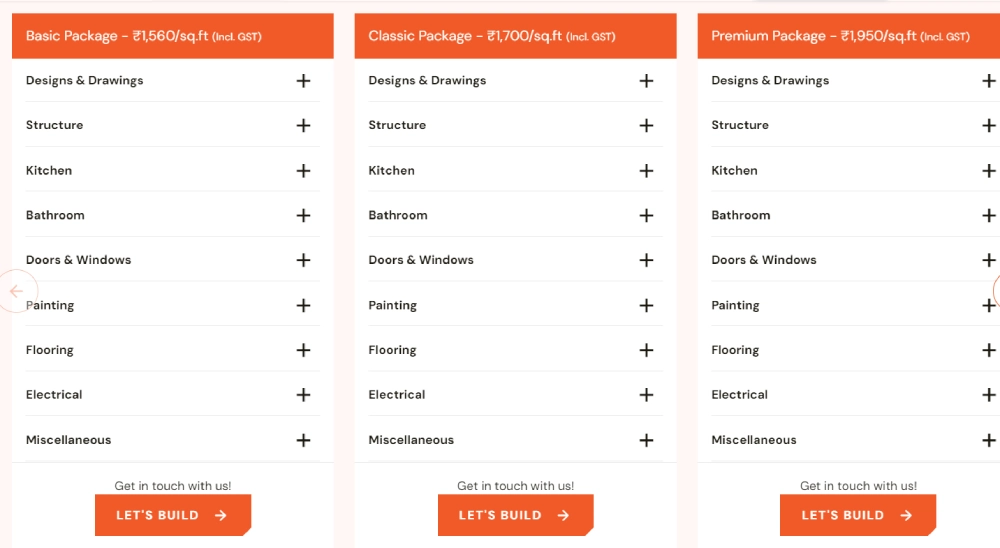
The basic package in Pune costs ₹1,560 per square foot.
Steel: Kalika or Kamadhenu or equivalent
Cement: Chettinad or Dalmia or equivalent of 43 or 53 grade
Wood: Waterproof flush doors or WPC for bathroom, main door is flush door with veneer. Sal wood frame of 5 inch by 3 inch, worth Rs.20,000 including fixtures.
Plumbing Fixtures: Ceramic Wall Dado up to 7′ height is up to Rs.40 per Sqft, Sanitarywares & CP fittings up to Rs. 30,000 per 1000 Sqft of Hindware make, CPVC Pipe is Astral or Equivalent.
Other Accessories:Overhead tank is double layered tank of 1000 Litres of Ekon make, Underground Sump is 4000 Litres, Staircase & Balcony Railing is MS Railing, Window Grills is asic MS Grill with enamel Paint at Rs. 180 per Sqft.
Paint: Interior Painting is JK Putty + Tractor Emulsion or equivalent. Exterior Painting is Asian Primer + Ace Exterior emulsion Paint or equivalent.
Classic Package
The classic package is priced at ₹1,700 per square foot.
Steel: JSW or equivalent
Cement: Chettinad or Dalmia or equivalent of 43 or 53 grade
Wood: Waterproof flush doors or WPC for bathroom, main door is teak Door With teak frame of 5 inch by 3 inch, worth Rs.30,000 including fixtures.
Plumbing Fixtures: Ceramic Wall Dado up to 7′ height is up to Rs.60 per Sqft, Sanitarywares & CP fittings up to Rs. 50,000 per 1000 Sqft of Parryware make, CPVC Pipe is Ashirwad or Supreme or Equivalent.
Other Accessories:Overhead tank is double layered tank of 1500 Litres of Ekon make, Underground Sump is 6000 Litres, Staircase & Balcony Railing is MS Railing, Window grills is basic MS grill with enamel Paint at Rs. 180 per Sqft.
Paint: Interior Painting is JK Putty + Tractor Shyne Emulsion or equivalent. Exterior Painting is Asian Primer + Apex Exterior Emulsion Paint or equivalent.
Premium Package
The premium package costs ₹1,950 per square foot.
Steel: JSW or equivalent
Cement: Ultratech or Birla Super or equivalent of 43 or 53 grade
Wood: Waterproof flush doors or WPC for bathroom, main door is teak Door With teak frame of 5 inch by 3.5 inch, worth Rs.40,000 including fixtures.
Plumbing Fixtures: Ceramic Wall Dado up to 7′ height is up to Rs.80 per Sqft, Sanitarywares & CP fittings up to Rs. 70,000 per 1000 Sqft of Jaquar make, CPVC Pipe is Ashirwad or Supreme or Equivalent.
Other Accessories: A Sintex /Apollo Double layered overhead tank of 2000L shall be provided. Any Additional capacity shall be chargeable at INR 9 per L. Platform for the OHT shall be charged additional based on the design and specifications, Underground Sump is 7000 Litres, Staircase & Balcony Railing is SS (Stainless) Railing of SS 304 grade profiles, Window grills is basic MS grill with enamel Paint at Rs. 200 per Sqft,
Paint: Interior Painting is JJK Putty + Apcolite Premium Emulsion or equivalent. Exterior Painting is Asian Primer + Apex Exterior Emulsion Paint or equivalent.
Royal Package
The royal package is priced at ₹2,100 per square foot.
Steel: JSW or equivalent
Cement: Ultratech or Birla Super or equivalent of 43 or 53 grade
Wood: Waterproof flush doors or WPC for bathroom, main door is teak Door With teak frame of 5 inch by 3.5 inch, worth Rs.50,000 including fixtures.
Plumbing Fixtures: Ceramic Wall Dado up to 7′ height is up to Rs.90 per Sqft, Sanitarywares & CP fittings up to Rs. 80,000 per 1000 Sqft of Grohe make, CPVC Pipe is Ashirwad or Supreme or Equivalent.
Other Accessories: A Sintex /Apollo Double layered overhead tank of 2000L shall be provided. Any Additional capacity shall be chargeable at INR 9 per L. Platform for the OHT shall be charged additional based on the design and specifications, Underground Sump is 8000 Litres, Staircase & Balcony Railing is SS (Stainless) Railing of SS (Stainless) Glass Railing of SS 304 grade profiles, Window grills is basic MS grill with enamel Paint at Rs. 200 per Sqft.
Paint: Interior Painting is JK Putty + Royale Luxury Emulsion or equivalent. Exterior Painting is Asian Primer + Apex Ultima Exterior Emulsion Paint or equivalent.
Conclusion
Bricknbolt provides a range of construction packages priced per square foot to various budget levels and construction needs. The prices of these packages may vary depending on the city and the specific package chosen.
Though each package uses different materials, superior quality steel and cement options, such as JSW Steel, Ultratech, and Birla Super cement, it ensures that clients can select a package that best suits their requirements and expectations for durability and quality.
Whether you are looking for a cost-effective solution or a premium construction experience, Bricknbolt provides transparent pricing and high-quality materials to meet your construction needs.
FAQs
1. What are the four packages offered by BricknBolt for home construction?
BricknBolt offers Basic, Classic, Premium, and Royal packages.
2. What is the cost of the Basic package per square foot in Delhi?
The Basic package in Delhi costs ₹1,790 per square foot.
3. Which steel is used in the Classic package in Chennai?
Cement is a component of concrete that is an indispensable construction material. Limestone and clay from quarries are processed to make cement. Portland cement is the most often used cement in buildings. Depending on your construction demands, Portland cement comes in a variety of forms, and the most common form is Portland Pozzolana Cement. This blog mainly states the uses of PPC, mainly about its benefits and application to various construction settings. But before we start, let’s understand what PPC is, its composition and the manufacturing process.
What is PPC cement ?
Portland Pozzolana Cement (PPC) is a type of blended cement. It is manufactured by mixing ordinary Portland cement and pozzolanic materials in a certain ratio. Normally, the mixing ratio varies from 15% to 35%. Pozzolanic materials are commonly powdered silica or alumina. They are in a finely divided form. In moisture, they will react with calcium hydroxide and produce compounds that have cement properties at room temperature. The primary pozzolanic materials used in the production of PPC are silica fumes, fly ash, and volcanic ashes.
Composition and Manufacturing Process of PPC
The chemical composition of PPC is normally as follows:
20% to 35% of Silicon Dioxide,
5% to 15% of Aluminium Oxide,
1% to 10% of Iron Oxide,
30% to 40% of Calcium Oxide,
0.1% to 4% of Magnesium Oxide and
1% to 3% of Sulphur Trioxide.
Portland pozzolana cement is produced by blending and grinding clinkers of Portland cement, gypsum, and other pozzolanic materials. The process is similar to the production of ordinary Portland cement. It involves four stages, namely:
Crushing of Raw Materials:
Limestone and clay are crushed to reduce particle size and pre-homogenized.
Raw Material Grinding:
The fine particles are grounded, mixed, and homogenized in silos.
Clinker Calcination:
The raw mix obtained from grinding is calcined in a rotary kiln. This forms a clinker.
Cement Grinding:
The clinker is cooled. Then they are mixed and ground with pozzolanic materials and gypsum in a cement mill. At last, they are stored in silos and packaged.
Uses of Portland Pozzolana Cement
The Portland Pozzolana Cement is used in different applications. Some of the applications are as,
Hydraulic Structures Constructions
Dams:
Portland pozzolana cements are mainly suitable for dams. This is due to their low heat of hydration. This helps in reducing the risk of thermal cracking in mass concrete structures.
An example of this application is Sardar Sarovar Dam construction in India. Here, PPC was used to reduce heat generation and thermal stress.
Canals and Sewage Treatment Plants:
Portland pozzolana cements have improved resistance and durability for the sulfate attack. So they can be a good choice for structures in constructions that are in contact with water. The Portland pozzolana cements have shown high sulfate resistance. They have an expansion rate of less than 0.1%, compared to 0.2% in OPC concrete.
Marine Structures
Ports and Harbors:
Portland pozzolana cement is mostly preferred in marine construction as it is resistant to chloride ion penetration. This is important for structures exposed to marine water. An example of this application is the Port of Chennai. The PPC has been used in the construction of new berths, this is mainly for the improvement of the construction structure’s life span.
Offshore Platforms:
The durability of PPC in an aggressive environment makes it suitable for offshore platforms, as they will be exposed to saline water.
Mass Concrete Works
Foundations and Piles:
PPCs can be used in foundations and piles as they have properties that reduce the risk of cracking and low heat of hydration. They can be used in large concrete pours. The construction of Burj Khalifa’s foundation used PPC. This is mainly used for the management of thermal stress.
Raft Foundations:
Raft foundations have used PPC for minimal thermal gradients and durability. They are used in projects like the Shanghai Tower.
Buildings and Structural Concrete
High-Rise Buildings:
PPCs are used for high-rise buildings, as they have improved workability and chemical attack resistance. They have been used in the Petronas Towers constructions. This helped in achieving a durable concrete structure with minimal requirements for construction.
Residential and Commercial Complexes:
PPC has a superior finish and decreased permeability along with the strength., so it is preferred for commercial buildings. This helps in the sustainability of construction, mainly due to the use of by-products of industries like fly ash.
Transportation Infrastructure
Roads and Highways:
For roads and highways, PPC can be used for its durability and reduced maintenance. One best example is the Delhi-Mumbai Expressway project. It employs PPC for its concrete pavements to ensure longevity and cost-effectiveness.
Airports:
The high strength and durability of PPC make it suitable for airport constructions like runways and taxiways. Indira Gandhi International Airport in New Delhi has used PPC for its expansion. This helps in improving the concrete surface lifespan.
Advantages of PPC cement:
Improved Durability: PPC shows improved resistance to any chemical attacks like chlorides and sulfates. This is due to the reaction of pozzolana, which decreases the permeability and porosity of concrete.
Lower Heat of Hydration: Lower heat of hydration is one of the properties of PPC. It helps in reducing the thermal tracing in large concrete structures. This makes it ideal for words related to mass concreting works.
Improved Workability: The fine particles in PPC help in improving the workability of the concrete. This helps involve easier placement and compaction.
Sustainability: By-products like fly ash can help in the maintenance of sustainability. As it can reduce the carbon footprinting of cement production.
Cost-Effectiveness: PPC is more economical than ordinary Portland cement. As PPC uses locally available materials. They have the potential to decrease the cement consumption in mixes.
Why choose PPC?
The comprehensive strength of PPC is the same as ordinary Portland cement. However, the pozzolanic reaction improves its long-term strength. The concrete made by PPC has a low water permeability of 20% to 30% compared to ordinary Portland cement. This is because of its high durability. PPC also shows a higher resistance to sulfate attack, over 50%,compared to ordinary Portland cement concrete.
Conclusion
PPCs have various applications in construction. Ranging from hydraulic structures and marine environments to Oil well cementmanufacturing and transportation infrastructure. By using PPC, the performance and longevity of concrete structures can be improved. Additionally, sustainable construction practices can be followed. By adding PPC to construction projects, the industry can get durable, sustainable, and cost-effective solutions.
FAQs
1. Can PPC be used in large concrete pours?
Yes, PPC is ideal for large concrete pours due to their low heat of hydration. They help in reducing the risk of thermal cracking.
2. What are the uses of PPC in hydraulic structures?
PPCs are used in hydraulic structures like dams, canals, and sewage treatment plants.
3. What is PPC’s resistance to sulfate attack?
PPC shows over 50% higher resistance to sulfate attack when compared to OPC concrete.
4. What is the role of gypsum in the production of PPC?
Gypsum is added to control the setting time and improve the workability of PPC.
As is commonly know, concrete is a primary building material that excels in strength and durability. It usually experiences two types of stresses: tension (pulling forces), and compression (pushing forces). Concrete is popularly known for its toughness in compressive strength and lacking in tensile strength, making it a notable factor in construction and structural engineering.
To give a rough value, the tensile strength of concrete is 1/10th of its compressive strength. However, it is one of the mechanical properties of concrete, difficult to estimate accurately because of increased brittleness of concrete.
This article explains in detail about the tensile strength of concrete, the factors influencing it, how to improve it and why it’s important.
Tensile Strength of Concrete
In general, tensile strength indicates the maximum tensile load or pulling force that a concrete can withstand without fracture. The tensile strength of traditional concrete can typically range between 300 and 700 psi. This is because it is weaker in tension compared to compression.
Why is the Tensile Strength of Concrete Important?
Though the concrete has lower tensile strength than its compressive strength, it still ensures the improved performance and longevity of structures. Here’s why:
Structural Performance
Cracks in concrete terribly affect the structural ability to carry loads. That’s why engineers keep tensile strength in mind when designing structures to resist cracking and maintain load-bearing capacity. This is most important for elements like slabs and beams that are more likely to experience the bending forces.
Flexural Strength
Tensile strength is indirectly connected to flexural strength, determining the concrete’s ability to resist bending. Bending is considered the biggest drawback when it creates tension on one side of a slab or pavement. Luckily, the higher tensile strength of concrete contributes to a higher flexural strength, allowing it to carry larger loads without breaking.
Durability
Cracks are loopholes for the creation of moisture content, encouraging the deterioration of concrete and embedded steel reinforcement. With proper tensile strength, the cracks can be minimized, leading to an improvement in the overall lifespan and durability of the structure.
Crack Control
Cracks in concrete are increasingly possible under pulling forces. Understanding the tensile strength of concrete allows engineers to predict how much stress it can withstand before the cracking appears. It aids people in designing structures with improved aesthetics, minimal cracking and water infiltration.
Factors Affecting Tensile Strength of Concrete
Several factors influence the tensile strength of concrete, which are explained below:
Curing Condition: A longer curing period allows concrete to hydrate fully, promoting higher tensile strength allowing it to withstand maximum stress.
Admixtures: Specific admixtures added to the concrete mix play a crucial role in improving the tensile strength.
Water-cement Ratio: The water-cement ratio is a critical mixture, a higher water content may increase the possibilities of cracking, while the lower water content causes reduced workability. A balanced ratio creates denser concrete, leading to higher tensile strength.
Aggregate Type: The size and type of aggregates like sand and rock can influence the tensile strength of concrete. Tailoring aggregates according to your specific needs resultsing in expected outputs.
How to Enhance the Tensile Strength of Concrete
The tensile strength can be improved using various methods and some of the significant points are mentioned below:
Fiber Reinforcement
Adding fibres to a concrete mix is one of the proficient ways to enhance tensile strength. fiber reinforcement involves using different types of fibers that act like microscopic reinforcements to distribute stress and bridge cracks throughout the matrix. Each type of fiber has unique properties:
Polypropylene Fibers: This is particularly suitable for tackling shrinkage cracks, and enhancing crack resistance and control.
Steel Fibers: The steel type is most commonly used, providing significant improvement in crack resistance and tensile strength.
Glass Fibers: It is known for its good corrosion resistance, leading to obtaining higher tensile strength.
Mix Design Optimization
A balanced water-to-cement ratio, appropriate type and size of aggregates and admixtures can achieve improved tensile strength. The following ways involve achieving maximum tensile strength:
Closer bond between aggregates and cement paste.
Bringing essential modifications in the setting and hardening process of the concrete leads to better tensile strength.
Adding sufficient water content offers denser concrete.
Prestressing
Prestressing is a process of applying compressive stress to concrete elements before the tensile stresses arise. It can be typically used in large-scale constructions like beams and bridges to reduce crack formation.
In a Summary
Understanding the importance of tensile strength prepares engineers to design and construct efficient, safe and durable structures. Compared to compressive strength, concrete has a lower tensile strength. However, it is a major factor affecting durability and performance of a structure.
FAQs
1.Why is Concrete Weak in Tension Compared to Compression?
Concrete is weak in tension but strong in compression because it is brittle in nature. The cement paste added to the concrete mix contains minimal tensile stress capacity, leading to shrinkage or cracking under pulling forces. Conversely, the concrete can resist compressive forces and form a rigid structure.
2.How is the Tensile Strength of Concrete Measured?
The tensile strength of concrete can be evaluated using various measures such as direct tension test, flexural test (modulus of rupture), and split cylinder test. These methods determine how efficiently the concrete can resist tensile stress under different conditions.
3.Are There Any Specific Applications Where the Tensile Strength of Concrete is Specifically Important?
Yes, the tensile strength of concrete is essential in certain applications such as pavements, bridges, high-rise buildings and other structures particularly subjected to dynamic loads, bending or tension that create tensile stress.
4.What are the Factors Affecting the Tensile Strength of Concrete?
Some significant factors influence the tensile strength of concrete such as the age of the concrete, water-cement ratio, admixtures, curing conditions, or fibre reinforcements. Handling these factors efficiently can enhance the strength and make structures resistant to cracks.
Before jumping into the construction, you have to be extra careful about the raw materials and their proportions. More than high quality, being aware of the right mix matters. One of the significant factors among them is the water-cement ratio, which determines the strength and durability of the final structure.
In general, the water-cement ratio is fundamental when involved in any kind of construction work. Understanding its estimation is crucial to designing the structure with desired concrete properties.
In between this discussion, people have queries that include ‘’adding some amount of extra water makes the concrete hard?” or “the addition of water content increases the concrete workability?”Along with the calculation of the water-cement ratio, you’ll be answered to these queries.
What is the Water-Cement Ratio?
The ratio defines the mass of water to the mass of cement in the concrete mix. As per IS code 10262, the water-cement ratio falls between 0.4 to 0.6 for the nominal mix.
It is a fundamental parameter that acts as a deciding factor of strength, durability and workability of concrete. With the appropriate water-cement ratio, contractors and engineers can manipulate the concrete properties more suitable to the applications.
It significantly influences the strength of concrete; results can be witnessed after the completion of the final product.
Role of Water in Concrete
As mentioned earlier, determining the amount of water content in the concrete is a difficult part. But we are still using it instead of chasing any alternatives, have you ever thought why?
Concrete of construction is a macro element, made with different ranges of micro raw materials. It includes sand, cement, fine aggregate, coarse aggregate, and water. In order to achieve high-strength concrete, the correct proportion of admixtures is essential to combine these ingredients.
Here comes the need for water. Water begins the chemical process called hydration, hence, water is added to 23% to 25% of cement volume to pack the voids in the concrete.
Importance of Water Cement Ratio
Water cement ratio is a primary key aspect to achieving the desired strength of concrete. An adequate ratio can lead to increased strength, durability, workability, long-term performance and resistance to chemical attack and cracking.
‘Water and cement-these two ingredients are fairly responsible for binding materials together. When the structure is cured completely, you can notice the visible results in the strength and durability of the concrete.
How to Calculate Water Cement Ratio in Concrete?
The water-cement ratio can be estimated using various steps and considerations. Here is the guide given below to determine the appropriate mix ratio:
Identify the Required Strength
The initial step is to evaluate the strength required for the concrete. It may vary according to the project specifications or intent of use. Before getting into the discussion of the water cement ratio, estimating the desired strength is paramount to proceeding further.
Choose the Range of Water Cement Ratio
Choose an appropriate W/C ratio based on the specific conditions of the projects and the required strength and workability of concrete. In general, 0.4 to 0.6 is considered a good start. A lower W/C ratio offers higher strength to concrete but lower workability.
Calculate the Water Content
Estimate the water content needed for a specific volume of concrete by considering factors like a desired slump and aggregate size. Ensure that portable water is used to avoid causing impurities and compromises in concrete strength.
Using the given formula, you can find the amount of water required:
Water Required = (Water-Cement ratio) x (Cement Required)
Adjust the Water Content
Luckily, targeted consistency can be acquired sometimes. In the meantime, you can adjust the water content based on factors like desired texture, environmental conditions, moisture content, size and shape of the aggregates, type of cement, and amount and type of admixtures, until the right proportion is achieved.
Weigh Cement
Weigh the cement before mixing as it directly influences the water-cement ratio. Ensuring the accuracy of measurement tends to obtain the desired concrete mix.
Estimate the Aggregate Size
The aggregate size also plays a pivotal role in water cement ratio, essential to be considered by the engineers. Refer to the table to understand:
Maximum Aggregate Size in mm
Maximum Water Content Per Cubic Meter of Concrete
10
208
50
186
40
165
Determine Water-Cement Ratio
Calculate the water-cement ratio exactly using the below formula:
Water-cement ratio = weight of water / weight of cement
How to Test the Water-Cement Ratio?
To verify its accuracy, use the following methods to determine the water-cement ratio:
Slump Test
Like the strength of concrete, the workability is also an important factor. By conducting a slump test, you can measure the flow of the fresh concrete, consistency, workability and the availability of water content.
Durability Testing
With durability testing, you can evaluate properties like permeability, freeze-thaw resistance and resistance to chemical attack. It allows engineers to identify the ratio of mixtures for achieving the intended results.
Compressive Strength Test
It takes curated concrete samples to evaluate the achieved strength and ensures that the final product meets the design requirements.
Final Lines
Overall, the w/c ratio is a base to determine the high quality and high strength of concrete. A good mix design is a key to leverage total confidence like consistency, durability and workability. Before getting into the construction process, understanding the importance of water cement ratio evaluation benefits you in all aspects.
FAQs
1. Does water cement ratio affect concrete strength?
Yes, the higher amount of water reduces the compressive strength of concrete due to the presence of voids between the particles of concrete. The lower water content compacts the overall concrete structure resulting in higher strength.
2. How to reduce the water cement ratio in concrete?
For additional water reduction use mineral admixtures like silica fume or fly ash. Also add special chemicals called superplasticizers that assist the concrete flow without extra water. Ensure that you are buying good quality sand and rock to fit together well without causing air bubbles.
If you’re a construction professional, project manager, and engineer who are constantly under pressure to meet tight deadlines without compromising quality, Rapid Hardening Cement (RHC) offers a crucial advantage. RHC allows projects to progress faster, reducing downtime and accelerating schedules.
Whether you’re working on urgent road repairs, precast concrete production, or emergency construction, RHC delivers the quick setting and high early strength needed to keep your projects on track. In this blog, we’ll explore RHC in detail.
What is Rapid Hardening Cement?
Rapid hardening cement is a unique type of cement with many added benefits. This cement is for construction professionals, like architects, engineers, and contractors. It’s also for disaster response teams and agencies in charge of fixing vital infrastructures.
Rapid hardening cement, also called high early strength cement, is a specific variety of cement. It gains strength much faster than Ordinary Portland Cement (OPC). It’s useful where early concrete strength is needed, such as in infrastructure repairs, after disasters, and with precast elements.
So, rapid hardening cement has a key difference from normal Portland cement. It has more tricalcium silicate (C3S), which is the compound that adds to early strength. Also, because the cement clinker is ground more thoroughly, RHC can reach the same strength as OPC in only 72 hours, whereas OPC takes 168 hours.
Manufacture of Rapid Hardening Cement
Making Rapid Hardening Cement involves a higher temperature process compared to making OPC. The blending of raw materials, such as limestone, clay, and other minerals required in the formulation of the cement, is done carefully to ensure the right chemical composition is obtained.
The process involves:
1. Grinding and Mixing: The raw materials are ground into a fine and uniform particle size and then blended to a required degree of uniformity.
2. Burning: The raw material is mixed and fed into a rotary kiln. It is then, burned at a higher temperature, typically around 1450°C, to form the cement clinker.
3. Grinding: The cement clinker is crushed and ground fine along with a moderate quantity of gypsum to act as a setting agent.
Composition of Rapid Hardening Cement
Rapid-hardening cement has more tricalcium silicate (C3S). It is usually 40% to 60% of the cement.
The other major components include:
– Dicalcium silicate (C2S): 15%
– Tricalcium aluminate (C3A): 10%
– Tetracalcium aluminoferrite (C4AF): 8%
The higher C3S content and the finer grinding of the cement are the key. They cause the rapid hardening and strength gain of the cement.
Properties of Rapid Hardening Cement
Strength Development
Rapid-hardening cement can develop strength at a much faster rate compared to OPC.
Setting Time
Rapid hardening cement’s initial setting time is 30 minutes and the final setting time is 600 minutes.
Early Strength Gain
Due to the higher C3S content, rapid hardening cement can achieve double the strength of OPC in the first 24 hours. It can reach the same 7-day strength as OPC in just 3 days.
Ultimate Strength
Early strength gain is much higher. However, the final strength of rapid-hardening cement is only slightly higher than OPC. It’s typically 10-20% greater.
Fineness
This cement has a higher specific surface area, over 3,250 cm²/g. This size makes it hydrate and harden faster.
Heat of Hydration
While being hydrated, the RH cement produces more heat than normal cement.
Shrinkage
The cement is ground to a higher fineness and has more C3S. This makes the product rapidly harden the cement. It shrinks less during curing and hardening than OPC.
Water Requirement
Rapid hardening cement uses a lower w/c ratio for set fluidity and strength. This is an added advantage compared to normal cement. It is due to better durability and less porosity.
Works like roads, bridges, and any other structure need early strength. They cannot afford to wait for their strength to develop.
– Precast concrete elements:
The slabs, poles, and other members are precast and used in RCC structures. These structures need quick stripping from the form. These members are made using rapid hardening cement.
– Cold weather concreting:
Rapid hardening cement gains strength early, making it ideal for cold regions where normal cement does not gain enough strength.
– Disaster response:
Quick-setting cement is required in the rehabilitation of structures affected by natural disasters and any other calamities.
Advantages of Rapid Hardening Cement
The key advantages of using rapid-hardening cement include:
1. Faster construction timelines:
The rate of strength gained enables the construction formwork to be removed faster hence, enhancing the rate of construction completion.
2. Suitability for cold climates:
The rapid hardening cement is much better than ordinary cement. It works well in cold regions.
3. Durability and resistance:
Significantly, rapid-hardening cement may entail lower shrinkage and higher chemical resistance.
4. Versatility:
Rapid hardening cement works for most construction, not just infrastructures but also precast items.
Alternatives to Rapid Hardening Cement
Rapid hardening cement has many benefits. But, other cement types may be suitable for some applications.
1. Ordinary Portland Cement (OPC):
Thus, OPC can be used in cases when construction project deadlines do not affect the need for early strength.
2. Sulphate-Resisting Cement:
This is for structures exposed to high sulfate in the soil or water. They should use sulphate-resistant cement.
3. Low-Heat Cement:
In massive concrete placing, heat of hydration is an issue. Low-heat cement can be a solution.
4. Extra Rapid Hardening Cement:
Extra Rapid Hardening Cement is a special cement. It is made by grinding rapid hardening cement with calcium chloride. It can reach its 28-day strength in as early as three days.
Conclusion
As the construction industry progresses into the future, probably, the use of advanced and superior specialty cement such as rapid hardening cement will increase meaning that the advancement of this particular cement type will not stagnate.
Stamp duty, stamp tax, or documentary tax is a type of tax levied during the documentation of the transfer of property ownership. In India, stamp duty is not imposed on a home loan amount. It can be levied on an immovable property like a home brought through a home loan amount.
Stamp duty is usually levied through a sale deed drafted between a buyer and a seller while transferring the ownership of a home or other immovable property.
What is Meant by Stamp Duty on a Home Loan?
Stamp duty is usually paid based on the market value of the property under consideration and not the loan amount. The buyer is generally entitled to pay the stamp duty.
State governments levy stamp duty during property ownership transactions to generate revenue and discourage frequent property transfer.
Traditionally, a physical stamp with its corresponding amount will be attached to a legal document as proof of the stamp duty payment.
How is Stamp Duty Calculated?
The stamp duty value is usually calculated as a percentage of the value of the property being transferred of ownership or based on the value of the legal document.
The stamp duty value, however, can be influenced by the following factors:
The jurisdiction of the property as each State government has a different stamp duty rate determining method.
The rate may differ based on the kind of transaction documentation, like the sale deed, gift deed, and so on.
The market value of the property.
Documents required for stamp duty
Below are the documents you must have in hand for stamp duty on your home loan.
1) The original and signed sale deed between the buyer and seller.
2) Proof of payment of the stamp duty (tax levied by the government on property transactions.)
3) Copies of the PAN (Permanent Account Number) card of both the buyer and the seller.
4) Government-issued identity proof of both the buyer and seller, such as an Aadhaar card, passport, voter ID, or driver’s license.
8) Passport-sized photographs of the buyer, seller, and witnesses.
9) Identification documents of witnesses.
10) Power of Attorney (if applicable)
11) Society Share Certificate (if applicable)
12) Recent bank statements may be required to verify the payment of stamp duty.
For properties in a housing society, the original share certificate issued by the society to the seller must be provided.
Development Agreement and Approved Building Plan (if applicable):
In the case of under-construction properties, the development agreement and the approved building plan by the local authority must be submitted.
Payment Proof:
Proof of payment made towards the purchase of the property, such as bank statements, demand drafts, or cheques, which may be required to verify the transaction.
Affidavit (if applicable):
An affidavit from the seller declaring that the property is free from any legal disputes or encumbrances.
Form 60 (if PAN is not available):
If the buyer or seller does not have a PAN card, Form 60 must be submitted as a declaration.
It is best to consult a lawyer or meet with a professional before you pay your stamp duty.
How to Save on Stamp Duty Charges?
There are some legally potential ways in which you can save on stamp duty charges as listed below:
Registration in a woman’s Name
Low-end projects
Lower undivided share
Invest in projects that offer stamp duty waivers
Negotiating with the seller
Registration in a Woman’s Name
Some states offer discounts on stamp duty for female property buyers. You can explore this option if it is applicable. You can inquire about this option in the State government’s official website on housing or real estate.
Low-end Projects
Stamp duties on property or homes under construction are usually lower than those on a completed project. However, this option is subject to variation across state government policies.
Lower Undivided Share
Stamp duty is generally allocated based on the individual share value in a larger property. If you purchase a larger property, ask for a lower undivided share to incur lower stamp duty.
Invest in Projects that Offer Stamp Duty Waivers
Certain projects offer stamp duty waivers to encourage purchasing of the property. You can, therefore, choose to invest in projects that provide stamp duty waivers.
Negotiating with the Seller
You can negotiate with the seller to bear the cost of the stamp duty, at least a portion of the stamp duty.
Factors influencing stamp duty
The location of the property
Stamp duty rates differ for urban and rural areas. Properties in urban areas have a higher stamp duty than property in rural areas.
Age and gender of the owner
Senior citizens and women have some stamp duty benefits that can reduce their stamp duty rates.
Property usage
The purpose for which the property is purchased can also influence stamp duty rates.
The type of property
The type of property, whether it is commercial or residential, can impact stamp duty rates. Commercial properties have a higher stamp duty than residential ones.
Government schemes and incentives
You can avail of stamp duty rate reduction under applicable government schemes and incentives.
Joint ownership
Joint ownership can reduce stamp duty rates as it is calculated based on the combined ownership.
Tax benefits on stamp duty and registration charges
You can claim tax benefits on stamp duty under Section 80C of the Indian Income Tax Act. This act allows you to get a maximum deduction of Rs. 1.5 lakhs in your income tax return filing.
If the property is under joining ownership, you both can claim tax reductions based on the shares you have.
Note: Additional expenses like admission fees, post-occupancy renovations, share costs, etc., will not come under this reduction.
Conclusion
Stamp duty is an essential additional cost incurred during the documentation of property ownership transfer. Not paying proper stamp duty charges can void the transfer documentation. So, look into the charges applicable to stamp duty while documenting your property ownership transfer and pay them appropriately.
FAQs
1. Why is stamp duty paid?
Stamp duties are taxes levied by the state governments to generate revenue and prevent frequent property transactions.
2. Can stamp duty be refunded?
Yes, stamp duty can be refunded when excess stamp duty has been paid, unused stamp papers, cancellation of a sale deed before registration, or under a court order that mandates the return of a property due to legal disputes.
3. Is stamp duty allowed as a deduction?
Stamp duty paid can be deducted through Section 80 C of the Income Tax.
Are you preparing to construct your dream home? Or are you about to renovate your personal space? Concrete will become the major element of your construction project. Hence, you have to ensure the quality of concrete and must ensure its workability to get better results. The slump test is one of the methods used to determine the workability of concrete. In today’s blog of Brick & Bolt, you are going to learn more about concrete slump testing, its importance, why it matters, and how it’s performed.
But first, we need to understand the workability of concrete and why it is important.
What is the Workability of Concrete and Its Importance?
Workability of concrete is a term that signifies how easily the freshly prepared concrete can be placed or poured, tamped, and cured without segregation or unwanted bleeding. If workability is not ideal, the structures are likely to exhibit air pockets and voids that affect the quality, strength, and durability of the completed building. Correct workability means that the concrete can be filled perfectly in the forms, spread around the reinforcement and compact with no air pockets or voids to be found. It also correlates with the surface finish and the overall construction or installation process.
Workability is significant for the performance of the final concrete by meeting quality, strength, and durability while reducing construction time and labour costs. Proper workability guarantees that structures are built of high quality and last long as well. Workability can be measured by slump test, compaction factor test, vee bee consistometer, key ball test, and flow test. Among all the workability tests, the slump test is widely used at the construction site due easiness of its performance.
What is the Slump Value of Concrete?
The slump value of concrete indicates its consistency and workability before it gets set. It signifies how easily the concrete can be placed, consolidated, and finished without segregation. The slump test is generally used to assess the freshly prepared concrete’s fluidity and workability.
Importance of the Slump Test
The concrete slump test is very important for the following reasons:
Workability assessment of concrete: By conducting the slump test, you can determine whether the concrete is suitable for the intended application or not.
Water content indication: The test allows for adjusting the water content to be suitable for the specific project, reducing any excess water.
The moulding capacity of concrete: The slump value of concrete shows how easily the concrete can be placed and consolidated.
Verification of mix design: Reaffirms that the prepared concrete meets specified requirements.
Slump Cone Test Equipment
To conduct the slump cone test, the following are the essential apparatus:
Slump cone: height 300 mm, bottom diameter 200 mm, and top diameter 100 mm.
Measuring Tape
Standard tamping rod
Base plate
Slump Test Procedure
The following are the general steps taken while conducting the slump test:
Clean the inner surface of the mould and apply oil.
Set the mould onto a non-porous, horizontal base plate.
Pour three equal layers of freshly prepared concrete into the mould.
With the usual tamping rod, tap each layer 25 times to make it more compact. After compacting, level the top surface of the concrete.
Level the upper surface of the concrete after compacting.
Gently lift the mould in an upward direction, leaving the concrete cone in place.
Gauge the difference in height between the mould and the concrete sample. This difference is referred to as the slump, measured in millimetres
Different Types of Concrete Slump
The following are the major types of concrete slump based on the concrete slump test values:
When someone lifts the cone in an upward direction, the concrete sample keeps its shape and slumps roughly the same symmetrical shape as the cone, it is called a true slump. Although each project and particular type of concrete may have different genuine slump specifications, general slump values typically range from 1 to 8 inches (25 to 200 mm). This kind of slump signifies that the mixture is quite workable. True slumps are usually found in concrete mixtures that have the right amount of water and a proportionate amount of cement, additives, and particles.
2. Shear Slump
A shear slump occurs when one-half of the cone-shaped concrete mass slides down or shears off an angle of 45 degrees or more from the other half. This type of slump often indicates issues with the mix’s cohesion and internal friction. It might be caused by improper proportions of fine and coarse aggregates or an improper grading of aggregates. Shear slumps indicate potential challenges in achieving uniform compaction and might result in uneven concrete surfaces.
3. Collapse Slump
When someone lifts the cone, the concrete slump collapses or flattens out. It’s taken to be a collapse slump. This is attributed to the very high amounts of water and superplasticisers in concrete. Collapse slumps serve as an indication to modify the water-cement ratio of the concrete mix and reconsider the proportion of the other ingredients.
4. Zero Slump
Zero slump occurs to the dry concrete mixes with less water content. If the mixture keeps its shape the same as the mould without any settling or deformation after the removal of the cone, it’s considered Zero slump. It implies very low workability, making it difficult to place properly and compact the concrete.
Concrete Slump Ranges for Different Types of Requirements
Depending on the type of construction, these various techniques and specifications for project requirements give acceptable ranges for concrete slumps. General considerations include:
The Slump value of concrete can vary based on the following key factors:
Amount of Water: The water-cement ratio or quantity of water significantly influences the slump value.
Cement content and type: The type of cement that is being used in the concrete determines its workability.
Aggregate size and shape: Aggregates of various sizes have unique characteristics that influence slump value.
Admixtures: Chemical admixtures can modify slump without changing water content.
Temperature: Higher temperatures may reduce slump over time.
Time: The slump generally decreases as the concrete is set.
Limitations of the Slump Test
While the slump test is helpful, it also has some limitations:
It cannot determine durability or strength directly.
Results depend upon the skill of the person performing the test.
It may not be suitable for all types of concrete mixes, especially those with very low or very high workability.
While the slump test is useful for many concrete mixes, some specialised types, like self compacting concrete, may require different workability tests.
Slump testing is a simple but powerful technique to determine the workability of concrete. Understanding slump values provides the assurance that concrete mixes will meet the required specifications for workability and consistency, which in turn augments the overall quality and durability of the concrete structure. Although it has its own limitations, the test is widely used and considered necessary in current concrete quality control. The integration of slump testing with other quality control measures will ensure that competent construction
One of the common dilemmas faced by those aspiring to build a house is whether to opt for sloping roofs or flat roofs. This is a significant factor in determining the architectural style and visual appeal of a home. This blog provides a comprehensive guide on sloping roofs, its types, material options and limitations, so that you can make an informed decision while building your home.
What is a Sloping Roof?
A roof which has an inclination angle of more than ten degrees against its normal or horizontal is termed as a sloping roof or pitched roof. Such roofs are commonly found in areas with frequent and heavy rainfall or snowfall due to faster drainage of water or snow accumulated on rooftops. However, sloping roofs are also a popular choice for homeowners living in areas with moderate rainfall due to aesthetic preferences. A sloping roof house is generally considered as traditional. However, new technologies and innovative designs have enabled the incorporation of sloping roofs into modern home designs as well.
Types of Sloping Roofs
Sloping roofs can be designed and constructed in a wide range of shapes and types, enabling enhanced customisation based on aesthetic considerations and individual preferences. A few types based on their shapes are discussed below.
Mono Pitched or Shed Roof
The shed roof is a type of roof which is inclined along only one direction and represents the simplest form of a sloping roof. Since this type of a roof consists of only one plane that forms the roofing surface, it is quick and easy to construct. Mono-pitched roofs also offer the advantage of mounting solar panels in the optimal direction for receiving maximum sunlight.
Gabled Roof
A gabled roof has two sloping surfaces that meet at the top (called ridge) and form a triangular shape, with the other two sides generally being flat. This is one of the most commonly found types of sloping roofs due to the versatility it offers with its variations, such as cross gabled, Dutch gabled, double gabled and double cross-gabled roofs.
Hip Roof
A hip roof has a horizontal ridge (peak) from which four sloping surfaces originate on four sides, forming a trapezoid in elevation. Such roofs are more commonly found in rural India. Multiple variations are available in this type too, such as double hip, cross hip and pyramidal hip roofs.
Mansard Roof
Mansard roofsare a combination of flat and sloping roofs that originated in Europe in the 15th century. One flat surface forms the top of the roof, with sloping surfaces—that can be straight, concave, convex or curve shaped—surrounding it on two or four sides. This type is not generally observed in India since it is expensive, time consuming and labour intensive.
Sawtooth Roof
This is a type of sloping roof with multiple ridges and sloping surfaces forming a jagged surface. Sawtooth roofs generally incorporate glass on slopes facing a particular direction to allow additional natural light into interior spaces. These are however expensive and difficult to maintain.
Material Options for Sloping Roof Construction
Although traditional sloping roofs featured tiles of different materials placed on some sort of framework, there are numerous other roofing material options available today to cover sloping roofs.
Concrete Sloping Roof
A concrete sloping roof is one of the simplest and most cost-effective types of pitched roofs to execute. However, ensuring quality of concreting, curing and waterproofing is crucial, without which the concrete can develop cracks and cause long-term water seepage and leakage issues.
Tiled Sloping Roof
Roofing tiles are available in various materials such as clay, concrete, fibre cement, slate and metal, providing a versatile range of finishing options. These are placed on a framework which is generally made of steel or wood and can be easily replaced in case of damage. However, most tile materials are vulnerable to even slight environmental changes.
Sheet Roof
Roofing sheets are commonly used for industrial buildings and not for homes, due to the heat that they generally trap inside buildings. They are available in numerous materials that could be metal or plastic based.
Wood Sloping Roof
This is a type of sloping roof which is comparatively more sustainable and includes multiple wooden panels or battens that are joined together. Care should be taken to ensure that properly seasoned wood with adequate termite treatment is used, in order to ensure that the wood does not rot and remains durable.
Limitations of Sloping Roofs for Home Construction
Generally a necessity in areas with heavy rainfall, a few practical difficulties with sloping roofs limit their usage in urban Indian cities for modern home designs.
Water Management
Sloping roofs require additional provisions of gutter pipes to ensure that water does not flow down with heavy force onto the ground. Although this is not a crucial requirement, it is a practical option for water management.
Leakage/ Seepage
Issues of leakage and seepage of water from the roof are more frequently found in sloping types than in flat ones. This is because waterproofing sloping roofs is much more difficult (except in concrete sloping roofs).
Access for Maintenance
Unless an additional or special catwalk is provided (which is rare), sloping roofs are difficult to walk on and access for maintenance purposes.
Usability
While flat rooftops allow their usage as terraces, the space above sloping roofs is rendered unusable. This is a major drawback as terraces provide the only open space accessible in most homes and are an essential part of Indian homes.
Sloping Roof Design
Designing and selecting the right type of sloping roof with the right materials is a crucial aspect of home construction based on various factors such as climatic conditions, usage requirements and aesthetic considerations. Although a sloping roof is a visually pleasing option, its design involves numerous technicalities such as waterproofing techniques, access planning and calculation of inclination angles. It is therefore advisable to consult with experts such as architects, structural engineers and contractors to ensure the ideal type and design of roof for your house. Contact Brick & Bolt to provide you with end-to-end construction solutions and ensure that all your needs for a dream home are fulfilled!