Home Blog Page 52

Pile Foundation: Types, Benefits, and Applications

0
Pile Foundation and its Types

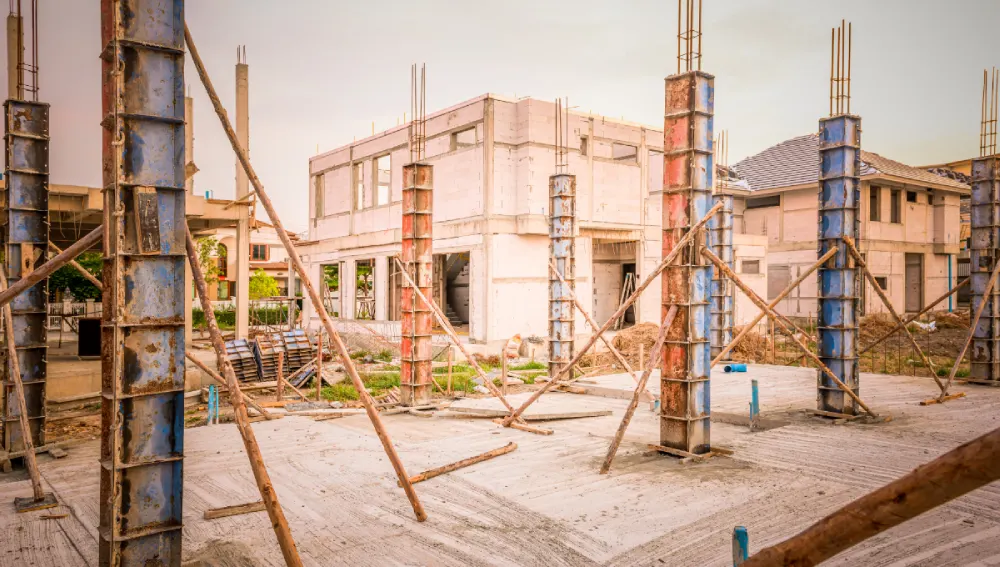
Pile foundations are essential as they provide a strong and stable foundation. They play a critical role in the construction industry and are specially used for buildings that need to withstand extreme forces. They are mostly applicable to structures built on unstable soil. 

Pile foundation helps transfer the structure’s weight to stronger soil layers. and is a type of deep foundation. Large construction projects like bridges and buildings use pile foundations. Read on to learn more about this crucial type of foundation.

What is Pile Foundation? 
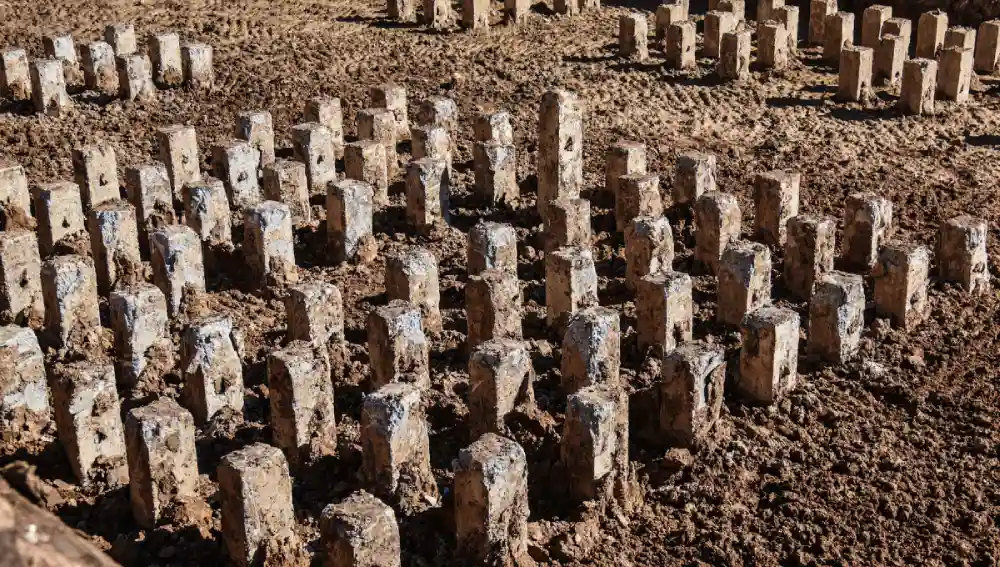
Pile Foundation

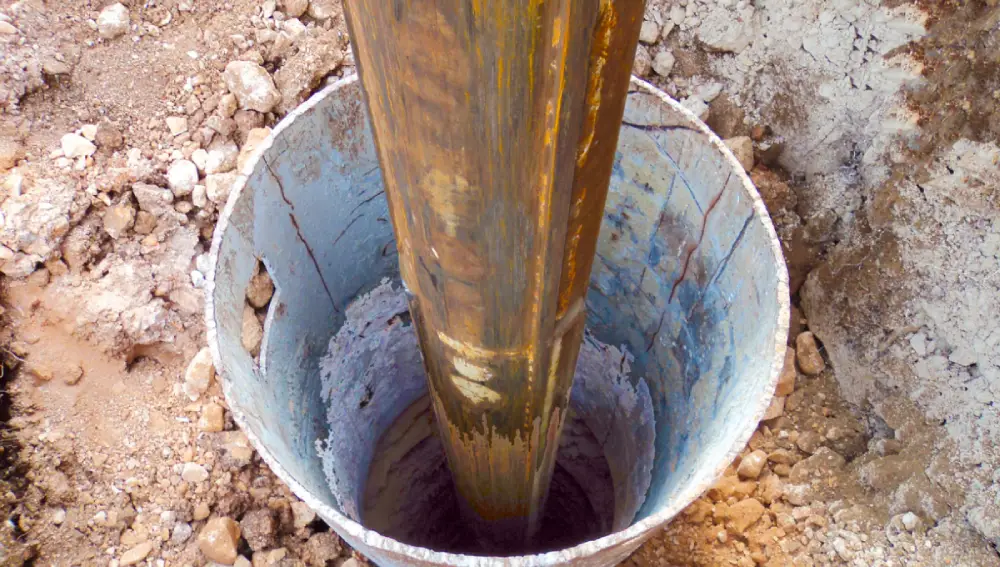
A pile foundation is a deep foundation that uses thin pillars under the ground for stability. It is typically long and made up of steel or concrete. It provides support for transferring weight to deeper layers of soil. Pile foundations are also used for high-rise buildings where the entire weight is concentrated in one precise area.

Types of Pile Foundation 

  1. Types based on function:
  1. End-bearing
  2. Load bearing
  3. Friction pile
  4. Sheet piles
  5. Screw piles

2. Types based on material:

  1. Steel pile foundation
  2. Concrete pile foundation
  3. Timber pile foundation
  4. Composite pile foundation

Pile Foundation types based on Function:

1. End Bearing Type Foundation

End-bearing foundations are otherwise known as point-bearing piles. They are  used in areas where a hard and strong layer is available at a reasonable depth. It is applicable in soil conditions of various kinds, including compressible soil. 

The end-bearing type is better than the frictional pile. One example of an end-bearing pile is the steel H pile. It is designed to handle variations in soil conditions and high driving stresses. However, H-piles, under hard ground conditions, can bend.

2. Load-bearing Pile Foundation 

Load-bearing pile is a type of deep pile foundation that is the most commonly used. It is applicable in the construction of tall buildings and bridges. 

The piles are driven or installed into the ground to reach the bottom. A load-bearing pile foundation transfers the loads vertically. A shift happens from the weak upper layers to the stronger bottom layers. It provides stability and support where the piles can be connected through grade beams. It can distribute heavy loads evenly and provide structural support to the building. Load bearing helps control settlement in the soft soil. It is suitable in seismic areas.

3. Frictional Pile Foundation  

Frictional pile foundation uses skin friction to transfer the load between the surrounding soil and the pile surface. It is also called a floating pile foundation. The load is distributed along the entire length of the pile through a frictional force. It necessitates careful inspection of the soil via pile interaction. 

A frictional pile is used in high-rise buildings. It is usually made of a material such as concrete, timber, or steel. When there is an excessive soil settlement, a friction-piling foundation is used. The main advantage is its tapered shape. 

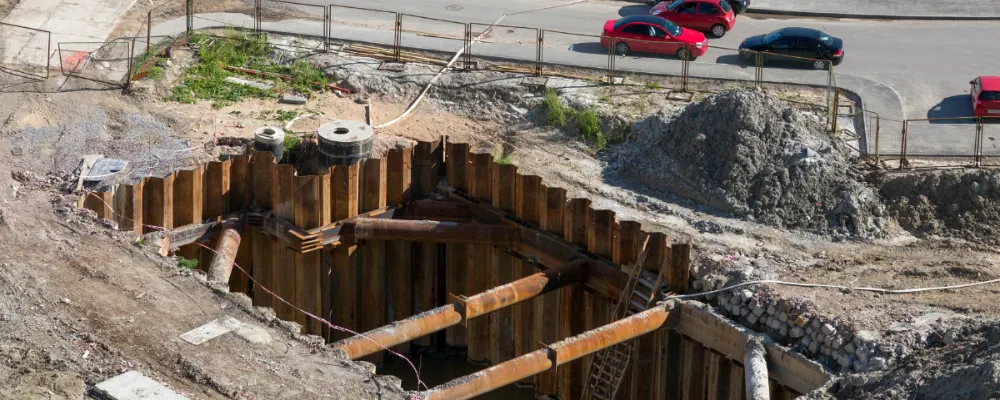
4. Sheet Piles Foundation

The sheet piling process involves interlocking sheets placed under the ground, forming. a continuous barrier. The interlocking sheets are usually made of plastic, wood or steel. It is placed using a hammer, hydraulic press, or any vibratory equipment. 

Types:

  • Z type 
  • Flat type 
  • Pan type 

When compared to cold rolls, hot role piles have a tighter interlock. This is suitable for hard driving conditions. It is mainly used for sea walls, bulk retaining walls, etc., where it acts as a barrier to the underground water flow. 

This foundation type is inexpensive and can be installed easily, leaving less environmental impact. Reducing soil displacement provides high stability and strength to the structure. Often they are used in groups to support large buildings.

5. Screw Piling Foundation

Screw piling, also known as helical piling, involves installing long steel piles shaped like screws under the ground.

Screw piles are applicable in various projects, including: 

  • Buildings and townhouse developments 
  • Commercial and industrial like office buildings, factories, and shopping centers 
  • Development of infrastructure such as bridges, boardwalks, and retaining walls.
  • They are also used as equipment foundations in mining and resources such as conveyor systems.

2. Types based on material:
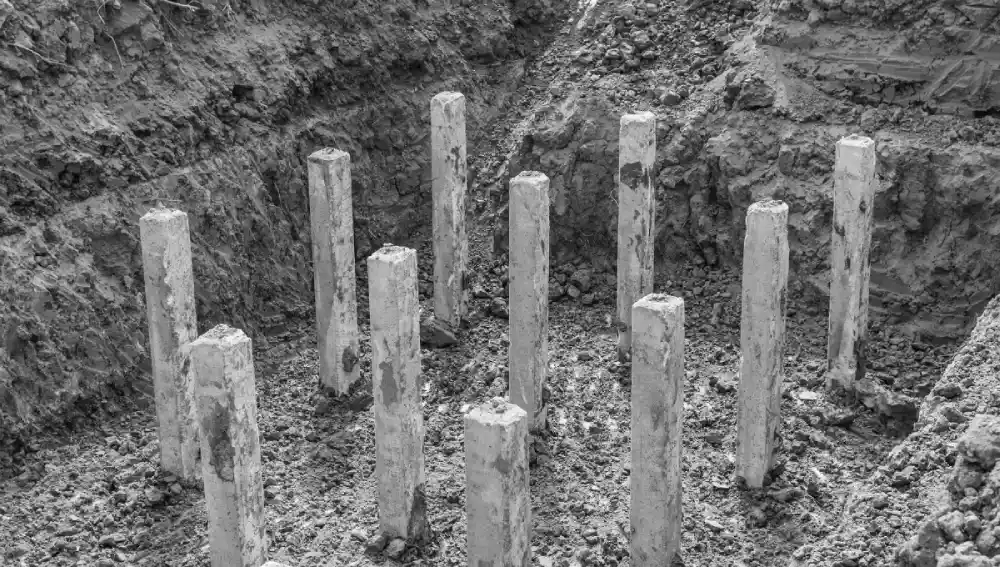
Pile  Types on materials

1. Steel Pile Foundation 

Steel piles are often cylindrical or H-shaped and.  can be driven into the ground or drilled and filled with concrete.

Types of Steel Piles

  • H-Piles
  • Pipe Piles
  • Screw Piles (Helical Piles)
  • Disc Steel Piles

Steel pile foundations have several advantages, including: 

  • Steel piles are much stronger than the soils they are driven into. Therefore, it can resist very high loads, bringing greater stability.
  • It is simple and cost-effective to adjust the length of a steel tube or H-pile on the job site. Steel piles are easily adaptable.
  • The customer knows the quality of all the components that will be driven into the ground before installation. 

However, they must be adequately treated before placement to ensure resistance to corrosion.

2. Concrete Pile Foundations

Concrete pile foundations are generally used for heavy buildings that cover a smaller area, including  water tanks, skyscrapers and, large bridges,. They are efficient, cost-effective, and environmentally sustainable. On average, they can last for about 30 to 100 years.

Types of concrete pile foundations:

The concrete pile foundation uses a cylindrical or square column.

Factors such as soil condition, load requirement, and environmental factors influence the design of the concrete pile foundations. They are highly durable and resistant to environmental factors. 

Advantages 

  • It has a high load-bearing capacity 
  • They are highly suitable for different types of soil.
  • A concrete pile foundation can also be used in areas of high water ground levels. 

3. Timber Pile Foundation 

In this type, treated wood piles are driven into the ground in wet or unstable soil conditions. Timber piles are often square or round in shape. The diameter range is between 12 and 16 inches, and the length is usually 20 times the width of the top. It is capable of transferring a 20-ton load. The strength is increased using a fish plate that can be fixed to the sides.

Types of timber pile foundation 

  • Untreated timber piles, which are used in temporary structures 
  • Treated timber piles are chemically treated to resist  decay and insects.

The timber pile foundations are easy to handle and install. They are also known to be cost-effective and environmentally friendly. 

Compared to concrete pile foundations or steel piles, the timber pile foundation has a limited lifespan. 

The timber pile foundation helps minimize the settlement of the structure. It is predominantly used in areas prone to scouring, such as near riverbeds.

4. Composite Pile Foundation 

A composite pile foundation combines two or more different materials. It includes concrete, steel, or timber to optimize the load bearing  capacity and increase the performance. 

Types of composite pile foundations: 

  • Concrete-steel composite pile
  • Timber-concrete composite pile
  • Steel concrete composite pile

Advantages of using composite pile foundation: 

  • Increased load capacity 
  • Improved structural performance 
  • Provides flexibility in design efficiency.
  • It combines  the strength of different  materials. 
  • Increased durability and resistance to corrosion 
  • Highly suitable in seismic areas where the conditions of the soil are unpredictable.

Advantages of Pile Foundation 

  • Pile foundations help transfer the building loads to a more stable soil found below several layers. It provides stability in sites that have weak upper layers of soil. 
  • Pile foundations are resistant to weathering, decay, and corrosion. Therefore, they are highly durable. 
  • It requires less space when compared to other foundation types, due to slender and long foundation elements.
  • It can be customized based on the project requirements and can be constructed in different sizes and materials. 
  • They are effectively used in areas where deep installations are required, especially wetlands. Pile foundations help in preventing uplift in structures. 
  • It minimizes vibrations and also prevents soil erosion around the foundation.
  •  Pile foundations are cost-effective and can be quickly installed. It helps speed up the construction process. 
  • It has less environmental impact compared to other foundations.

Conclusion 

Pile foundation forms the base to support large buildings in unstable soil conditions. It plays a vital role in constructing projects in situations where the top layer of the soil is weak. The pile foundation type is used following proper design, testing, installation, and maintenance. It is an effective way to transfer load into deep layers of soil and contributes to high safety and security, enhancing the longevity of the building and its infrastructure.

FAQs

What is the limit of foundation piles?

The limit of foundation piles depends on various factors including the soil conditions, load requirements, and design specifications. Typically, the number of piles required is determined based on:
Load-Bearing Capacity: The size and number of piles must support the structural loads of the building.
Soil Properties: Soil strength and load-bearing capacity influence the type and number of piles.
Design and Code Requirements: Engineering standards and local building codes specify pile design and spacing.

What is RCC pile foundation?

An RCC pile foundation is a type of deep foundation where piles are made from Reinforced Cement Concrete (RCC). These piles are used to transfer the load of a structure to deeper, more stable soil layers or rock. RCC piles are reinforced with steel bars to enhance their strength and load-bearing capacity. They are typically used in situations where surface soil conditions are inadequate for supporting structures, such as in areas with weak or compressible soil.

What is the minimum depth of pile foundation?

The minimum depth of a pile foundation generally starts at 5 to 10 meters (approximately 16 to 33 feet), but this can vary based on factors such as soil conditions, load requirements, and local building codes. The actual depth is determined by a geotechnical engineer, who assesses the soil profile and structural loads to ensure the pile foundation reaches a stable layer capable of supporting the building’s load effectively.
Grading of Aggregates: Types, Importance, and Their Role in Construction Quality

0
Grading of Aggregates

Introduction

Grading of aggregate holds  immense importance in the industry of construction. Aggregates are a predominant construction material. The concrete aggregates are a blend of limestone, volcanic ashes, and saltwater. When these are combined, they result in a strong mixture that is used in building applications. It results in exceptional performance. The aggregates are basic raw materials that are extracted from natural sources. These are found in queries of its sand crust, stone, and grave. Aggregate grading refers to the measured distribution of particle sizes in a given sample. It can also help determine the quality of the aggregate and analyze the performance.

Significance of Grading of Aggregate

Significance of Grading of Aggregate

​The grade of aggregates is crucial, as it serves as a fundamental component in the success of construction materials.

  • Well-grated aggregates can lead to more durable and dense concrete. The major factor for this is the balanced distribution of the sizes of particles in the aggregate. 
  • The gradation of aggregates influences the deformation of hot-mix asphalt and is a key characteristic that impacts performance
  • The grading of aggregate needs a balanced mix to improve workability. This is obtained by mixing coarse and fine particles. This mixture must contain an adequate quantity of paste to fill the voids between these aggregate particles. They are also separated slightly, which acts as a lubricant. Reducing the voice improves the durability and strength of the concrete.
  • The grading of aggregate helps increase volume stability. This results in increased structure performance . It prevents cracking by reducing the quantity of cement base needed. 

Types of Grading of Aggregate 

Types of Grading of Aggregate 

Uniformly Graded Aggregates 

The uniformly grated aggregates predominantly contain particles with a narrow range of size. This has a very minimal variation, with all the particles mostly of the same size. 

Characteristics of uniformly graded aggregates 

  • They have a higher percentage of voids. Therefore, a greater amount of cement paste is needed to fill the gaps. 
  • The overall density of uniformly created aggregate is lower. This can affect the structural integrity. 
  • They have increased permeability due to large voids. This allows fluids and other water to pass easily. 
  • They have lower strength potential due to the large voids . 

Application 

  • Uniformly graded aggregates are used in drainage projects to prevent water accumulation. 
  • In the filter system, the uniformly grated aggregate allows easy flow of water, and acts as a  filtration medium for purifying water and in aquariums. 
  • Sidewalks and parking lots often use porous concrete to improve water runoff. It provides improved management of water. 
  • The railroad tracks need stability and drainage, which are provided  by uniform graded aggregate.

Open-Graded Aggregate 

Open-graded aggregates consist of the particles that are uniform in size. They result in a significant number of voids between the particles. It is not suitable for all purposes in construction. due to lower strength and density, but it excels in managing the water flow. 

Characteristics of Open-Graded Aggregates 

  • The open-graded aggregates have a high number of voids, which results in a higher permeability nature. 
  • It has low density when compared to dense graded aggregate. This is mainly due to the absence of fine particles. 
  • It has low freeze-thaw resistance. The water that gets trapped in the voice may freeze and expand, which causes damage. 
  • The open-graded aggregate results in an open structure. This enhances the drainage system, which is crucial in preventing drainage-related problems. 
  • The open-graded aggregates have increased strength and provide construction with low fine content. 

Design Considerations

When designing an open-graded mix, it’s important to consider the following factors: 

  • Aggregate shape 
  • The specific gravity of the aggregate 
  • Aggregate type 
  • Residual asphalt content 
  • Emulsion/aggregate compatibility 
  • Runoff tests

Dense Graded Aggregate 

Dense-graded aggregate has a high level of compaction. It has smaller stone particles with maximum weight, resulting in minimal voids. It is known for increasing strength, better stability, and excellent compaction. It is nominally referred to as the maximum size of the particles. It is generally classified as either coarse- or fine-graded. The dense graded aggregate is crushed rock aggregate.

Characteristics 

  • The dense graded aggregate provides the optimum moisture content that is required for the compaction. 
  • It has high stability and is resistant to movement, which is ideal for load-bearing applications. 
  • Due to its tightly packed structure, the dense graded aggregate results in low permeability. It does not allow fluids to flow easily. 
  • The dense graded aggregate has a versatile application for various purposes in construction projects. 
  • It has a higher density that creates strong and durable surfaces used in construction. 

Gap Graded Aggregate 

Gap-graded aggregate is a combination of both small and large particles. It does not have any medium-sized aggregates. It is used to create uniform textures in concrete mixes as it increases the strength and reduces the shrinkage problem. This requires lower water content, and hence the water-cement ratio is also less. This enables us to achieve the desired strength with lower cement factors. 

Characteristics of gap-graded aggregate 

  • The gap-graded aggregate has fewer voids when compared to other types; therefore, it requires less cement. 
  • The gap-graded aggregate also requires less water content, which results in a lower water-cement ratio. 
  • The gap-graded aggregate has a uniform distribution of particles, which has better homogeneity.
  • It also leads to reduced work ability and excessive water bleeding.

Procedure for Grading the Aggregate

Procedure for Grading the Aggregate

The grading of the aggregate process typically involves a sieve analysis. It uses a series of sieves with smaller openings. It can separate the aggregate into different sizes. The weight of the particles that remain on each sieve is then measured and compared to the total weight of the sample. The results are then presented in a table or graph. It often uses a 0.45 power gradation graph.

Importance of Sieve Analysis

Quality Control

Ensures whether the aggregate used in construction follows the required size distribution. This is necessary for optimal performance.

Mix Designing

It helps in designing concrete with the right balance. This enhances the strength, workability, and durability.

Consistency

Regular sieve analysis ensures the maintenance of consistent quality.

Problem Identification

Identifies potential issues such as segregation, improper blending, or contamination in the aggregate supply.

Conclusion:

Each grading type of aggregate  serves different purposes in construction. It has unique characteristics that make it suitable for specific applications. The most preferred for cement in construction is continuous grading. This is due to the balanced distribution of the particles. It enhances strength durability and workability. Other types, such as gap or open grading, are used in specialized situations based on their purpose. It is applicable where specific properties like permeability or aesthetic effects are desired. Understanding these different types of grading is essential for selecting the right aggregate mix to meet the requirements of various construction projects.

FAQs

What are the grade sizes of aggregates?

Aggregate grades are categorized based on their particle sizes, which affect the strength and workability of concrete. Common grades include:

Coarse Aggregates: Typically range from 4.75 mm to 40 mm in size, used for structural concrete.
Fine Aggregates: Usually range from 0.075 mm to 4.75 mm, such as sand, used to fill gaps and improve concrete’s workability.

How to check aggregate size?

Sieve Analysis: Place a sample of the aggregate through a series of sieves with varying mesh sizes. Weigh the amount retained on each sieve to determine the distribution of particle sizes.

Visual Inspection: Compare the aggregate against standard size charts or use a mesh gauge to visually assess the size of particles.

Caliper Measurement: For a more precise measurement, use a caliper to measure the diameter of individual aggregate particles.

Difference Between PCC and RCC

0
Difference Between PCC and RCC

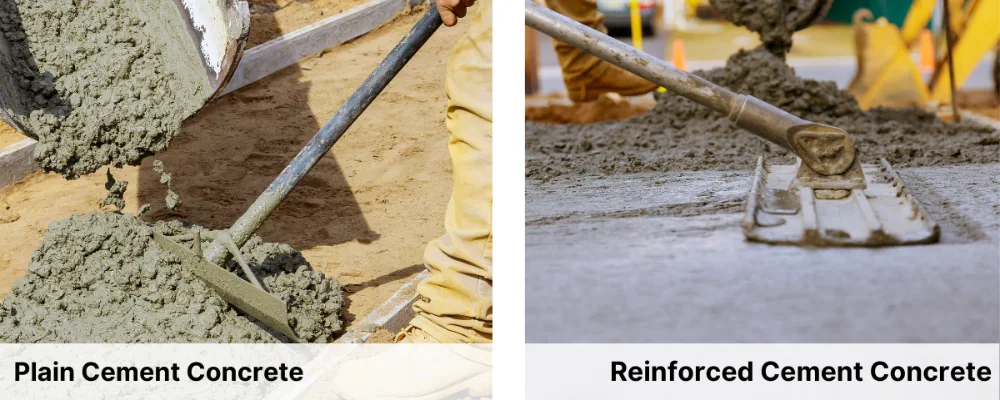
Concrete is one of the most commonly used materials in construction. There are various types of concrete, each having its own function. Two of the most common concrete types that have been used in construction are plain cement concrete and reinforced concrete. By understanding the difference between PCC and RCC, construction builders can provide a material-based solution. 

Meanwhile, This blog will provide the key differences between PCC and RCC for a better understanding.

PCC (Plain Cement Concrete)

Plain Cement Concrete

The simplest form of concrete that does not have any reinforcement is PCC. It is normally used in structural components with less strength. Plain cement concrete is an important component for construction as it prevents direct contact between the concrete structure and the underlying soil or water. They are mainly used because of their compressive strength and are applied in areas in which the strength is not expected to be a significant load or in need of undergoing tension.

Materials used are,

  • Coarse aggregate 
  • Fine aggregate (sand)
  • Cement 
  • Water  

The mix ratio of plain concrete cement is 1:2:4, where cement is one part, sand is two parts, and aggregates are four parts. Their main properties are compressive strength, durability, workability,  longevity, shrinkage, and cracking consideration.

This material is commonly used in flooring, pavements, foundation footings, and other non-structural elements like garden paths, concrete blocks, and boundary walls.

RCC (Reinforced Cement Concrete)

Reinforced Cement Concrete

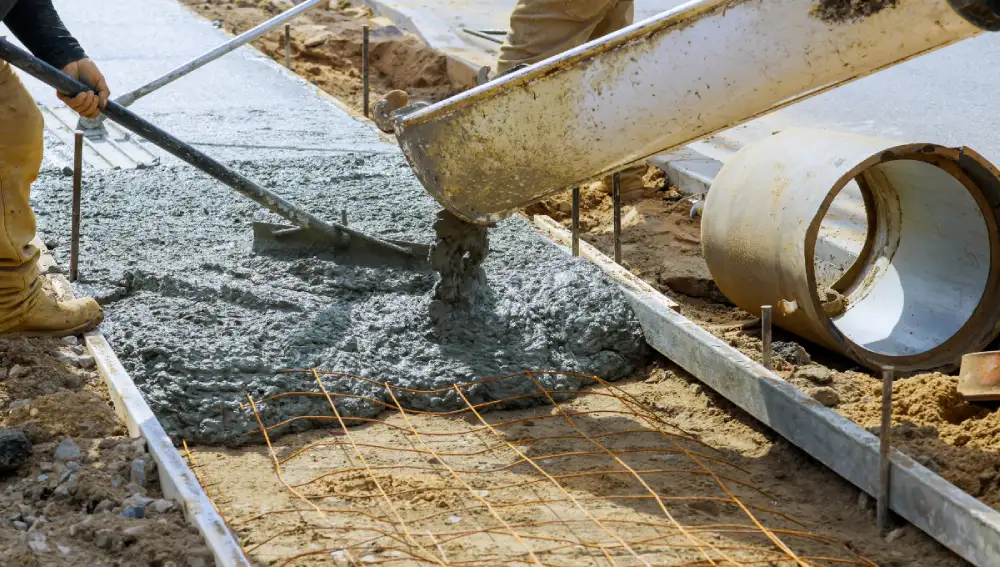
The combination of steel bars and concrete to improve their durability and strength is called reinforced cement concrete. This helps them to withstand both the tensile stress as well as compressive stress. This can be used in the structural components that use more strength. They can be considered load-bearing structures. The steel reinforcement is normally attached to the concrete to create a material that can resist the shear, bending, and tensile force.

The main materials of RCC are,

  • Sand
  • Cement
  • Aggregate 
  • Water 
  • Steel reinforcement

The reinforced cement concrete provides a combination of tensile strength and compressive strength with high durability and flexibility. They also have shrinkage and cracking control properties because of their reinforcement restraint.

Difference Between PCC and RCC

FeaturePCC (Plain Cement Concrete)RCC (Reinforced Cement Concrete)
CompositionCement, sand, aggregate, and waterCement, sand, aggregate, water, and steel reinforcement
Structural StrengthDesigned to withstand compressive forces onlyCombines compressive strength of concrete with tensile strength of steel reinforcement
Tensile StrengthLacks tensile strength; cannot resist bending or tensionPossesses tensile strength due to steel reinforcement
Load-Bearing CapacitySuitable for non-load-bearing applications onlyHigh load-bearing capacity; suitable for structural components
ApplicationsUsed in pavements, flooring, and non-structural elementsUsed in columns, beams, slabs, as well as bridges that are structural elements 
DurabilityDurable in non-structural applications, may crack under tension
Highly durable, especially in structural applications, and resistant to cracking
CostGenerally less expensive due to absence of steel reinforcementMore expensive due to steel reinforcement and additional labour requirements
Construction TechniqueSimple construction process; involves mixing, pouring, and curingMore complex; involves reinforcement placement, concrete pouring, vibration, and curing.
MaintenanceLow maintenance in non-structural applications but may require resurfacing due to crackingRequires regular maintenance to prevent corrosion of steel reinforcement
Crack ResistanceSusceptible to cracking and shrinkageBetter crack resistance due to steel reinforcement
Flexibility in DesignLimited flexibility in architectural designProvides more flexibility in design, allowing for complex shapes and forms
Shock ResistanceLow shock resistanceHigh shock resistance due to the composite nature of RCC
Yield Strength of SteelNot applicable as there is no steel reinforcementSteel reinforcement typically 200–300 N/mm² or higher
ThicknessTypically between 50 and 75 mm, depending on the applicationThickness varies according to structural design requirements
Material UseSuitable for minor construction where high strength is not requiredEssential for major construction requiring high strength and durability
Environmental ResistanceLess resistant to environmental stresses; prone to weatheringHighly resistant to environmental conditions like temperature variation and moisture
Vibration RequirementNo vibration is required during constructionVibration is required to remove air bubbles and ensure concrete compaction around the reinforcement
Curing ProcessStandard curing methods like keeping the concrete moist for several daysRequires careful curing to ensure full hydration and strength development
Use of EquipmentDoes not require specialised equipment for constructionRequires specialised equipment like vibrator 
TestingSimple testing of concrete strengthTesting involves both concrete and steel reinforcement

Considerations in Choosing Between PCC and RCC

Requirements of the Project

In choosing between PCC and RCC, it is important to consider the specific requirements needed for the project. Plain cement concrete is mainly suitable for non-structural elements where the concern is compressive strength. However, reinforcement cement concrete is used in load-bearing structures that need high tensile strength and durability.

For example, PCC can be used for pavements and flooring if the construction is a residential building and RCC can be used as columns, beams, and slabs that can support the structure.  This decision must be taken by considering the overall design of the project.

Environmental Factors

The conditions of the environment also affect the performance of the concrete structures.  RCC is used in areas that have high-temperature changes, high levels of humidity, or any exposure to strong chemicals as they can improve the durability and resistance to cracking. PCCs are more susceptible to environmental stress, but they can perform well in some control environments, where there are not many changes in temperature or chemical attack.

Conclusion

It is important to understand the differences between RCC and PCC in the construction industry.  PCC may be simple and cost-effective materials that are used in non-structural applications, while RCC is normally used in load-bearing structures and critical components as it provides strength and versatility. It is important to identify the correct material that is needed for the project by considering the demands and environmental conditions. The structures can be safe and stable if the proper type of concrete has been used.

FAQs

Does PCC resist environmental stresses well?

No, PCC is less resistant to environmental stresses.

Is RCC resistant to environmental conditions?

Yes, RCC is highly resistant to temperature variation and moisture.

Does PCC require vibration during construction?

No, vibration isn’t required for PCC construction.

Does RCC require vibration during construction?

Yes, RCC requires vibration to ensure proper concrete compaction.

Is RCC construction complex?

Yes, RCC construction is more complex due to reinforcement placement.

Does PCC require maintenance?

PCC requires low maintenance but may need resurfacing due to cracking.

Aggregates in Construction: Types, Classifications, and Applications

0
Aggregates

Aggregates play a crucial role in building. Understanding the classification and types of aggregates determines the quality and performance of the construction materials. Aggregates are primarily mixed with cement paste or mortar to form concrete. In civil engineering, aggregates play an important role. The smarter way to know about aggregates is to examine  the types and classifications explained in the blog to improve your building functionality. 

Types of Aggregates

Types of Aggregates

Aggregates are crucial elements that are used in construction. There are different types of aggregates depending on their application. Some of the generally known aggregates are mentioned below:

Sand

Sand is a fine material that is widely used in construction sites. It is generally taken from river beds, deserts, and  beaches. Sand is composed mainly of silicon dioxide in the form of quartz. 

The size of the sand particles differs according to the place from which they are taken. The particle size differs from 0.05 mm to 2.0 mm. Sand aggregate is extensively used in construction projects and forms a strong foundation, plasterwork, and flooring.

Crushed Stone

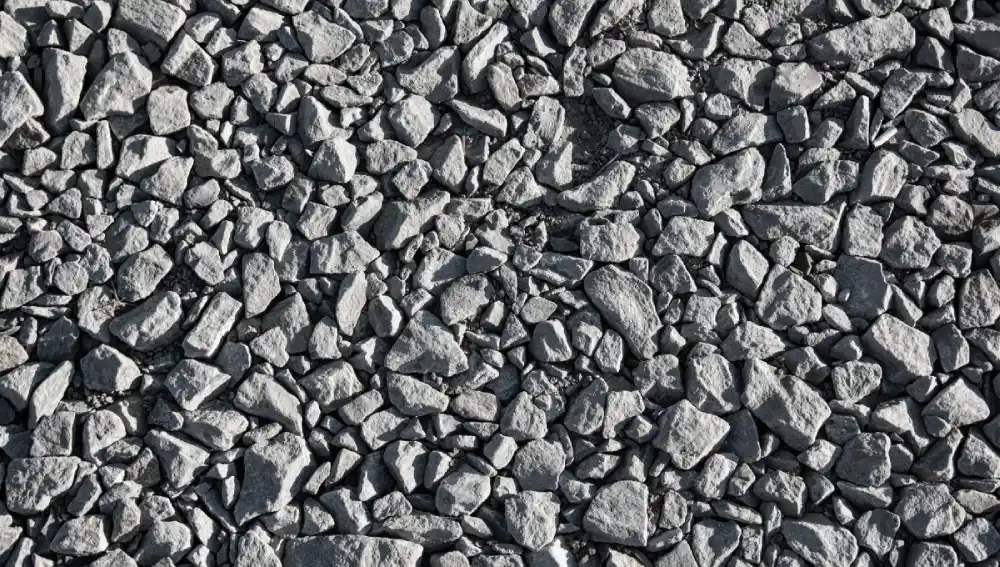
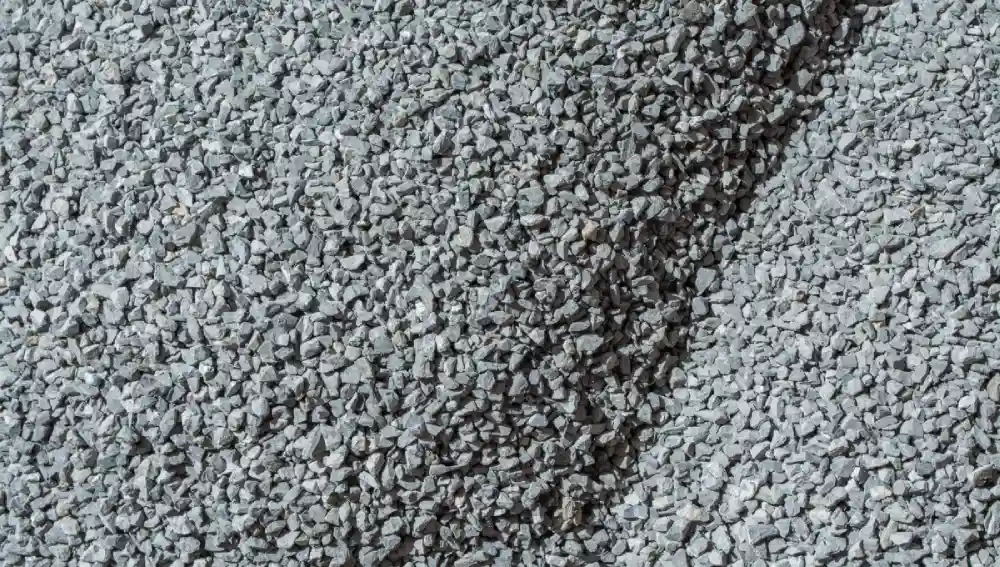
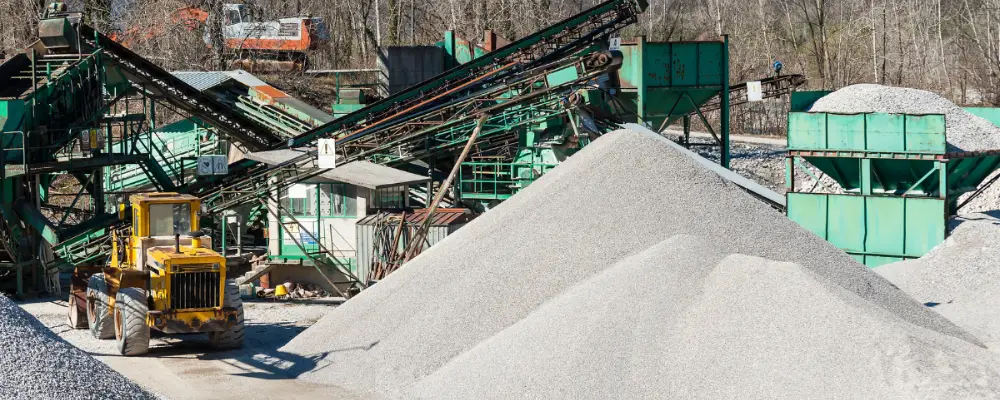
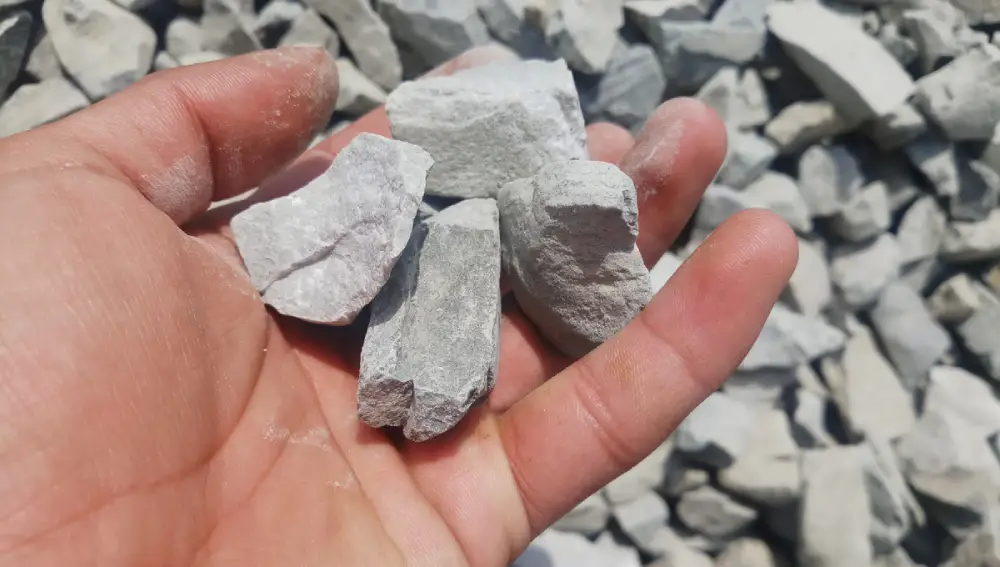
The crushed stone definition is straightforward: it is stone crushed into small pieces. Crushed stones are generally produced in quarries. Crushed stones are man-made aggregates. Once the stone is crushed, the end product is screened and segregated according to size. 

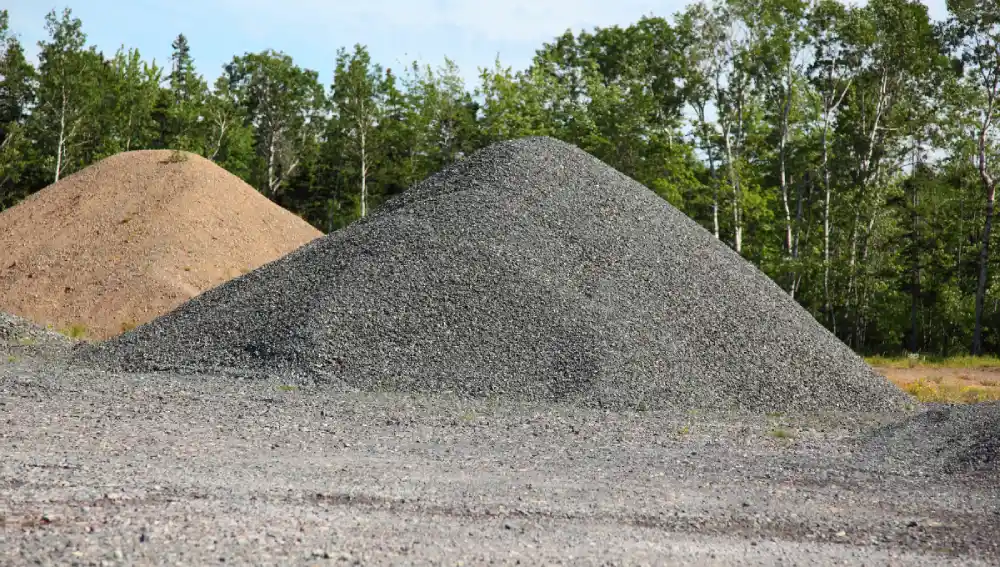
Generally, the crushed stone does not have a specific size, but it depends on the crushing process. However, they generally come under coarse aggregate, which are larger than 4.75 mm. Crushed stones are used in railway ballast, decorative rock gardens, and the construction of buildings. 

Gravel

Gravel is a stone material. In geology, gravel is defined as “a natural material that consists of water-transported materials and usually has a round shape as a result of the water transport.”

 Since gravel is formed by natural process, it has a smooth surface and a size larger than two millimeters. 

Gravel can be utilised in landscapes, foundations, and drainage systems. River rock and pea gravel are the two types that come under gravel. 

Slag

Slag is an industrial waste or by-product produced from iron smelting. Slag is commonly used along with asphalt or concrete. Since it is a by-product, it promotes sustainability..

Slag generally falls under two categories: Coarse slag and Fine slag  The coarse slag is larger than 4.75 mm and is widely used in concrete aggregate and road construction. The fine slag, is less than 100 microns. Fine slag is used in asphalt mixtures, slag wool insulation, and as fillers in different industrial products.

Recycled Concrete

If the concrete is no longer usable for  for construction, it can be recycled. Instead of depositing the waste into landfills, this  concrete can be crushed into aggregates. They are sustainable alternatives to natural ones.

Recycling concrete is generally around 4.75 mm. Application of recycled concrete includes road construction, asphalt, and new concrete production.

Geosynthetic Aggregates

Geosynthetic aggregates are not naturally made. They are made in industries using polymers such as polypropylene or polyethylene. These materials can be tailored according to the size required for construction.

The application of these aggregates are found in erosion control, road construction, and drainage systems. 

Classification of Aggregates

Classification of Aggregates

Aggregates are classified into different types depending on their shape, origin, and size. The classification of aggregates is explained below:

Classification Depending on Size

Depending on the size, aggregates are divided into two types, namely fine aggregates and coarse aggregates. 

  • Fine Aggregates: These are finer particles that are less than 4.75 mm in diameter. These particles include crushed stone or sand. 
  • Coarse Aggregates: If the size of the particles is higher than 4.75 mm in diameter. Coarse Aggregate materials include a larger portion of rocks, crushed stone, or gravel.

Classification Depending on Shape

  • Round aggregates: These are naturally weathered particles that are round and are normally found in riverbeds.
  • Irregular Aggregates: Irregular particles can be man-made or natural. They have angular edges and primarily include crushed stones.
  • Angular Aggregates: The shape of these particles is generally sharp and angular, and they are found in crushing stone.
  • Flaky Aggregates: Flaky aggregates are flat, thin, and have a thickness smaller than the surface area.
  • Elongated Aggregates: Elongated particles have a smaller width compared to their length and are long and thin.

Classification Based on Density

  • Lightweight Aggregates: These lightweight aggregates include shale that have low density. The density is usually less than 1120 kg/m3.
  • Normal Weight Aggregates: These aggregates are primarily used in construction. They normally have standard density..  The standard density is 1520-1680 kg/m3.
  • Heavy Weight Aggregates: Magnetite or barite are high-density materials. They are fundamentally used for shielding radiation. The density is higher than 2080 kg/m3.

Classification Based on Source

Natural Aggregates

  • Igneous: These aggregates are formed from cooled magma, including basalt or granite.
  • Sedimentary: These aggregates are formed due to the overtime deposits, namely sandstone or limestone.
  • Metamorphic: These rocks are formed under pressure and heat from other rocks.

Artificial Aggregates

  • Manufactured: They are produced as waste in industrial processes, such as  slag from  steel production. 
  • Recycled: These materials are made from recycled construction materials, such as recycled concrete or crushed glass. 

Classification Based on Texture

  • Smooth: They have minimum surface texture and have a strong bond with concrete.
  • Rough: They are rough and have maximum surface area, thus providing a stronger mechanical bond.

Conclusion

Aggregates come in different forms, shapes, textures, sizes, and forms. If you are looking for crushed stones for your pavement or a soft pebble for a garden, there is always an aggregate in the process. Hence, it is important to look at the aesthetic value and its applications. 

FAQs

What are the different types of aggregate?

Different types of aggregate include gravel, crushed stones, slag, recycled concrete, geosynthetic aggregates, and sand.

What are type 2 aggregates?

Type 2 aggregates are finer-grade materials that act as a base layer. They are typically crushed to 63 mm. 

What are the sizes of aggregates?

The size of aggregates is divided into two types, either fine or coarse. Coarse aggregates are generally greater than 4.75 mm, and fine aggregates are less than 4.75 mm in diameter

Coarse Aggregate: Types and Their Role in Construction

0
Coarse Aggregate

Introduction

Coarse aggregates are granular materials. It is often used in construction for concrete making.  Its major composition includes crushed stone, gravel, or recycled concrete. Coarse aggregates typically accounts for more than 60-80%  of the volume of the concrete. Their durability depends on the quality of the coarse aggregate, significantly impacting the strength and workability of the concrete. Coarse aggregates are classified as those larger than 4.75 mm according to sieve analysis, with a common diameter range between 3/8 inch (approximately 9.5 mm) and 1.5 inch (approximately 38 mm) 

Coarse aggregates have existed since ancient times, with notable use around 150 BC. The Romans used this concrete to build many important structures. Typical coarse aggregates are mostly smaller than two inches. It is obtained naturally from ground deposits of crushed stone, quarries, river gravels, etc. They can also be extracted by blasting the queries or crushing them. 

Production and Characteristics of Coarse Aggregate

Coarse Aggregate

The methods of producing coarse aggregates have evolved considerably over time. The strength and angularity of the coarse aggregates are essential factors that affect the quality of the concrete mix.  The production of coarse aggregate involves various operations,. Including blasting, crushing, and screening, primarily determined by the rock type used in its creation. It could be the metamorphic igneous or sedimentary. 

Benefits of Coarse Aggregate

Coarse aggregate imparts several benefits to concrete construction: 

  • Coarse aggregate provides the required strength to concrete for heavy load- bearing structures. It increases the structural quality.
  • Coarse aggregate gives better water resistance and maintains dimensional stability in concrete.
  • It controls shrinkage and maintains balance in the heat retention during the curing process, which is crucial for cement hydration 
  • The coarse aggregate quantity determines the size and shape of the concrete mix.
  • The coarse aggregate also determines the bonding of the cement paste.

Types of Coarse aggregate 

Types of Coarse aggregate 

Rounded Aggregate

Rounded aggregates generally occur naturally. They have a rounded and smooth surface., that improves workability and helps reduce the water demand. 

These rounded aggregates can be easily found near the streams and riverbeds. The major source of rounded aggregates is from natural deposits. The smooth texture of the aggregates are used in concrete production. It is known for its workability and ease of handling. The use of rounded aggregates dates back to ancient times. 

This helps reduce the usage of cement-based materials required in construction. The smooth surface of the rounded aggregate produces less friction and enhances the workability of the concrete. The major compositions of rounded aggregate are quad and granite, it is essential to note that rounded aggregates can include various materials such as sand, gravel, and other naturally occurring stones. Rounded aggregates can range in size from 0.1 inches to 10 inches(approximately 2.54 mm to 254 mm) across. It has a diameter range between 3/8 inch and 1.5 inch(approximately 9.525 mm to 38.1 mm). The smooth texture affects the bonding of the cement paste. 

Irregular Aggregates 

Irregular aggregates, characterized by their non-uniform shape, can decrease workability compared to rounded aggregates. Its abnormal shape is formed by friction.. It is mainly composed of gravel and small stones. The irregular aggregate has a rough surface, produced by crushing the largest stones. The use of irregular aggregate started with  the advent of mechanical crushing techniques. It is used to provide strength and durability to the concrete mix. The irregular shape and rough surface help bring friction, increasing the strength of the concrete. It is mainly composed of limestone, trap rock, or granite. and have a higher void percentage ranges between 35 and 37%. These characteristicsIt plays a major role in the construction industry. 

Angular Aggregates 

It is formed at the intersections of rough surfaces and consists of well-defined edges formed by crushing the rocks. The maximum percentage of the void is found in the angular aggregate, resulting  in decreased workability. It is composed of sharp angular edges created by crushing large stones. 

The angular aggregate is popularly known for its higher interlocking capacity. This offers high strength to the concrete mix. It is composed of basalt, limestone, or granite. It improves the bonding of the cement with  its rough surface texture. It comprehensively produces greater strength and stability in concrete structures with higher interlocking properties. It is used in pavement and road construction. 

Flaky aggregates 

Flaky aggregates are aggregates with the least dimension. Any aggregate with a thickness less than 60% of its mean dimension is classified as flaky aggregate. This implies that the thickness must be less than the length and width. 

The flaky aggregate does not suit the production of concrete. It causes a severe impact on the workability and strength of the concrete mix. It is composed of different types of rocks. Its surface texture varies with the rock type. Flaky aggregates are elongated and flat, often influencing the overall performance of concrete.

Flaky and Elongated Aggregates 

These are aggregates that are identified as both flat and elongated. These types of aggregates have a length that is greater than that of their thickness and width. The flaky and elongated aggregates are not suitable for the production of concrete. It creates a significant impact on the workability and strength of the cement. Its shape can affect the performance and workability of the concrete.

Characteristic Requirements of Coarse Aggregate 

Grading of aggregate is an important process in the construction industry. It determines the particle size and distribution through sieve analysis. Key requirements include:

  • The coarse aggregate must have comprehensive hardness and strength. This improves the overall strength of the concrete. 
  • The coarse aggregate must be free from impurities and layers of organic substances. It has a strong influence on the bonding of the aggregate with cement. 
  • The coarse aggregate should be resistant to moisture absorption. Excessive moisture absorption can affect the performance of the concrete. 
  • The coarse aggregate must be strong and resistant to chemical attacks and weathering.
  • The specific gravity indicates the density of the coarse aggregate, ranging between 2.6 and 2.9. High specific gravity and bulk density are essential for aggregates. It effectively enhances the overall mass of the cement and contributes to its strength.
  • The coarse aggregate should not contain harmful substances like chloride sulfate alkalis, which can affect the quality of the concrete.

Conclusion 

Coarse aggregate is crucial in the construction industry. It provides the necessary strength and durability and determines the workability of the concrete. Understanding the different types, properties, and benefits can help with construction. Each has its own unique advantage and purpose. The right selection of type and size can improve the longevity and stability of the structure.

Differences Between Beams and Columns

0
Column vs beam

Structural elements such as beams and columns are important components that help in the integrity and stability of buildings. They are the building blocks of modern architecture that help engineers design structures that can be visually pleasing, as well as capable of withstanding different loads and stresses.

Beams and columns are significantly different, but they complement each other in the function related to the structural framework of the buildings. This blog helps in understanding the differences between beams and columns that are used in the construction industry.

Beam vs Column

Beam: 

Beam

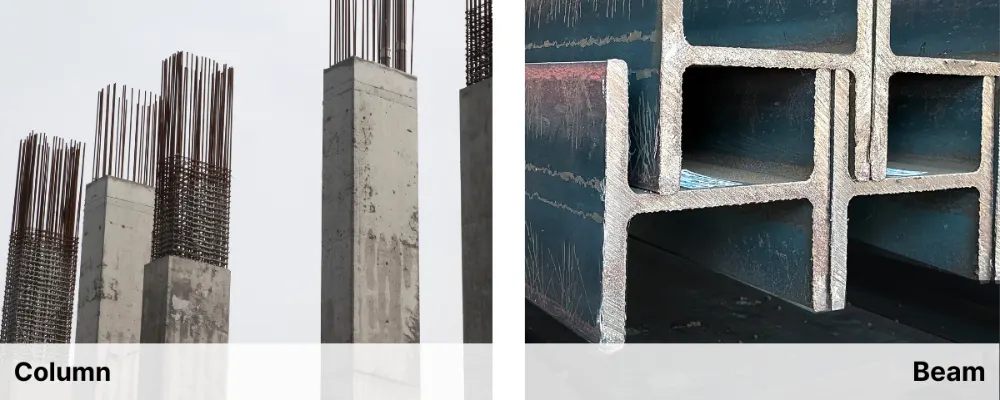
The horizontal structural component that resists the vertical load is known as a beam and its mode of deflection is bending.  It helps in the transfer of loads to the walls, columns, and foundations. Beams are mainly designed to handle different types of loads like

Some types of beams based on support conditions are,

  • Simply Supported Beams
  • Cantilever Beams
  • Fixed Beams
  • Continuous Beams

Some types of beams based on cross sectional shapes are:

  • Rectangular Beams
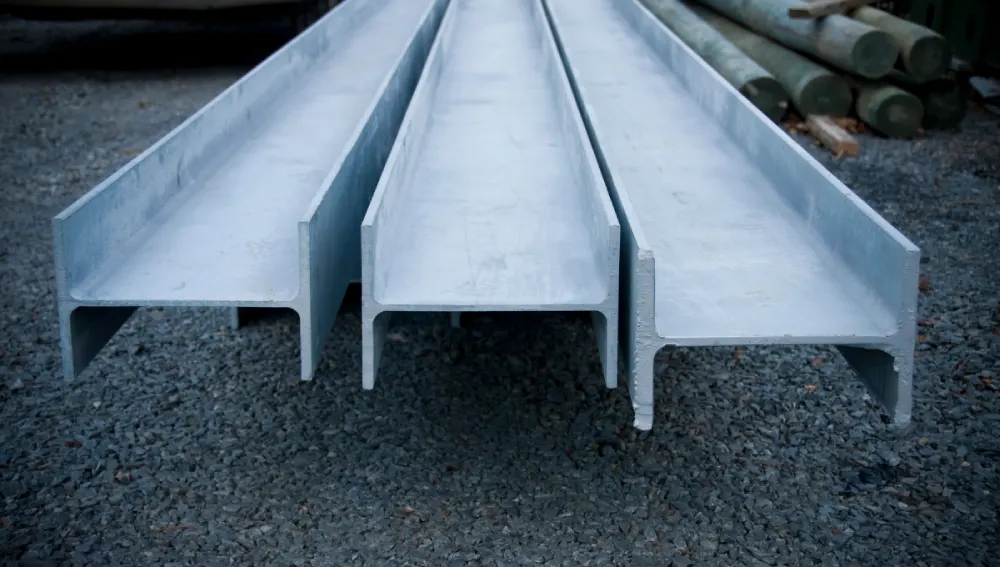
  • I-Beams
  • T-Beams
  • L-Beams
  • H- Beams

Some common materials used for beams are concrete, steel and wood. They are mainly present below the roof and floor structures of every building and help in transmitting loads from there to the columns or load bearing walls.

Column: 

Column

A column is a vertical structural element that bears the loads, especially compression. It majorly bears loads from the beams or roofing above it and transmits these to the floor or foundation below it. It is essential for supporting slabs, beams, and other horizontal elements.

The main role of columns and in transferring loads to foundations is bearing vertical loads and resisting buckling and crushing.

Column types based on shape are: 

Column types based on slenderness ratio are:

  • Short columns 
  • Long columns

Column types based on material used are:

  • Concrete column 
  • Steel column 
  • Wood column 
  • Composite column

Columns are essential in different types of construction that include high-rising buildings, bridges, and large infrastructures like stadiums, airports, and so on. 

Differences Between Beams and Columns

S.NoDESCRIPTIONBEAMCOLUMN
1SupportThey are supported by columns or load bearing walls at one end or both ends.They are supported on the foundation or on floor slabs.
2Weight transferIt carries the weight of slabs, ceilings, floor, and roofs of a building and transfers it to columns.It carries the load transferred by the beam or roof and ultimately transfers it to the footing and ground.
3ClassificationBeams are classified based on their shape and support end condition.Columns are classified based on their cross-section shape, slenderness ratio and types of loading.
4ShapeA beam may be square, rectangular, T-shape, I-shape, and H-shape.A column may be rectangular, circular, square, T-shape, L-shape, and C-shape.
5DefinitionA beam is a structural member carrying transverse loads.A column is a structural member carrying axial loads.
6Load TransferringA beam transfers the load perpendicular to the longitudinal axis.A column transfers the load parallel to the longitudinal axis
7Way of Load ResistanceBeams resist the transverse load of the structure.Columns resist the compression load of the structure.
8Steel Consumption in RCCMinimum and maximum steel usage of an RCC beam is 0.25% to 2.5%.Minimum and maximum steel usage of an RCC column is 0.8% to 5%.
9FailureBeam failure shows symptoms like cracks or deflection before collapse.Column failure happens suddenly without any warning and can cause fatal damages.
10PositionBeams are horizontal structural components.Columns are vertical structural components.
11Response to LoadsShear force and bending moment occur in beams, causing strain and deflection.Columns experience compressive stress, with lateral deflection occurring due to lateral loads.
12Confinement BarsBeams require stirrups to resist shear force and torsion.Columns use ties to hold longitudinal bars in place and prevent buckling.
13Design CriteriaBeams require checks for longitudinal, shear, and torsional reinforcement during design.Columns require checks for PMM interaction ratio, rebar percentage, and other criteria during design.

Example: Consider a steel rod with a length of 5 meters that needs to support a load, labeled “P.”

  1. First Situation: We place the rod horizontally across two supports and then apply the load on top of it. In this configuration, the load is primarily transferred through bending, so the rod functions as a Beam.
  2. Second Situation: If we keep the rod vertical and apply the load horizontally, the primary method of load transfer remains bending, so we still refer to it as a Beam.
  3. Third Situation: Now, let’s position the rod vertically on the ground and place the load on top. Here, the load is transmitted through compression, making the rod act as a Column.
  4. Fourth Situation: Finally, we suspend the rod from the ceiling and attach the load to the other end. In this scenario, the load is primarily transferred through tension, so the rod is called a Tie.

Conclusion

In the construction industry, the roles of beams and columns are different but they are complementary to each other. They both have certain functions that help in the maintenance of stability and integrity in construction. Understanding the difference between these two structural elements is important for people involved in the design, construction, or inspection of the building. By carefully understanding the characteristics and functions of beams and columns,  common mistakes can be avoided.  Additionally, structural designs can be optimized and buildings can meet the safety standards and design goals properly. 

FAQs

1. What is the primary mode of failure for a beam?

Beam failure typically shows cracks or deflection before collapse.

2. Can a beam function as a column?

No, a beam functions as a horizontal member, while a column functions as a vertical member.

3. What types of columns are based on shape and slenderness ratio?

Types include circular, square, rectangular, short, and long columns.

4. What reinforcement is used in beams?

Beams use stirrups to resist shear force and torsion.

5. What reinforcement is used in columns?

Columns use ties to hold longitudinal bars in place and prevent buckling.

Exploring Well Foundation and its Types

0
Well Foundation

Foundations are a crucial component of construction, providing stability and support to built structures. They can be deep or shallow, depending on the soil conditions and specific project requirements. This blog explores one of the oldest types of deep foundations, known as well foundation, including its meaning, types and benefits. Read on to learn more about it.

What is a Well Foundation?

Well Foundation

A well-foundation is a form of deep foundation generally used for bridges, dams, and other underwater structures. Well-foundations were first initiated in India, and the Taj Mahal was built using the well foundation. Well-foundations are boxes made up of materials like metal, masonry or concrete,  It is used to develop passive resistance against the horizontal forces at the top of the wall. It is stable and durable for construction. The main purpose is to distribute the structural load and reduce the risk of settlement of soil. It helps in bringing long-term stability. 

Components of Well Foundation 

Well foundations are generally built in parts and then floated to their final position. They consist of several components, which are explained as follows:

Cutting edge 

The cutting edge is placed at the lowest part of the well foundation and. It can easily penetrate the soil. The design of the cutting edge is sharp and short to ensure quick soil or surface penetration. 

Well curb

Well curb is a component of the well-foundation that  brings stability to the base.  It  is generally a reinforced concrete ring beam placed above the cutting edge. It helps distribute the load evenly around the circumference.   

Bottom plug

The bottom plug is a concrete layer. It is placed at the bottom of the well after it reaches the desired depth. It acts as a seal and provides a solid base which resists pressure from the bottom.

Top plug 

It is a concrete layer placed at the top of the sand filling. Its solid surface helps distribute the load by providing a top seal to the well.

Steining 

Steining refers to the walls of the well foundation. It is the main body of the well and is usually made up of reinforced concrete. It provides structural stability and integrity. 

Well cap

The well cap is the top component of a well foundation, formed by an RCC slab. It covers the top of the well and distributes the load from the superstructure to the well foundation. 

Types of Well Foundation

Types of Well Foundation

Open caisson

It is a type of deep foundation where both the top and the bottom cases are open during placement  The top and bottom are later sealed with concrete. This typeIt is typically used in places such as bridges and foundations in rivers where underwater construction happens. It also has a cutting edge at the bottom and is constructed with the first portion of the shaft at the site. They are usually hollow in structure and create a deep foundation. The sinking is facilitated using cutting-edge components. 

Floating caisson

Floating caissons are large hollow structures that are assembled on floating platforms. Reinforcement cages are created here and concrete is poured, then the entire structure is floated to its final location. It reduces the challenges faced in underwater construction by reducing the vibration, making it suitable for sensitive structures. It is used in offshore platform bridge piers and docks.

Pneumatic caissons 

It is a closed type of casing that is used for underwater construction. During transportation to the bottom surface of water, it utilizes pressed air to keep the water out. Typical materials used in pneumatic caissons are steel or reinforced concrete. Unlike other types, it is closed at the top and open at the bottom during construction. To facilitate driving into the sea, this type is equipped with a cutting edge at the bottom. The compressed air helps create a dry environment inside the caisson. Pneumatic caissons help in construction in deep water conditions or places with difficult soil. It can be found at a depth of 40 m or more. 

Well Foundation Shapes

Circular well

A circular well foundation has a circular cross-section to support heavy structures. It provides the minimum surface area for the given weight, leading to a great sinking effort. Circular wells are subject to lower pending stresses. This is due to the absence of sharp corners. It provides high structural strength. No file cap is required for circular well foundation.

Rectangular well 

A rectangle-well foundation has a rectangular cross-section area. It has large piers when compared to square sections. The rectangular well foundation requires careful control to prevent the island from sinking.

Oblong well

Oblong well foundations have elongated rectangular or rectangular cross-sections. It requires careful handling to prevent tilting during sinking.

Advantages of well-foundation 

The well foundation is suitable in a variety of soil conditions. It works well in both soft and unstable soil, . including loose sand, clay, and silt. The load distribution is even to the underlying soil.

The well foundation can support heavy vertical and horizontal loads. This is because they have a large pace and enable deep penetrations. It is relatively easy to construct and requires less excavation work.

Well foundations are provided with a larger cross-section area, with effective resistance to scouring. They are highly durable and can last hundreds of years with proper maintenance.

When compared to other deep foundation methods, the construction for well foundations is quick.They are an efficient way to create underground stability for structures like bridges and piers. 

Disadvantages of well-foundation 

Constructing a good foundation can be time-consuming and requires skilled labor and professionals who are experienced 

During the construction process, it can face difficulties due to the presence of groundwater. There can also be delays.

The soil inspection is difficult at deep depths and also challenging to clean. Well foundation cannot generally be constructed on contaminated sites. 

Deepwater has a high safety risk during the construction of a well foundation. It requires specialized equipment, which is not easily available and is affected by weather conditions. 

It requires complex anchoring in tidal zones. A well foundation has difficulty accessing remote areas. 

Conclusion 

A well foundation is a vital solution for supporting heavy structures in construction, especially underwater. The well foundation is particularly useful in challenging environments. With complex adaptability, stability, and durability, it is one of the most reliable and suitable choices for ensuring structural quality in heavy construction. They are applicable for constructing bridges due to their longer lifespan and high success rate. Structures built across rivers or streams, such as railway bridges, pathways, and roads, often utilise well foundations. In areas with high water tables, conventional shallow foundations may not be effective. In these places, well foundation is required

Types of Primer in Construction

0
Types of Primer in Construction

An important step in construction that determines the success of the project is the preparation of the surface. It can be a residential building, a commercial building, or any other industrial building. The surface preparation quality will impact the final appearance and duration of the paint.  The component used in this preparation is the primer. 

Primer plays a significant role in the construction industry in improving paint adhesion, sealing underlying materials, and providing a uniform base for finish coating. This will help make the paint adhere properly and last for a long time. It also helps address problems like stains, rust, and uneven surfaces. Different types of primers are available for specific applications and materials. This blog helps you understand the different types of primers that are used in construction and helps you choose the correct one for your project.

Primer in Construction

Primer in Construction

The primary is undercoat flat and sticky paint that does not have any pigments attached to the wall and gives a consistent foundation for the top layers of paint. If the surface is not coated with primer, then there will be a need for additional paint coatings to get proper coverage.

The main purpose of applying primer is to provide a polished and professional look to the materials. It also helps seal porous surfaces, preventing the material from absorbing paint and creating a barrier between the material and the paint. This helps prevent cracking and peeling in the layers of paint. Different types of primers are used in construction available in the market.  It is important to consider the primer based on the surface it is being used on and the material that needs to be applied. 

Types of primers used in construction

Three main types of primers are used in construction. They are, 

Oil-based primer 

Oil-based primers can also be called alkyd primers. They are mainly designed to increase attention and improve the durability of the paint finishes. They can be applied in oil-based paints as well as latex paints, making them more versatile and suitable for various applications that include interior woods, exterior woods, metals, and previously painted surfaces. They are mainly composed of alkyd resins that can enhance adhesion and also block stains. 

Oil-based primers are most effective in power services such as wood, and they can seal the surface and prevent tannins from bleeding through paint.  They can also be used on metal surfaces, as they provide rust protection and corrosion resistance. Along with that, these primers also provide an excellent stain-blocking property that helps in covering imperfections like nicotine, water, and ink stains.

The main advantages of oil-based primers are stain-blocking properties, adhesion, and durability. They provide a flexible surface that helps prevent the paint coatings from expanding or contracting because of temperature variations. It can also be used in unfinished woods, varnished woods, and heavily weathered woods. 

The main disadvantages of oil-based primers are that they emit volatile organic compounds (VOCs) and they need solvents for cleaning. They need more than twenty-four hours to dry. They are also difficult to clean from the painting equipment and are not effective if used on masonry surfaces directly.

Latex primer 

Latex primer is also known as water-based primer. They include acrylic-based coatings for preparing surfaces for painting. They are composed of water-soluble materials that can help in getting a smooth and even application. This is mainly used in porous surfaces such as masonry, drywall, and previously painted walls. 

Latex primers are mostly effective on drywall as they can provide uniform texture on the surface and produce a uniform base for paint. They are also suitable for masonry and already painted surfaces, as they can give good adhesion to latex or acrylic paints. 

The main advantage of latex primers is that they are flexible and typically dry faster in about 3 to 4 hours when compared to oil-based primers. They help in equating the surface and covering the repair areas while reducing the volatile organic compound emissions and providing a healthy environment.  They are easy to clean up and are more durable compared to oil-based primers.

The main disadvantage of lattice primers is they cannot be able to cover dark stains and deep discolorations. They are not suitable for hardwood and metal surfaces, although they do provide excellent resistance to cracking.

Shellac-Based Primers

Shellac primers are mainly made from natural resin. They have good stain-blocking abilities and fast-drying properties. They can be used along with oil-based and latex paints, as they have high adhesion capacity, which makes them suitable for various interior surfaces.

Shellac primers are effective for sealing the smell and covering the stubborn stains that may be caused by rust, smoke, and water.  They can also be applied to wood, plaster, metal, plastic, and other materials.  These primers are used in situations where severe damage needs to be covered, and the odour must be sealed. 

The main advantage of using shellac-based primers is that they have a quick drying time, normally one hour. They are also highly adhesive. They can also be used to seal the pitch pockets, wood knots, and some stubborn tannin bleedings. They have qualities to block the stain.

The main limitation of using shellac primers is that they are not as versatile as oil primers or latex primers, and they produce strong and toxic fumes. They need some denatured alcohol for thinning and cleaning, which makes them more challenging to work with.  Proper ventilation and protective gear are needed when using these primers.

How to Choose the Right Primer for Your Construction Project?

Choose the Right Primer for Your Construction Project

It is important to choose the correct primer for your construction project to get the desired result.  Some of the factors that need to be considered while selecting the primers are,

  • Type of the surface material – this is the primary consideration as there are different surfaces like wood, metal, or concrete that need specific primers to ensure proper adhesion and durability.
  • Environmental factors – Some environmental factors like temperature, humidity, and exposure to elements can influence the performance of the primer, making it essential to select one that can withstand these conditions. 
  • Any specific needs for the project – the need for stain blocking, rust prevention, or mold resistance must be addressed by choosing a primer with the appropriate properties.

By carefully evaluating these factors, you can ensure that the primer you select will provide a solid foundation for your finishing coat, leading to a successful and long-lasting result.

Conclusion

An important step in the construction is the selection of the correct primer, as it can impact the long life and quality of the final paint. Understanding the different types of Primus that are available and their applications can help you achieve the best results for your project. Proper application techniques and attention to detail are important in the process of applying primer. Investing in quality primers and using best practices can help you in the long run, as it makes the surface look great and stand for a long time. 

FAQs

1. Why is primer essential for a professional finish?

Primer ensures a uniform surface, enhances paint adhesion, and helps the final paint job look polished and last longer.

2. Do all primers require ventilation during application?

Yes, especially oil-based and shellac-based primers due to their strong fumes.

3. Where is shellac-based primer best used?

It is best used on interior surfaces with severe stains or odours, like smoke or water damage.

4. Where is latex-based primer best used?

Latex primers work well on drywall, masonry, and already painted surfaces.

5. What is a primer in construction?

A primer is a coating applied before the painting for improvement in address and the long life of the final paint.

6. Is it good to use shellac primers for exterior wood application?

Shellac primers are not ideal for exterior wood due to their lack of flexibility in varying weather conditions.

Adding Calmness to Pooja Rooms Through Colours As Per Vastu Shastra

0
pooja room colour as per vastu

Do you ever find yourself wondering why some areas in your homes seem to have some sort of magical feel to them? One such place is often the pooja room. It is a place of worship, personal reflection, or a simple retreat from the realities of life. The choice of colours to paint the pooja room enhances the feeling of the room to make it  more special. Okay, let’s start exploring how it is possible to make your home area a peaceful and happy one by making some right choices of colours for your pooja room according to Vastu Shastra!

What is Vastu Shastra?

Before exploring the right  colours, let us understand Vastu Shastra first. Think of it as an enchanting roadmap that you can use to arrange your house and bring about positive energies or happiness. The ancient Indian practice of Vastu Shastra  explains where and how to place things and what colours  to select to make our homes perfect.

Why Are Colours Significant for Pooja Rooms?

Colours Significant for Pooja Rooms

Colours are not just used to enhance the beauty of an object or make it attractively stylish. They influence how we feel. For instance, some colours are perceived to bring about relaxation, such as blue, while others like red bring about energy  and drowsiness is caused by green colour . In the pooja room, therefore, we only desire colours that bring a sense of calm and tranquillity during prayer and meditation.

Top 5 Colours for the Pooja Room According to Vastu Shastra

Here are five great colours for your pooja room, based on the principles of Vastu Shastra:

White for Peace

White is like a fresh, clean slate. It’s a colour that symbolises purity and peace. When you paint your pooja room white, it helps create a calm and serene atmosphere. It’s perfect for focusing on your prayers and meditation. White can also make the room look bright and spacious!

Light Blue for Calmness

Light blue is another awesome colour for your pooja room. It’s known for its calming effect. Just like a clear blue sky makes you  feel relaxed, light blue walls can help you feel peaceful and focused. It’s great for a room where you want to meditate or pray without distractions.

Light Green for Growth and Harmony

Green is the colour of nature and growth. Light green in your pooja room can make you feel connected to nature and balanced. It’s a colour that represents harmony, making it a wonderful choice for a space where you seek spiritual growth and peace.

Yellow for Wisdom and Knowledge

Yellow is bright and cheerful, and it represents wisdom and knowledge. Using light yellow in your pooja room can bring a warm, positive vibe. It’s like having a little sunshine in your room, which can make your prayers and meditation more uplifting.

Light Pink for Love

Light pink is gentle and soothing. It’s a colour that represents love and peace. If you choose light pink for your pooja room, it can make the space feel loving and calm. It’s a great colour for creating a sweet, comforting environment and to symbolise your love and devotion to God.

Fun Colour Combinations for Your Pooja Room

If you want to mix things up a bit, here are some cool colour combinations that look great and follow Vastu principles:

White and Gold

Imagine white walls with some gold accents or decorations. This combo can make your pooja room look elegant and divine, while adding a bit of royalty.

Light Blue and White

Pairing light blue with white creates a super calming effect. It’s like having a sky-blue room with fluffy white clouds. This combination is perfect for making your pooja room feel serene and relaxing.

Light Green and Yellow

Green and yellow together can be a cheerful and harmonious mix. It’s like bringing the freshness of nature and the warmth of the sun into your room. This combo is great for a balanced and positive atmosphere.

Light Pink and White

Light pink with white accents makes the room feel gentle and soothing. It’s like a soft hug from your room, creating a warm  space for your prayers.

Beige and Off-White

Beige and off-white can create a tranquil  and balanced atmosphere . This subtle combination is perfect if you want a more understated but still beautiful pooja room.

Decorating Your Pooja Room

Decorating Your Pooja Room

Apart from colours, you can also make your pooja room extra special with some cool decorations. Here are a few ideas:

Traditional Mandala Art

Mandalas are beautiful patterns that represent unity and harmony. Their geometric patterns also create a sense of symmetric unity  and can help focus your mind during prayers.

Om Symbol

The Om symbol is very important in many spiritual practices. Painting or stencilling this symbol on your wall can add a powerful spiritual touch to your room.

Divine Figures

You can decorate your walls in color as per Vastu as well as with images of deities or spiritual figures. These can make your pooja room feel more sacred and special. Such figures can be painted on, carved or embossed onto walls or screening elements.

Mantras and Chants

Displaying mantras or chants on your walls can be both decorative and inspiring. Choose elegant fonts and place them in a way that feels peaceful.

Sacred Symbols

Frame and hang pictures of sacred symbols like the Om or Swastik. These can remind you of your spiritual path and create a serene atmosphere.

Colours to Avoid in the Pooja Room

Some colours are not recommended for the pooja room because they might not create the right energy. Avoid:

  • Dark Colours: Dark colours like black and brown can make the room feel heavy and small. They also introduce a negative energy and vibe in the room.
  • Bright Colours: Very bright colours like neon shades can be distracting and overpowering and create a sense of chaos.
  • Grey: Grey can create a very sombre  and depressing atmosphere, which is not ideal for a place of worship.

Conclusion

Selecting the right colour combination needs considerable thought since colours can significantly affect the atmosphere and vibrations of the room. Therefore, according to vastu shastra for pooja room painted white, light blue, light green, yellow and,  pink. These colours can help in creating a calm and positive atmosphere which is ideal for praying and meditating.

Your pooja room should be a place where you feel connected and serene. So, choose colours and decorations that make you happy and help you connect with your spiritual side.

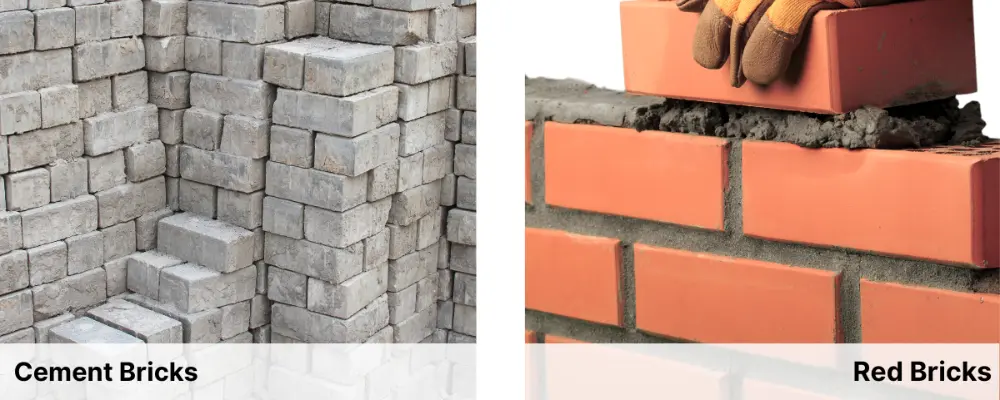
Cement Bricks vs Red Bricks

0
Cement Bricks vs Red Bricks

Bricks are an important construction material that has been used for centuries,  as they play an important role in the development of architecture and infrastructure. Many people are often confused before the construction of civil structures like buildings or houses about whether to use red bricks or cement blocks as the construction material. Everyone wants the construction to be durable and safe, considering it a one-time process that cannot be reversed.  

So understanding the differences between red bricks and cement bricks can be advantageous for making an effective decision before construction. This blog helps in exploring the details regarding the cement bricks and red bricks.

Cement Bricks

Cement Bricks

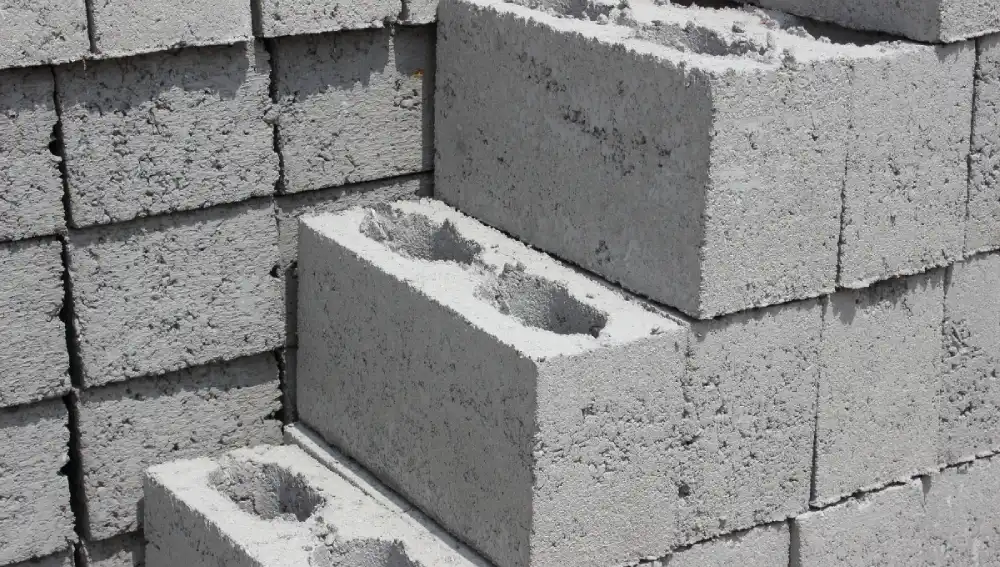
Cement bricks are also called concrete bricks, and they are produced by using a combination of cement, fly ash, sand, and water. Here cement will act as a binding agent, while sand provides strength and reduces the amount of cement needed. Fly ash is a by-product of coal combustion that helps improve strength and durability, while water is necessary for the chemical reaction to take place between the cement and other materials.

Cement bricks are made by various steps, including mixing, molding, and curing. The types of cement bricks include,

The hardening of cement bricks occurs with the help of sand concrete and aggregate like gravel, slag,  crushed stones, etc., as the result of a chemical reaction.  With the correct ratio of inputs, cement bricks can be produced more efficiently and have high resistance to different environmental conditions and external factors.

Red Bricks

Red Bricks

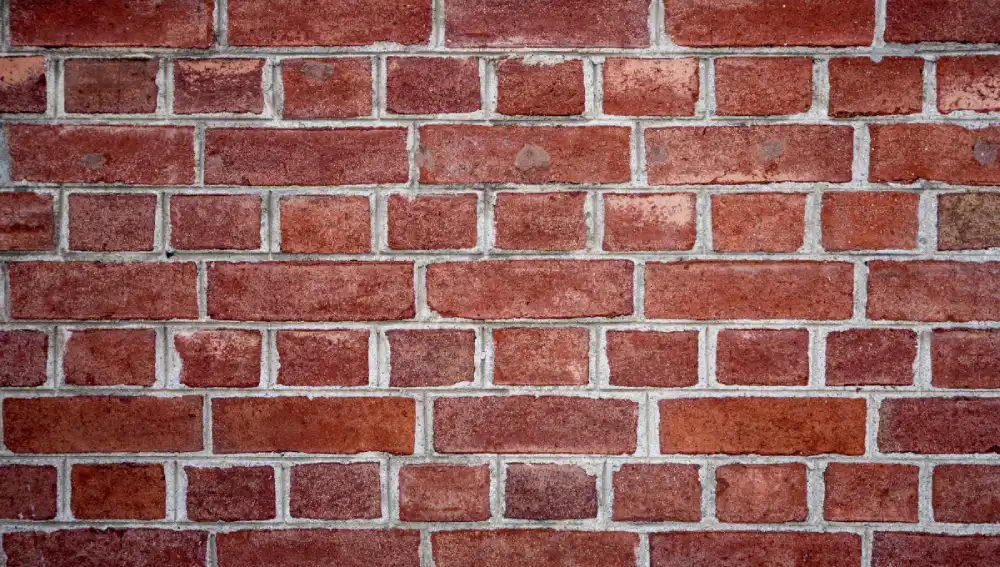
Red bricks are also called clay bricks, are one of the oldest building materials. They are mainly made from clay, sand, and water.  Here, clay is the primary material that gives plasticity and strength, while sand is used to temper the clay, and it prevents excessive shrinkage during the drying process. Water is important for molding the bricks and getting the correct consistency. 

The main steps involved in the production of red bricks are molding, drying, and firing. There are various types of redbrick, and some of them are,

  • Traditional red bricks 
  • Refractory bricks 
  • Engineering bricks

Red bricks are usually made by burning or baking a mixture of clay, soil, and water in a kiln. The output from this process gives durable, fire-resistant bricks that exhibit seismic and insect resistance properties.

Availability of Grades and Types

Red Bricks

Red bricks are readily available in various sizes and quantities locally. They come in different grades and types, each varying in strength and specific applications.

Grades

  • First Class: These bricks are well-burnt and have a uniform shape. Suitable for flooring and constructing permanent structures like arches, external walls, and reinforced brickwork. It will have a minimum compressive strength of 10 N/mm².
  • Second Class: Commonly used for interior tasks such as building compound walls, and partition walls, but not for flooring. It will have a compressive strength of approximately 7.5 N/mm²
  • Third Class: These bricks are overburnt, often have a rough texture, and may have irregular shapes. They are ideal for temporary structures and pavements. Generally, it will have a compressive strength of around 3.5 N/mm² (or 35 kg/cm²) to 5 N/mm² (50 kg/cm²), depending on specific classifications.
  • Fourth Class: Usually called Jhama bricks. Includes Zhamas (over-burnt) and Pilas (half-burnt), typically used as aggregates in road construction, foundations, and floors due to their lower strength. It will have a minimum compressive strength of about 1.5 N/mm² (or 15 kg/cm²).

Cement Bricks

Cement bricks are also available locally in various sizes and quantities. They are in different grades and types. 

Grades

  • Grade A: This has the capacity to withstand heavy loads, with a minimum block density of 1500 kg/m³. Grade A bricks are the top-tier option, specifically engineered to withstand heavy loads. These bricks are suitable for constructing high-rise buildings, industrial structures, or any project that requires a robust and durable foundation. They provide superior strength and stability, making them a reliable choice for critical structural elements.
  • Grade B:  Suitable for medium-loads to heavy loads, and they have block densities that range from 1100 kg/m³ to 1500 kg/m³. Grade B cement bricks are designed for projects that require medium to heavy load-bearing capacity. These bricks are suitable for a variety of construction tasks like walls, partitions, and general masonry work. They provide a balance between strength and cost-effectiveness, making them a popular choice for both residential and commercial buildings.
  • Grade C: Commonly known as solid concrete blocks. They have a minimum block density of 1800 kg/m³.  Grade C cement bricks are known for their high density and durability. These bricks are suitable for constructing load-bearing walls, foundations, and other components that needs a solid and reliable base. Grade C bricks are often used in applications where maximum strength and minimal porosity are essential, ensuring long-lasting performance even under challenging conditions.

Types

  • Solid concrete blocks: These are mainly used for the construction of load-bearing structures. Their high density and strength make them suitable for supporting significant weights like foundations and walls of buildings. These blocks are known for their excellent fire resistance and sound insulation properties, contributing to the safety and comfort of a building.
  • Hollow concrete blocks: These are mainly used for the construction of load-bearing exterior and interior walls. Hollow concrete blocks are designed with hollow cores, reducing the overall weight of the block while still providing structural integrity. The hollow cores can be filled with insulation materials or additional concrete to improve the thermal and acoustic insulation, making them an option in modern construction.
  • ACC blocks (Autoclaved Aerated Concrete blocks): ACC blocks are a lightweight and innovative alternative to traditional bricks and concrete blocks. These blocks are made from a mixture of cement, lime, sand, water, and an expansion agent that creates air pockets within the block. This makes the block both strong and lightweight, making it easier to handle and reducing the overall load on the structure. ACC blocks are also known for their excellent thermal insulation properties, which can contribute to energy efficiency in buildings.
  • Paver blocks: They are used for making sidewalks,  petrol bunk floors, driveways, etc. These blocks are available in a variety of shapes, colors, and patterns, allowing for creative design solutions in landscaping and outdoor spaces. Paver blocks are highly durable, resistant to wear and tear, and can withstand heavy traffic, making them a practical choice for both residential and commercial projects.

Differences Between Cement Bricks and Red Bricks

FeatureCement BricksRed Bricks
Strength and DurabilityHigher compressive strength, enhanced durability.Lower compressive strength, more prone to weathering.
Thermal InsulationLess effective thermal insulation.Provides better thermal insulation, absorbs and releases heat.
Water Absorption and ResistanceLower water absorption, less risk of dampness.Higher water absorption, can be treated for better resistance.
Weight and DensityDenser and heavier, contributing to strength but increasing structural weight.Lighter, easier to handle, reduces foundation load.
Cost and AvailabilityMore cost-effective, uniform quality, widely available.Often more expensive, labour-intensive manufacturing and is regionally available.
Environmental ImpactMore sustainable, uses by-products like fly ash, lower carbon footprint.Significant environmental concerns, deplete topsoil, high energy consumption.
Recycling and ReusabilityEasier to recycle, can be reused in various forms.Can be recycled, but the process is more labour-intensive.
Applications and SuitabilityIdeal for load-bearing structures, modern construction techniques.Preferred for aesthetic and historical projects, residential buildings.

Cost of Bricks

The cost of red bricks in the market is generally low and affordable, with prices ranging from ₹7 to ₹25 per brick, depending on various factors such as dimensions and quality. In different regions, such as Bengaluru, the prices can specifically range from ₹8 to ₹10 per brick. If we consider the overall requirement during the construction process, then the demand for mortar mix and repairs, if necessary, may make the overall cost higher.

The cost of cement bricks varies widely across different cities, typically ranging from ₹27 to ₹45 per brick. For example, in Bengaluru, cement bricks cost approximately ₹28 to ₹34 each, while in NCR-Delhi, they can go up to ₹36 to ₹45 per brick . As the cement bricks need less mortar mix they can be repaired easily.  The number of cement bricks used in construction is similar to that of red bricks, which balances out the total cost aspect.

Conclusion

When comparing the red bricks and cement bricks, we can understand their strengths and weaknesses clearly. Cement bricks have high strength, durability, and environmental benefits that make them suitable for construction projects that have high low bearing capacity. The red bricks will give excellent thermal insulation and aesthetic look, so they can be used in residential buildings and restoration projects. 

FAQs

1. Which brick has lower water absorption?

Cement bricks have lower water absorption compared to red bricks.

2. Which brick contributes to a lower carbon footprint?

Cement bricks contribute to a lower carbon footprint compared to red bricks.

3. Which brick type is better for historical restoration?

Red bricks are better suited for historical restorations due to their traditional material composition.

4. Are red bricks suitable for seismic activities?

Yes, red bricks offer some resistance to seismic activities due to their natural material properties.

5. Are cement bricks used in pavements?

Yes, cement bricks, like paver blocks, are commonly used in sidewalks and pavements.