Home Blog Page 44

Construction Cost in Pune: All You Need to Know

0

Offering ideal weather conditions, advanced technological hubs and proximity to the bustling city of Mumbai, Pune is a rapidly developing metropolis in Southern India. This growth is driven by large-scale rural-to-urban migration into the city, accompanied by a booming demand for new housing. With skyrocketing land prices and persistently evolving construction costs, building a house in the city can be an intimidating task. This blog serves as a comprehensive guide on construction costs with per square feet rates in Pune, to enable property owners to make informed choices and decisions with enhanced financial planning.

Factors That Affect Construction Costs in Pune

Numerous physical, environmental and political factors affect the home construction cost across various regions. A few of the specific factors influencing construction costs in Pune are explained below. 

Climate Control

Pune has a climate ranging from moderate to warm and humid. Therefore, passive design strategies (such as additional shading, green building features and insulated, ventilated roofs and windows) and active design strategies (such as exhaust fans and coolers) to minimise heat and maximise ventilation must be incorporated for house construction. Such features result in additional expenditure and increased total construction cost. 

Site Location

Pune is a fairly large city, thus the location of the site inside the city is a major factor that affects the building construction cost. Material transportation costs for sites in the centre of the city may be high (as materials are generally manufactured on the city outskirts). However, labour costs will be higher for isolated sites or sites far away from the city centre. Use of locally available materials is vital to ensure minimisation of costs for material transportation. Accessibility to the site with adequate road sizes and quality are also important. For example, sites with small abutting roads will require manual labour for excavation since they cannot be accessed by large vehicle excavators, this consequently increases the total construction cost. 

  • Local Regulations and Approvals

The building plan approval process in Pune requires various documents to be submitted to local authorities, such as the PMC (Pune Municipal Corporation) and PMRDA (Pune Metropolitan Region Development Authority). Electrical and water supply connections must be obtained through the MSEB (Maharashtra State Electricity Board) and MWSSB (Maharashtra Water Supply and Sewerage Board). Apart from this, stamp duty and registration also need to be completed. All of these processes entail specific costs, which may be subject to variation based on the site location and current political conditions. 

Type of Construction and Material Choices

Pune is a city composed of a diverse population with very large income differences between the poor and rich. This means that home construction choices can range from very basic to ultra-luxurious. The type of materials for building the main structure and for finishing can likewise range from affordable to extremely expensive. These choices predominantly affect the home construction costs in Pune.

Estimating the Average House Construction Cost in Pune

Construction cost per square feet in Pune varies widely depending on the factors explained above. For estimation, it is first necessary to calculate the total built-up area of a house, which can then be multiplied with the square foot rate to obtain total cost of construction.

Prices in Pune generally start at ₹1600/sq ft for basic construction, while high-end home construction costs can even go beyond ₹10,000/sq ft. 

In general, the above mentioned square foot construction cost is made up of the following components:

ComponentPercentage of total cost required
Architectural design charges3-15%
Structural design charges0.5-5%
Contractor’s charge20%
Labour cost40-50%
Material cost50-60%
Services cost (plumbing and electrical work including labour and materials)18%

These figures are just general indicators that can be used to derive rough estimates for construction before all the building details are designed and confirmed. 

Cost of Building a 1000 sq ft House in Pune

Considering the general values explained above, the total cost of constructing a 1000 sq ft house in Pune can be calculated as:

Basic construction (at ₹1600/sq ft)Mid range construction (at ₹2000/sq ft)Luxury construction (starting at ₹2500/ sq ft)
Architectural services (₹30 to ₹200/sq ft)30,00070,0001,00,000
Structural design services (₹10 to ₹50/sq ft)10,00020,00040,000
Material cost (~60%)7,44,0009,06,00011,16,000
Labour cost (~40%)4,96,0006,04,0007,44,000
Contractor’s profit (~10%)1,60,0002,00,0002,50,000
Overheads and miscellaneous (~10%)1,60,0002,00,0002,50,000
Total cost 16,00,00020,00,00025,00,000

Similarly, the construction costs for different sizes of houses can be calculated:

Size of House (Built-up area)Basic construction (at ₹1600/sq ft)Mid-range construction (at ₹2000/sq ft)Luxury construction (starting at ₹2500/sq ft)
500 sq ft₹8,00,000₹10,00,000₹12,50,000
1200 sq ft₹19,20,000₹24,00,000₹30,00,000
2000 sq ft₹32,00,000₹40,00,000₹50,00,000
5000 sq ft₹80,00,000₹1,00,00,000₹1,25,00,000

The figures mentioned above are only indicative and variable depending on the numerous site conditions and specific project requirements, such as location, number of floors, and design complexity. 

Home Construction Cost Calculator

The steps explained above can be followed to obtain rough estimates for building construction costs in Pune. However, our Construction Cost Calculator can be used to procure more accurate construction per square feet rates in Pune. This calculator will produce estimates based on customisable options for structural materials, finishing materials, types of services required, site location, and various other aspects.

Brick & Bolt is a tech-enabled company with 4500+ completed residential projects that conducts 470+ quality checks at every construction stage to ensure the best quality for your house. With 3200+ customisable designs to tailor your home to accommodate your desires and the provision of end-to-end construction services, Brick & Bolt is one of the top construction companies in Pune and numerous other Indian cities. Contact Brick & Bolt today to construct your dream home at the lowest market price in Pune!
Cantilever Footing:Design, Benefits, and Common Applications

0
cantilever footing

Everyone knows the importance of foundation. The foundation must be strong enough to balance the whole building or structure. Otherwise, everything will be collapsed. A strong structure cannot stand without a robust foundation. 

Only a strong foundation can support the entire building or structure. To achieve the perfect foundation, cantilever footing is widely used in construction projects. Let us see the types, advantages, and applications of cantilever footings.

What is Cantilever Footing?

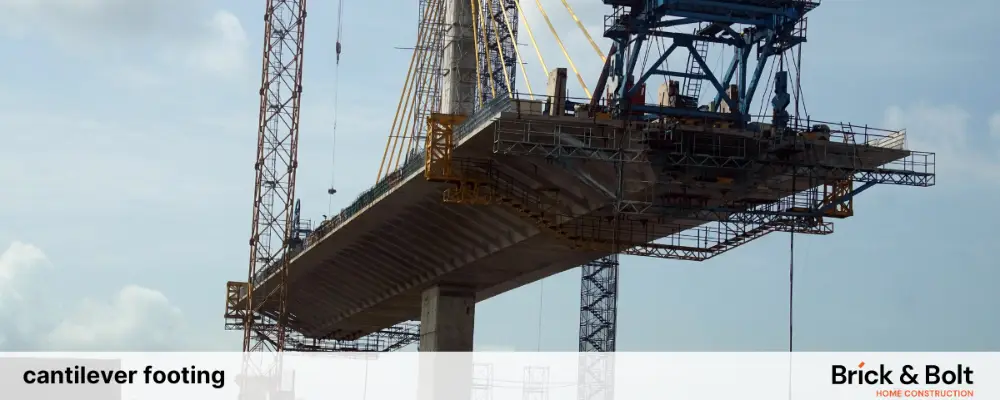
A cantilever Footing is a foundation that extends beyond its support base, distributing loads effectively. It is the base for all buildings and structures. It provides durability and strength to the building or the structure. 

If there is not enough planning for a strong foundation, you must not expect the desired outcome of the building. Effective planning and designing help to build a solid foundation. It also helps to prevent settling, which means the downward movement of the building due to poor soil.

Why is Footing Important?

Footings provide a strong connection for one or more columns of the building or the structure. It helps to balance the loads of the building by transferring them from the external to the internal side of the building. It can also spread the loads at equal proportions to avoid further damage to the building. The strap beam distributes the loads to the columns and transfers the weight to the soil.

Types of Cantilever Footing

Different types of cantilever footings can be used in the construction industry. Each one had its unique features and advantages. Choosing the right type for your construction project is in your hands. The two types of cantilever footings in the construction industry are as follows:

  1. Uniform strap cantilever footing
  2. Non-uniform strap cantilever footing

1. Uniform Strap Cantilever Footing

A uniform-strapped cantilever footing is intended to provide a means of connecting two columns with a strap beam of a rigid nature and one that is equal in proportions. The load is uniformly distributed through the footing into the strap beam and differentially settles to provide structural stability. The footing is useful if, for example, you have two closely positioned columns and, for balance through the structure, the amount of load from both columns connected to the footing needs to be the same. 

2. Non-uniform Strap Cantilever Footing

A non-uniform strap cantilever footing is used when variations in load conditions or dimensions warrant using different design properties. For example, a strap may vary in size or thickness along its span to more effectively respond to variable but anticipated loading conditions in comparison to both uniform strap cantilever footings and strap beams. When specific column loads experience different levels of stress, a non-uniform strap bearing the load can improve load transfer between competing footings. 

Design Considerations of Cantilever Footing

The ultimate things that can be considered before designing footing include soil investigation, footing dimensions, eccentricity, vertical & horizontal loads, and a minimum depth. It should be 50cm for sloping sites, 60cm for rocky soil, and 90cm for below-ground surface. This special type of footing connects one or more beams by a strap. Some points are as follows:

  • The cantilever footing is purely flexural, which can easily bend or fold.
  • It is lightweight and doesn’t remain in contact with the ground or soil. 
  • It distributes the heavy loads from external to internal parts of the supporting beams. 
  • This strap beam is subjected to bending moment and shear force. 
  • The beam which is located at the boundary of the plot has eccentric load footings.
  • It is mainly used to balance the asymmetrical loads of the structure.

Advantages of Cantilever Footing

The major advantages of cantilever footing are as follows:

  • It needs only a limited space to provide a better foundational structure.
  • Mostly suited for the urban development process
  • Secures the safety of the long-built walls.
  • It helps to build strong buildings even in poor soil conditions.
  • Widely spaced columns with supported beams distribute the loads evenly at every corner.
  • It prevents the structure or building from settling.

Disadvantages of Cantilever Footings

The major disadvantages of cantilever footings are as follows:

  • The design of the cantilever footings is more complex.
  • It is more difficult to construct than the traditional footing method
  • It requires more attention and detailed engineered knowledge to prevent failure.
  • It also acquires high costs for the construction process
  • The cantilever structures are always concerned about the safety of the workers.

What Conditions Might Call for Cantilever Footings?

Cantilever footings are used when you don’t have a sufficient area to move the foundation to the underground terrain. It can also be used when the soil cannot bear the loads from the structures and transfer them to the ground. In this case, the size of the footings can be increased out of the range. 

If a column is constructed near the boundary of the plot and cannot be extended further, cantilever footings are used. If the distance between the two consecutive columns is large, cantilever footings are used to interconnect them and transfer the load evenly. If combined footings fail, strap footings help to increase the soil’s load-bearing capacity.

Overall, strap footings play a crucial role in providing strength to the structure. When the columns are built far apart, strap footings are used to combine one or more footings with a beam. They evenly distribute the loads from the structure to the beams. Without them, the building cannot withstand the test of time.

FAQ’s About Cantilever Footing

1. What is the purpose of cantilever footing?

The ultimate purpose of the cantilever footing is to support the foundation of the structure or the building and prevent settling.

2. What is another name for cantilever footing?

Another name for cantilever footing is strap footing.

Concrete Lintel Beams: All You Need to Know

0
concrete lintel beam

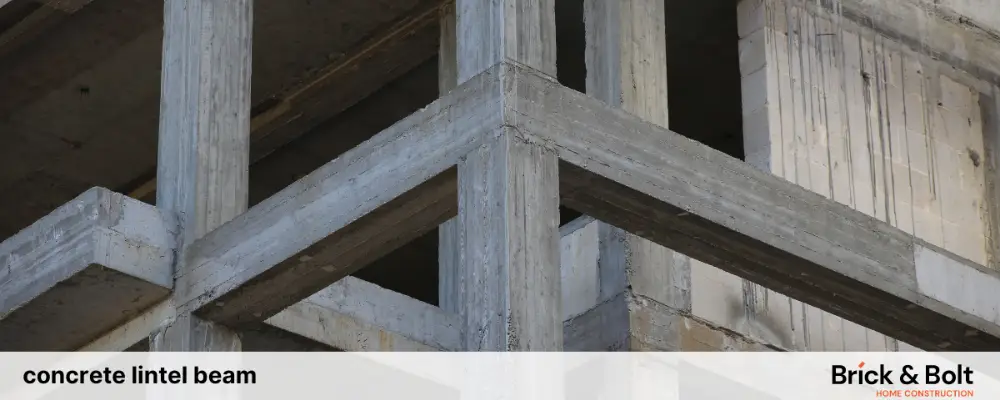
A lintel is a horizontal beam that distributes the load over openings in a structure. The weight t

hat is above such openings is transferred to the surrounding vertical support. It spans openings such as windows, doors, fireplaces, etc., helping to maintain the stability of the building.

The beams are commonly made of reinforced concrete. However, other materials can also be used. The word lintel is derived from an old French word meaning “threshold.” The earliest lintels were found to be made of wood, which was replaced with stone for larger buildings. The first ever lintel was found around the first century BC. 

The lintel beam’s primary purpose is to deliver stability and structural integrity to the building by supporting loads above openings. It can also add architectural value to a structure.

Types of Concrete Lintel Beams

  1. PCC Lintel Beam
  2. RCC Lintel Beam
  3. Cast in-situ Lintel Beam
  4. Precast Lintel Beam
  5. Prestressed Lintel Beam

PCC Lintel Beam

PCC lintel beams are horizontal structural elements composed of plain cement concrete. PPC lintels do not contain reinforcement. They are generally used for smaller spans and lighter loads. 

The usual range of thickness of the PCC lintel is between 100 mm and 150 mm. In particular, PCC lintels are found to be suitable for non-load-bearing walls in framed structures, where the load to be borne by lintels is much lower.

Advantages 

  • In comparison to reinforced concrete lintels, PCC lintels are less expensive. 
  • It does not require skilled labor as the construction process is easy and simple.
  • PCC lintels are durable and have a longer lifespan under proper maintenance. 

RCC Lintel Beam

Reinforced concrete lintel beams are composed of concrete and reinforced with steel bars. They are a popular choice in modern construction for door and window openings. It has high tensile strength due to its reinforcement characteristics. 

Reinforced lintel beams provide excellent resistance and create a balance for casting various shapes and sizes of openings, bringing flexibility. The design flexibility contributes to energy efficiency, allowing it to maintain sleek aesthetics matching its building design with a smooth finish. This type of beam reinforcement enhances corrosion resistance and brings stability over time. 

It is cost-effective and known for its highly durable and long-lasting nature, making it suitable for a maximum spanning of 2 m. 

It has minimal thermal expansion, can be customized to meet regulatory standards, and offers safety applications to the building. They are a popular choice due to their high load-bearing capacity and low thermal expansion, and they perform well in seismic areas. 

Cast in-situ Lintel Beam

Cast in-situ lintel beams are horizontal structural elements created by pouring concrete into the formwork on site. It is composed of cement, water, aggregate, and reinforcement, such as steel bars or mesh. 

Advantages:

  • Provides the necessary flexibility in designing. Also, it is customised according to specific project requirements.
  • It can be seamlessly integrated with the surrounding structure, providing high strength and durability.
  • Cast in-situ lintel beams are resistant to fire and weathering. Furthermore, it greatly helps in the weight distribution of the structure above the opening.

Precast Lintel Beam

Precast lintel beams are made from concrete, where the casting is done in a controlled environment off-site, transported and then installed in the construction location. Precast lintel beams are made from high-strength concrete. Also, it can be reinforced with steel bars. 

M30 is typically used as a high-strength concrete in precast lintel beams. This type requires load-bearing length on both sides of the opening. 

This lintel ranges from 4 inches to 12 inches in height. A minimum bearing length of 100 mm is recommended to ensure proper load distribution. Moreover, the precast lintel beam has a minimum comprehensive strength of 3000 PSI. 

Additionally, they distribute loads to withstand seismic forces. They are considered highly durable by providing thermal insulation and improving energy efficiency. 

Prestressed Lintel Beam

Prestressed lintel beams are pre-tensioned with steel tendons to enhance the load-bearing capacity. It is made from high-strength concrete and steel tendons. 

. It offers superior strength compared to non-prestressed lintels. 

As it is highly durable and resistant to cracking, it supports hefty loads. High-strength concrete such as M 40 grade is used. Prestressed concrete lintels can support weight between large piers. This is made possible by prestressing processes that help concrete resist the tensile force. 

It is primarily of two types:

  • Pretensioned: in this type the tendons are tensioned before the concrete is poured. 
  • Post-tensioned:  the tendons are tensioned after the concrete is set. 

Design and Construction of Concrete Lintels

Structural Requirement and Design

Load calculation majorly determines the load that needs to be supported by a lintel beam. With its self-weight, the weight of the masonry above and any additional weight, including the floors and the roofs, are calculated. 

After a precise calculation, the next step is to identify the span length and the type of support required at every end. The size and reinforcement of the lintel are usually influenced by the span length. 

The depth of a lintel is usually 1/10th of its height and thickness usually remains the same as the wall thickness. However, structural or civil engineers are required to accurately estimate the size.

The design reinforcement is then assessed based on the resistance to bending shear and compressive stress. The ideal material used for reinforcement is typically steel bars. 

Formwork Preparation 

A temporary structure, often called formwork, is constructed to support the concrete until it hardens. It generally matches up with the lintel dimension. 

This precisely ensures that the lintel is well supported and helps in maintaining the shape during the concrete process. 

Placement of Reinforcement 

Placing the reinforcement bars provides the necessary tensile support and involves cutting, bending, and laying according to the design requirements. 

With proper spacing and covering, the bars are positioned carefully within the formwork.

 During the reinforcement placement, proper maintenance of distance for spacing is required both at the bottom and sides of the lintel. This is done by using tie wires or cover blocks.

Concrete Pouring

While pouring the concrete into the formwork, it is essential to ensure it is well compacted and avoid voids. 

For achieving proper compaction, vibrators can be used. After the pouring process, the concrete is allowed to cure. 

Allowing concrete to achieve full strength, the lintel should be kept moist and covered properly for a minimum of 7 days. 

Formwork Removal and Finishing 

Once the concrete gains sufficient strength, the formwork can be removed. This process duration depends on the curing conditions but generally takes around 7 days. 

Conclusion 

Concrete lintel beams are a vital component in providing structural support to openings like windows and doors. Careful consideration is required to facilitate lintels with adequate load distribution for specific requirements. This ensures durability with reliable long-term support, ensuring the necessary safety for building occupants.

What is Assembled First in Prefab Home Construction?

0
what is assembled first in prefab home construction

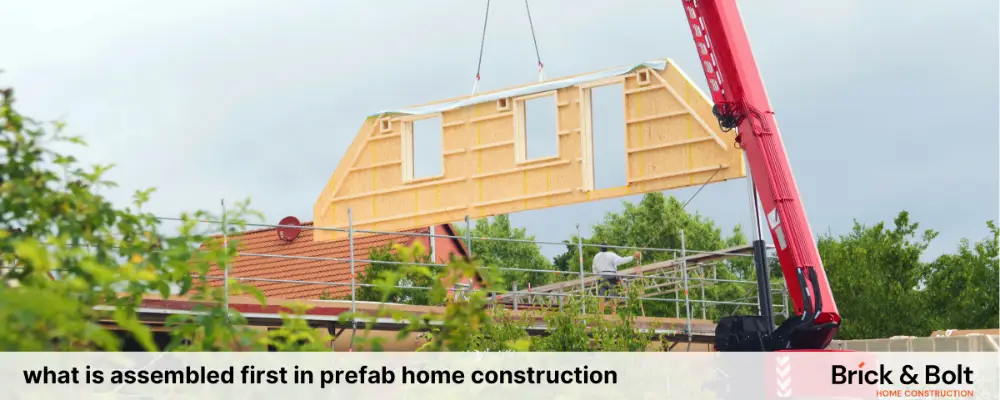
A prefabricated building, familiarly called prefab, is a construction method in which factory made components or units are used to create built structures. Once all the elements are ready, they are transported to the correct location and assembled according to the requirements to complete the building. Nowadays, this method of construction has experienced rapid advancements, making it cost effective and energy efficient.

In this article, we shall discuss what is assembled first in a prefab home and its impact on overall construction.

Sequence Followed for Prefab Construction

There are several steps followed to ensure a streamlined prefab construction process, including:

1. Site Preparation for Installation

Before assembling all the components, the construction site must be prepared as it is the crucial step for all other steps to be followed. By analysing and evaluating the land’s topography, soil type, load bearing capacity and other such factors, the prefab assembly can follow smoothly..

Be sure to secure basic requirements and clear all debris in the site as it may cause trouble while installing the foundation. It is more important to be aware of the availability of water, electricity, and sewage on-site. One of the most important steps is getting a permit for utility instalment and construction from the local municipal office. After this, the ground must be prepared for routing of these utility lines before the foundation is laid. 

2.Crew Coordination for Site work

“Teamwork is the secret that makes common people achieve uncommon results.” – Ifeanyi Enoch Onuoha

As per the sayings, effective crew coordination and site work is the crucial technique that can enhance a good construction. Coordinated teamwork with clear communication, timelines, and a well organised plan can make the work easier. It can potentially save energy and time.

 3. Foundation and Anchoring

Once the site is prepared properly, installing foundation and anchoring is the next major step for ensuring structural integrity and safety. RCC is the most common material used for the foundation. Key components are footings and tie Beams

Footings are required to connect columns and dispense loads equally across the structure.

Tie beams secure all foundation elements and give stability.

Anchoring gives stability and ensures safety under various weather conditions. Concrete anchoring provides firmness against heavy winds. Earth anchoring provides a tight hold for temporary and permanent structures with soft ground.

4.Assembling the Prefabricated Components

Most exciting and challenging process is assembling the prefabricated components in a systematic structure as per manufacturer’s instruction. Care must be taken when connecting each component like floors, walls, and roofs in its position. Monitor whether the components are fixed and secured properly.

5.Installation and Finishing

Once the prefab components are assembled properly and structurally, electrical and plumbing installation is done. Electrical works should be done as per technical designs. After this installation, remaining finishing works must proceed. Wall finishing such as drywall, panelling, and other wall finishing materials can be used according to the aesthetic appeal or chosen design. Roofing and exterior finishing plays a vital role in protecting and enhances the overall view. Interior finishing gives you a satisfying appeal which will meet your functional and aesthetic needs. These can be organised and customised according to your requirements.

6.Final Checks and Adjustments

Once the procedures come to an end, it is important to check everything once again to avoid any controversies in future. Check the entire house for any task to be done, maybe touch-up paints, minor adjustments and repair. Also ensure the home’s safety by checking the functioning of electrical, plumbing and other utility lines. Ensure that all components are assembled properly and there are no loose joints.. 

What is Assembled First in Prefab Home Construction?

In prefabricated home construction, the structural framework is assembled first which includes a strong foundation, floors, columns, beams, and roof.  This is considered as the skeleton of the building. Generally, a foundation is the basic structure on which further units like walls, concrete wood frames, panels and other components are supported. It establishes a strong base for the whole construction. Once the floor is assembled, other elements of prefab construction are added, such as walls, insulation, siding, electrical, plumbing and other interior works.

Only when the foundation is assembled skilfully, it can ensure the stability and durability of the construction, because it has to hold the entire structure of prefab components. 

Major Components for Floor Construction

The main components required for laying the floor in constructing a prefab home, include a combination of materials and structural frame elements. These works are typically carried out off-site. Following are the key elements for floor construction;

Floor Panels: Floor panels are the first element to be assembled and are made from components like concrete or engineered wood. Concrete panels are recommended for their toughness or strength and durability, whereas wood panels are preferred for their flexibility in design.

Support Structures: Either wood frames or precast concrete panels are used to provide the needed support underneath the floor which is considered as a sustainable base. These support structures are significant elements for ensuring stability and load-bearing capacity, and are generally completely recyclable at the end of their life.

Insulation: Insulated floor panels are used to enhance energy efficiency which can be fixed either above or below the concrete. This insulation acts as a heat barrier and helps in maintaining pleasant indoor temperatures and reduces power consumption.

Connections and Utilities: The incorporation of plumbing and electrical works is systematically planned during the floor assembling process to make sure that all utilities and connections are properly connected and functional.

Finishing Materials: Once the structural components and utilities are fixed, final touch is done. Finishing materials like tiles, hardwood, and laminate flooring are laid down in their position to fabricate the final surface of the floor.

How Does Assembling the Floor First Impact the Construction Process?

Assembling the floor first in the prefab home has remarkable benefits in the construction. It has significant impacts on the overall construction in various ways, such as: 

Streamlined Workflow: By laying the floor first, the construction process becomes more organised and is ready to permit the other works on it like assembling of walls and roofs. This leads to faster completion of construction work. 

Reduced Weather Delays: Prefab homes are usually constructed in a critical and controlled environment, allowing for well-organised production and lessen the impact of weather on the construction. If the floor is assembled first, other components can be assembled or added quickly and efficiently without waiting for a convenient weather condition to support other basework.

Efficient Utility Installations: The efficient way to install plumbing and electrical work is after the floor is laid down perfectly. This can minimise the complexity of the work and enhance the construction process. 

Minimised Coordination Issues: Early assembly of the floor can enhance the coordination between different teams and get rid of potential delays in the on-site construction. With a strong and stable base, further work can be done more efficiently by minimising coordination issues.

Thus, assembling the floor first in prefab homes has a significant impact and it contributes to further enhancing the construction process.

Conclusion

You cannot build any strong and sustainable construction on a weak floor. It is important to follow the correct sequence of prefab construction to ensure durability, safety and structural integrity. It is advisable to consult structural or civil engineers to recommend the best procedure and techniques to be followed for prefab construction. 

FAQs

1. What is assembled first in Prefab home construction?

The floor is assembled first in prefab home construction, after the foundation.

2. What are the Major Components for Floor Construction?

Floor Panels, Support structures, Insulation, Connections and Utilities, and Finishing materials are the major components for the floor construction.

Compressive Strength of Concrete and calculation methods

0
Compressive Strength of Concrete

No matter if you’re a builder or engineer, the common goal when building construction is the long-term stability of the structure. For that, the compressive strength of concrete plays a huge role, which determines how much weight or force it can handle before it breaks.

In general, the compressive strength of concrete ranges from 17.2 MPa to 27.6 MPa (approximately 2500 psi to 4000 psi). ​However, depending on the specific application and requirements, it can be increased to exceed 68.9 MPa (more than 10,000 psi). Let’s look at the compressive strength of concrete in detail. 

What Exactly is the Compressive Strength of Concrete?

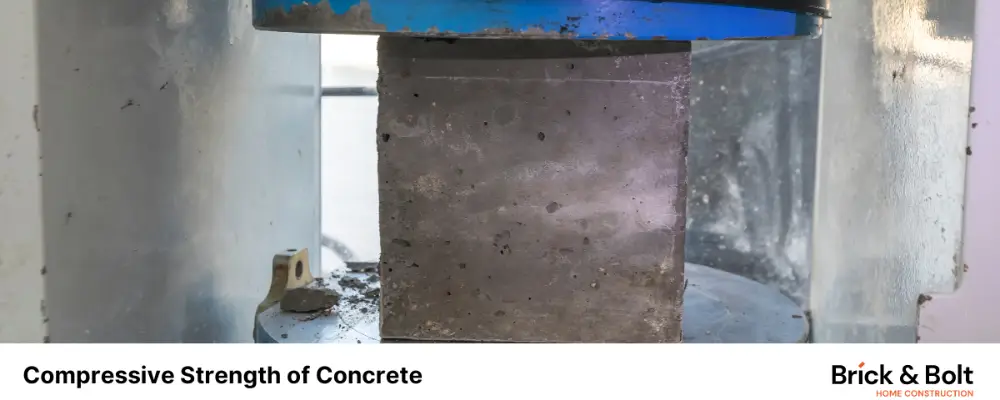
In simple terms, compressive strength is a measure of concrete’s ability to withstand axial loading. It is specifically determined from standard 150 mm x 150 mm x 150 mm cube samples tested at 28 days. 

This strength is measured by testing machines in terms of Newton per millimeter square (N/mm²) or megapascals (MPa).

The formula to calculate compressive strength is fc = P/A.

  • “P” is the maximum load applied
  • “A” is the cross-sectional area of the specimen.

4 Main Factors that Impact Compressive Strength:

The strength and durability of concrete primarily depend upon the quality of materials used. These factors determine the ability of the structure to withstand heavy loads or burdens. 

Below are the significant factors interrelated with compressive strength:

Quantity of Cement

The quantity of cement is an important factor that directly impacts the strength of the concrete. Mixing cement and water in the right proportion improves the concrete’s strength. If the cement ratio is less than the desired requirement, the structure’s strength will be reduced. Similarly, excessive cement can reduce bonding with coarse aggregates.

Material Quality

Making compromises in raw material quality affects the concrete strength. 

Generally, fine aggregates are very fine particles used to fill the gaps among coarse aggregates. The higher the quality of fine aggregates, the greater the concrete strength can be achieved. If any impurities exist in it, the concrete can lose its strength.

Uneven Mixing

Proper mixing distributes all components (water, cement, admixtures) evenly throughout the structure. If not blended properly, cement can concentrate in one part of the mixture, reducing overall strength.

Concrete Curing

Curing is crucial to concrete strength development. For optimal results, concrete should be cured in a controlled environment for 28 days to prevent durability issues, shrinkage, and ensure proper strength development.

Strengths Varied On Concrete Type

Ordinary Concrete

Ordinary concrete’s compressive strength is between 20 and 40 MPa (2900 to 5800 psi), making it suitable for homes and commercial buildings. 

High-Strength Concrete

The compressive strength of high-strength concrete is more than 40 MPa (5800 psi). 

It can reach up to 140 MPa (14,500 psi) or more in certain applications. It is suitable for high-rise buildings, bridges, and other structures that need exceptional strength.

Concrete Grades and Their Strengths

Standard grades of concrete and their characteristic compressive strengths are specified as follows:

  • M10: 10 N/mm²
  • M15: 15 N/mm²
  • M20: 20 N/mm²
  • M25: 25 N/mm²

These grades signify the minimum compressive strength of concrete attainable at 28 days when tested.

Compressive Strength After 7 Days & 28 Days

Concrete gets stronger with time. On day 7, it typically reaches about 70% of its full strength, with its peak strength usually measured at 28 days.

S.NoMinimum AgeAge Factor
17 days0.7
228 days1.0
33 months1.1
46 months1.15
512 months1.2

Importance in Home Construction

A reliable home construction lies in having a high compressive strength of concrete

The key points are as follows:

  • It ensures the safety and longevity of the construction. 
  • It helps prevent structural failures, reduces maintenance costs, and increases the lifespan of the building. 
  • Quality control measures like regular testing and proper curing ensure the concrete meets required strength standards.

Best Practices for Achieving High Compressive Strength

Achieving high compressive strength involves several practices as follows:

1) Optimized Mix Design

  • A balanced mix of water, cement, and aggregates can significantly improve the compressive strength. 
  • It also ensures the sufficient hydration of cement particles and improves particle distribution.

2) Optimal Water-Cement Ratio

  • The well-proportioned water-cement ratio is a critical factor in achieving high compressive strength. 
  • Excess amounts of water cause weak bonds between cement particles that can negatively influence strength and durability.

3) Selecting Right Materials

  • The quality of materials is everything that determines the strength of a construction project. 
  • It is crucial to ensure the cement and aggregates are clean and well-graded to offer structure-enhanced strength and durability.

On The Whole

The compressive strength of concrete is a critical factor in construction. By following the best practices we discussed and optimizing proper mix design, adequate curing, and conducting regular testing, the desired compressive strength can be achieved for various applications like buildings, bridges, and other concrete structures.
Home builders and engineers need to be aware of these things before involving any construction projects, and for accurate results, Brick & Bolt will be your trusted partner.

FAQs

1. What are the primary factors affecting the concrete’s compressive strength?

The factors that influence the compressive strength of concrete are 
mixing techniques, 
water-cement ratio, 
quality of aggregates used, 
curing condition, and 
cement type.

2. Is compressive strength varying for each concrete type?

Yes, different types of concrete are used in construction based on requirements. They are high-strength, normal-weight, and lightweight concrete. Each has unique characteristics that determine an individual’s strength.

Anchor Pile Foundation and Construction Process 

0
anchor pile foundation

Anchor piles are important in construction and are widely used in civil engineering. They play a crucial role in supporting lateral load weights and are used extensively in marine and retaining walls. However, they also have their own limitations. Understand the anchor pile foundations in this blog and utilise them in your construction. 

Anchor Pile Foundation

Anchor piles are a specialised type of deep foundation that are used in construction to transfer loads in different directions. They are generally used in complicated applications such as offshore moorings to resist uplift forces, and they can also withstand lateral load weights. 

Anchor piles are called vertical ground, frictional, and foundation anchors. These materials are made of reinforced concrete, cement, and timber. When looking to perform an anchor pile foundation, it is crucial to look into the pile’s capacity, soil resistance, and anchor connection capacity is also checked. 

Applications of Anchor Pile Foundations

Anchor piles are used in both commercial and residential areas to provide foundational strength. Some of the applications are explained below:

Retaining Walls

Anchor piles are used to retain walls in the field of civil engineering. They are adhered to the soil and reinforced with rods or cables to make the structure stronger. It is an alternative to a traditional gravity-based approach, thus preventing soil erosion. Anchored piles can also be used in retaining walls to secure road cuts, protect slopes, and build high walls on them. 

Marine Construction 

Anchored piles are used in marine constructions as they provide support to offshore platforms and undersea tunnels. Additionally, anchor piles are used in the construction of bridges to support lateral loads, in oil rigs to maintain potion in deep waters, in floating docks, and as a coastal defence that protects the shore from erosion.

Building Foundations 

The general application of an anchored pile is in building foundations. It is cost-effective compared to concrete foundations and doesn’t need excavations or Shoring. This foundation can be swiftly installed, and there is no waiting time for it to settle. It can be taken to the next step in a couple of minutes. 

Agricultural Structures

Anchored piles can also be used in agricultural structures to anchor grain bins and storage facilities. Additionally, they can be used to anchor or fix tents on agricultural land. It provides protection from the wind and requires no concrete. 

Power Transformer

It is a safe and fast method to secure a power transformer. It doesn’t affect the polarity but does not provide any hindrance to the transformer’s working. It can also be used with a concrete foundation to offer additional support. 

Advantages of Anchor Pile Foundations 

There are several advantages of anchor pile foundations, and some of them are explained below:

Fast Installation 

Anchor piles can be used as conventional construction equipment. They are fast and inexpensive as they do not need a crane. Generally, one labourer and one operator are required. The rate of installation is around 6 to 10 rpm and can take up to thirty seconds. The installation is not dependent on the weather conditions. 

Immediate Load Carrying Capacity 

They can be loaded readily after installation. There is no need to wait for the concrete to cool down or wait for excess pressure to settle. In case of any emergency response or if the construction time is limited, they are great alternatives to traditional concrete. 

Installation of Hard Soil Conditions 

Anchored piles can be used in remote areas where there is little to no mobilisation, and the cost is generally higher. In some cases, the sites are congested and have limited headroom spaces. In such hard conditions, anchored piles offer extended sections for low headroom. 

Wide Range of Soil Application 

They can be installed in different ranges of subsurface conditions, from soft soil to clay cliffs. Design loads have a range of applications that are required for the project and can be as high as 650 kips. 

Limitations of Anchor Pile Foundations 

There are certain disadvantages of anchor pile foundations, and a few of them are listed below:

Limited Load Capacity

Anchored piles are generally limited to the type of soil and are higher than grain size, less than 60% of the pitch helices. Anchor piles don’t fix better in cobble deposits or gravels. This reduces the strength due to its fast operational time. 

. This reduces the strength due to its fast operational time. 

Cost of Material 

They are generally low cost but the price of the anchor pile can vary depending on grain size, type of soil, and limitations of torque. This can affect the anchored pile foundations in a negative way.

Type of Soil

Anchored piles can be limited depending on the soil. Har or rocky soil are not suitable for anchor piles. Large rocky areas can increase the time and cost. Sensitive soils can cause displacements and are important to analyze soil type before undergoing any pile process. 

The Construction Process of Anchor Pile Foundations

The general process of anchor pile foundations are explained below:

  • The site needs to be investigated to understand the soil conditions, groundwater levels, and other parameters. 
  • The anchor piles are selected for the process depending on the soil condition
  • The ground is then drilled to create holes. Anchor piles are then installed in these holes and are rotated into the ground using specialised equipment. 
  • To fill any holes, grouting is injected.
  • Steel cables are installed in the drilled hole and are connected to anchor piles these uplift forces and add stability.
  • Load tests are performed and safety is ensured. The file is then capped. 

Conclusion

Anchor pile foundations are versatile materials that are used in construction. They can be used in marine, bridges, and in other tough environments where lateral weight plays a crucial role. It is important to hire experts to perform this in your construction. 

FAQs

1. What are anchored piles?

Anchored piles are primarily used to withstand weights in lateral loads and can be used in different applications.

2. What are the advantages of anchored piles?

The advantages of anchored piles are they are cost-effective, they can be quickly installed and won’t take time to start functioning, they can be used in different soil conditions, and they can effectively reduce vibration and noise. 

Conversion of Land from Agricultural to Residential

0
conversion of land from agricultural to residential

Population growth, industrialisation, urbanisation, and economic incentives have resulted in the conversion of agricultural land into residential areas. Planning for housing demand is important, but it is directly impacting the availability of farmlands. 

The landowners, authorities, and developers want to understand the purpose of converting farmland into residential property. While converting agricultural land into residential areas supports the city’s growth and meets the housing needs of the community, it can negatively impact the environment by reducing green spaces and disrupting local ecosystems. It is important to balance urban development with sustainable practices to mitigate these environmental consequences.

This article will explain the key steps, challenges, and effects of turning farmland into residential areas.

What is Agricultural Land?

Agricultural lands are used for farming activities. It involves the production of crops and plants as food for humans and other living beings. It also requires an interest, knowledge, and specialised skills in various farming methods, irrigation, pest control, etc. A farmer can cultivate his food from his agricultural land and lead a sustainable lifestyle without depending on anyone.

Why Convert Agricultural Land?

The ultimate reasons for converting agricultural lands into residential lands include urban development, population, and income potential for land owners. The residential development of agricultural land may bring economic growth and infrastructure development to the local community.

Key Factors to Consider Before Conversion

The major factors that influence the conversion of agricultural land into residential land are as follows:

  • Environmental effect
  • Zoning Rules and Regulations
  • Land quality
  • Infrastructure needs
  • Local economic impact
  • Local community impact
  • Urban Expansion
  • Long time sustainability

Required Documents to Convert Agricultural Land to Residential Land

For any kind of conversion, the paperwork plays a crucial role. In this aspect, several documents are mandatory for converting the agri-land to residential land, but it depends upon the state and authorities. 

Here are the documents listed below,

1. Application form requesting the conversion of agricultural land to residential land submitted to the relevant local authority (such as the Revenue Department or Urban Development Authority).

2. A copy of the Sale Deed/Title Deed

3. Khata Certificate(Karnataka)/Patta(Tamil Nadu)/ Pune (7/12 property card)/ Faridabad (Intkal).

4. RTC (Record of Rights, Tenancy, and Crops)

5. Land Revenue Receipts

6. Zonal Certification

7. Mutation Document

8. No Objection Certificate (NOC) from panchayat or local council

9. Land Map/Survey Map

10. Affidavit

11. Encumbrance Certificate

12. Tax Clearance Certificate

13. Power of Attorney (if applicable)

Once these documents are ready, they must be submitted to the relevant local authorities for review. After verifying the documents, they will conduct necessary inspections; then, the authority will grant approval for the conversion of agricultural land to residential land. These are subject to any applicable conditions.

The Application Process for Converting Agricultural Land to Residential Land

In India, land conversion involves a specific process that can vary depending on state and local regulations. It can be done either online or offline. 

Let’s look at the general steps involved in both methods.

Offline Application Process

  • Keep all the documents ready to begin the application process. 
  • Approach the revenue department that handles land-related issues in your zone. The specific department can vary by state; for example, in some regions, the local urban development authority or the panchayat handles these matters. Usually, this department is in the District Collector’s office, Tahsildar, or local urban development authorities.
  • Enter the necessary details, enclose the required documents, and submit the form. Fees may be applicable depending on the size of the land and locality.
  • Next, the authorities will verify your documents and inspect your property.
  • If the application is approved, the authorities will issue an official Conversion Order, allowing you to change your agricultural land use to residential.
  • After receiving the Conversion Order, the landowner must register it with the local land records office. This ensures that the conversion is legally recognised.

Online Application Process

In many states, the land conversion process can be completed online through the respective state government portals. Here’s a general overview of the online process:

  • Initially, research and get into the official state portal of the Urban Development Authority or Revenue Department. 
  • Create an account and log in. 
  • You will enter the “Land Conversion” or “Change of Land Use” section of the portal. Enter accurate details about the land, owner, and requested conversion.  
  • The requested documents should be uploaded as the scanned copy. 
  • The next step is paying the application fee or conversion fee. The fee structure varies significantly by state, and there may be other financial obligations, such as development charges or infrastructure-related fees. Use the convenient payment gateway mode provided on the portal to make a payment. Keep the record of your payment copy safe. 
  • Next, you will receive an acknowledgement receipt with a reference number. You can use this to track application status. 
  • The next step is the verification process. Authorities will conduct a site inspection to carefully review all the submitted documents. 
  • Once they have done so, you will receive the conversion order. You can download it directly from the portal.

Legal Consequences of Unauthorised Land Conversion

  • If unauthorised conversion involves forged documents or false declarations, you may face charges under Sections 420 (cheating) and 468 (forgery for the purpose of cheating) of the IPC. When there is evidence of fraud or forgery in land conversion processes. Unauthorised conversions without such activities may still lead to penalties but not necessarily criminal charges. 
  • You will be fined by the local authorities, such as the Revenue Department or Urban Development Authority. The amount fined may depend on factors such as the size of the land, the extent of unauthorised construction, and the deviation from approved land use. 
  • Demolition orders can also be issued for unauthorised structures even if the land was converted properly but the construction violated building codes.
  • If a property is sold after unauthorised conversion, the sale deed may be declared invalid by the courts under the Transfer of Property Act of 1882. 

Conclusion

The change from agricultural to residential use requires formal approval from local authorities and the submission of the necessary documents along with an affidavit. As it favours urbanisation and responds to housing needs, it brings some problems, including the destruction of farmland and environmental pollution. Conversion of land includes the legal formalities, tendering of relevant papers, and adhering to the set legal requirements of the regions. This is because as city areas expand, it will be challenging to manage growth and the effects on farmland and the general environment.

FAQs

1. Can agri-land be converted into residential property?

Yes, land may change from agriculture to residential use. The switch needs permission from the relevant authorities.

2. What documents are required for converting farmland into residential land?

You must provide land records, tax receipts, proof of ownership, and a detailed affidavit. Additional documents may vary based on the state or region.

3. How long does the conversion process take?

The time to convert land may be short or long. From 3 to 12 months, depending on the complexity and other conditions like land type and the country or region. Also, it depends on the number of applications being worked on.

The fact Differences Between One-way Slab & Two-way Slab

0
difference between one way slab and two way slab

Slabs are integral structural elements that support the usage of any building. The two major types used in the construction industry are one-way slabs and two-way slabs.  Each one has its unique features and characteristics. We have to understand the purpose of each slab at the early stage of the design process in order to comprehend their functioning. Let us explain its unique qualities in detail. 

What is a One-Way Slab?

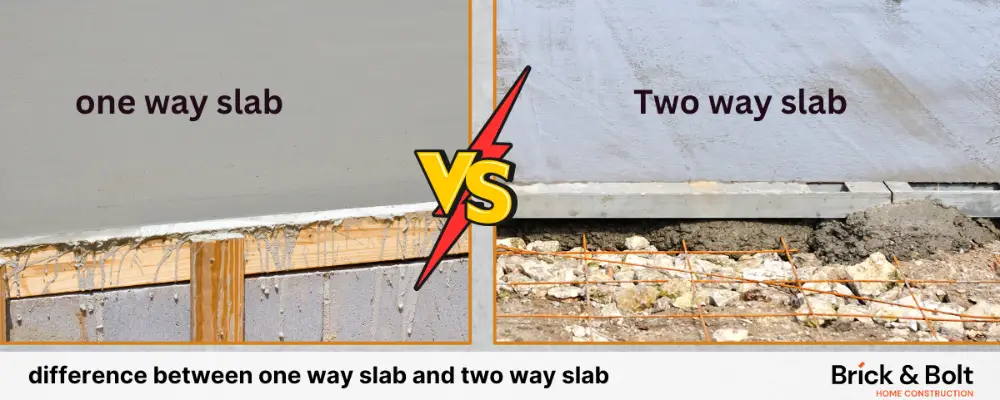
A one-way slab is a simple concrete slab in which beams or other load bearing supports are located on two opposite sides to distribute the loads in one direction. If the ratio of the longer span to the shorter span is greater than or equal to 2, then we use a one-way slab for constructing a structure. It resists bending in only one direction with lower steel reinforcement.

What is a Two-Way Slab?

A two-way slab is supported by beams or load bearing supports on all four sides. It distributes the load along both the directions. The ratio of the longer span to the shorter span must be less than 2. It resists bending in two directions, namely the longer and shorter directions.

Pros and Cons of One-way Slab

Pros:

  • It is cost-effective and spans up to 3.6 meters
  • It requires less amount of steel for reinforcement
  • Due to its greater slab depth, it provides structural strength in the shortest direction

Cons 

  • Bending of the slab in only one direction results in distributing a very limited load.
  • The thickness of the slab is high due to its low steel reinforcement.

Pros and Cons of Two-way Slab

Pros 

  • It can span very large areas due to its higher load bearing capacity.
  • Slab thickness is low

Cons

  • It is more expensive
  • Requires more steel for reinforcement
  • The designing process is very complex when compared to a one-way slab.

Differences Between One-way slab and Two-way Slab

There are a few specific differences seen between a one-way slab and a two-way slab. They are as follows:

S.noFeaturesOne-way slabTwo-way slab
1SupportSupported by beams or load bearing walls on two opposite sidesSupported by beams or load bearing walls on all four sides
2Load TransferIt transfers the load along one direction which is perpendicular to the supportsLoad is distributed along both directions
3ThicknessThicker in size Thinner in size
4ReinforcementIt requires less reinforcement. Consists of main rebars along the longer direction and distribution rebars along the shorter direction.It requires large reinforcement. Consists of main rebars along both directions. 
5Span lengthThe maximum span length is short, upto 3.6mThe maximum span  is high, upto 6m
6SizeThe ratio of longer to shorter span is greater than or equal to two.The ratio of longer to shorter span is less than two. 

Conclusion

On the whole, one-way and two-way slabs have distinct properties and applications. Both provide support to the columns or other load-bearing elements above and ensure strength and durability. The choice between the two slabs depends on the slab’s span, load capacity, and supports available. It is advisable to consult civil or structural engineers to recommend the best type suitable for your project and provide the necessary design for it. 

FAQ’s

1. What are the two major types of slabs used in concrete buildings?

The two major types of slabs used in concrete buildings are one-way slabs and two-way slabs.

2. What is the major difference between a one-way slab and a two-way slab?

The major difference between the two slabs is their load capacity and load distribution process. In a one-way slab, the load is distributed in only one direction. Whereas in a two-way slab, the load is distributed along both directions.

3. What is the minimum thickness of a one-way slab?

The minimum thickness of a one-way slab is 4-10 inches (10.2-25.4 cm)

4. What is the minimum thickness of a two-way slab?

The minimum thickness of a two-way slab depends on the drop panel.
With drop panel – 100 mm
Without drop panel – 120 mm

5. Which slab is used for commercial buildings?

Two-way slab is generally used for constructing commercial buildings due to its higher load bearing capacity.

A Comprehensive Guide to Shoring in Construction

0
what is shoring in building construction

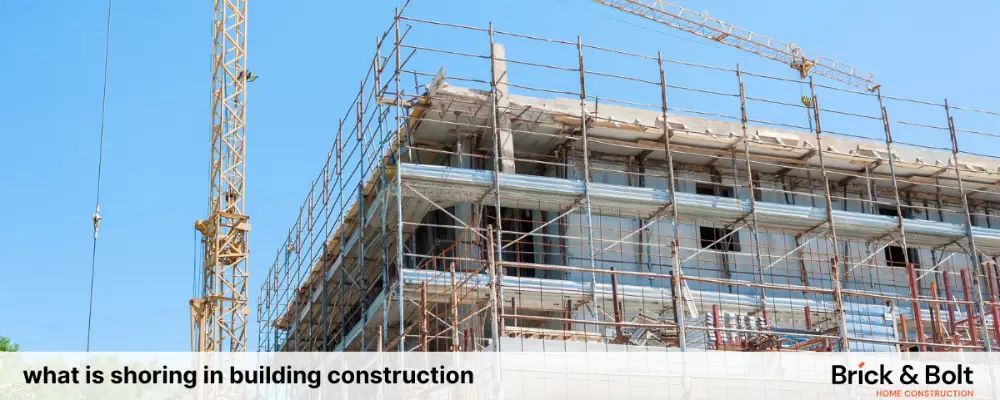
Have you ever wondered how building structures stand without collapsing during construction and how workers move in and around tight spaces safely? The answer is: it’s possible because of the process of shoring.

Let’s take a look at the details of shoring and its types.

What is Shoring?

Shoring refers to the process of providing temporary support systems to building components during construction, excavation, demolition, foundation, and renovation work. It is done with the help of support props such as timber, aluminium, or steel rods. The main objective of shoring is to prevent collapses by offering support, avoid damages, and ensure the safety of workers. Shoring can provide support or balance in various directions, like horizontally, vertically, and diagonally.

Importance of Shoring in Construction

  • It plays a major role in providing a balanced structural system temporarily to prevent collapse of building elements during construction. They act as an additional support system for roofs, walls and other structures.
  • Ensures safety for workers when they work in small construction spaces.
  • This process is also carried out for repairing cracked walls and making sure of avoiding further cracking by stabilising and reinforcing building structures.
  • It helps in distributing loads evenly during construction, therefore improving the strength, durability, and stability of building structures.
  • During construction, walls have the highest chances to bulge out due to water absorption, moisture, or mistakes made in building techniques. Shoring helps in resisting bowing or buckling and further damages.

Differences Between Shoring and Scaffolding

Scaffolding refers to the process of building a temporary structure to provide support for workers on the construction site. It provides safe access and movement in and around the construction site. However, shoring refers to the temporary structure made to prevent collapse of building elements by giving stability. Scaffolding is a separate and freestanding structure, whereas shoring is often connected with the existing building structure.

Materials Used for Shoring

Different materials can be used for shoring, each with its advantages and disadvantages. Some of them are:

Steel Beam Shoring

In this system, steel beams are used to provide support during foundation work, excavation work, and other structural activities. The major components used are:

  • Steel H-Beams: Offer horizontal support
  • Steel Posts: Connect H-Beams to the ground, providing vertical support
  • Base Plates: Transfer loads from posts to the ground
  • U-Channel Brackets: Secure H-Beams to posts
  • Steel Wire Rope: Used for extra lateral support and stability

Steel beam shoring is commonly used in bridge construction, auditorium construction, trench work and foundation renovation works. It has some advantages and disadvantages, such as: 

AdvantagesDisadvantages
Can withstand heavy loads and  has maximum strength with minimal mass. High setup costs
It can be customised easily and has flexible installation.Produces excess noise and vibration during installation.
High durability and can be used in various soil conditions. Requires specialised equipment and skilled labour.
Resistant to weather conditions.

Heavy Timber Shoring

Timber beams or planks are used to offer strength and carry heavy loads of structural elements. The common components include:

  • Solid Sawn Timber Beams: Act as lateral support system
  • Timber Posts: Connect the beams to the ground vertically
  • Timber Planks: Used as soil retention panels
  • Wooden wedges: Ensure a tight and stable structure by maintaining alignment and position.

Heavy timber shoring is used in small excavation areas, tunnel work and other construction activities. It has its own sets of benefits and disadvantages as well.

Advantages Disadvantages
It is less expensive compared to other shoring methods It cannot withstand heavy loads
Environmentally friendly as it is easily available and can be recycled and reused It is prone to moisture absorption, degradation and pest attack  
It is easy to set up and installTimber shoring has a shorter life span and is less durable compared to other shoring materials 

Sheet Pile Shoring

It is a construction technique that uses profiled sheet piles, installed by drilling and driving them into the soil, to act as a barrier and supporting system, preventing collapse during trench work and excavation. Types of sheet piles used are:

  • Steel sheet piles
  • Vinyl sheet piles
  • Concrete sheet piles
  • Timber sheet piles

Sheet pile shoring is suitable for deeper excavations, tunnel projects, and coastal projects because it can effectively manage groundwater systems and support other underground works. Let’s look at the pros and cons of sheet pile shoring.

ProsCons
Has high load carrying capacity Highly expensive to purchase and install
It can manage groundwater levels by preventing infiltration and controlling seepage Installation generates high levels of noise and vibration
Effective in diverse soil conditions, including clay, sand, silt and rock. Needs careful handling because sheet piles are prone to damage
Fast installation and speeds up project completionSheet piles become less resistant to corrosion and abrasion if not maintained properly

Types of Shoring

1.Raking Shores: The application of raking shores is to give temporary lateral support to the walls, making them withstand forces and preventing collapses. Rakers are support elements that are inclined at an angle of 45-75 degrees and often consist of small braces that provide additional support.  They are generally fixed to the wall (or other vertical structures that require temporary support) with the help of cleats, wall plates and needles.

2.Flying shores: Flying shores offer horizontal support to parallel walls of adjacent buildings to avoid collapse during the construction or demolition of central buildings. This temporary support is offered during roof or wall construction or renovation of tightly spaced buildings. They play a vital role in resisting tilting or overturning of nearby buildings.

 As the name suggests, flying shores are made to provide lateral support without touching the ground. They transfer load through anchored structures that extend between two building frames. During excavation, flying shores are used between the walls of trenches to prevent soil collapse. They are usually horizontal beams bridged over the trench and supported with struts at each end to provide safety and stability.

3.Dead Shores: These are used to provide vertical and horizontal support to structural elements when there is no support below it. For example, in roofs without walls below or walls with openings below it.. Dead shores carry the dead loads, which means the permanent loads of walls or roofs, vertically. It is called dead shoring because once the process is completed, it is non-adjustable and left in place for a long period to maintain stability.

4.Hydraulic shores: This system is commonly used for heavy construction work, deep excavation, and bridge repair work. They are generally made up of steel beams, which have a high load-carrying capacity, are easily adjustable, and are most effective in installation. They give support through hydraulic pistons at both sides of trench walls to block the collapsing or falling of gravel or sand in the construction work.

Safety Considerations

  • Proper planning: Evaluate the designs and review the plans before installing the shoring system. Weight of the building structures, internal pressures, soil conditions, and other factors should be considered before starting the process.
  • Regular inspection and proper maintenance: Check and verify the stability of shores. Monitor for any deterioration, damages, or corrosion in the shoring system and arrange for replacements and repairs if needed.
  • Proper installation and alignment: Shores are installed to offer support and prevent collapses, but if they are not aligned or installed properly, it can lead to a mishap in construction work. Make sure they are aligned correctly.
  • Educate the workers: Engineers should prioritise the safety of workers by creating awareness. They should teach them about the handling of heavy materials and tell them about the hazards of the shoring system, particularly in trench areas.

Conclusion

From the above discussion, it is clearly evident that shoring helps immensely in construction by offering temporal support and preventing collapses. It plays a critical role during alteration or renovation work. The success of shoring relies on the effective planning, installation, and maintenance of support structures.

FAQs

1. Why is shoring necessary?

They prevent damages or collapses, enhance the safety of workers, and help in maintaining the strength and stability of structures.

2. How long does the shoring have to be left in place?

They are left in place until the building elements gain sufficient strength and can stay erect without collapsing. The exact duration depends on the material used for the element. For example, concrete elements will require a minimum of 7 days before the shoring can be removed.

Guide to Interior Wall Cladding Tiles Benefit & Maintenance

0
cladding tiles for interior walls

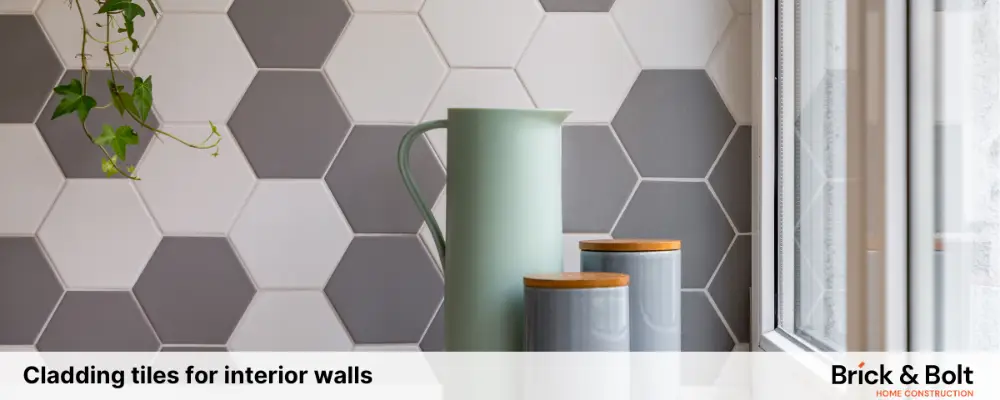
In any construction type, the walls are susceptible to potential damages. To add a layer of protection, cladding is an ideal solution. It is strong, durable and provides a new appealing look to your space.

Whether you’re looking to go with a modern, rustic, or minimalist style, installing cladding tiles can be a unique option. With so many interior cladding options available, choosing the right one adds a touch of elegance and sophistication.

In general, interior decoration is a challenging job. This blog is here to make the job simple for you. It carries information on the types and significance associated with interior cladding tiles, to enable you to make more informed choices.

Types of Interior Cladding Tiles

There are different types of cladding tiles available and each has its own characteristics and applications. These can broadly be classified into two types:

  1. Cladding tiles made of natural materials
  2. Cladding tiles made of manufactured materials

A brief description of the choices available in these types are given below.

1. Cladding Tiles Made of Natural Materials

Cladding tiles from natural materials instantly bring natural beauty to the house or home.They are an eco-friendly and versatile option available in various types, as listed below: 

Brick Wall Tiles

Bricks are the most common type of wall cladding material available in a wide array of earthy colours. The types of bricks include rustic, rosebud, stone, greywood, and vintage. It protects the structure from fire elements and lasts for years. It may seem expensive, but it benefits the building in numerous ways. However, these can be vulnerable to moisture and develop mould. Painting is an ideal solution to this and can also add a unique aesthetic.

Metal Wall Tiles

Metal tiles are generally made from galvanised steel, copper or aluminium. They offer an industrial aesthetic, which is relatively  more expensive. It will be a great choice for modern construction, offering a more commercial look. However, such tiles can often undergo rusting with prolonged exposure to moisture and require protective coating to prevent it.

Natural Stone Wall Tiles

Stone cladding is naturally durable, visually appealing, and cost-effective, making it an ideal choice for interior decoration. It includes various options like slate, marble, and granite, providing a luxurious appearance. They are also available in various finishes such as polished, rough, sandblasted, flamed, rough hammered and leather, enabling versatility to match any kind of interior decor.

Ceramic Wall Tiles

Ceramic tile is a versatile option, preferred for its adaptability and durability available in various textures, patterns and colours. It is highly resistant to moisture and stains, making it an excellent choice for kitchens and bathrooms. Ceramic wall tiles are also fire resistant, which ensures the safety of residents. They come in a variety of finishes including, glassing, embossing, and enamelling. 

Wood Tiles

Wood tile is a dynamic and stylish option to elevate your interior space. The natural beauty of wood offers warmth and sophistication, allowing you to blend with other furniture elements. Wood tile is ideal for interior house floor and wall, containing high-resistant against stains, dents and corrosion. However, protective coatings are required to prevent rot and decay.

2. Cladding Tiles Made of Manufactured Materials

Manufactured cladding tiles are a cost effective and versatile cladding option to enhance your spaceLet’s uncover its popular types below: 

Glass Wall Tiles

Glass tiles offer a sleek and modern look to your interior walls. It transforms your space into a luminous and inviting atmosphere by allowing natural light to pass through the rooms, creating an airy and bright feel. Installing unique patterns and effects makes the place more vibrant and aesthetic. However, these tiles require regular cleaning and maintenance to ensure prevention of stains and breakage. 

Vitrified Tiles

Vitrified tiles are non-porous cladding options available in various textures and finishes. They are highly-resistant to stains, moisture and scratches and are primarily known for their exceptional strength and durability, making them ideal for both indoor and outdoor applications. They are easy to clean and require very minimal maintenance.

PVC/ uPVC Wall Cladding Tiles

They are an excellent choice for homeowners or developers looking to avail a modern look at a reasonable price. It is easy to install and available in various styles, colours, patterns, and textures. These wall cladding tiles don’t need to be refinished or painted, which makes it completely maintenance-free. It can be installed on exterior walls of both new construction and existing walls

Concrete Cladding Tiles

Concrete cladding tile is a pre-formed material, prepared using decorative concrete mouldings in the desired tile shape. It offers a combination of strength, durability, and aesthetics. It can  withstand heavy loads, as well as resist scratches and weathering. It can be suitable for both commercial and residential applications. 

Benefits of Installing Cladding Tiles for Interior Walls

A few significant advantages of cladding tiles over traditional wall coverings are discussed below:

  • Create Visual Interest: Cladding tiles for interior walls come in numerous textures, finishes, colours, and patterns. This allows you to customise your space with unique designs. Choosing an appropriate option elevates your space and adds visual interest to your walls.
  • Enhanced Durability: Cladding tiles are extremely durable and easy to clean and maintain. With proper installation and care, its functionality and appearance can last for decades. Due to its high-resistant properties against stains, moisture, and scratches, it is an ideal choice for protecting interior walls against these aspects.
  • Easy Maintenance: Cladding tiles are ideal for high humidity areas like kitchens and bathrooms. They are non-porous, and can be easily cleaned with mild detergents. It prevents the formation of bacteria, mould, and mildew, ensuring a hygienic interior space.
  • Versatility: When it comes to cladding tiles, you won’t run out of options. You have a wide range of options to explore. Depending on your taste and preference, you can select the material. Ensure your choice aligns with your cost and interior infrastructure. The ranges include aluminium, wood, brick, stone, metal, terracotta, etc.

Maintenance Tips for Wall Cladding Tiles

Generally, wall cladding tiles are popularly known for their low maintenance and easy cleaning. Described here are some efficient tips to extend their lifetime:

  • Regular Cleaning: Clean the tiles often with normal water and mild detergent solutions. It is important to avoid using abrasive cleaners or harsh chemicals with increased chances of scratching the surface.
  • Inspection: Often inspecting the tiles makes you note down the signs of damages like missing pieces or cracks in the initial stage. It helps resolve them immediately without causing any further harm.
  • Moisture Build up Control: The spaces should have proper ventilation and drainage to avoid formation of moisture, which can lead to mildew or mould growth. This is highly probable in kitchen and bathroom areas where we frequently use water.
  • Reapplying Sealer: In order to maintain your tile finish and smoothness, it is essential to reapply the protective sealer at regular intervals. This prevents the entry of dust and moisture content into tile gaps.

Final Thoughts

There are no specific guidelines to choose any type of wall cladding tiles. By considering certain significant factors like maintenance, durability, insulation property and cost, you can go with the choice most suitable for your home. In general, wall cladding is installed for a stylish look and makes spaces more versatile in nature. Based on your budget range and construction appearance, choose the right one.

FAQs

1. What is the difference between wall cladding stones and tiles?

Stones are naturally occurring materials that offer a rustic and original look to the place. Wall cladding tiles, on the other hand, are made from various materials like porcelain, ceramic, glass or other synthetic materials. Both the stone and tile may vary in certain features, but can be customised as per the intended use.

2. Why is cladding tile used for interior space?

Cladding is used for dual purposes: Appearance and durability. Installing appropriate cladding tiles drastically transform the interior space and make it more vibrant. Additionally, the increased thermal resistance properties prevent the buildings from being damaged.