Home Blog Page 113

Foundation Types Depending Upon Soil Types and Other Factors

0
Foundation Types Depending Upon Soil

Types of foundation, substructure, foundation, shallow foundation, deep foundation, soil, step footing, eccentric footing, pile foundation,

A foundation is a lower portion of the building structure or substructure that transfers its gravity loads to the earth. Foundations are generally broken into two categories: shallow foundations and deep foundations.

Types of Foundations

1.Shallow foundation

Foundations with a depth of less than 3 meters are shallow foundations. Such foundations are used for structures that do not carry much load. They are also used in case the soil has a low weight-bearing capacity.

Types of shallow foundations are –

  • Isolated footing or column footing
  • Combined footing
  • strap footings
  • Mat/Raft footings
  • Wall Footings
  • Deep foundation

2. Deep Foundation

Foundations with a depth greater than 3 meters are deep foundations. They are deep below the finished ground surface such that their base bearing capacity is not affected by surface conditions.

Types of deep foundations –

  • Pile foundation
  • Piers
  • Cassions


Choosing the Right Foundation Based on Soil Type

Rocky soil

Rocks such as limestone, granite, sandstone, shale and hard solid chalk have a high bearing capacity. When the soil is rocky with high bearing capacity, then strap foundations work well. The preferred depth of the foundation is less than 0.7 meters.

Gravel and sand

When the ground has gravel and soil in the sub-base, then combined footing and strap foundations work the best. The depth of the foundation is less than 1m.  Such soils are extremely suitable for constructing foundations and have a good bearing capacity. When the capacity of the bearing is more footing or strip foundation is used and when the bearing capacity is comparatively low, combined footing or wide striped foundation is preferred.

Hard Clay

Usually, clay has a higher moisture content and when the moisture content becomes stable up to a certain depth it becomes suitable for the substructure. A raft foundation is preferred when the clayey soil is compact and hard. Even strap foundation can also be used.

Soft clay

Soft clayey sand is prone to expansion and shrinkage. They have a low bearing capacity and are unsuitable for footing and strap foundation. In such cases, a Pile foundation is used. Piles are dug deeper until the stable strata are attained and are suitable for the construction of the substructure.

Peat

Peat is one of the poor subsoil for foundation. If a layer of peat is excavated from the ground and stable soil with bearing capacity is found, then strap foundations work well. In case no stable soil is found, then raft foundations are used.

1200 Square Feet House Plan cost

0
Construction Cost For 1200 sq. ft. House

Budget plays a crucial role when you planning your home construction. Hence, calculating the construction cost is critical in project planning and scheduling to ensure your project remains under budget. It consists of estimating all construction-related costs, such as labour costs, material costs, architect and contractor’s fees, etc. However, many factors affect house construction costs, including location, material and finish selection, structural complexity, market fluctuation, etc. Thus, precise cost estimation is crucial for making sound decisions.

Therefore, Brick&Bolt brings the calculation for construction cost for a 1200 sq. ft. house. This guide will help you to understand the estimation and cost segregation for your home construction project.

Before we start estimating the cost to build a 1200 sq. ft. house, it’s important to understand its importance.

Importance of Cost Estimation

Construction estimation assists you in evaluating how much a project will cost. You may also use it to ensure that you stay under budget, have enough money to buy everything you need during construction, and you can avoid any delays due to financial issues.

However, as we mentioned earlier, your house construction cost depends on many factors, such as the location, the type of designs you choose, material quality, market fluctuation, etc. Building a custom home will usually cost more than buying a new, ready-to-move home. So, when calculating the average cost to build a 1200 sq. ft. house, you must consider all the factors.

The basic factors that majorly impact construction costs are:

  • Labourers
  • Building materials 
  • Architect’s and contractor’s fee

Other factors are:

  • Approval fees from government authorities
  • Plan approval
  • Electricity approval

A water meter is also installed in some places to measure water consumption.

Labour Cost

You require various types of labourers to complete a construction project, such as masons for constructing walls and slab casting, helpers for cleaning, digging and moving materials, carpenters, plumbers, electricians, welders, etc. 

So, you must know the labour cost when it comes to your 1200 sq. ft. house build cost because it’s around 30 to 40% of the overall construction cost. It’s a variable cost that varies with supply and demand. 

When calculating the actual labour cost, you should consider the historical data on the construction projects. But this will only be useful if you leave room for changes that may inevitably occur.

The cost of labour in construction is not something that you should take lightly. Be careful right from the initial stage of the project.

Material Cost

Construction consists of a huge range of materials. To build a house, you require primary construction materials like cement, sand, aggregates, bricks, steel and finishing materials like tiles, marble, wood, false ceiling, paint, primer, etc. The material cost is around 60% of the overall construction cost. Hence, it’s important to calculate this material cost precisely.

Hence, it’s beneficial for you to check out Brick & Bolt’s Exclusive Building Material Calculator to estimate precisely how much your building materials will cost.

Architects and Contractor’s Cost

Hiring an experienced architect and contractor can keep you a little stress-free about the project. They work efficiently and know all the necessities of your project. Hence, the professional’s fees are most important to calculate your average cost to build a 1200 sq. ft. home. Their charges will vary according to the location, size of the project, their experience and market value. In addition, the details of your plan also impact the costs, and any confusion and delay resulting from unclear plans can create a mess in the process. That leads to extra expenses from your estimated budget.

Hence, when it comes to the selection of an architect and contractor, make an informed decision. So, we are recommending Brick & Bolt. It’s a construction company that not only provides you with affordable house construction services, etc at the best package but also transparency, money safety and on-time delivery.

1200 Square Feet House Plan cost (Rupees/Sq.ft)

Let’s assume your plot size is 30*40 feet, and you have all the requirements like living room, master bedrooms, kitchen, balcony, terrace, foyer, backyard, and parking. You are giving a lot of space to the architect to explore all the possibilities in terms of planning, zoning, and elevation.

Then, your average cost to build a 1200 sq ft house can range between 1200 to 2200 rupees/sq. ft. However, it depends on your location, design complexity, labour cost, and quality of materials you use for construction.

Out of the total cost of building a 1200 sq ft home, at least 40% will be calculated as labour charges and 60% for construction materials.

For Example, if your construction cost per square foot is 1200 rupees, your 1200 sq. feet house construction cost is 14. 4 lakhs (1200*1200/sq ft = Rs 14.4 lakhs). In which,

  • 40% labour cost
  • 60% material cost

Hence,

  • The labour cost will be 5,76,000 rupees, 40% of the total construction cost of the house. 
  • Material cost will be 8,64,000 rupees, 60% of the total construction cost of the house.

However, the following points are not part of your cost of building a 1200 sq. ft. home, but you can include them in the package while selecting the design when finalising your construction contract.

  • Interior designs
  • Woodwork
  • False ceiling
  • Modular kitchen
  • Wardrobes. etc.

Expenses Other Than the Construction Cost of the House

When calculating an average cost to build a 1200 sq. ft. home, you must keep the 10% amount aside for clerical works such as sanctioning your house plan and other permits by your government authority. You should always keep some contingency charges aside for unforeseen events or circumstances. So that, if any unfortunate event happens, you can deal with it smoothly without any financial stress.

Conclusion

On a final note, calculating the construction cost for a 1200 sq. ft. house is a very complicated process. Because so many factors affect the construction cost, including location, size, design, quality of materials, etc. Hence, it’s crucial to consider all these factors to get an exact amount. Moreover, you need to know that you can never really know the precise amount from the estimation before the execution of the project. Still, you can have a basic idea of how the construction cost is calculated at different stages, and you can make arrangements for your finances for smooth and hassle-free construction work. In addition, you can also use the online house construction cost calculator to get a basic estimate for your construction cost.
Affordable House Construction at ₹1200 per Sqft

0
House Construction at ₹1200 per Sqft

Building a home is an expensive affair. With increasing real estate prices, most of your budget would get dedicated to buying good land for your dream home. Also, various aspects of construction costs are also increasingly becoming costlier and just becoming heavier on your pocket. With a sparse amount left for construction is it possible to build a good home? Well, a few tips to keep in mind and your dream can fall in place within your budget.

Looking for cheap labor is one way of cutting costs. But this also comes with various issues and restrictions. Investing in a detailed plan is the first step to saving a lot of money. The basic design and layout need to be planned well ahead and carefully documented. You can hire an expert to do the same but make sure every bit of detail is fully documented so as to avoid any reworks. From here starts the cost-effective construction.

  • Make sure the design involves square-shaped partitions for most rooms in the layout. A square shape will cost a little less than a rectangle or any other shape for your room.
  • Roofing choices: While steel is most commonly used for the concrete you can choose having filler slabs to cut down the cost. This means that in areas where concrete tension zones are considered are replaced by low-cost alternatives such as soil and brick.
  • Flooring options: ceramic tiles are the cheapest way to go to cut down the cost of material, installation as well as maintenance. Ceramic tiles are available in various sizes and colours along with vibrant designs and hence you can pick them without having to worry about losing the good appearance of your home. It will also be cost-effective for you to maintain in the long run. Alternatively, you can also experiment on vinyl flooring which is a little cheaper than ceramic.
  • Walls: Hollow concrete blocks are increasingly being used to cut down construction costs as well as provide thermal insulation. This method cuts down a lot of clay being used and is extremely cost-effective. Soil cement blocks are also seen as an alternative to bricks. Other methods such as Rat trap bonds and half-thick brick walls reduce cost significantly.
  • Doors and windows: A lot of money is spent on buying and installing expensive doors and windows. A great deal of money can be cut down by choosing the cheapest alternatives. You can choose a normal-grade wooden door for your main entrance and use low-cost PVC doors for your rooms and internal areas. This way you get to save a lot of money. Similarly, for windows instead of going for wooden or metal frames choose aluminum frames which are low cost as well as lightweight and hence will be easy to install too. For door frames, you can go for pulva wood which is among the cheapest alternatives.
  • Painting: Use semi-acrylic paint for your walls to save quite some money.
  • Fixtures and fittings: Use local fitting for plumbing and sockets and switches including wiring. But do be careful to buy a good quality product rather than the cheapest as this is very crucial. There are various local brands that offer good products you can choose from.
  • Grills & Railing: For grills and railing go for a painted MS grill.

Plot Registration Process And Charges in Bangalore

0
Plot Registration Process

Whenever you purchase the land it is important to get the plot registered with the concerned authority to ensure legal ownership.

The plot registration process in India is governed by section 17 under the Registration Act, of 1908, applicable to the whole of India.

A plot registration has to be done with the sub-registrar within four months to make the transaction valid.

Why is Plot Registration Important?

  • Plot registration reduces the risks related to frauds and assists in solving disputes with ease. 
  • You should know that it is mandatory to do your plot registration.
  • The purpose is to record the ownership of the plot.
  • If you fail to register your plot, the previous owner will be considered the legal and rightful owner of the property.
  • The unregistered plot is at a higher risk of fraud. 
  • Without plot registration, the property is not said to be legal and can be deemed fake.

Process for Plot Registration in Bangalore

  • Documents Checked for Assurance: In this step, all the documents are checked to make sure that the property is owned by the person from whom it is purchased. And the seller is authorized to sell the property and has no pending bills and loans against him. After a satisfactory result, the documentation for plot registration shall begin.
  • Deed Preparation: The second step is the preparation of the final deed. Whoever has the name in the deed is the rightful owner of the home. Therefore, it is one of the most important documents when it comes to buying and selling a property. The sale of deed drafting must be completed for plot registration. 
  • Payment of Stamp Duty: The document is prepared by the buyer’s lawyer and is sent for stamping. This stage does not take more than a day after the payment is made a receipt is issued by the bank.
  • Registration: The advocate can schedule a date in the sub-registrar office and both parties go there to complete the documentation.
  • Final Execution: This is the final stage where both the buyer and the seller along with all the witnesses goes to the sub-registrar office to complete the formalities. The registration fee is calculated in this step and is paid in the form of cash/DD against a receipt.

Online Procedure for Pre-Plot Registration Process in Bangalore

With the advancement of technology, the government of Karnataka has an online portal called KAVERI.

  • The portal also has a registration fee and stamp duty fee calculator to calculate the charges. 
  • On the online portal click on the document registration under pre-registration and fill in all the details, approvals, fees details, and book an appointment session to complete the registration process for plot registration.
  • After completing the above steps, the buyer, seller, along the witnesses should go to the sub-registrar office on the scheduled date and should produce the original Id card including other original documents to complete the entire registration process.

Step-by-Step Guide for Plot Registration Online in Bangalore

  • Visit https://kaverionline.karnataka.gov.in/
  • Log in with a user Id and password
  • Click on the document registration option
  • Fill in the details like the sale deed, and other documents 
  • Fill in the details of the witness, buyers, and sellers
  • Select the ID proof that you would produce in the sub-registrar office
  • Fill in the property details
  • Calculate the stamp duty 
  • Upload documents like the sale deed, NOC, address proof, etc.
  • Select the payment details
  • Book an appointment for registration.

As a final step, you need to visit the SRO’s office with the documents, and your documents will be verified. You then have to sign and collect the original documents and complete the other formalities for your registration process.

Documents Needed for Plot/Property Registration in Bangalore

  • Tax pay receipt: Property owners in Bangalore are liable to pay property tax to the Bangalore Municipality body called Bruhat Bengaluru Mahanagara Palike (BBMP) every year.
  • Khata Certificate: A legal document that has the buyer’s name, location, and size of the location 
  • Sale Deed: A sale deed or title deed is the main document by which a seller transfers his right to the property to the purchaser, who then acquires absolute ownership of the property.
  • Building Plan: Building plans are a graphical representation of what a building will look like after construction. They are used by builders and contractors to construct buildings of all kinds.
  • Possession certificate: A possession certificate is a document that transfers the possession of the property from the first owner to the buyer.
  • Encumbrance Certificate: An encumbrance certificate is a certificate of assurance that the property is free from any legal or monetary liability.
  • Sale agreement: An agreement of sale constitutes the terms and conditions of sale of a property by the seller to the buyer.
  • PAN Card
  • Aadhar Card
  • Evidence of payment of stamp duty, transfer duty, registration fees, etc.
  • Document with original signatures of all parties.

Change in The Title After Plot Registration

After plot registration happens in the sub-registrar office, the buyer of the property has to get the title updated in his/her name. This step is done with the assistance of a lawyer.

After registering the buyer needs the ownership title of the property to be changed to the buyer’s name as the owner and taxpayer of the property. 

It is the change of ownership from one person to the other when a plot is transferred or sold.

Process for Change in Title

This is the longest process where you have to submit the final sale deed along with a copy of an affidavit in the office of the City Survey and Land Records Department. 

  • You need to get the title transferred to avoid legal issues in the future.
  • Rs 100 is charged as the application fee.
  • In the application, you will have to mention your property details, address, and registration date.
  • After the application is submitted the tax on the property is calculated and a letter of mutation is issued by the buyer.
  • By mutating the plot/property the new owner gets the property recorded in his name in the Land Revenue Department and the government can charge property tax from the rightful owner.

After following all the steps mentioned above and by paying all the charges you will legally be considered the rightful owner of the property. As a property owner in Bangalore, you need to pay charges in the form of the registration fee and stamp duty. A property owner needs to pay a very small percentage of the total cost of the plot to the state government to register the property in their name.

The Plot Registration fee Depends on Several Factors:

  • The registration fee varies depending on the location
  • In urban areas, the registration fee will be higher as compared to rural areas.
  • The registration fee for a new property will be expensive as compared to an old property.
  • The registration fee will also be higher if the property is transferred to you by a non-family member.

In Bangalore, you have to pay 1% of the total property value as a registration fee.

Stamp Duty Charges for Plot Registration in Bangalore

Stamp duty is a tax charged by the government on the sale and purchase of a property. It is a charge paid by the buyer to claim that the documents submitted are valid. The stamp duty charges are 5.6% in urban areas and 5.65% in rural areas. Be advised, that stamp duty charges in Bangalore might vary a little.

Why Is Stamp Duty Important for Plot Registration
Stamp duty is important because it provides legal status to the property transaction and It is a charge paid on or before the date of registration.

Factors That Determine Stamp Duty Charges in Plot Registration

  1. Age of the property
  2. Buyer’s age
  3. Nature of the property
  4. Location of the property
  5. Amenities and services

Stamp duty charges in Bangalore are the same for men and women. There is no difference like some states have.

In case when a male and a female in Bangalore buy a joint property, stamp charges will be 5% on properties above 35 Lakhs, 3% on properties between 21 Lakhs to 35 Lakhs, and 2% on properties less than 20 Lakhs. The registration charge will be 1% of the total value.

Surcharge on Stamp Duty in Bangalore for Plot Registration

A cess of 10% and a surcharge of 2% are applicable for properties priced above Rs35 lakhs. You as a property owner should keep some budget for cess and surcharge as well.

For your information

Housing and Urban Affairs Secretary Durga Shanker Mishra in a recent webinar said that the ministry has been urging states to consider cutting down stamp duty across the country.


Property Guideline Value for Plot Registration

It is the cost estimated by the government. The government is authorized to fix the property guideline value for all the areas in the state. Property guideline value is the market value of the property. The property guideline value shows the real market value of the property.

The system was first introduced in Karnataka in the 1990s. Well-developed locations have higher guidance value. Underdeveloped locations have lower guidance value. It is a source of revenue to the government and affects the pricing of the property.

How to Calculate the Guidance Value of Property in Bangalore?

1: Visit the online portal KAVERI.

2: opt for basic/advanced search

3: Type in details like

·       Name

·       Area

·       Name

·       District

·       Property usage type

·       Property type

·       Total area and measurement.

4: Other details that you have to fill in are

·       The construction type,

·       Annexure rules,

·       Parking type etc.

Government Change Guidance Value in Bangalore

The Government of Karnataka has confirmed that they will not be increasing property guidance value throughout the state till 2021. The guidance value of Bangalore 2020 was already revised to stand at 25% in January 2019. 

After following all the steps mentioned above and by paying all the charges you will legally be considered the rightful owner of the property.

A registration document with a stamp duty tag is considered a legal document. It is therefore very important to pay the charges for plot registration to claim the property legally. Brick&Bolt is a house construction Company in Bangalore providing the best house construction services in Bangalore.

Bring home some positive Chi – Feng Shui Tips for Positive Energy at Home

0
Chi_Feng_Shui

Feng Shui is an ancient Chinese science that studies the flow of life energy through the environment and the surrounding space. The word Feng Shui means ‘Wind and Water’. They are believed to dispel and keep in check the essence force of things respectively. This art has been practised for many years now with the hopes of encouraging prosperity, happiness and good health.

By understanding the underlying meaning of how various elements at home affect these forces we can increase positive energy at home. Here are a few Feng Shui tips to bring home positive energy.

  • Always study the outside energy to decipher the inner energy of the house. No good can come from any tips unless the outside energy or Chi has good elements to bring home. 
  • Keep your homes free of cluttering: A home with cluttered spaces and items is a bad symbol. Feng Shui requires one to remove such cluttering at home in order to divert positive energy to your home. This will help attract and keep wealth as well.
  • Keep a strong front door- Feng Shui suggests having a strong front door can bring home good energy. Also, the front door must be bigger than all the other doors in the home for good relationships and marriage.
  • If there are any beams directly above places you study, eat or rest, this will affect your energy and disrupt your thought process. Hence hanging a wind chime directly from the beam can help remove this negative energy.
  • Adding a Feng Shui Aquarium – A Feng Shui Aquarium is considered a good symbol of wealth, prosperity and positive energy. You can keep one at home.
  • Placing a wind chime or bamboo in the home entrance or in the windows helps remove and reflect away negative energy.
  • 7. Adding a Feng Shui tortoise or a Buddha statue to your garden is considered a good symbol. It is believed to bring stability at home as well as protect and promote the energy of your house.  
  • The best Feng Shui Tip for money is to use symbols such as fountains or mystic knots in the areas that can be mapped as the money centers at home. This will help bring an abundance of energy and power to your home.

Feng Shui also considers holidays as a great opportunity to revive and bring positive energy home. These days energize the elements in your home and shower you with positive energy and happiness.

Construction of Building Process

0
Home constrcution

The construction of the building process requires a lot of planning for the construction to begin.

I have mentioned all the steps for the construction of the building process.

Site preparation or leveling

The site needs to be cleaned and leveled before further processes. Sometimes the site may not need leveling.

Excavation and PCC

Excavation is the digging of trenches in the ground for making it ready for the foundation substructure of the building. After excavating the ground, a layer of PCC (Plain cement concrete) is laid in the dug portion before placing the reinforcements for the foundation.

Foundation

In the construction of the building process foundation is the lowermost part of the building that is in contact with the soil. It transfers the load on the building from the superstructure to the soil and needs to be extremely strong to handle the load. The reinforcement for the foundation is then prepared after excavation and concreting is done. The level of the base of foundations should be checked before pouring the concrete. The earth filling is done in the excavated portions after the concrete foundations stabilize.

Plinth beam and slab

Once the foundation is built, the ground beam reinforcements are prepared, and then concrete is done. Later masonry is done above the ground beam and concreting of plinth beam is done above that. The void between the foundation and plinth level is filled with compacted soil. Ground beam and plinth beam both reinforced concrete elements

Superstructure – Column

In the construction of the building process, the plinth slab is cured then the main structure for the house is started. The columns are brought up and the frame for further construction is prepared.

Masonry

In the construction of the building process, the walls are prepared with different materials such as bricks, concrete blocks, fly ash bricks, etc. according to the prepared drawing. Masonry work is carried out with cement mortar. Cement mortar is a mixture of cement & sand. Then gaps are laid for doors and windows during the masonry work. Bricks have been a traditional material used in construction ages.

The lintel over door window gaps

Lintels are prepared with reinforcement and concrete to support the masonry work over the doors and windows.

Upper floor slab with beam or Roof structure

In the construction of the building process, after the masonry work is completed then the slab for the upper floor is prepared with the beams resting on the concrete columns. The reinforcements for beams and slabs are assembled and then in a single day, the concrete is poured. Later curing is done.

Door window framing and fixations

Once, the covering is prepared with walls and structure, the door and window frames are installed. Later the doors and window panels are fixed without finishes.

Rough ins

The electric and plumbing cables and pipes are installed in the walls and slabs such that they are concealed and not visible after the finishing work is done. The cables and pipes are left out protruding such that later they can be finished with the electric fitting and plumbing fixtures.

Exterior finishing

The exterior plastering and painting are also started once the superstructure is ready. Waterproofing is also done to prevent weather effects. Cladding can also be done to enhance the elevation of the house.

Terrace and roof finishing

Waterproofing is done on the terrace and usually, terrazzo tiles are applied on the slabs to keep prevent the passage of heat.

Internal finishing

The walls are plastered and the flooring is leveled and tiling is done. Later on, the walls are painted and tiled. Artificial ceilings are hung from the slab to give an attractive look to your house. Have a better understanding of the different types of false ceilings

Woodwork and Fixture fittings

Once the construction process is done. Furniture work is started. Side by side, electric lights, switchboards, and other electric fixtures are fitted. And plumbing fittings are complete in the bathrooms and kitchen areas too. Have a better understanding of the various types of teak wood and the average cost.

Interior decoration is the last step in completing the house with proper furnishing and fabric used.

Brick&Bolt is a house construction company in Bangalore that provides house construction services at affordable rates.

Construction and Renovation Pain in India – Can it be Fixed?

0
Home Construction
  • Does construction and renovation space interest you ?
  • Have you constructed or renovated something or planning to do in the future?
  • Have you gone through pain while constructing and renovating?

If any of the above answers is Yes, Then this article is for YOU.

Introduction

The construction industry is an unorganised sector in India and it is the second largest employer and contributor to economic activity, after the agriculture sector. Needless to say, we all become a part of this economic activity multiple times in our lifetime. This industry can be divided into three mega segments:

  • Real Estate — residential and commercial construction
  • Infrastructure — includes roads, railways, airports, power, etc.
  • Industrial – which comprises refineries, textiles, etc.

Let’s dive into real estate sector where majority of us are interested in and get involved. This sector can be divided into :

  • Construction Initiated By Expert (big builders – big residential and commercial projects)
  • Construction Initiated By Non Expert (house construction by homeowners, office renovation for corporates, school construction by some govt agency, shop or home renovation by any individual). Basically, people like you and me.

Lets get into Non-Expert Initiated Real Estate Sector.

Short Story – Problem Statement

Ram wants to construct a house and Priya wants to renovate her flat. They met lots of contractors, trusted them with their gut feeling (thats how it works 🙂 – right ). Ram thought its all going good until contractor said, that this job was not covered in the budget – BOUNCER – and at the end Ram ends up paying more. And as expected, the project also got delayed by months. Priya ends up having more grey hairs than she has before project because project management sucks and she came to know that same stuff could have been done at better rates.

Question – Can this space be fixed by being an aggregator of trusted professionals where company does due diligence and provides customers with the best and trusted contractor? Can this fix the system? 

Ok lets understand why and why not.

What is the difference between typical mobile purchase or booking a bus from an e-commerce website VS booking a home renovation or construction job ? For the former, the customer engagement time is small. May be max an hour or in a bus may be 12 hours. What happens if the product was not good or you didn’t like the bus you travelled in; you return the product or you gave a bad review and you are done. I am NOT saying there is no pain, there will be; but for a very short span of time. In case of construction and renovation if there is a pain then this pain can be for months, may be years in case of jumbo house construction or a commercial building. Also here money losses can be significant. Thats why just providing the best contractor will not help. Agreed ?

Other issues: What if the contractor takes the money and does not work properly? What would happen if he delayed the project by months? What happens if he says in the end that this job was never discussed and will be charged extra ? What about project management at site? etc.

In North India there is an adage saying- “Shaadi Kar ke dekho ya ghar banaa kar ke dekho” which means ” If you want to understand pain, try to organise a marriage or try to build a house”.

Solution

With our research and understanding we found that just providing trusted construction & renovation professionals (acting as an aggregator), will be half baked solution and miss a real intent to fix this space. I will say it is not half-baked but one-third-baked. What is rest two-third ?

  • Can we make all the work specifications, materials, timelines, penalties for delay etc. online and black & white so that customers clearly understand what they are getting at a certain cost. They will know exactly what is going to be done and everything crystal clear. They can compare different contracts (read specification) like they compare mobile phones on any e-commerce website and can make informed and educated decision.
  • Money safety- Most of contractors takes milestone money in advance to start the work. What happen if contractor/architect/renovator runs with your money or does not complete your work or delays your work?

We have tried solving both the above issues with the following proposition :

  • Online Contract- which consist of the extensive forms/questionnaire that take all material and process specifications to do a job. Online contract forces contractors to enter all the work related details, work schedule, quality standard, legal clauses etc. This makes sure that there is no grey areas left, the project becomes trackable by our systems, makes it transparent, makes it comparable. Though we have ZERO tolerance to delays but penalties section make sure that for any project delay, customer is compensated with the money refund.
  • Escrow Type Facility – We act as an escrow account- your safety net of money. You transfer the money to us and we transfer it to contractor only when the milestone is completed as per specification. It means customer is safe all the time and he pays only for what is done.

Does customer have anything to loose here?

Do you think, anything else can be added to ensure absolute trust to this space? Suggestions are welcome !

The Ultimate Guide To Parapet Wall Designs For Your House

0
Parapet wall design home

Parapet walls serve as guardians. They not only perform useful functions like offering protection and safety, but they also greatly enhance the appearance of the front of your home. When parapet walls are designed correctly, they can make your house look better and leave a lasting impression. In this blog, Brick & Bolt explores the parapet wall design, its importance, types, pros, and cons.

What is a Parapet Wall?

A parapet wall is a low wall or barrier that protects a roof, balcony, terrace, or bridge. Parapets are mostly used in boundary walls, Besides keeping people safe by keeping them from falling off the edge by mistake, they also look nice and improve the architecture of a building or structure. The height, material, and design of parapet walls can range from plain and practical to fancy and complicated, based on the building’s style and purpose. They may also add coping stones, railings, or decorative patterns to match the overall design.

Parapet walls can also be very helpful for controlling water flow and keeping the building safe from the weather, especially in places where it rains or winds a lot. The way they are made can also affect how energy efficient they are by insulating and preventing heat flow. Overall, carefully constructed parapet wall design is necessary for building projects that work well and look good.

Types of Parapet Wall Designs

Sloped parapet wall design

Plain Parapet Wall Design

A plain parapet wall design is the perfect example of elegance in architecture. This design choice is useful and nice because it has clean lines and isn’t overly complicated. The plain parapet wall acts as a barrier along the edges of roofs or balconies, giving people safety and privacy while making the building look like it belongs to the rest of the building. Because it is simple to build, it can go with a wide range of building types and materials, from new buildings to old historic sites. The simple parapet wall design is a flexible and long-lasting part of the architectural design because it doesn’t need much upkeep and looks good for a long time.

Embattled Parapet Wall Design

The embattled wall design looks like something you’d see in a medieval castle, giving off a vibe of history and strength. Marked by alternating projections and indentations along its upper edge, resembling the silhouette of crenellations, this design imparts a distinct visual interest to architectural structures. Beyond its ornamental appeal, the embattled parapet serves a practical purpose, providing cover for defenders and enhancing the fortification of the building. Whether adorning the rooftop of a castle-inspired residence or adding a touch of nostalgia to a modern structure, the embattled parapet wall design brings a timeless allure and a hint of romanticism to architectural landscapes.

Sloped Parapet Wall Design

Sloped parapet wall designs are good for buildings because they look good and work well. The slow slope of these walls makes them useful for more than one thing. They improve draining by sending water away from the building, which lowers the risk of water damage. Also, sloped parapet walls add an extra layer of protection and security while keeping the space open. They improve the look of a building by making its lines more interesting and giving its outline more depth. Sloped parapet walls are a beautiful and useful addition to both new and old buildings. They can be found on skyscrapers and other historic buildings.

Stepped Parapet Wall Design

Stepped parapet wall designs are eye-catching architectural features that have a number of different levels or steps along the top edge of a building’s facade. It is possible to use these raised walls for many things, and they also look nice. In terms of how they work, they make structures more stable by spreading the weight out more widely and providing extra support against wind and earthquake forces. Aside from that, raised parapet walls help water drain away, which keeps water from building up and causing damage. In addition to being useful, these designs make architectural compositions more interesting to look at and give the outside of the building a sense of flow and movement. Stepped parapet walls show how form and function can work together harmoniously in building design. They are also found on both new skyscrapers and old historic sites.

Perforated Parapet Walls

Perforated parapet wall designs are visually appealing and useful to architectural structures. These walls, which have complicated designs of holes or openings, are used for more than one thing. In a practical sense, they help with movement and ventilation, which makes the air inside the building healthier and more stable. Perforated parapet walls also provide protection and safety while letting natural light pass through, creating a delicate balance between light and shadow. When it comes to design, these walls become focus points that make the outside of the building more interesting and complicated to look at. Whether they are used in modern towers or older buildings, perforated parapet walls show how practicality and beauty can work together in modern architecture, taking form and function to whole new levels.

Panelled Parapet Wall Design

The use of separate panels along the top edge of the exterior of a building makes panelled parapet wall designs a clever and adaptable architectural feature. These panels come in a wide range of materials, textures, and colours, so you can make them look however you want. Paneled exterior walls support the building’s structure and can make it more stable overall. They also protect the inside from things like wind, rain, and trash that come from the outside. These walls also allow for creative embellishments and details, so builders can add decorative themes, geometric patterns, or elements for branding. Whether they have clean, modern lines or use traditional techniques, panelled gable walls help define the style of a building by giving the outside more depth, personality, and visual interest.

Advantages of Parapet Wall 

Parapet wall dessign

There are several advantages to parapet designs in architecture:

  • One of the best things about parapet designs is that they can protect the edges of roofs, balconies, or terraces, which can also improve safety and privacy. This feature makes things safer by stopping people from falling, which is especially helpful in buildings with multiple floors or open areas that are higher up. Apart from that, parapets can give building users more privacy by blocking direct views from nearby buildings or public areas, making the space more comfortable and safe.
  • Parapets can make a building look a lot better by adding architectural interest and character to its front. These parts come in many styles and materials, so architects can use them in creative ways to fit with the general design idea. Whether they have classical balustrades, modern minimalist shapes, or ornate decorative patterns, parapets give a building its own personality and help it stand out from other buildings in the same area.
  • Parapets are useful for more than just looking nice. For example, they can hold HVAC systems, vents, solar panels, and other important building services and equipment. This helps hide these parts from view and makes them look like they were always there. Additionally, parapet roof design can support green roofs, rooftop gardens, or outdoor seating areas, which can make more room available inside a building and help it be more environmentally friendly and sustainable.
  • Parapets are an important part of weatherproofing and protecting a building, keeping it safe from the weather and making it use less energy. By adding another layer of protection against wind, rain, snow, and debris, parapets help to lower water damage, heat loss, and moisture infiltration. This makes the building last longer and more comfortable. Parapets can also have drip edges, overhangs, or rainwater collection systems added to them to help with water flow and promote environmentally friendly ways of managing water.

Disadvantages of Parapet Wall Design

There are some disadvantages while constructing parapet designs, and they include

  • Parapets can be difficult to maintain, especially if they have many small parts or go up more than one story. Cleaning and fixing these structures might require special tools and knowledge, which will raise the cost of upkeep over time. In addition, parapets can be damaged by weather and time, especially in places with tough climates, so they may need to be maintained often.
  • Parapets may add much weight to a building’s structure depending on how they are designed and built. This extra load must be carefully thought out during the initial planning and engineering stages to ensure the structure stays strong and stable. If parapets aren’t built or kept properly, they can fall down or come loose, which can be dangerous, especially during earthquakes or strong winds.
  • Water can get into parapets if improperly sealed or the drainage systems are not good enough. If water pools behind or on top of the wall, it can cause damage over time, such as mould growth, rot in building materials, and loss of strength. To lower the risk of water-related problems, the right waterproofing measures must be used during construction and regularly checked.
  • Parapets can make a building look better and give it character, but they may also make it harder to change how it’s designed. Some building functions or architectural styles might not work with parapets, or their presence might not fit the general aesthetic vision. Parapets can also block views or sunlight for people inside, which can make areas less useful and uncomfortable.

In conclusion, parapet wall design is an important part of building architecture because it combines functionality, safety, and new ways of looking at things. Additionally, these walls not only protect against outside elements and possible dangers but they also add to the general look and appeal of a building. Parapet walls shape the built world in many ways, from making structures more stable to providing privacy, safety, and architectural style. Architects and designers can use parapet walls to make places that are useful, strong, and beautiful to look at and fit in with their surroundings by carefully choosing design principles, materials, and building methods. As an important part of building creativity, parapet wall design shows how form and function can work together to improve the built world for future generations.

If you want to know about bedroom wall colour combinations for your home, click the link below.

10 Stunning Bedroom Wall Colour Combinations to Transform Your Space

Modern Lighting Solutions: Trends in False Ceiling Light Designs

0
Modern False Ceiling Lights Design

One of the most unappreciated parts of a house is the ceiling, regardless of how beautiful it is. Some homeowners see the potential this feature has in a room and choose to install a false ceiling to give it a bit more flair. However, does it suffice? Does it not make sense to use some strategic lighting to showcase your false ceilings after investing some of your funds in them? On top of that, your false ceiling may be used to conceal the wiring for your new lighting system expertly. 

Hence, in this blog, Brick & Bolt shares some trendy false ceiling light designs that may completely alter the atmosphere of your home.

What is a False Ceiling?

False ceilings, often called secondary ceilings, are usually hung below the primary ceiling with the use of suspension cables or struts. These ceilings are made from various materials, such as wood, asbestos sheets, particle board, POP (plaster of Paris), aluminium panels, and more. They are also called dropped or suspended ceilings.

Modern Trends in False Ceiling Light Design

The following are the top false ceiling lighting trends

  1. Flush Lights for False Ceiling
  2. Chandeliers for False Ceiling Light Designs
  3. Cove Lights for False Ceiling
  4. Pendant False Ceiling Light Designs
  5. Recessed Lights for False Ceiling
  6. Gimbal False Ceiling Light Designs
  7. Track Lights for False Ceiling
  8. Backlit False Ceiling Panels

Let’s have a detailed look at all 8 types of false ceiling light designs.

1. Flush Lights for False Ceiling

Flush lights are the most basic forms of false ceiling lights that employ bulbs with greater wattage. They are capable of producing light strong enough to illuminate a whole room. We advise using at least two of these in a single room to ensure that the light is distributed evenly. If not, a single source of light may fade and become darker in the corners.

2. Chandeliers for False Ceiling Light Designs

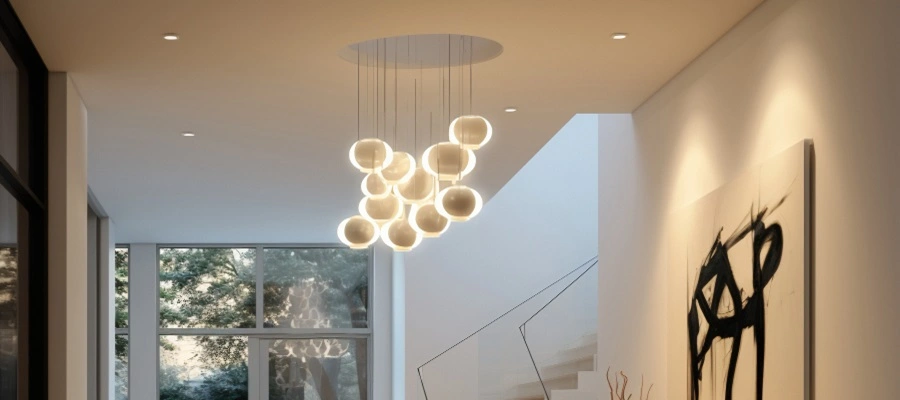
Chandeliers are among the most luxurious false ceiling lighting fixtures you may have in your house. They have the power to change a space’s appearance quickly. However, the chandeliers may be large, which makes it harder for the usual false ceiling made of gypsum to support their weight. As a result, occasionally, a false ceiling is constructed around these lights, which are attached directly to the original ceiling. These days, most chandeliers employ tiny LEDs that come in various colour combinations and permutations. They often emit warm, neutral, blue lights. Your living and dining areas will benefit from these false ceiling lights the most.

3. Cove Lights for False Ceiling

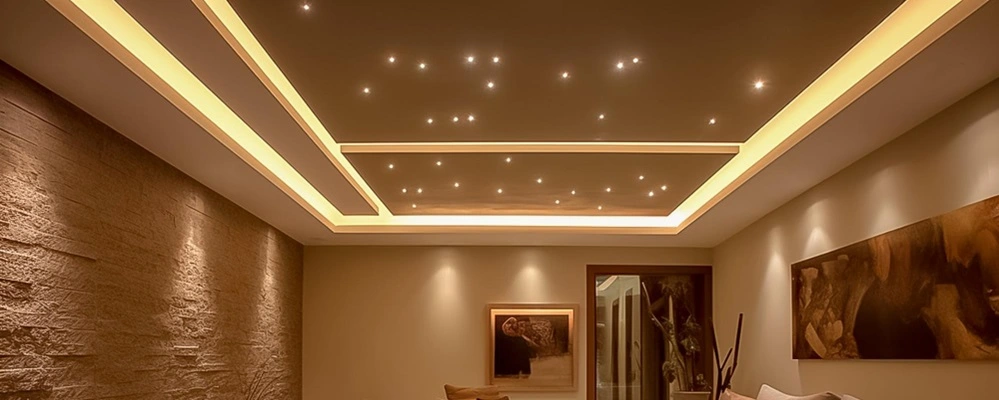
To create an impression of gentle and dispersed lighting, you may use strip lights, such as cove lights, in your false ceiling. By hiding the strip lights on a ledge in the false ceiling or above the crown moulding (in the cove), you can create an opulent, hotel-like atmosphere at home. This design produces a warm, welcoming glow and is gentle on the eyes since it creates an indirect false ceiling light. These false ceiling light kinds are ideal for setting the atmosphere or accent lighting when guests arrive. 

4. Pendant False Ceiling Light Designs

Pendant False Ceiling Lights Design

Compared to chandeliers, pendant lights are more affordable and lightweight. It is very simple to maintain these false ceiling light designs. Furthermore, it’s easy to have them fixed or replace a bulb as necessary. These false ceiling light designs give your interiors more depth and facilitate the connection between your ceiling design and your walls, furniture, and other furnishings since they often hang lower than other types of lighting. We advise installing your fixture in a corner if it is around eye level; otherwise, you may use it in the middle of the room.

5. Recessed Lights for False Ceiling

Single bulbs that fit into holes or recesses in your ceiling are known as recessed lights. Recessed lighting is designed for general illumination throughout your house or as accent lighting for a false ceiling in your living room. However, an indirect lighting source, such as a cove light, is the most appropriate for small spaces with low ceilings. Because of the grid pattern design, it may seem quite modern.

6. Gimbal False Ceiling Light Designs

Gimble false ceiling lights work well as accent lights, spotlights, and nightlights in almost every area of our house. They are long-lasting and easily replaceable when necessary. These are essentially a more advanced form of spotlights with a rotating mechanism to provide greater movement. To draw attention to and emphasize a certain region in your space, you may spin or pivot them. Although there are many other types of gimbal lights available, the industrial telescopic and seamless recessed models are the most often used ones. They are essentially simply chip-on-board LEDs; the only thing that sets them apart is the fixture body.

7. Track Lights for False Ceiling

Track lights have several uses. Track lights can provide enough light, thanks to modern technology, to be utilized as ambient lighting. In addition, you may easily utilize them as work lights, accent lights, or spotlights, thanks to the tracks and pivots. Installing track lights is easy, and you have more control over how much light reaches each part of your room. Because they often use LED chips rather than bulbs, these false ceiling lights are more difficult to repair. In a positive way, however, chips typically survive more than 100,000 hours, so changing them will only happen in unusual circumstances.

8. Backlit False Ceiling Panels

Backlit panels can serve as accent, ornamental, and ambient lighting. Since they are factory-finished, installation may be completed in as little as 30 minutes. They are a really popular choice for false ceiling lights, and you won’t regret your decision. 

Conclusion

On a final note, false ceiling lights are an excellent way to enhance the atmosphere of any house. With the variety of false ceiling light designs, you can give any room a distinctive appearance. They may also be used to conserve energy, reduce glare, and alter the ambience of a room.

10 Easy Home Maintenance Tips Every Homeowner Should Know

0
Home Maintenance Tips

Once you own a house, you feel relaxed and satisfied. Although the new house construction process seems daunting, there is much more to becoming a homeowner than simply constructing a new home. Home maintenance and repairs might seem like a huge hassle at first. However, their outcome is consistently satisfying. A regular home maintenance schedule for your home will end up saving you money. Hence, its recommended to upkeep your home regularly. 

If you don’t have any experience and don’t know how to maintain your home, don’t worry. Brick & Bolt provides easy home maintenance tips for your DIY home maintenance.

But, before jumping to the home maintenance tips, let’s understand why regular home upkeep is important.

Why is Regular Home Maintenance Necessary?

Your regular home maintenance and repair will give you numerous benefits, including-

  • Increases the value of your house or apartment
  • Creates a better living experience for you
  • Provides protection for your home from additional damage
  • You will end up saving money in the long run.
  • It helps to keep pests away from your home.

10 Easy Home Maintenance Tips

The following home maintenance tips will help you to upkeep your home.

  1. Upkeep of the Exterior of Your Home
  2. Clean Your Appliances Frequently
  3. Upkeep your HVAC Systems
  4. Maintain Bathroom Exhaust Fans
  5. Conduct an Energy Audit in Your Home
  6. Inspect and Correct Plumbing Problems
  7. Stop Drafts and Leaks
  8. Regularly Maintain the Grout
  9. Observe the Foundation of Your House
  10. Inspect Your Basement and Attic Frequently

Let’s explore all the house maintenance tips.

1. Upkeep of the Exterior of Your Home

Your home exterior also needs maintenance. Hence, you must periodically inspect the roof for missing or broken shingles and replace them as needed. You can paint your exterior with vibrant colours to protect it from different weather conditions and enhance its aesthetic appeal. Maintain neat landscaping to avoid tree roots harming the foundation of your house.

2. Clean Your Appliances Frequently

As we all know, appliances have a limited lifetime, so routine maintenance and cleaning may significantly extend their life. These parts, which range from the filters in your air conditioner to the coils in your refrigerator, may gather dust and debris over time, decreasing their effectiveness and efficiency. Maintaining these components guarantees that your appliances operate at their best and cut down on wasteful energy use.

3. Upkeep your HVAC Systems

HVAC Maintenance

Regular maintenance is required to keep your HVAC -heating, ventilation, and air conditioning system, operating at its best. An HVAC system with inadequate maintenance might use more energy and last less time. Professional maintenance can keep it in excellent operating condition and assist you in identifying any issues before they become expensive repairs.

4. Maintain Bathroom Exhaust Fans

Exhaust fans are essential for keeping bathrooms dry and avoiding the formation of mildew. Regular cleaning and checking of the fans’ functionality is crucial. If they’re not functioning well, there’s a greater chance of mold growth, which may be costly to treat.

5. Conduct an Energy Audit in Your Home

Undertaking a home energy audit is a practical approach to reducing energy costs. An expert energy examination determines how much energy your house uses and how to make it more energy-efficient. This might include suggestions for replacing outdated appliances with energy-efficient replacements, caulking windows and doors, and enhancing insulation. By conducting a home energy audit, you can identify energy-wasting areas in your house, and by making the required changes, you can save money over time. 

6. Inspect and Correct Plumbing Problems

If plumbing problems are not addressed, they may result in costly repairs and significant water damage. Check often for drips, leaks, or low water pressure. By addressing these problems, you may prevent more serious difficulties later on, such as the formation of mold or structural damage from leaks.

7. Stop Drafts and Leaks

Another effective strategy to reduce energy expenses is to seal up drafts and leaks in your house. Drafty doors and windows make it easier for heat to leave in the winter and warm air to enter in the summer, which increases the workload of your heating and cooling systems. You may save energy and increase the longevity of your heating and cooling systems by caulking or weatherstripping these drafts.

8. Regularly Maintain the Grout

Mold and mildew may grow rapidly on grout in bathrooms and kitchens. You can prevent mold growth, preserve the integrity of the tiles, and maintain the original appearance of your areas by routinely cleaning and sealing them.

9. Observe the Foundation of Your House

If you neglect the health of your home foundation, foundation issues may result in major and costly consequences. Hence, look out for wall cracks, uneven flooring, and poorly closed doors. These can indicate that the foundation is changing. Future repairs that are more expensive may be avoided with early diagnosis and correction.

10. Inspect Your Basement and Attic Frequently

These frequently ignored parts of the home may be the first to show signs of more serious concerns, such as structural difficulties or the development of mold. Frequent inspections may guarantee the early identification of bugs, insulation gaps, and moisture issues. By addressing these problems early on, more serious and expensive concerns may be avoided later on.

Conclusion

Although it may seem time-consuming and tiresome, house upkeep is an essential duty for homeowners. By following this home maintenance advice, you will eventually save money in addition to maintaining the worth of your house. We hope these home maintenance tips proves helpful to you and your family.